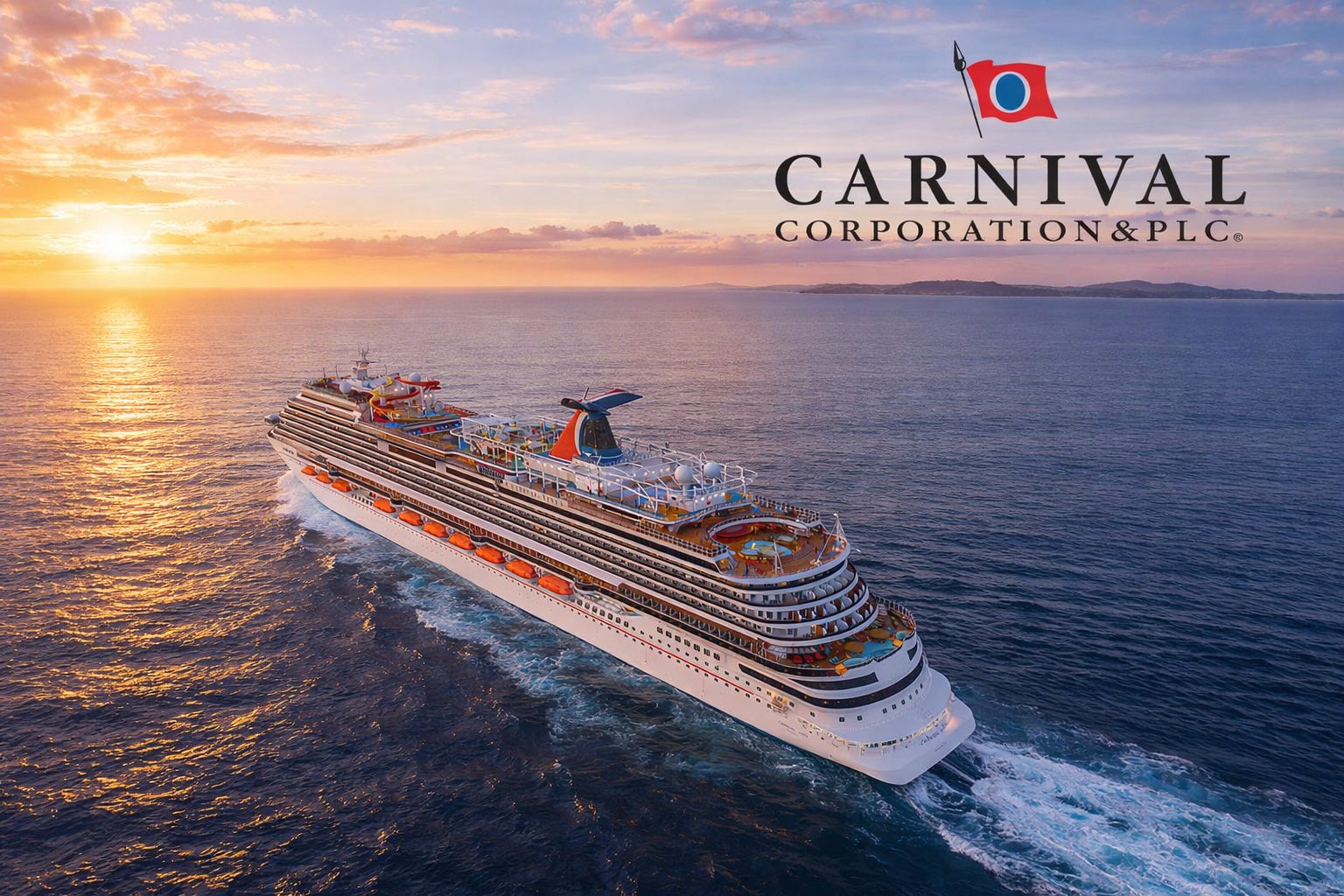
Carnival Corporation & plc stock is back in the spotlight as investors digest a cluster of catalysts that landed just ahead of (and into) Dec. 22, 2025: a quarterly earnings beat, the return of the dividend, upbeat 2026 guidance, and a proposal to simplify the company’s unusual dual-listed structure. Add in new headlines around fuel strategy and longer-term LNG supply planning, and you’ve got a cruise giant giving the market plenty to price in.
By Monday afternoon, Carnival’s U.S.-listed shares were trading around $31.98 (NYSE: CCL), while the related U.S. line for Carnival plc (NYSE: CUK) hovered near $31.62.
That level reflects a post-earnings reset after a sharp move late last week: Reuters reported the stock jumped as much as 10.2% on the day of the results and guidance update. Reuters
Below is a detailed breakdown of the latest news, forecasts, and analyses shaping the Carnival stock narrative as of 22.12.2025—and what investors will likely watch next.
Why Carnival stock is moving: earnings beat + dividend + upbeat outlook
Carnival’s latest report delivered the kind of trifecta equity markets love:
- A clear earnings beat
- A confidence signal (dividend reinstatement)
- Forward guidance that landed above or around expectations
In the fiscal fourth quarter of 2025 (ended Nov. 30, 2025), Carnival reported net income of $422 million and adjusted net income of $454 million, translating to $0.34 adjusted EPS. Carnival Corporation
That $0.34 figure was widely framed as above consensus (Reuters cited estimates of $0.25). Reuters
Revenue for the quarter was also a record for the period at about $6.3 billion, and the company highlighted improved yields and disciplined cost control. Carnival Corporation
The big picture from 2025: record revenue, record adjusted EBITDA, investment-grade leverage metrics
Carnival’s headline message wasn’t just “good quarter.” It was “we’re operating like a real company again”—with big, specific numbers attached.
For the full year 2025, Carnival reported:
- Net income: $2.8 billion
- Record adjusted net income: $3.1 billion
- Record revenue: $26.6 billion
- Record adjusted EBITDA: $7.2 billion
- Net debt to adjusted EBITDA ratio: 3.4x, which the company said was recognized by Fitch as investment grade leverage metrics
Carnival Corporation
It also reported record customer deposits of $7.2 billion (a proxy many cruise investors watch as a demand indicator). Carnival Corporation
Carnival’s 2026 forecast: profit growth on minimal capacity growth
Guidance is where cruise stocks often live or die—because the market is constantly trying to answer a deceptively hard question: are pricing and onboard spending holding up, even as the industry adds capacity?
Carnival’s outlook for fiscal 2026 pointed to continued growth, with management projecting (among other items):
- Adjusted net income ~ $3.45 billion (and highlighted as $3.5 billion in the release) Carnival Corporation+1
- Adjusted EPS ~ $2.48 Carnival Corporation
- Adjusted EBITDA ~ $7.63 billion Carnival Corporation
- Net yields (constant currency) up ~2.5%, with a “normalized” view closer to ~3.0% after specific accounting and itinerary impacts Carnival Corporation+1
- Less than 1% capacity growth for the year, a key point for investors worried about supply-driven pricing pressure Carnival Corporation
Reuters also noted the company guided to adjusted EPS up to $2.48, above analyst expectations cited by LSEG. Reuters
For the first quarter of 2026, Carnival guided to approximately:
- Adjusted net income ~ $235 million
- Adjusted EPS ~ $0.17
- Net yields (constant currency) up ~1.6% year over year
Carnival Corporation
Demand signal investors care about: bookings strength heading into “wave season”
Cruise demand isn’t just about whether people want vacations—it’s about pricing power and how far out customers are willing to commit.
Carnival said it hit record booking volumes for 2026 and 2027 sailings over the last three months, and highlighted that booking strength continued through the Black Friday–Cyber Monday period—an important read-through into the post-holiday “wave season” selling period. Carnival Corporation+1
The company also said it was sitting at its highest booked occupancy for the coming year, at about two-thirds booked at higher prices (constant currency). Carnival Corporation
Dividend reinstatement: Carnival brings back shareholder payouts (first time since the pandemic era)
One of the most market-moving headlines: Carnival is reinstating its quarterly dividend.
The company declared an initial $0.15 per share dividend with a record date of Feb. 13, 2026 and a payment date of Feb. 27, 2026. Carnival Corporation+1
Media coverage framed this as a milestone after years of balance-sheet repair. MarketWatch emphasized this would be Carnival’s first dividend in more than five years and tied the move to the company’s refinancing work and leverage improvement. MarketWatch
For stock investors, dividends do two things at once:
- They return cash (obviously).
- They signal management confidence that cash flows can sustain payouts even if demand cools.
That said, investors will still scrutinize whether the dividend competes with other priorities—especially continued deleveraging and fleet investment.
Balance sheet glow-up: refinancing, debt reduction, and interest expense relief
Carnival’s post-pandemic story has been, in large part, a story about debt: the company borrowed heavily to survive shutdown-era demand collapse, and the market spent years pricing in refinancing risk and interest expense drag.
In its earnings materials, Carnival said it completed a $19 billion refinancing plan in less than a year and reduced debt by more than $10 billion from its peak less than three years ago. Carnival Corporation+1
The company’s investor presentation also called out a striking number: an expected improvement of more than $700 million in net interest expense in 2026 versus 2023. Carnival Corporation
On credit ratings, the same presentation shows Fitch at BBB- (stable)—investment grade—while also indicating S&P was one notch away with a positive outlook at the time shown. Carnival Corporation
Why this matters for the stock: lower interest expense can turn “good demand” into “real earnings,” and investment-grade dynamics can reduce future financing costs.
The corporate structure shake-up: Carnival proposes a single NYSE listing and Bermuda redomiciliation
Carnival’s structure is… weird (financially efficient, historically necessary, but weird): a dual-listed company (DLC) arrangement with shares trading in New York and London. Now Carnival wants to simplify.
On its investor-facing “Unify” page, Carnival says its boards recommend moving from the DLC structure to one company—Carnival Corporation Ltd—listed solely on the NYSE, with Carnival plc becoming a wholly owned UK subsidiary. Carnival Corporation
The company also recommends shifting Carnival Corporation’s place of legal incorporation from Panama to Bermuda. Carnival Corporation
Key timeline (as currently outlined by the company):
- Feb. 2026: additional shareholder materials expected
- April 2026: shareholder meetings/votes
- Q2 2026: targeted completion (subject to approvals)
Carnival Corporation
Seatrade noted the proposal is subject to shareholder and regulatory approvals (including UK court approvals), consistent with the company’s messaging. Seatrade Cruise News
What this could mean for CCL stock (and CUK holders)
Carnival explicitly argues simplification could:
- reduce governance/reporting complexity and costs
- eliminate price differences between listings
- increase liquidity
- potentially increase weighting in major U.S. stock indices
Carnival Corporation+1
For Carnival plc shareholders, the company says the plan would include a one-for-one share exchange into the NYSE-listed entity (no brokerage fees charged as part of the exchange, per the company’s page). Carnival Corporation
Fresh Dec. 22 headline: Carnival ties into long-term LNG bunkering planning in Galveston
One of the most new headlines dated Dec. 22 involves fuel logistics and long-term planning for LNG operations tied to Port of Galveston.
Trade coverage reported Carnival reached an LNG offtake agreement connected to Stabilis Solutions’ planned Galveston LNG project, bringing contracted offtake to about 55% of planned capacity. Seatrade Cruise News+1
A separate industry report said the agreement is structured as a 10-year LNG bunkering deal, with deliveries expected to start in Q4 2027, subject to financing and construction of the facility. Manifold Times+1
For equity investors, this is less of a near-term earnings driver and more of a strategic signal: Carnival is planning fuel sourcing and compliance pathways years out, which matters in a world of tightening emissions standards and volatile energy markets.
Analyst forecasts and price targets: where Wall Street is clustering (mid-$30s, with notable bulls)
After the earnings release, several analyst notes and target price updates circulated.
Some examples highlighted in market coverage include:
- Mizuho raising its price target to $38 (Outperform), and Wolfe reiterating Outperform with a $33 target, according to Investing.com’s roundup. Investing.com
- A cluster of targets in the mid-to-high $30s, with some higher outliers (e.g., Susquehanna noted at $40) in compiled analyst-update feeds. Quiver Quantitative+1
Aggregators also show a generally constructive consensus:
- MarketBeat cited a “Moderate Buy” consensus with an average target price around $34.14. MarketBeat
- TipRanks showed an average target price around $35.84, with a stated high forecast of $42 and low around $28.20. TipRanks
Take these aggregator numbers as directional, not gospel—different services include different analyst universes and update schedules—but the pattern is clear: the center of gravity is in the mid-$30s, with upside cases leaning on continued yield gains, falling interest expense, and disciplined capacity.
The bull case vs. bear case for Carnival stock heading into 2026
The bull case: “pricing power + deleveraging + capital returns”
Optimists see Carnival threading the needle:
- Demand remains resilient (bookings and pricing holding at high levels). Carnival Corporation+1
- Earnings expand as interest expense eases and operating leverage kicks in. Carnival Corporation+1
- The dividend is a turning-point signal, not just a cash payout. Carnival Corporation+1
- Simplifying the structure could improve liquidity and index dynamics over time. Carnival Corporation+1
The bear case: “capacity worries, macro risk, and the cruise cycle”
Skeptics will keep pointing to classic cruise-stock risks:
- Macro sensitivity: leisure spending can turn quickly if consumers retrench, even if recent demand has held up. Reuters explicitly framed current strength as supported by consumers maintaining discretionary spending. Reuters
- Caribbean supply/competition: sector commentary has flagged concerns about Caribbean oversupply, even as Carnival is viewed as somewhat less exposed than peers in some analyses. Barron’s
- Fuel and cost volatility: Carnival’s own guidance includes sensitivities for yields, costs, and fuel—small percentage changes can move adjusted net income meaningfully. Carnival Corporation
- Execution risk on the unification plan: shareholder, regulatory, and court approvals introduce timing and uncertainty. Carnival Corporation+1
What to watch next for CCL stock
As the market shifts from “earnings reaction” to “next-quarter reality,” here are the likely swing factors:
- Wave season pricing and booking volumes (Jan–Mar): Carnival itself spotlighted post-Black Friday strength as a signal heading into wave season. Reuters+1
- Yield vs. cost spread: 2026 guidance implies yield growth alongside cost inflation; investors will watch whether pricing stays ahead of costs. Carnival Corporation
- Net leverage and free cash flow direction: the market will reward continued deleveraging, especially with dividends returning. Carnival Corporation+1
- Progress on the NYSE-only unification plan: look for the February shareholder materials and April votes outlined by the company. Carnival Corporation
- Any further analyst revisions: price targets tend to drift after earnings as models update with new booking and cost data. Investing.com+1
Bottom line
Carnival Corporation & plc is entering 2026 with momentum: record 2025 results, guidance pointing to another year of profit growth on minimal capacity expansion, a restored dividend, and a restructuring proposal that could simplify the equity story for global investors. Carnival Corporation+2Carnival Corporation…
The market’s next job is to test whether this is a durable “new normal” driven by pricing power and lower interest expense—or a peak-ish moment before the cruise cycle reminds everyone it exists. Either way, CCL stock is unlikely to be boring in the months ahead. Carnival Corporation+2Reuters+2