Browse Category

Space Technology News 1 June 2025 - 12 June 2025

Artificial Intelligence in Satellite and Space Systems

Artificial Intelligence in Satellite and Space Systems

In May 1999, NASA’s Deep Space 1 operated for three days with the Remote Agent AI, planning activities and diagnosing simulated faults autonomously. From 2001 to 2004, NASA’s EO-1 carried the Autonomous Sciencecraft Experiment (ASE), using onboard machine learning and the CASPER planner to re-task after events like volcanic eruptions. In 2013, JAXA’s Epsilon rocket became the first AI-enabled launch…
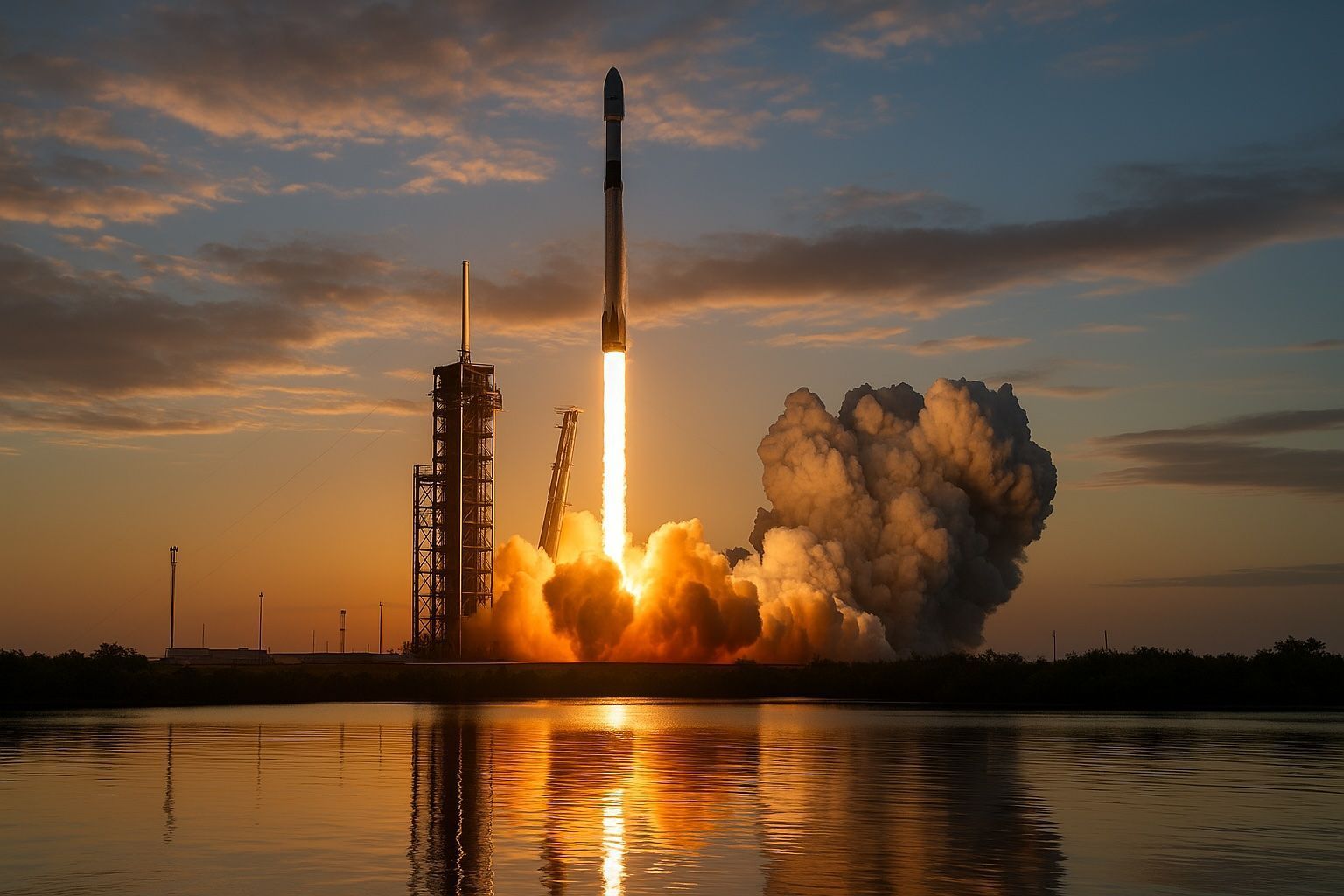
SpaceX: Comprehensive Overview of History, Technologies, Missions, and Future Plans

SpaceX: Comprehensive Overview of History, Technologies, Missions, and Future Plans

September 2008: Falcon 1 reached orbit on its fourth flight, becoming the first privately developed liquid-fuel rocket to orbit Earth. December 2008: NASA awarded SpaceX a $1.6 billion Commercial Resupply Services contract to deliver cargo to the ISS. May 2012: Dragon cargo capsule became the first commercial spacecraft to rendezvous with and deliver cargo to the International Space Station. December…
Hyperspectral Eyes in the Sky: How Space-Based Imaging Is Revolutionizing Earth Observation

Hyperspectral Eyes in the Sky: How Space-Based Imaging Is Revolutionizing Earth Observation

NASA’s Hyperion, launched in 2000 on the EO-1 satellite, collected 220 spectral bands from 400 to 2500 nm at 30 m resolution. A hyperspectral data cube stacks hundreds of narrow wavelength bands for every ground pixel, creating a two-dimensional spatial image plus a spectral dimension. Hyperspectral imaging records hundreds of narrow bands (often 10 nm or less) enabling identification of…
Starlink Satellite Internet FAQ

Starlink Satellite Internet FAQ

Starlink is SpaceX’s satellite-based broadband internet service, and by 2025 the constellation has launched over 7,500 satellites with about 6,750 active in orbit. The satellites orbit in low Earth orbit at roughly 550 km altitude, delivering typical download speeds of 50–200+ Mbps and latency around 20–40 ms. SpaceX began launching Starlink in 2019, and by early 2025 it served more…
Battle for the Final Frontier: Starlink vs OneWeb vs Kuiper vs Telesat Lightspeed

Battle for the Final Frontier: Starlink vs OneWeb vs Kuiper vs Telesat Lightspeed

Starlink has launched over 8,000 satellites since 2019, serves 125 countries, and by April 2025 reached the 250th dedicated Starlink launch, establishing SpaceX’s network as the largest in orbit. OneWeb, founded in 2014, began Gen1 launches in 2019 with 618 of 648 satellites deployed by March 2023, filed for Chapter 11 in 2020, was rescued by a UK/India $1 billion…
Global Satellite and Space Industry Report 2025: Market Overview and Outlook to 2030

Global Satellite and Space Industry Report 2025: Market Overview and Outlook to 2030

In 2024, the global space economy reached $415 billion in revenue, up 4% from 2023. Commercial satellite activities totaled about $293 billion in 2024, representing 71% of the global space economy. The number of operational satellites rose from roughly 3,371 in 2020 to 11,539 by the end of 2024, a more than threefold increase. SpaceX dominated US launches in 2024,…
1 7 8 9

Stock Market Today

  • Soybeans Rise 5-6 Cents Amid Strong Export Sales Data
    January 25, 2026, 3:15 AM EST. Soybeans futures jumped 5 to 6 cents across contracts on Friday, with the national average cash price up 5.5 cents to $9.99 ½. Soymeal futures increased $2.50 to $3.30 per ton, while soy oil futures gained 30 to 35 points. The gains followed strong export sales data showing a marketing year high of 2.45 million metric tons (MMT) for soybeans in the week of Jan. 15, surpassing expectations and marking an 18.6% rise from last week and a nearly 64% increase year-over-year. Soybean meal sales also hit the upper range of estimates at 412,671 MT, while soybean oil sales were moderate. Traders reacted to robust demand signals amid ongoing market tightness.
Go toTop