Browse Category

Stock Market News 22 March 2025 - 12 June 2025

Eritrea’s Digital Desert: Inside the World’s Most Isolated Internet – and the Satellite Lifeline on the Horizon

Eritrea’s Digital Desert: Inside the World’s Most Isolated Internet – and the Satellite Lifeline on the Horizon

As of early 2024, about 26% of Eritrea’s 3.7 million people were internet users. Eritrea is the only coastal African nation with zero submarine fiber-optic cable landings. The telecom sector is entirely state-owned and monopolized by Eritrean Telecommunication Services Corporation (EriTel), with no private ISPs or competing mobile operators. Public mobile data is essentially unavailable; the mobile network runs on 2G GSM with 3G/4G largely disabled for ordinary users. Fixed broadband remains extremely limited, with fewer than 150 subscriptions in the mid-2010s. Internet cafés are the primary access point, with fewer than 10 in Asmara and roughly 100 nationwide. EriTel’s

12 June 2025
The Digital Divide and Skyborne Signals: Internet Access in El Salvador

The Digital Divide and Skyborne Signals: Internet Access in El Salvador

As of early 2025, about 4.88 million Salvadorans are online, representing 76.9% of the population. The telecom sector privatized in 1997, leading to competition among Claro (~40%), Tigo (~25%), Digicel (~11%), Movistar (~6%), and Others (~5%) for fixed broadband. Mobile networks cover about 93% of the territory, and 92% of Salvadorans have at least 3G coverage. Mobile phone subscriptions reached 11.5 million in 2022, exceeding the 6.5 million population for roughly 160% penetration due to multiple SIMs. Fixed telephone lines and legacy DSL have stagnated at under 0.9 million, as mobile becomes the preferred access. Median fixed broadband download speeds
11 June 2025
High Seas Broadband Boom: Maritime VSAT & L-Band Services Market Set to Soar by 2032

High Seas Broadband Boom: Maritime VSAT & L-Band Services Market Set to Soar by 2032

The global maritime VSAT and L-band services market is forecast to reach about $12.4 billion by 2032, with a roughly 8.5% CAGR from 2024 to 2032. In 2024, VSAT-based connectivity accounted for about 77% of maritime satcom revenue, while L-band MSS accounted for about 23%. The maritime VSAT market is projected to grow from about $3.46 billion in 2024 to $9.30 billion by 2032, a 14.6% CAGR for 2025–2032. Post-pandemic, total maritime satcom revenues fell by over 11% in 2020, then surged 42% in 2021 as demand rebounded and VSAT-equipped vessels rose from 28,350 in 2020 to 39,700 in 2021.
11 June 2025
In-Flight Wi-Fi Takes Off: The Sky-High Race for Satellite Connectivity 2024–2030

In-Flight Wi-Fi Takes Off: The Sky-High Race for Satellite Connectivity 2024–2030

Euroconsult projects the number of IFC-equipped aircraft worldwide will grow from about 9,900 in 2021 to over 21,000 by 2030. SpaceX Starlink, an LEO system with more than 4,000 satellites by 2024, has contracts to equip over 2,000 aircraft by early 2025 and can deliver up to 350 Mbps per aircraft with installation times of 8–10 hours. OneWeb completed a 618-satellite constellation in 2023, merged with Eutelsat to form a multi-orbit offering, and began aviation service in 2023–2024 with Panasonic Discover Airlines projects by 2025. Viasat and Inmarsat provide a global Ka-band GEO network after merger, with ViaSat-3 entering service
11 June 2025
Telecommunications Infrastructure in Ukraine (2022–2025): Destruction and Resilience

Telecommunications Infrastructure in Ukraine (2022–2025): Destruction and Resilience

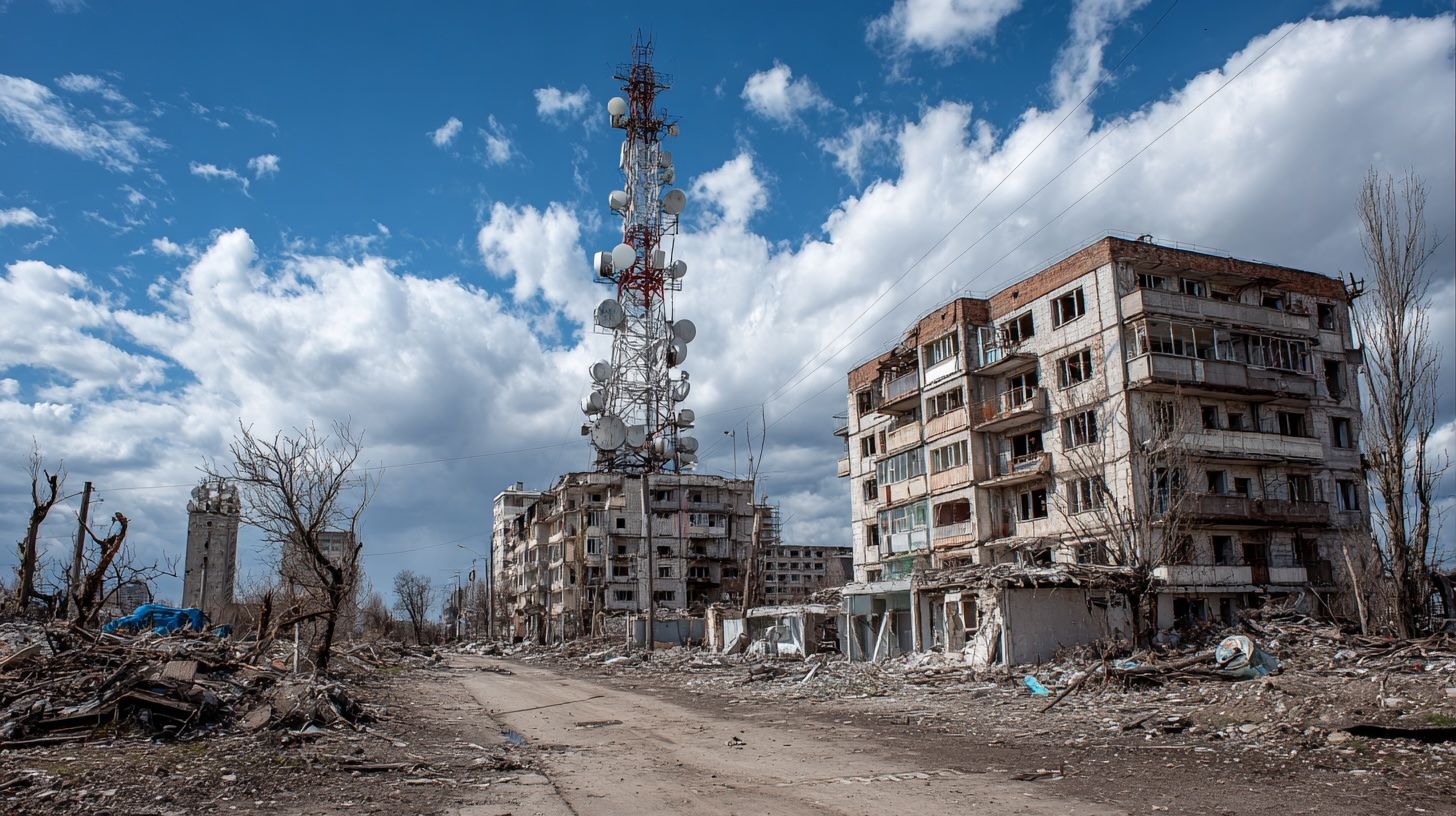
Overview: Types of Infrastructure Targeted Ukraine’s telecommunications network encompasses a wide range of critical infrastructure that has come under attack since 2022. These include: Together, these attacks have aimed to sever Ukraine’s connectivity – both civilian communications and military command links – by dismantling the physical pillars of the internet, phone, and broadcast systems. The following sections detail the timeline of destruction, the regional impacts, and how Ukraine has kept communications running against the odds. Chronology of Major Damage (2022–2025) People examine the wreckage of a broadcasting tower destroyed by a Russian missile strike in Kharkiv (April 2024) euronews.com. Critical telecom
10 June 2025
Dominica: Internet Infrastructure and Access Technologies

Dominica: Internet Infrastructure and Access Technologies

Dominica is a landing point on the 3,000-km Southern Caribbean Fiber (SCF) ring linking 15 Eastern Caribbean islands. On-island, Flow (formerly Cable & Wireless) provides fixed DSL and coaxial/cable service, while Digicel Play offers cable/FTTP over an upgraded HFC network. In 2018 Digicel won a 15-year contract to overhaul Dominica’s telecommunications, rebuilding towers and fiber to government offices and health centers. In 2019 the Southern Caribbean Fiber cable landed at Dominica’s Canefield, boosting international capacity. Starlink LEO service began serving Dominica in June 2025, offering high-speed, low-latency internet across the island. As of January 2024, about 61,020 Dominicans were online,
10 June 2025
Rural Broadband Revolution: Satellite Internet’s Sky-High Growth (2024–2030)

Rural Broadband Revolution: Satellite Internet’s Sky-High Growth (2024–2030)

The global satellite broadband market was roughly $5–9 billion in 2023 and is forecast to reach about $24–23 billion by 2030, with an annual CAGR of 14–30%. North America led in 2023 with about 32% of revenues, while Asia-Pacific (~15%), Europe (~14%), Latin America (~12.5%), and Middle East & Africa (~12%) are forecast to grow fastest. By 2030, North America, Europe and Asia-Pacific are each projected to be in the $6–7+ billion range, with Latin America and MEA contributing several hundred million USD. In 2023 the regional revenues were North America $2,966.1 M, Europe $2,435.0 M, Asia–Pacific $2,264.6 M, Latin
10 June 2025
Internet Access in Czechia: From Prague to the Sky

Internet Access in Czechia: From Prague to the Sky

As of 2023, about 91.6% of Czechia’s population is online, equating to roughly 9.6 million internet users in a country of 10.5 million. Fixed broadband connections reached 4.1 million in 2023, roughly 38–40 subscriptions per 100 people. There are 15.5 million mobile SIM cards (about 148 per 100 people) and 11.5 million active mobile internet subscriptions, with mobile broadband subscriptions nearly three times fixed broadband. Wireless fixed access accounts for about 27% of fixed connections in 2023, with about 1.13 million fixed wireless subscriptions in 2022 and 452,000 fixed LTE/5G connections in 2022, together about 39% of fixed broadband. FTTH
9 June 2025
The State of Internet Access in Denmark: From Fiber to Satellite in 2025

The State of Internet Access in Denmark: From Fiber to Satellite in 2025

Fiber-to-the-premises reach about 88% of Danish households as of early 2024, up from just over 84% in mid-2023. DSL coverage has declined to around 87–89% as copper networks are retired, with full decommission planned by 2030. Hybrid fiber-coaxial cable networks upgraded to DOCSIS 3.1 now cover roughly two-thirds of households, with rural fiber reach around 90.3% of rural homes by mid-2023. 5G coverage reached 98% of populated areas by 2023, with high-band 3.5 GHz reaching about 85% of the population by mid-2023, and a 5G Standalone core activated in 2023. Denmark has 151% mobile penetration with over 9 million mobile
9 June 2025
Austria’s Digital Autobahn: The State of Internet Access in 2025 (Including Satellite!)

Austria’s Digital Autobahn: The State of Internet Access in 2025 (Including Satellite!)

As of 2025, only about 17% of Austria’s available fiber connections are in use, equating to 317,000 active fiber subscriptions from roughly 1.9 million homes passed. Vienna alone has over 750,000 fiber-ready connections, illustrating dense urban fiber capacity. In 2025, A1 Telekom Austria accounts for about 30–31% of fixed broadband subscriptions, Magenta Telekom roughly 29%, and Drei/Tele2 about 17%, forming Austria’s three major broadband players. 4G coverage reaches about 99% of the population, and 5G coverage reached 85% by 2023 with a goal of nationwide 5G by the end of 2025. Starlink became available in Austria around 2021–2022, delivering typically
31 May 2025
State of Internet Access in Armenia: From Fiber to the Final Frontier

State of Internet Access in Armenia: From Fiber to the Final Frontier

Armenia ended ArmenTel’s monopoly around 2005–2007, opening Armenia’s internet market to new ISPs and mobile operators. In 2013, Armenia removed the licensing regime for ISPs, allowing any company to provide internet after notifying the Public Services Regulatory Commission (PSRC). By 2022, more than 200 ISPs were officially registered in Armenia. In 2020, Armenia scored 88.5 out of 100 on the ITU ICT Regulatory Tracker, placing it in the advanced “fourth generation” regulation category. As of 2023, about 77% of Armenia’s population uses the internet. By 2021, 100% of Armenia’s settlements had 4G/LTE coverage. Fiber accounts for over 83% of fixed
30 May 2025
Internet Access in Kiribati: Bridging the Digital Divide Across Remote Pacific Islands

Internet Access in Kiribati: Bridging the Digital Divide Across Remote Pacific Islands

Kiribati comprises 33 atolls spread across 3.5 million square kilometers of ocean. As of January 2024, there were about 73,300 internet users, representing 54.4% of the population. In early 2024, there were about 69,200 mobile cellular connections, equal to 51.4% of the population. All international and inter-island connectivity currently depends on satellite links, and Kiribati has no submarine fiber cable. Amalgamated Telecom Holdings Kiribati Ltd (ATHKL), trading as Vodafone Kiribati, is the main operator after acquiring Telecom Services Kiribati Ltd in 2015 and upgrading 3G/4G coverage in Tarawa and Kiritimati. Ocean Link launched in 2019 to introduce competition and extend
22 March 2025

Stock Market Today

Alphabet stock drops for a fourth straight day as AI spending jitters linger

Alphabet stock drops for a fourth straight day as AI spending jitters linger

7 February 2026
Alphabet shares fell 2.53% to $322.86 Friday, marking a fourth straight decline as investors questioned heavy AI-related spending. The Nasdaq slipped Thursday after Alphabet detailed up to $185 billion in capex, while the Dow and S&P 500 rose Friday on chipmaker gains. U.S. markets reopen Monday, with attention on Alphabet’s outlook and upcoming jobs and inflation data.
BBAI stock jumps 16% into BigBear.ai share-vote week — what to watch next

BBAI stock jumps 16% into BigBear.ai share-vote week — what to watch next

7 February 2026
BigBear.ai Holdings shares surged 15.7% Friday to $4.72 ahead of a key shareholder vote on doubling authorized shares to 1 billion. Options trading was heavy, with a put/call ratio of 0.19. The company recently announced deals in AI customs technology and a partnership with Abu Dhabi’s AD Ports Group. The special meeting is set for Feb. 18, with online voting open until late Feb. 17.
American Airlines stock jumps nearly 8% as airlines rally — what to watch next week

American Airlines stock jumps nearly 8% as airlines rally — what to watch next week

7 February 2026
American Airlines shares jumped 7.6% to $15.24 Friday, rebounding with a broad rally that sent the Dow past 50,000 for the first time. Investors are watching the carrier’s battle with United at Chicago O’Hare, where a summer capacity surge could trigger a fare war. American also announced new Philadelphia–Porto service for 2027 and launched a centennial inflight menu.
Go toTop