Browse Category

Technology News 6 June 2025 - 12 June 2025

Generative AI Revolution: 2025 Breakthroughs, Industry Disruption, and Predictions Through 2035

Generative AI Revolution: 2025 Breakthroughs, Industry Disruption, and Predictions Through 2035

OpenAI launched GPT-4.5 “Orion” on February 27, 2025, as the largest model to date with improved reasoning and a chain-of-thought mode. Google’s Gemini 2.5, released in 2025, is a multimodal AI that handles text, code, images, audio, and video and comes in Nano, Flash, Pro, and Ultra tiers with an AI Pro plan and Deep Research agent. Meta unveiled Llama…

Inside Ecuador’s Digital Frontier: Internet Access, Inequality, and Satellite Solutions

Inside Ecuador’s Digital Frontier: Internet Access, Inequality, and Satellite Solutions

Fixed broadband penetration is around 15% of the population as of December 2022, equating to roughly 2.75–2.9 million fixed broadband accounts in a country of 18 million people. About 20,242 km of fiber-optic cable were laid in 2022 alone, representing nearly 10% of Ecuador’s total fiber infrastructure. The Mistral undersea cable was activated to increase international bandwidth, in partnership with…
Timor-Leste’s Internet Evolution: Bridging the Digital Divide in 2025

Timor-Leste’s Internet Evolution: Bridging the Digital Divide in 2025

In June 2024, Timor-Leste landed the TLSSC submarine cable, about 607 km to Australia with 27 Tbps capacity, built by Alcatel Submarine Networks, connecting Dili to Australia’s NWCS via Darwin and Port Hedland. Starlink launched in Timor-Leste in December 2024, becoming the 116th country with Starlink coverage and achieving nationwide signal by December 13, 2024. As of Jan 2025, internet…
Bandwidth Wars: The High-Stakes Battle for High-Throughput Satellite Dominance (2025–2035)

Bandwidth Wars: The High-Stakes Battle for High-Throughput Satellite Dominance (2025–2035)

HTS use numerous narrow spot-beams and on-board processing to deliver dramatically higher data rates than legacy FSS, with platforms like Boeing 702X and SES-17 featuring fully digital, reconfigurable payloads. HTS constellations can deliver terabits of capacity worldwide to power broadband, backhaul, IoT and government networks. Modern HTS platforms operate primarily in Ku/Ka-bands and increasingly in V/Q/KuL bands to support mobility.…
Sky Is No Limit: Global Satcom Market Set to Soar Through 2035

Sky Is No Limit: Global Satcom Market Set to Soar Through 2035

In 2024 the global space economy reached $415 billion, with commercial satellite activities totaling about $293 billion (71%). The number of active satellites rose from about 3,300 in 2020 to over 11,500 by end-2024 due to mega-constellations. SpaceX and OneWeb have joined traditional players like Airbus, Boeing, Lockheed Martin, Thales Alenia, Intelsat, SES, Eutelsat, and Inmarsat, intensifying competition. By 2035…
Internet Access in Comoros: From Island Gaps to Satellite Signals

Internet Access in Comoros: From Island Gaps to Satellite Signals

The Union of the Comoros comprises Grande Comore (Ngazidja), Anjouan (Ndzuwani), Mohéli (Mwali) and the Mayotte territory, with island geography that complicates terrestrial network rollout. Submarine cables have transformed connectivity: EASSy landed in Moroni in 2010–2011, AVASSA was completed in 2016, and FLY-LION3 landed at Itsandra, Moroni in 2019, creating three major international links. Internally, AVASSA connects Grande Comore and…
Sky Scanners: How SAR Imaging Satellites Are Redefining Earth Observation

Sky Scanners: How SAR Imaging Satellites Are Redefining Earth Observation

About 75% of the planet is obscured by cloud cover or darkness at any moment, making optical imaging inaccessible. Synthetic Aperture Radar (SAR) satellites actively illuminate the ground with microwave radar and synthesize a large aperture by moving the antenna to produce high-resolution images. SAR can operate day or night and in all weather, providing 24/7 imaging. Sentinel-1 (ESA) comprises…
7 June 2025
fldksafljads

Satellite Phones: Comprehensive Global FAQ

Iridium operates about 66 LEO satellites at roughly 780 km, offering truly global coverage including the poles with a one-way latency around 0.1–0.2 seconds. Inmarsat uses 3–4 GEO satellites at about 35,786 km, delivering near-global coverage (roughly ±70° latitude) with about 0.5 second latency, and IsatPhone 2 offers up to 8 hours of talk and 160 hours of standby. Thuraya,…
7 June 2025
Satellite Internet FAQ

Satellite Internet FAQ

Traditional GEO satellite internet sends data roughly 22,000 miles to a satellite and back, yielding a round-trip latency of about 600–800 ms. Satellite internet can reach virtually anywhere with a clear view of the sky, including most of the continental United States. HughesNet uses geostationary satellites and advertises speeds up to 25 Mbps download and about 3 Mbps upload on…
Connecting Colombia: Bridging the Digital Divide from Cities to the Amazon

Connecting Colombia: Bridging the Digital Divide from Cities to the Amazon

As of early 2025, 41.1 million Colombians were internet users, representing about 77% of the population. By 2025 Colombia had 78.3 million cellular mobile connections in service, roughly 147% of the population. The urban–rural gap remains wide: 63.9% of households had internet in 2023, 28.8% of the rural population were online, and fewer than 13% of rural households had fixed…
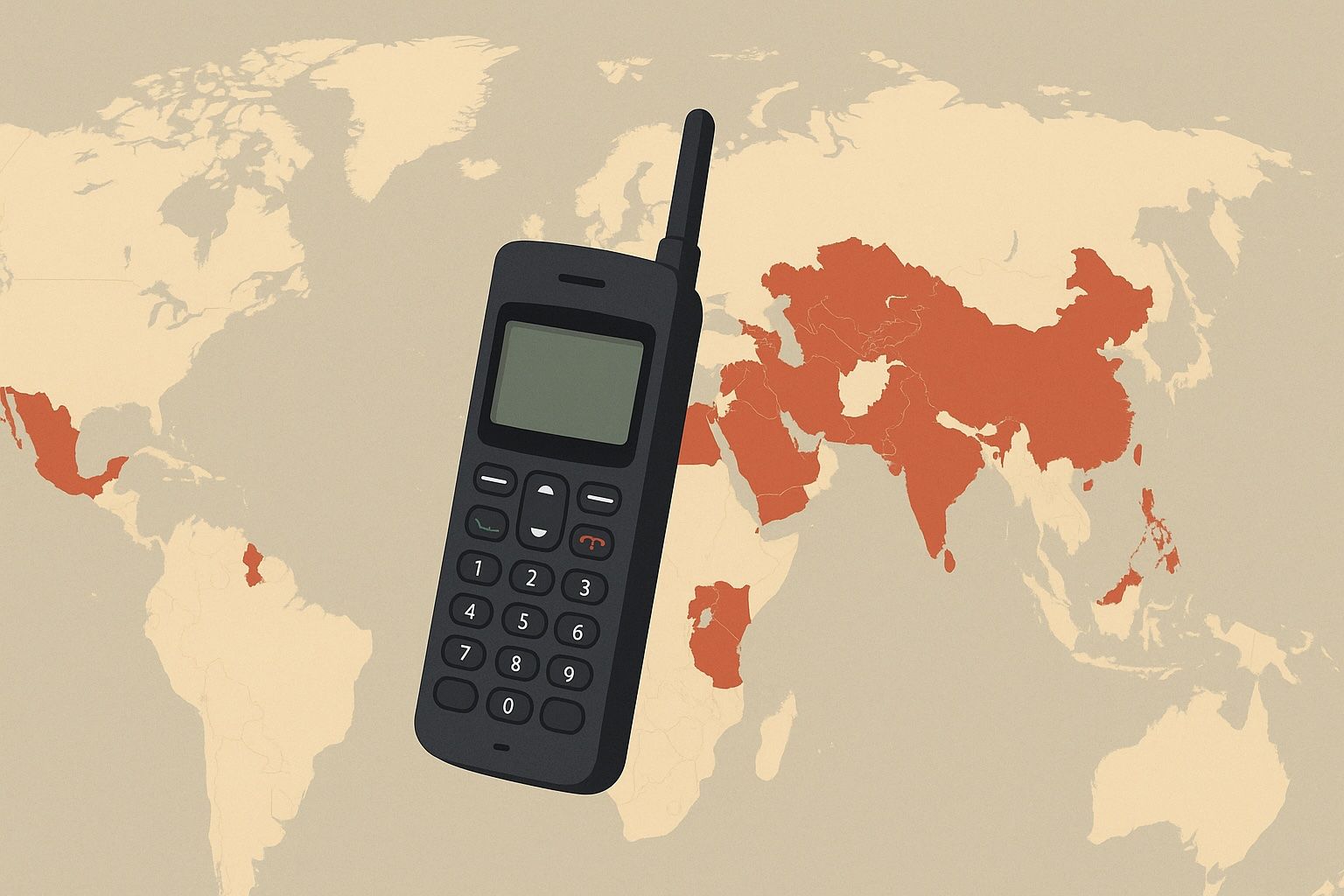
Where Satellite Phones Are Illegal?

Where Satellite Phones Are Illegal?

Bangladesh bans satellite phone use; possession can lead to arrest and imprisonment. North Korea prohibits all unauthorized communication devices, foreigners must surrender phones and privacy is not guaranteed, with detention possible. India restricts satellite phones to government‑approved Inmarsat devices, requiring a license (No Objection Certificate) from the Department of Telecommunications before bringing one in. China maintains a de facto ban…
6 June 2025
1 242 243 244 245 246 250

Stock Market Today

  • Asia-Pacific markets mixed as Trump threatens South Korea with higher tariffs
    January 26, 2026, 7:45 PM EST. South Korean auto stocks slid sharply after U.S. President Donald Trump announced plans to raise tariffs on South Korea from 15% to 25%, citing Seoul's failure to approve a trade deal with Washington. Hyundai and Kia shares dropped 4% and 5% respectively, pulling the Kospi index down 0.36% after a strong start to the year. However, the Kosdaq small-cap index rose 1.41%. Elsewhere, Asia-Pacific markets showed mixed openings: Australia's S&P/ASX 200 surged 1.22% to a nearly three-month high, while Japan's Nikkei 225 and Topix fell by around 0.3%. Hong Kong Hang Seng futures edged higher, signaling cautious investor sentiment across the region amid rising geopolitical trade tensions.
Go toTop