A decade-long international effort to “cap” the world’s most infamous nuclear disaster site is now facing a daunting reality: the massive steel arch built to contain the remains of Chernobyl’s destroyed Reactor 4 can no longer fully do the job it was designed for.
In early December 2025, the International Atomic Energy Agency (IAEA) said the New Safe Confinement (NSC) — the giant protective shelter over the reactor — has lost its primary safety functions, including its confinement capability, after sustaining damage from a drone strike earlier this year. While the IAEA says there has been no permanent damage to the structure’s load-bearing components or monitoring systems, it warned that only comprehensive restoration can prevent further degradation and protect long-term nuclear safety. Reuters+1
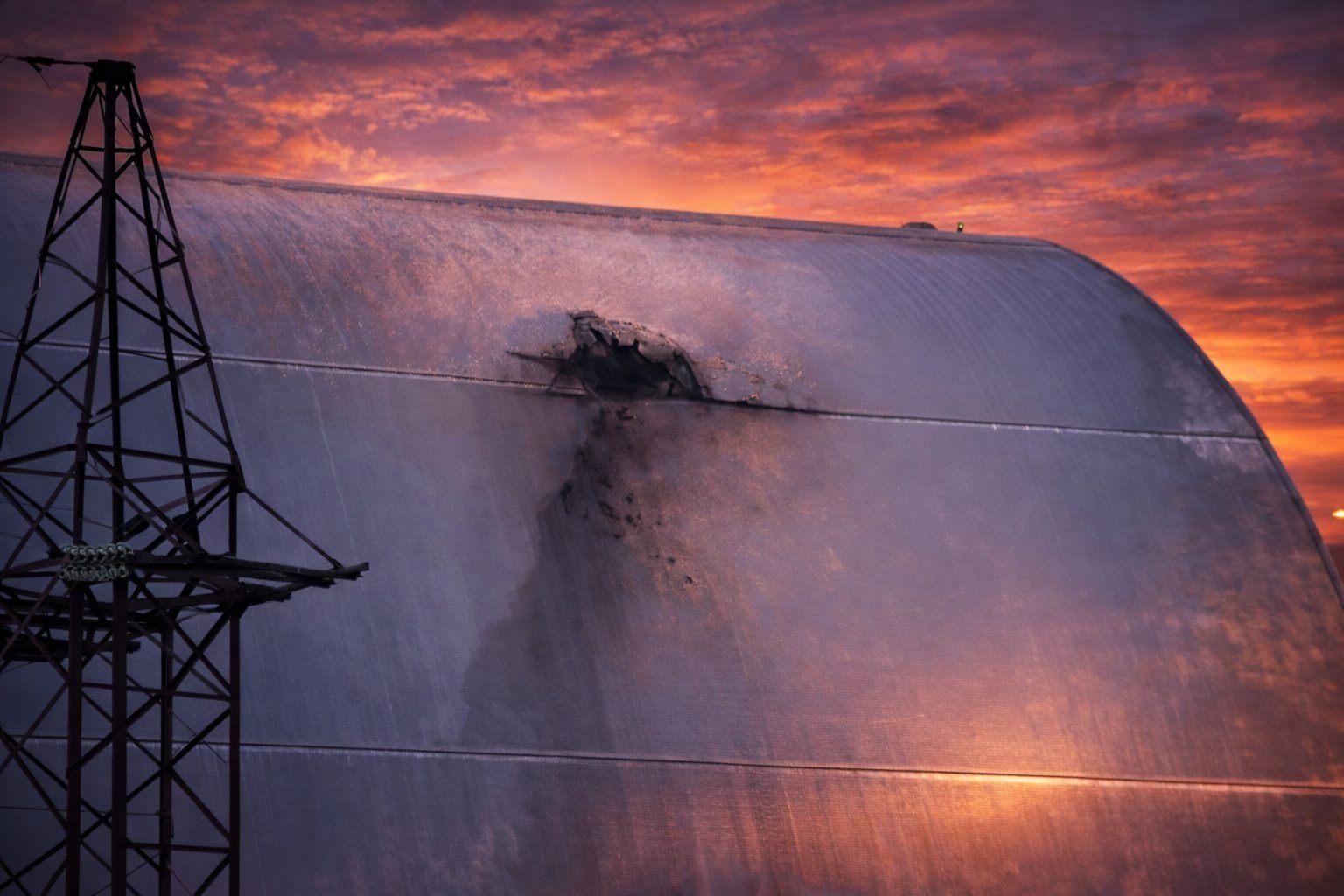
At the Chornobyl site, engineers and emergency crews have been battling the consequences since February 14, 2025, when Ukraine reported a drone explosion that tore into the shield and sparked a fire. Ukrainian officials blamed Russia; Moscow denied involvement. Reuters+1
Below is what’s known so far — and why experts say the situation matters far beyond Ukraine.
What happened at Chernobyl on February 14, 2025
Ukraine’s government says a drone struck and damaged the NSC, the modern enclosure built to isolate radioactive material left by the 1986 Chernobyl disaster. Reuters reported that President Volodymyr Zelenskiy described the damage as “significant,” and that a fire triggered by the impact was later extinguished. Both Zelenskiy and the IAEA said radiation levels remained normal immediately afterward. Reuters+1
Chernobyl’s chief engineer, Oleksandr Tytarchuk, told reporters the barrier meant to prevent radioactive spread was no longer functioning as originally designed, emphasizing how narrowly the site avoided worse damage to the older shelter structure beneath the NSC. Reuters
Expert identification of the drone type
Reuters also cited Marcel Plichta, a Fellow at the Centre for Global Law and Governance (University of St Andrews), who said visuals released by Ukraine “almost certainly” showed a Shahed-136 (Russia’s Geran-2 designation). Plichta noted the typical warhead size is around 30 kg, enough to seize headlines and cause damage, but generally less destructive than a traditional missile strike. Reuters+1
The IAEA’s December 2025 warning: “lost its primary safety functions”
On December 5, 2025, Reuters reported that the IAEA concluded the NSC can no longer perform its main safety function due to the drone impact and resulting degradation. IAEA Director General Rafael Grossi said an inspection mission confirmed the structure had “lost its primary safety functions, including the confinement capability,” while also finding no permanent damage to load-bearing structures or monitoring systems. Reuters+1
Grossi added that while some repairs had been carried out, “comprehensive restoration remains essential” to prevent further deterioration and to ensure long-term nuclear safety. Reuters
A separate IAEA-focused report by NucNet described additional technical follow-ups recommended after the assessment — including humidity control measures, updated corrosion monitoring, and upgrades to monitoring systems associated with the shelter structure. NucNet
Why the New Safe Confinement matters: the world’s biggest “nuclear safety” construction project
The NSC is not a symbolic cover — it’s a complex nuclear safety system engineered to buy time for decades of controlled dismantling and waste management.
According to the European Bank for Reconstruction and Development (EBRD), the NSC:
- Cost €1.5 billion and was financed by 45 donor countries and institutions
- Was built in two halves and slid into place over Reactor 4
- Spans 257 meters, is 108 meters high, and weighs over 36,000 tonnes
- Encloses the destroyed reactor and the provisional post-1986 shelter, which still contains the molten core and an estimated 200 tonnes of highly radioactive material EBRD+1
EBRD describes the NSC’s core mission as confining radiological hazards long enough to stabilize and eventually dismantle unstable structures and manage radioactive materials safely. EBRD+1
How bad is the damage — and why repairs aren’t simple
Holes in cladding, damaged joints, and breached layers
Industry reporting from World Nuclear News (WNN) in March 2025 cited Ukrainian operators saying the drone caused a 15 square metre hole in the external cladding, with defects affecting about 200 square metres and damage to some joints and bolts. World Nuclear News+1
WNN also reported that both the internal and external cladding layers were breached — important because the NSC relies on layered protection and controlled conditions to maintain confinement. World Nuclear News+1
“Large hole” plus hundreds of smaller punctures
In a December 2025 report published by Arab News (carrying AFP reporting), Chornobyl plant director Sergiy Tarakanov described a “large hole” that engineers were trying to seal, plus roughly 300 smaller holes left after firefighters had to open parts of the structure to put out smouldering insulation. Arab News+1
Tarakanov said repairs are expected to take three to four years, a striking timeline for a structure designed to last a century — and a reminder that “quick fixes” may not restore full performance. Arab News+1
Plant director’s stark warning: another strike could trigger a collapse scenario
Tarakanov’s most alarming point wasn’t just the current damage — it was what could happen if the shelter is hit again.
In the AFP interview, he warned that if another strike “hits the same place,” it could cause vibrations that might bring down the older shelter beneath the NSC — “like a mini-earthquake.” The concern is that a collapse could increase the spread of radioactive dust and complicate already dangerous cleanup work. Arab News
This is also where the IAEA’s caution matters: even without an immediate radiation spike, the NSC’s job is to keep the site stable over decades. When its confinement function is compromised, time and weather become adversaries.
Radiation levels are stable — but that doesn’t mean the risk is over
Multiple sources emphasize the same near-term fact: radiation readings have remained in the normal range at the site after the February strike, even as the NSC’s integrity has been degraded.
- Reuters reported that radiation levels remained “normal and stable” after the February incident and that there were no reports of leaks at the time. Reuters+1
- World Nuclear News cited IAEA monitoring and said no abnormal readings had been detected during its reporting window. World Nuclear News+1
However, the long-term hazard at Chernobyl is less about a sudden “reactor event” (Reactor 4 was destroyed in 1986) and more about containment: preventing the gradual spread of radioactive particles and keeping the site safe enough for dismantling work that is expected to take decades.
Repair costs and funding: “several hundred million euros” may be needed
One of the biggest open questions is how — and how quickly — Ukraine and international partners can restore the NSC to full function.
On its Chornobyl page, the EBRD warned that the February 2025 drone attack severely affected the NSC’s ability to carry out its two primary functions (containing hazards and supporting decommissioning). The bank said key systems designed to ensure the NSC’s 100-year lifespan have been rendered non-operational, creating a “significant risk of further deterioration” without swift emergency repairs. EBRD+1
EBRD also stated that recent contributions to the International Chernobyl Cooperation Account (ICCA) brought available funds to almost €60 million — but added that, given the scale of damage and the radiological environment, repairs could cost “several hundred million euros.” EBRD
WNN reported that EBRD representatives visited the site in March 2025 and that the EBRD allocated €400,000 for specialist-led damage assessment at that time — an early step that underscores how technical and resource-intensive the repair planning process is. World Nuclear News
What comes next: temporary repairs vs. full restoration
The emerging picture from IAEA-linked reporting is that the site may move in stages:
- Temporary stabilization (patching holes, managing weather exposure, addressing fire-related damage)
- Monitoring and corrosion control to prevent secondary deterioration
- Progressive restoration of confinement capability and long-term systems — potentially requiring larger-scale interventions and major funding NucNet+1
NucNet reported that additional temporary repairs were expected in 2026 with EBRD support to help re-establish confinement — with full restoration likely constrained by the ongoing conflict and safety conditions. NucNet
The broader nuclear safety reality of a war zone
Chernobyl is a uniquely sensitive symbol — but it’s also one part of a wider nuclear safety challenge in wartime Ukraine.
IAEA and industry reporting has repeatedly noted that international inspectors have maintained a presence not only at Chernobyl but also across Ukraine’s nuclear energy system, aiming to reduce risks tied to air raids, grid disruption, and attacks on energy infrastructure. World Nuclear News+1
For Chernobyl specifically, the central issue is the world’s reliance on a carefully engineered barrier to keep one of the most contaminated sites on Earth stable over time — and how vulnerable that barrier becomes when war turns infrastructure into targets.
Sources and further reading (linked)
- Arab News (AFP): Chernobyl site director warning and repair… Arab News+1
- Reuters (Dec 5/6, 2025): IAEA says shield lost key safety function Reuters+1
- Reuters (Feb 14, 2025): Initial strike reporting and expert drone … Reuters+1
- EBRD: Chornobyl overview, funding, and repair co… EBRD+1
- EBRD: NSC cost, dimensions, and donor financing … EBRD+1
- World Nuclear News: Emergency work and technical damage detail… World Nuclear News+1
- World Nuclear News: EBRD site visit and damage assessment deta… World Nuclear News+1
- NucNet: IAEA assessment details and recommended re… NucNet
- The Hindu (related coverage): Russian strike could collapse Chernobyl sh…
- Red94 (related coverage): Summary article referencing UN watchdog wa… Red94+1