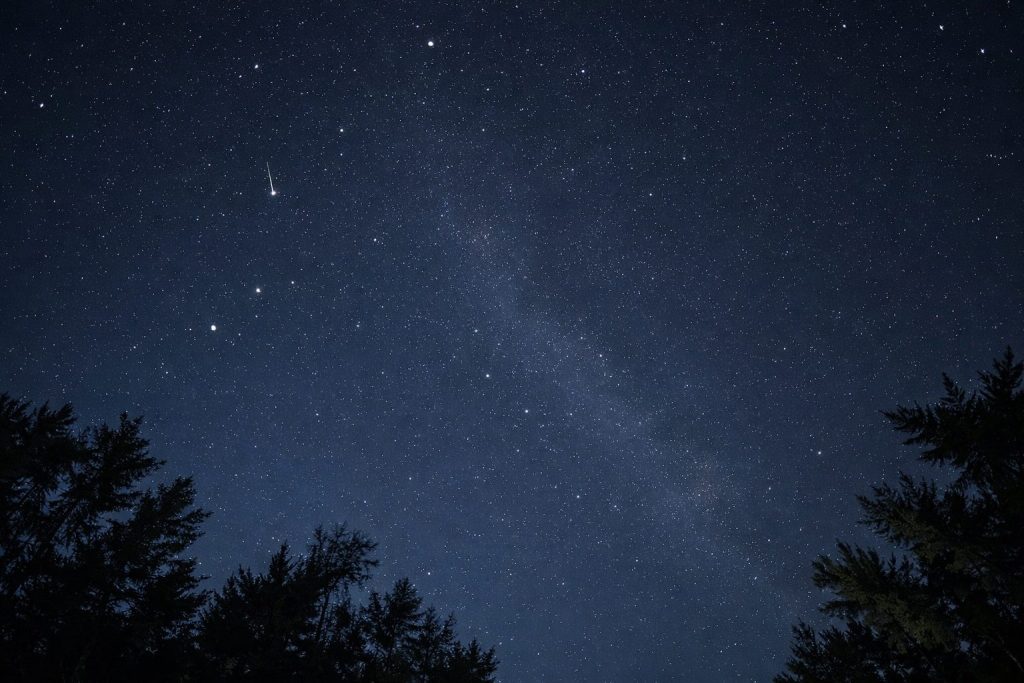
On December 25, 2025, Comet 3I/ATLAS is already on its way out—yet it remains one of the most intensively monitored visitors of the year. After making its closest approach to Earth on Dec. 19, the rare interstellar comet continues to recede, but the science is accelerating: new analyses of its dust jets, multiple NASA and ESA spacecraft observations, and fresh radio results have sharpened the picture of what this object is (and what it isn’t). seti.org
As of 06:01 UTC on Dec. 25, NASA/JPL ephemerides show 3I/ATLAS is about 1.814 AU from Earth and 2.463 AU from the Sun, with a solar elongation ~120°—a wide separation that keeps it accessible to telescopic observers (even as it fades). Solar System Dynamics
What is Comet 3I/ATLAS—and why the world is watching
3I/ATLAS is only the third confirmed interstellar object ever observed passing through our Solar System, following 1I/‘Oumuamua (2017) and 2I/Borisov (2019). Unlike typical long-period comets that originate in our own distant Oort Cloud, this one arrived from beyond the Solar System and is on a hyperbolic escape path—meaning it won’t return. Space
It was first detected on July 1, 2025, by the NASA-funded ATLAS survey telescopes in Chile—built to spot potentially hazardous objects but increasingly valuable for discoveries like this. Space
And while 3I/ATLAS has inspired plenty of online hype, the core reason scientists are excited is straightforward: it is a physical sample—at a distance—of another planetary system’s leftovers. Every spectrum, light curve, and plume measurement can reveal how icy bodies form and evolve around other stars. European Space Agency
Where Comet 3I/ATLAS is “today” and what that means observationally
The big skywatching milestone already happened: closest approach was Dec. 19, at about 1.8 AU (~168 million miles / ~270 million km) from Earth—close in astronomical terms, but still far beyond Mars’ typical distance and never a threat. Space
Since then, it has been steadily receding. The same JPL/Horizons batch ephemeris set shows that on Dec. 25 the comet’s Earth distance (Δ) has increased to about 1.814 AU, and its range-rate relative to Earth is now positive (moving away), about 9.56 km/s in the table output. Solar System Dynamics
For practical observing:
- Sky position: Current live-tracking services place 3I/ATLAS in Leo on Dec. 25, 2025, which fits its late-December sky path described across multiple trackers. The Sky Live
- When to look: With a solar elongation around 120° and the comet “leading” the Sun in the ephemeris coding, it’s best treated as a late-night to pre-dawn telescopic target (your local horizon and latitude matter). Solar System Dynamics
- What you’ll need: This is not a naked-eye comet. Coverage around the flyby emphasized that it remained too faint for unaided viewing, but within reach of amateur telescopes under dark skies. Space
If you try to observe it this week, the main challenge isn’t speed—it’s faintness plus the need for accurate pointing. A computerized mount, plate-solving “smart telescope,” or careful star-hopping will help.
The most important science updates heading into Dec. 25
1) A rare sun-facing “anti-tail” and wobbling jets—seen in an interstellar comet for the first time
One of the most talked-about new analyses in the final week before Christmas focused on something counterintuitive: a sun-facing anti-tail, plus jets that appeared to wobble on a roughly 7h 45m rhythm during the comet’s inbound phase. Space
According to reporting that summarizes an arXiv preprint and telescope monitoring across 37 nights (July 2–Sept. 5), researchers saw jet structure in the anti-tail on several nights in August. The inferred precession implied a nucleus rotation period of about 15 hours 30 minutes, shorter than earlier estimates. Space
Why this matters: jets are among the best “remote probes” of a comet nucleus. If the jet geometry is stable enough to model, it can constrain rotation, active regions, and how volatile ices are venting—clues to how this body formed around another star. Space
2) NASA spacecraft observations are turning 3I/ATLAS into a multi-mission target
Even though the comet never came close to Earth, multiple NASA missions used the opportunity to collect unique vantage-point data:
- Europa Clipper observed 3I/ATLAS on Nov. 6 for seven hours using its Europa Ultraviolet Spectrograph (Europa-UVS), from about 102 million miles (164 million km) away. The goal: measure the composition and distribution of elements in the coma using ultraviolet spectroscopy. NASA Science
- Psyche tracked the comet on Sept. 8–9 for eight hours, when 3I/ATLAS was about 33 million miles (53 million km) from the spacecraft. NASA notes these multispectral-imager observations help refine the comet’s trajectory and characterize its faint coma. NASA Science
- Hubble reobserved the comet on Nov. 30 with Wide Field Camera 3, when it was about 178 million miles (286 million km) from Earth, enabling precision tracking (visible in star streaking as Hubble followed the moving target). NASA Science
- Parker Solar Probe observed 3I/ATLAS from Oct. 18 to Nov. 5 with WISPR, snapping about 10 images per day during the run—an unusual “comet cameo” for a solar mission. NASA Science
Taken together, these observations are valuable because they view the comet under different illumination angles and geometries—helping researchers disentangle dust, gas, and viewing effects that can fool single-vantage interpretations.
3) ESA’s campaign adds Mars-orbit data, X-ray “firsts,” and a look from JUICE (with more to come)
ESA’s updated FAQ page (which it notes is regularly refreshed as new findings come in) provides one of the clearest snapshots of the broader international effort. Among the key points:
- No danger to Earth: ESA reiterates that at closest, the comet would be about 270 million km (~1.8 AU) away and on the other side of the Sun during the closest approach, posing no threat to Earth or other planets. European Space Agency
- Planetary-defense tracking: ESA’s Planetary Defence Office responded quickly; and ExoMars Trace Gas Orbiter (TGO) data from early October helped improve the predicted location by a factor of ten, according to ESA. European Space Agency
- Composition highlights: ESA reports that JWST observations in late August of the coma revealed carbon dioxide, water, carbon monoxide, carbonyl sulphide, and water ice—a chemically rich, comet-like signature. European Space Agency
- X-ray glow: In late November and early December, ESA says XRISM and XMM-Newton observed the comet and saw a diffuse X-ray glow, describing 3I/ATLAS as the first interstellar comet observed in X-rays. European Space Agency
- JUICE observations: ESA’s JUICE spacecraft observed 3I/ATLAS in November 2025 with multiple instruments. Because of spacecraft pointing and communications constraints (including using the main antenna as a heat shield), ESA says it does not expect to receive the bulk of JUICE’s science data until February 2026—a built-in “second wave” of updates to watch for after New Year’s. European Space Agency
The “alien comet” claims vs. what the best data say now
3I/ATLAS has been an internet magnet, and not all of the attention has been scientific. But one of the most direct reality checks this month came from Breakthrough Listen, one of the world’s best-known technosignature search programs.
Breakthrough Listen reports that:
- On Dec. 18, 2025—less than 24 hours before closest approach—it observed 3I/ATLAS with the 100-meter Green Bank Telescope across 1–12 GHz (L, S, C, and X bands). Seti
- At closest approach, it had sensitivity to transmitters down to an equivalent isotropic radiated power (EIRP) on the order of ~0.1 W, and it reports no artificial radio emission localized to 3I/ATLAS. Seti
- The team concludes the object “continues to behave as expected from natural astrophysical processes,” while emphasizing that interstellar objects remain compelling targets precisely because they’re rare. Seti
Meanwhile, ESA’s description of the comet’s activity—dust plume, evolving tails, and a growing list of detected volatiles—is exactly what researchers expect from a warming, outgassing comet nucleus. European Space Agency
In short: the most sensitive public radio search reported this week found no technosignature evidence, and the physical signatures being tracked across NASA and ESA assets are overwhelmingly consistent with a natural comet.
What happens next: the forecast beyond Dec. 25
Even after the Dec. 19 flyby, 3I/ATLAS still has important milestones ahead:
The next big encounter is Jupiter in March 2026
AP reports the comet will pass much closer to Jupiter in March 2026, coming within about 33 million miles (53 million km). AP News
That matters because Jupiter’s gravity can subtly reshape the outbound trajectory (and observational geometry), and because the comet may still be active enough for major telescopes to track gas and dust evolution at larger solar distances.
New spacecraft data drops are expected in early 2026
ESA explicitly flags February 2026 as the likely timeframe for receiving JUICE’s more complete science return from its November observations—meaning the comet could generate fresh headlines well after it becomes harder for amateurs to detect. European Space Agency
When does it “leave” the Solar System?
There are different ways to define “leaving,” but the broad point is consistent across coverage: it is on an escape trajectory and will not return. AP quotes NASA’s Paul Chodas (CNEOS) saying it will be the mid-2030s before it reaches interstellar space “never to return” in the sense used in public-facing reporting. AP News
Why Comet 3I/ATLAS is bigger than a one-week skywatching story
The scientific payoff of 3I/ATLAS isn’t just that it was “here.” It’s that it has become a real-time case study in how quickly modern astronomy can mobilize:
- Ground-based monitoring caught evolving dust structures and jet behavior. Space
- Flagship observatories and spacecraft (Hubble, JWST, planetary missions, solar missions) built a multi-angle physical picture of an interstellar nucleus that can’t be sampled directly. NASA Science
- Planetary-defense infrastructure treated orbit refinement as an operational test—without sensationalizing risk. European Space Agency
ESA also uses 3I/ATLAS to put a spotlight on the future: Comet Interceptor, a mission designed to visit a pristine, dynamically new comet (and, in the long-shot scenario, potentially even an interstellar one). European Space Agency
Bottom line for Dec. 25, 2025
Comet 3I/ATLAS today is a fading but still scientifically active interstellar visitor: far, safe, and receding, yet delivering an ongoing stream of results—from wobbling anti-tail jets to ultraviolet spectra, solar-imager sequences, and the cleanest radio “no-signal” verdict yet. European Space Agency
If you’re an observer, the window isn’t over—but it is tightening. For scientists, the most interesting phase may be just beginning, as spacecraft datasets are processed and ESA’s next data releases (especially from JUICE) arrive in early 2026. European Space Agency