Updated December 3, 2025
D-Wave Quantum Inc. (NYSE: QBTS) is back in the spotlight. On December 3, 2025, the quantum-computing company is trading around $22.50 per share, up sharply in recent sessions after a bruising pullback, and fresh catalysts are reshaping the debate around the stock.
In the last 24 hours, three developments have defined the narrative:
- Evercore ISI initiated coverage with an Outperform rating and a $44 price target, nearly double the current share price. Investing.com
- D-Wave formally announced a U.S. Government business unit aimed at defense and national-security customers, reinforcing its positioning as a government-focused quantum supplier. ir.dwavequantum.com+1
- A wave of updated analyst forecasts and valuation debates has intensified, with some firms calling QBTS a high-upside opportunity and others warning of extreme overvaluation. MarketBeat+1
Here’s a detailed look at where D-Wave stands on December 3, what the newest forecasts say, and how the latest government and Wall Street moves could shape the stock’s path from here.
Where D-Wave Quantum Stock Stands Today
As of midday on December 3, 2025, D-Wave Quantum shares trade around $22.50, giving the company a market capitalization of roughly $7.9 billion, according to Evercore ISI’s coverage note. Investing.com
That price follows:
- A 4.9% gain on December 2, when QBTS closed at $22.47, after trading as high as $22.91. Volume of roughly 19.7 million shares was about 68% below the stock’s average daily volume, signaling a quieter, but still positive, session. MarketBeat
- A brutal drawdown of roughly 50% over recent months from this year’s highs, highlighted in a December 2 analysis syndicated by Nasdaq and The Motley Fool. Nasdaq
- A broader quantum-computing “boom and bust” pattern in 2025. A recent Yahoo Finance piece noted that D-Wave fell more than 30% in a single “quantum stock meltdown” alongside peers Rigetti (RGTI) and IonQ (IONQ), underscoring how sentiment can flip quickly in this niche sector. Yahoo Finance
Despite the volatility, D-Wave remains dramatically higher year-to-date. TipRanks estimates the stock has climbed over 160% in 2025, though that surge has come with extraordinary valuation multiples and equally extraordinary swings. TipRanks
Fresh Catalyst #1: A Dedicated U.S. Government Business Unit
On December 2, D-Wave announced it has formed a U.S. Government business unit specifically dedicated to accelerating adoption of its quantum technology across federal agencies, particularly in defense, logistics, and national security. ir.dwavequantum.com+1
Key elements of the announcement:
- The new unit will be led by Jack Sears Jr., a veteran government-contracting executive with more than 25 years of experience in defense and aerospace markets. ir.dwavequantum.com+1
- Sears becomes Vice President of U.S. Government Solutions, responsible for government-focused go-to-market strategy, application development, and specialized product and support for systems that must meet federal security and compliance requirements. ir.dwavequantum.com+1
- The move responds to increasing calls from senior U.S. defense leaders for quantum technologies to address complex logistics, routing, and national-security challenges. The Quantum Insider
Crucially, this announcement is tied to an operational milestone:
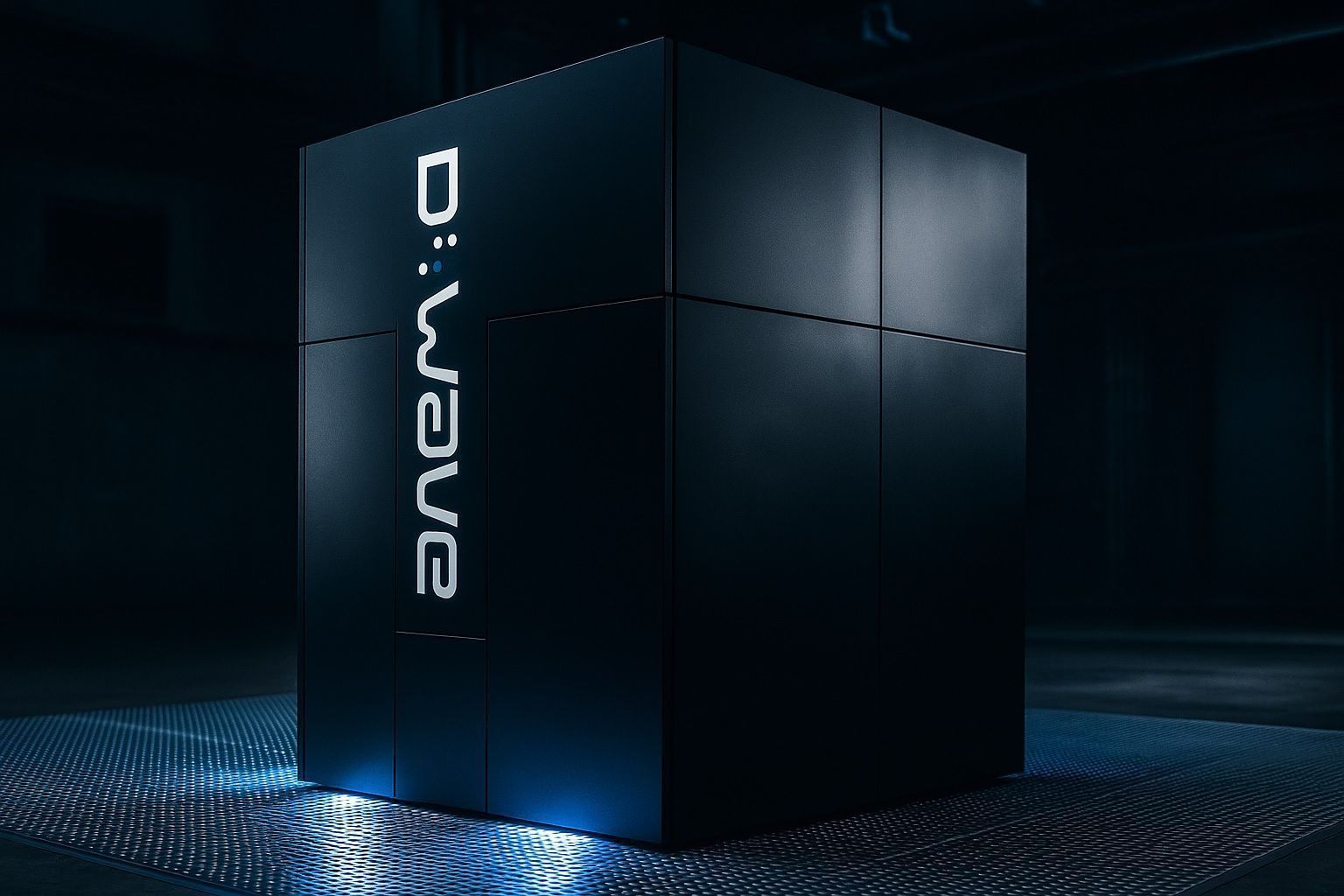
- D-Wave’s Advantage2™ annealing quantum computer is now operational at Davidson Technologies in Huntsville, Alabama, a contractor serving the U.S. Department of Defense and aerospace customers. The system is expected to tackle mission-critical government problems and, in time, run sensitive applications. ir.dwavequantum.com+1
For investors, this new unit matters for at least three reasons:
- Clearer vertical focus – Government and defense become an explicit, organized pillar of the company’s growth story, rather than a scattered set of contracts.
- Higher signaling value – A dedicated business unit, paired with a live system in Alabama, signals to other agencies that D-Wave’s tools are not experimental toys but operational assets.
- Potential long-term revenue visibility – If D-Wave can move from pilots to multi-year programs, recurring contracts could gradually smooth the “lumpy” bookings that analysts frequently flag as a risk. TipRanks+1
Fresh Catalyst #2: Evercore ISI’s Outperform Rating and $44 Price Target
The headline on December 3 is Evercore ISI’s decision to initiate coverage of QBTS with an Outperform rating and a $44 price target. Investing.com
In its note, Evercore highlights several pillars of its bullish thesis:
- The $44 target is based on projected 2035 earnings per share of $2.61, valued at a 40x P/E multiple and discounted back nine years, reflecting a long-dated, growth-heavy model. Investing.com
- Evercore estimates D-Wave can capture roughly 12% of the global quantum-computing market, with particular strength in the 15–25% of workloads that “alternative quantum approaches cannot naturally address” – a nod to D-Wave’s annealing-focused architecture. Investing.com
- The firm cites D-Wave’s trailing 12‑month revenue growth of around 156% and an 82.8% gross profit margin, metrics that underscore how small, but high-margin, the current business is. Investing.com+1
Evercore also notes several recent positives:
- D-Wave’s Q3 2025 beat on both revenue and earnings. Investing.com+2D-Wave Quantum+2
- The completion of warrant redemptions that raised about $54.6 million in cash, contributing to a very large cash balance. Investing.com+2D-Wave Quantum+2
- The newly announced U.S. Government business unit, which Evercore clearly views as strategic to long-term demand. Investing.com+2ir.dwavequantum.com+2
Importantly, Evercore’s $44 target sits well above the broader Street consensus (around $28–29), making it one of the higher-profile bullish voices on QBTS today. MarketBeat
Earnings Backdrop: Q3 2025 Showed Real Progress – and Big Losses
Much of the current analyst debate traces back to D-Wave’s Q3 2025 results, reported on November 6. D-Wave Quantum+1
Key financial highlights for the quarter ended September 30, 2025:
- Revenue of $3.7 million, up 100% year over year from $1.9 million in Q3 2024 and up 8% from Q2 2025. D-Wave Quantum+1
- Bookings of $2.4 million, up 3% year-over-year and up 80% sequentially, with more than $12 million in additional bookings closed after quarter-end. D-Wave Quantum
- GAAP gross profit of $2.7 million and gross margin of 71.4%, both substantially improved versus the prior year. Non‑GAAP gross margin reached 77.7%. D-Wave Quantum
- A headline GAAP net loss of $140.0 million, driven largely by $121.9 million in non‑cash charges related to warrant remeasurement and exercises as the share price surged. On an adjusted basis, net loss was $18.1 million, better than the year‑ago quarter. D-Wave Quantum+1
- A record cash balance of about $836 million, thanks mostly to those warrant exercises rather than operating cash flow. D-Wave Quantum+1
Fundamentally, D-Wave remains a company with:
- Tiny absolute revenue, even if it is doubling year-over-year.
- Very high gross margins, reflective of software and high-value system sales.
- Substantial operating and R&D spending to advance both its annealing and gate-model programs. D-Wave Quantum+1
For bullish analysts, Q3 shows a business starting to scale, with bookings, customers and margins all heading in the right direction. For skeptics, it reinforces that D-Wave is still far from profitability, with a capital structure heavily influenced by warrants and share issuance.
What Wall Street Analysts Forecast for QBTS
Beyond Evercore’s new $44 target, the broader sell-side picture is unusually aggressive for such a speculative stock.
Street consensus
According to MarketBeat:
- 14 analysts currently cover D-Wave Quantum.
- The consensus rating is “Moderate Buy”, with 12 Buy, 1 Hold and 1 Sell rating.
- The average 12‑month price target is $28.67, with a low of $9 and a high of $41, implying about 27.6% upside from a reference price of $22.47. MarketBeat
StockAnalysis, which tracks a slightly smaller group of analysts, shows:
- An average price target of $27.36, forecasting roughly 21.6% upside over the next year.
- A “Strong Buy” consensus label from its analyst set. StockAnalysis
Quiver Quantitative, aggregating targets over the last six months, reports:
- Eight recent price targets with a median of $34, including $35 from Benchmark, $40 from Cantor Fitzgerald and Rosenblatt, and $41 from Canaccord Genuity. Quiver Quantitative+1
Taken together, the message from most professional analysts is clear: they expect D-Wave’s share price to rise further, despite the recent surge and volatility.
The Bear Case: “Overvalued” and Dependent on Future Hype
Alongside this optimism is a growing chorus of skepticism.
Valuation concerns
A widely read TipRanks analysis on December 3 bluntly asks whether D-Wave Quantum is overvalued:
- QBTS has surged more than 167% year-to-date.
- It trades at a price-to-sales multiple of about 182x, vastly above typical tech-sector averages and even above its own recent history. TipRanks
- Revenue remains highly concentrated and lumpy, with a large share of Q3 revenue coming from a single system upgrade, not broad-based, recurring enterprise use. TipRanks+1
The Nasdaq/Motley Fool piece, “Down 49%, Should You Buy the Dip on D-Wave Quantum?”, makes a similar argument:
- Despite the recent pullback, D-Wave’s market cap is still around $8 billion.
- That equates to a price-to-sales ratio above 300x on trailing 12‑month revenue of roughly $24 million. Nasdaq
- The article questions whether such a valuation is sustainable in a field where big-tech giants (IBM, Alphabet, Microsoft, Amazon) are also investing heavily in quantum computing, and where the total addressable market in 2035 is still an educated guess rather than a certainty. Nasdaq
Seeking Alpha commentary, where accessible, has likewise emphasized that even after drawdowns of 50% or more, QBTS can still look “too expensive to buy”, given ongoing operating losses and the risk of further dilution. Seeking Alpha+1
Liquidity and dilution
TipRanks and Q3 disclosures highlight that:
- D-Wave’s enormous cash position (~$836 million) is primarily the result of warrant exercises, not organic profits.
- In November, the company redeemed all outstanding public warrants, raising another $54.6 million but increasing share count and potential dilution for existing holders. TipRanks+2D-Wave Quantum+2
That combination – strong cash but heavy reliance on equity-linked financing – is typical of early-stage, high-risk tech companies, but it also means future returns depend not just on business success, but on how that success is shared across a growing base of shareholders.
Volatility Watch: Quantum Boom, Quantum Bust
Recent trading in QBTS is a textbook example of speculative volatility:
- A “quantum stock meltdown” article from Yahoo Finance described D-Wave plunging more than 30% in a single session, alongside similar slides in IonQ and Rigetti, as the 2025 quantum boom “unraveled.” Yahoo Finance
- MarketBeat’s instant alert on December 2 then tracked a 4.9% rebound, pointing to renewed analyst enthusiasm and a still-healthy “Moderate Buy” consensus with upside targets clustered in the $28–41 range. MarketBeat
- Social-media and alternative-data coverage from Quiver Quantitative notes intense debate on X (formerly Twitter) around D-Wave’s legitimacy, price swings, and long-term potential – a sign that sentiment is being driven as much by narrative as by quarterly numbers. Quiver Quantitative
For many investors, the practical takeaway is simple: QBTS trades like a high-beta, story-driven growth stock, not a stable, fundamentals-only play. Daily moves of 10–30% – in either direction – are not outliers but part of the regime.
Technology and Strategy: Why D-Wave Is Different
Beneath the stock-ticker drama, the core of the D-Wave story is technological.
D-Wave is currently:
- The only commercial player building both annealing and gate‑model quantum computers, according to its own disclosures and industry reports. D-Wave Quantum+1
- Focused today on annealing systems (Advantage and Advantage2), which are designed for optimization problems – logistics, routing, scheduling, resource allocation – rather than general-purpose quantum algorithms. D-Wave Quantum+1
- Investing heavily in a gate-model program built around fluxonium qubits and cryogenic control chips, aiming to eventually build what it calls the “first ever scalable gate-model system with cryogenic control.” D-Wave Quantum
Q3 highlights included:
- Completion of fluxonium qubit and control chip fabrication and ongoing integration work.
- A series of hybrid quantum-classical proofs-of-concept, including optimization projects with BASF and law-enforcement routing with North Wales Police. D-Wave Quantum+1
This dual-track strategy—monetize annealing today while building gate-model capabilities for tomorrow—is part of what bulls like Evercore are paying for. It also adds execution risk: D-Wave must sustain R&D spending for years while competing against much larger, better capitalized rivals.
Key Themes for Investors on December 3, 2025
Pulling the threads together, several themes define the QBTS investment case as of December 3:
1. Government and defense as a central growth pillar
The new U.S. Government business unit and operational Advantage2 system in Alabama make it clear that defense and national security are now front-and-center in D-Wave’s go-to-market plan. If the company can convert pilot projects into multi-year programs, this segment could provide more stable bookings and a powerful branding advantage. ir.dwavequantum.com+2The Quantum Insider+2
2. Analysts are bullish, but not unanimous
Most major firms covering D-Wave have Buy or Overweight ratings, with targets typically between $27 and $41, and Evercore now out in front with $44. A small minority have Sell or cautious ratings, and independent commentary increasingly warns that these targets rest on ambitious models extending to 2035 and beyond. TipRanks+3MarketBeat+3Investing.com+3
3. Fundamentals are improving – from a very small base
Revenue is doubling year over year, gross margins are expanding, and the customer base now includes over 100 organizations, including airlines, banks, semiconductor foundries and public-sector entities. But absolute revenue is still in the low single-digit millions per quarter, and adjusted losses remain substantial. D-Wave Quantum+2TipRanks+2
4. Valuation is extreme by any conventional metric
Whether one uses TipRanks’ 182x price‑to‑sales estimate or the Motley Fool’s 300x+ P/S calculation, QBTS is priced for massive future success. This doesn’t make that success impossible—but it does mean that even good news may already be partially reflected in the share price, while disappointments can trigger violent selloffs. TipRanks+1
5. Capital structure is strong on cash, heavy on dilution
D-Wave’s $836 million cash balance gives it runway to keep investing in technology and go-to-market initiatives. But because that cash was primarily raised through warrant exercises and share issuance, existing shareholders bear dilution risk, especially if future capital raises are needed before the business turns sustainably cash-flow positive. D-Wave Quantum+2TipRanks+2
Outlook: What Could Move D-Wave Quantum Stock Next?
Going forward, several catalysts could swing QBTS in either direction:
- New U.S. government contracts or classified projects emerging from the new business unit. Any confirmation that D-Wave’s systems are embedded in long-term defense infrastructure would likely be seen as a major positive. ir.dwavequantum.com+1
- Additional analyst initiations or target changes, particularly from large banks or if consensus targets shift meaningfully higher or lower. MarketBeat+2Investing.com+2
- Future earnings releases that either reinforce the Q3 growth story—sustained 80–100% revenue growth and strong margins—or show a slowdown, which would raise questions about the underlying demand curve. D-Wave Quantum+2Investing.com+2
- Sector-wide sentiment in quantum computing, where a handful of companies (IonQ, Rigetti, D-Wave and others) often move together in response to news about government funding, big-tech partnerships, or changes in risk appetite. Yahoo Finance+2Yahoo Finance+2