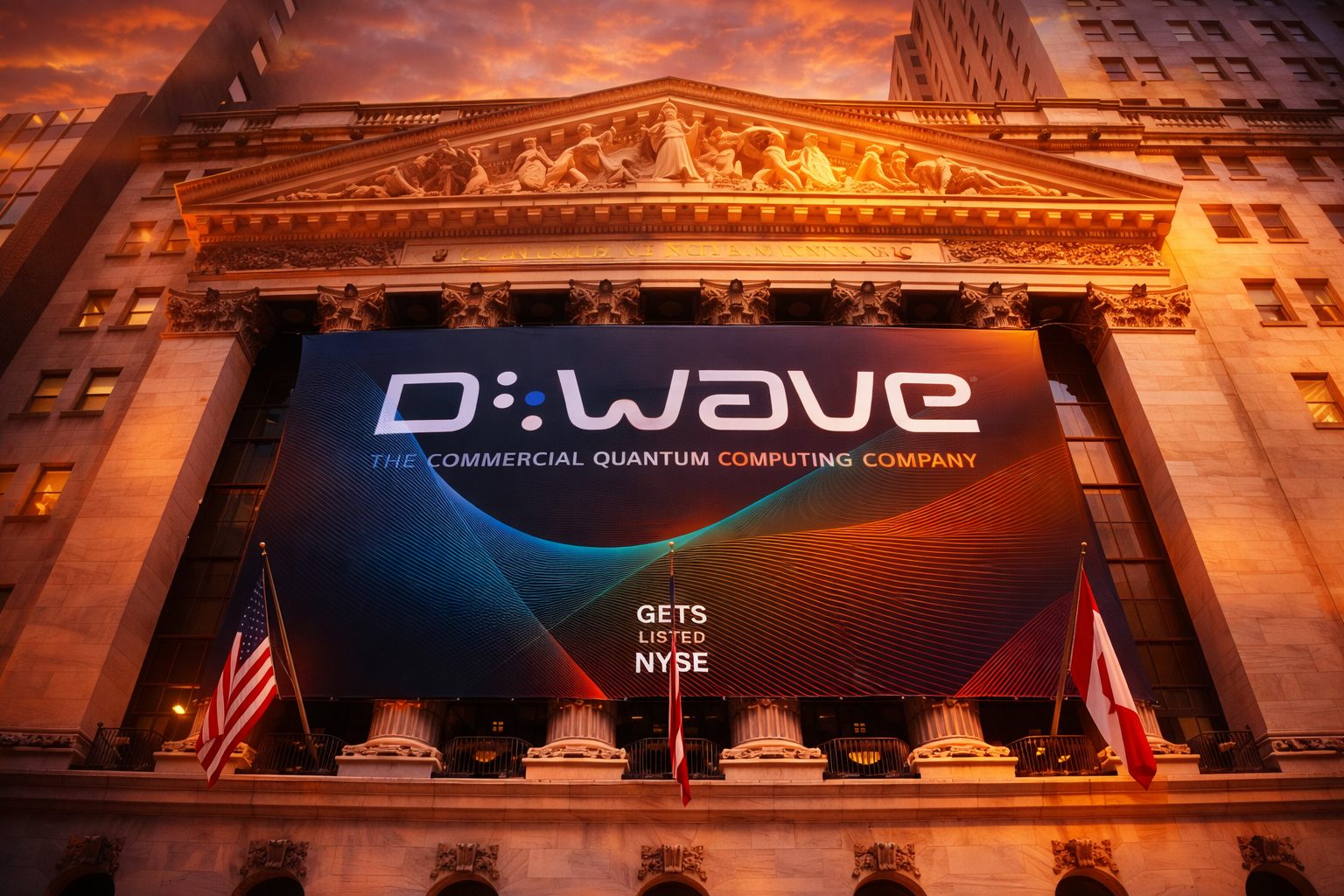
D-Wave Quantum Inc. (NYSE: QBTS) is back in the spotlight on December 22, 2025—and not in a subtle way. Shares surged in Monday trading as investors reacted to fresh company news tied to CES 2026, the technology mega-event in Las Vegas. As of the latest available quote, QBTS traded around $31.19, up roughly 16% on the session, after swinging between $27.15 and $31.41 with volume above 28 million shares.
That headline pop is the “today story.” The bigger story—why D-Wave has become one of the most talked-about speculative tech names of 2025—sits at the intersection of quantum computing hype, real (but still small) revenue, a wave of new analyst coverage, and a stock that can move like it’s powered by espresso shots and gamma rays.
Below is what’s new today, what Wall Street is forecasting, and what to watch next.
What sparked the rally: D-Wave heads to CES 2026
Early Monday, D-Wave announced it will participate in CES 2026 as a sponsor of the CES Foundry, a two-day event held at the Fontainebleau Las Vegas on January 7–8, 2026. The company says it will showcase its annealing quantum computing technology, hybrid quantum-classical solvers, and customer use cases aimed at demonstrating “measurable performance benefits.” D-Wave Quantum+1
A specific moment that markets love (because it’s concrete and schedulable): D-Wave says Murray Thom, its vice president of quantum technology evangelism, will deliver a masterclass and demo on January 7 from 1:00–1:30 p.m. PT, and the company will also have on-site presence at CES Foundry booth FT12. D-Wave Quantum+1
This is the kind of announcement that doesn’t instantly change next quarter’s revenue—but it does give the market a clean narrative: “Quantum isn’t just in labs; it’s being demoed on a mainstream stage.” That framing showed up repeatedly across same-day coverage of the move. The Motley Fool+2Investing.com+2
Why investors are paying attention: D-Wave’s “commercial quantum, now” positioning
D-Wave is not trying to win the quantum conversation by promising a distant, fault-tolerant future first. Its pitch is more grounded (and more controversial, depending on who you ask): deliver value today using quantum annealing and hybrid approaches, while also building toward broader capabilities.
In its CES announcement, D-Wave reiterates several scale-and-credibility claims: it describes itself as the world’s first commercial supplier of quantum computers, says it’s building both annealing and gate-model quantum computers, and notes that more than 100 organizations use its technology, with 200 million+ problems submitted to its systems. Those are company-provided figures—but they’re central to the story investors are buying (at least on up days). D-Wave Quantum+1
Same-day analysis also leaned into the “real workloads” angle, highlighting D-Wave’s cloud accessibility and practical deployment model as a differentiator versus quantum peers that are still largely in R&D mode. Investing.com+1
The fundamentals checkpoint: growth is real, but the base is still small
D-Wave’s latest quarterly results (reported November 6, 2025 for Q3 ended Sept. 30, 2025) help explain why the stock can inspire both believers and skeptics in the same sentence.
Key items from that report:
- Revenue:$3.7 million in Q3 FY2025, up 100% year over year (from $1.9 million). D-Wave Quantum
- Bookings:$2.4 million, up 80% versus the prior quarter; D-Wave also said it closed over $12 million in additional bookings after quarter-end. D-Wave Quantum
- Customers: D-Wave reported 100+ revenue-generating customers over the most recent four quarters, including nearly two dozen Forbes Global 2000 companies. D-Wave Quantum
- Cash: the company cited its highest cash balance historically at over $836 million. D-Wave Quantum
The part that makes traditional valuation models start sweating:
- Net loss: Q3 net loss of $140.0 million, which D-Wave attributed primarily to non-cash, non-operating charges tied to remeasurement of its warrant liability and losses related to warrant exercises. It also reported adjusted net loss of $18.1 million, excluding those warrant-related items. D-Wave Quantum
That mix—small revenue, improving commercial signals, huge headline losses distorted by capital-structure mechanics—is catnip for momentum traders and an instant headache for cautious investors.
Capital structure cleanup: the warrant redemption that added cash
One underappreciated thread in the 2025 QBTS story is how aggressively the company worked to simplify its capital structure.
D-Wave said it completed redemption of its public warrants in November. It reported that 4,746,358 warrants were exercised, producing about 6.9 million shares and generating approximately $54.6 million in cash proceeds, with remaining unexercised warrants redeemed at $0.01 per warrant. D-Wave Quantum+1
Why that matters: quantum computing is still a capital-intensive business, and extra cash buys time—time to build product, pursue government channels, and keep the “commercialization” narrative alive long enough to become true.
Government and international expansion: where D-Wave is aiming next
Beyond CES, D-Wave’s late-2025 news flow has leaned heavily into two themes: government and Europe.
U.S. government push
On December 2, 2025, D-Wave announced a new U.S. Government Business Unit led by Jack Sears Jr., aimed at expanding adoption of its systems and services across federal use cases. D-Wave Quantum
Separately, the company has promoted progress around its Advantage2 system being made available for U.S. government applications at Davidson Technologies (an effort it positions as helping address mission-critical challenges). D-Wave Quantum+1
Europe: a €10M agreement tied to Advantage2 deployment
In October, D-Wave announced an agreement with Swiss Quantum Technology SA (SQT) involving a €10 million commitment to deploy a D-Wave Advantage2 annealing quantum computer in Europe, with access delivered via D-Wave’s Leap quantum cloud service and tied to Italy’s Q-Alliance ambitions. D-Wave described Advantage2 as a 4,400+ qubit system. D-Wave Quantum+1
These initiatives matter because they point toward the hardest thing for quantum pure-plays: building a predictable pipeline of paid deployments, not just press releases.
Analyst forecasts: Wall Street coverage arrives—and price targets cluster above the market
If 2024 was “quantum is interesting,” 2025 became “quantum is tradable,” and the last few weeks of 2025 look like “quantum is getting underwritten.”
The newest wave of coverage and targets
Multiple firms initiated or reiterated bullish views in December:
- Wedbush initiated coverage with an Outperform and a $35 price target (reported by multiple outlets). Investopedia+1
- Jefferies initiated with a Buy and a $45 price target. Investing.com+1
- Evercore ISI initiated with Outperform and a $44 price target (as reported in analyst-coverage roundups). Investing.com+1
- Mizuho initiated with Outperform and a $46 price target, according to reports of the note. TipRanks+1
There are also reports of Benchmark moving to a $35 target and Cantor Fitzgerald increasing to $40, reflecting broader bullishness on D-Wave’s commercialization trajectory (again, as compiled in analyst-coverage reporting). Investing.com+1
Consensus-style “forecast ranges”
Data published via Nasdaq (sourced from Fintel) placed the average one-year price target around $37.81, with a low around $26.04 and a high around $50.40 (based on the dataset timestamp cited in those reports). Nasdaq+1
That same dataset also lists projections like ~$117 million in annual revenue and non-GAAP EPS around -0.45—a reminder that even optimistic models still assume losses continue as the category matures. Nasdaq+1
The uncomfortable valuation math
More skeptical coverage focuses on valuation versus current revenue. One widely read piece noted that D-Wave’s annual revenue run-rate is still modest relative to a multi‑billion-dollar market cap, implying an extremely high price-to-sales multiple—and also pointed out that some analysts do not expect D-Wave to turn profitable until late in the decade. The Motley Fool+1
Short interest and volatility: QBTS remains a high-drama ticker
Even after Monday’s jump, QBTS is still living inside a wide volatility corridor. Market data places the stock’s 52-week range at approximately $3.74 to $46.75, underscoring how quickly sentiment has swung during 2025. MarketWatch+1
Short positioning adds another layer. MarketBeat reported that as of November 14, 2025, D-Wave had about 42.25 million shares sold short, roughly 12.47% of float, with days-to-cover around 1.0. MarketBeat
That setup doesn’t guarantee a “short squeeze,” but it does help explain why QBTS can gap up (or down) hard when a narrative catalyst hits—like CES, analyst initiations, or a government-related headline.
What investors will watch next: CES, Qubits, and the “proof” phase
D-Wave has two near-term calendar catalysts in January:
- CES Foundry (Jan. 7–8, 2026): demos, talks, and media attention—good for narrative, partnerships, and lead generation, but not automatically revenue. D-Wave Quantum+1
- Qubits 2026 user conference (Jan. 27–28, 2026, Boca Raton): D-Wave says it will showcase customer stories and share roadmap progress across annealing and gate-model initiatives. D-Wave Quantum+1
The market’s real question going into 2026 isn’t whether quantum computing is fascinating (it is). It’s whether D-Wave can turn three things into a repeatable machine:
- Enterprise renewals that scale, not just pilots
- Government adoption that becomes contractual, not just organizational
- Proof that hybrid quantum workflows reduce cost/time materially, often enough to justify budgets
CES can amplify that story. It can’t finish it.
Bottom line on D-Wave Quantum stock on Dec. 22, 2025
Today’s QBTS rally is best understood as a catalyst-driven move in a stock that trades on narrative momentum—especially when the catalyst is “mainstream stage + demos + analyst optimism.”
At the same time, D-Wave’s late-2025 backdrop isn’t empty hype: it has reported rapid percentage growth off a small base, a very large cash position, and a pipeline of commercialization pushes spanning enterprise, government, and Europe. D-Wave Quantum+2D-Wave Quantum+2
The risk, as always with quantum pure-plays, is that the stock can price in a future that arrives late—or arrives in a different company’s ticker.