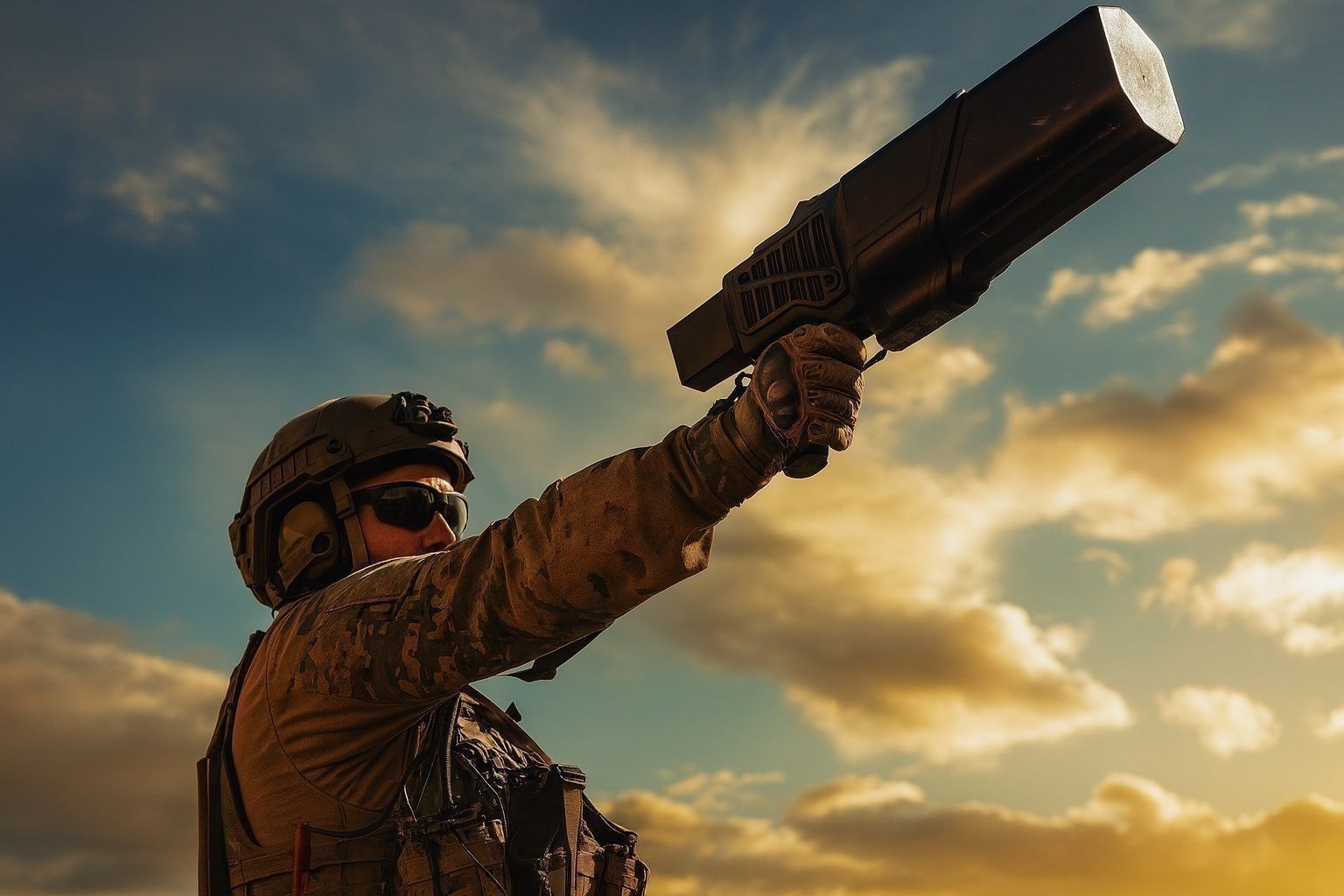
In 2025, two Australian companies – DroneShield and Electro Optic Systems (EOS) – moved from niche suppliers to central actors in NATO’s response to the drone threat over Europe and Ukraine. Their technologies are different but complementary: DroneShield specialises in “soft‑kill” detection and jamming, while EOS brings “hard‑kill” effectors such as guns, lasers and, now, interceptor drones.
Importantly, there is no publicly announced formal joint venture between DroneShield and EOS as of December 2025. Instead, their cooperation is happening in practice: their systems are increasingly deployed side‑by‑side inside layered counter‑UAS architectures that NATO states and Australia are rushing to field.
A new phase in Europe’s drone war
The year has been defined by persistent drone incursions across European airspace, from Norway and Denmark to Poland and Ukraine. In October, Monocle reported that unexplained drones forced flight diversions in Norway and triggered a military alert in Denmark, prompting renewed urgency around airspace security.Monocle
That urgency is translating directly into orders. An Army Recognition analysis in late October described how Australian firms DroneShield and EOS are rapidly supplying European militaries with everything from handheld jammers to 100 kW‑class lasers, as EU institutions push for a continent‑wide drone defence initiative.Army Recognition
The Australian Broadcasting Corporation (ABC) went further, calling it a “quiet shift” in Europe’s arms market: European buyers want systems they can field now, not in a decade. The ABC highlighted DroneShield’s AI‑driven jamming platforms and EOS’s Apollo laser – capable of burning holes in drones at ranges of up to 6 km and knocking down around 30 drones a minute – both used in Ukraine and newly sold to a Western European NATO state for about A$125 million.ABC+1
Together, these stories frame the core reality of 2025: Australia’s counter‑drone ecosystem has become strategically relevant to NATO, and DroneShield and EOS sit at the centre of that story.
Two Australian champions with complementary roles
DroneShield: software‑heavy “soft‑kill” counter‑drone defence
DroneShield is best known for its RF‑sensing, AI‑driven detection and jamming systems – tools that can spot drones, classify them and then sever control links or GPS so they crash or land. Its portfolio ranges from handheld DroneGunjammers and RfPatrol detectors to multi‑sensor fixed systems such as DroneSentry.Wikipedia+1
In June 2025 the company announced its largest contract in history: a package of three follow‑on orders worth US$61.6 million (A$ equivalent) for handheld detection and counter‑drone systems destined for a European military via an in‑country reseller. The deal is larger than DroneShield’s entire 2024 revenue and will be fully delivered in Q3 2025.DroneShield
To support that demand, DroneShield is establishing a European manufacturing and assembly “Centre of Excellence”, aiming for at least 65% European content on certain products and aligning with EU’s ReArm Europe / Readiness 2030 defence industrial drive.DroneShield+1
By September 2025, DroneShield reported it had surpassed 4,000 systems sold globally, with 2,200+ RfPatrol units alone and 1H 2025 revenue of A$72.3 million – up 210% year‑on‑year – plus a profit before tax of A$5.2 million.DroneShield
EOS: guns, lasers and now interceptor drones
Electro Optic Systems, by contrast, sits mostly at the “hard‑kill” end of the spectrum. Its Slinger remote weapon system (RWS) combines a 30 mm Bushmaster cannon, advanced optics and AESA radar on a 400 kg stabilized turret that can be mounted on vehicles or fixed positions to physically shoot down drones.PS News+1
In August and September 2025, EOS confirmed what News.com.au dubbed a “ground‑breaking” deal: a €71.4 million (~A$125 million) export contract for its 100 kW high‑power laser – now branded Apollo – with a European NATO country. The laser can destroy around 20–30 drones per minute within roughly a 2–5 km band, at an engagement cost measured in single dollars per shot.Drones World Magazine+2News.com.au+2
EOS has also turned Slinger into a significant export product. In May it announced its largest Slinger naval order to date, a €53 million contract for a maritime variant for a Western European government.Electro Optic Systems+1
By November, EOS had secured another Slinger order worth €11.4 million (≈A$20 million) from a Western European NATO nation – its third Slinger contract in 2025 – with deliveries scheduled within six months to meet “urgent operational requirements”.Electro Optic Systems+2Drastic News+2
And in parallel, EOS is expanding its C‑UAS portfolio by acquiring MARSS’s interceptor drone business for A$10 million, positioning itself as a provider of low‑cost hard‑kill interceptors (targeting ~US$10k per interceptor) that can complement jamming, guns and lasers in a multilayered defence.Streetwise Reports
Unmanned Airspace summed up EOS’s approach neatly: Slinger plus high‑energy lasers underpin a layered hard‑kill architecture that closes the “capability gap” left by traditional short‑range air defence systems when faced with cheap, ubiquitous drones.Unmanned Airspace
2025 milestones: DroneShield’s expansion across Europe, Ukraine and Australia
Record European deal and a new EU footprint
The US$61.6m European contract is the clearest sign of DroneShield’s momentum in NATO. The order covers handheld detection and counter‑drone systems and accessories, with delivery compressed into a single quarter – a sign that buyers are no longer experimenting with small evaluation lots but moving into broad deployment.DroneShield+1
To sustain that shift, DroneShield’s planned European Centre of Excellence will bring local manufacturing, R&D, testing and training into the EU, with at least 65% regional content for selected products and a pipeline of more than A$1.1 billion across 55 opportunities.DroneShield+1
Ukraine and frontline learning loops
Army Recognition notes that DroneShield is active in roughly 50 countries and has “several hundred systems” deployed in Ukraine, where feedback from the front line feeds directly into its AI‑based detection and jamming algorithms.Army Recognition
This mirrors the “cat and mouse” dynamic described by DroneShield CEO Oleg Vornik in ABC’s feature on Australian drone‑war firms; he emphasised that if adversaries stopped innovating, DroneShield’s revenues would collapse, underlining how software updates and rapid threat‑library refreshes are central to the company’s business model.ABC
Domestic manufacturing and Adelaide R&D hub
On the home front, DroneShield has leaned heavily into sovereign production. A Courier‑Mail report from early 2025 highlighted that roughly 80% of the components for its systems are sourced from Australian suppliers, supporting some 50 local companies and a large in‑house engineering team – now roughly 400 staff globally.Courier Mail+1
In October, DroneShield committed A$13 million to a new R&D facility in Adelaide focused on RF electronics, electronic warfare and systems integration. The site will host an anechoic chamber and create at least 20 engineering roles, complementing its existing Sydney R&D base and a planned 30% expansion of US R&D.Unmanned Airspace+2News.com.au+2
Australian Land 156 and handheld C‑UAS
Domestically, the Australian Department of Defence’s Project LAND 156 has become a focal point for counter‑drone capability. A Shephard Media piece reposted by EOS notes that Australia’s CUAS tender explicitly seeks a system that integrates sensors, effectors and C2, and lists DroneShield among the key local players.Electro Optic Systems
DroneShield subsequently confirmed a A$5 million order under LAND 156 Line of Effort 2 for handheld detection and neutralisation equipment for the Australian Defence Force, with its RfPatrol detectors explicitly flagged as part of LAND 156‑linked programs.DroneShield
This means DroneShield is already embedded as a soft‑kill component inside Australia’s emerging layered CUAS architecture.
2025 milestones: EOS turns lasers and Slinger into big‑ticket NATO exports
Apollo: a 100 kW laser goes mainstream
EOS’s Apollo high‑energy laser is arguably the most headline‑grabbing Australian weapons export of 2025. Drones World Magazine and News.com.au both reported that EOS secured the world’s first export order for a 100 kW‑class laser defence system, a €71.4m contract with an unnamed NATO member to be fulfilled from 2025–2028 via its Singapore laser innovation hub.Drones World Magazine+1
The system combines beam‑steering optics, radar, threat detection and advanced algorithms and is designed to defeat drone swarms at low cost, offering a dramatic cost advantage over missile‑based air defence.Drones World Magazine+1
ABC’s coverage of the deal emphasised both the technical edge and the symbolism: Apollo will become NATO’s newest anti‑drone system, with EOS’s CEO describing how feedback from Ukrainian troops is improving performance “on the fly”.ABC+1
Slinger: from concept to serial export
Alongside Apollo, Slinger has gone from a new product in 2023 to a serially exported counter‑drone turret in 2025.
Key contracts this year include:
- A €53m order for a maritime Slinger variant from a Western European government, described as EOS’s largest naval RWS order to date.Electro Optic Systems+1
- A €11.4m / A$20m order for Slinger RWS from a Western European NATO member, with deliveries inside six months to meet urgent operational needs – the third Slinger contract of 2025.Australian Defence Magazine+3Electro Optic…
PS News detailed how the 400 kg Slinger mounts a 30 mm Bushmaster M230LF cannon, a four‑axis EO/IR sight and a 4D AESA radar, enabling it to track and engage moving drones beyond 800 m while the vehicle is on the move.PS News
Interceptors and autonomy: building a full hard‑kill stack
The late‑2025 acquisition of MARSS’s interceptor drone business adds a new dimension to EOS’s portfolio. According to a Bell Potter–summarised analysis, the interceptors are designed as low‑cost, high‑agility hard‑kill options with roughly 5 km range and unit costs EOS hopes to keep near US$10k, significantly below competing missile‑based solutions.Streetwise Reports
In parallel, EOS Defense Systems USA is rolling out C‑UAS enhancements for Slinger, including aided target recognition and selectable autonomy levels, specifically to better handle drone swarms and complex engagements.European Security Defence+1
Taken together – Slinger, Apollo, and interceptor drones – EOS now offers a multi‑layer hard‑kill package that can plug into wider C‑UAS architectures.
Where DroneShield–EOS cooperation actually happens
Despite frequent talk of “DroneShield and EOS cooperation”, public records do not show a formal strategic alliance, joint venture or co‑developed product between the two companies as of December 2025.
Instead, their cooperation is practical and ecosystem‑driven, unfolding in three main ways:
1. Shared role in layered C‑UAS architectures
Modern counter‑drone concepts are fundamentally layered. Land 156, for example, is built around an open‑architecture stack that ties together multiple sensors, effectors and a central C2 system. In September 2025, the Australian Government appointed Leidos Australia as the Land 156 systems integrator, with:
- Acacia’s Cortex system as the C2 “heart”
- An effector system from EOS Defence Systems
- A sensor system from Department 13
- and explicit provision to integrate additional Australian sensors and effectors over time.PS News
Separately, DroneShield has already won a Land 156 LOE2 contract to supply handheld detection and neutralisation gear to the ADF.DroneShield+1
In practice, that means Australian and allied militaries are fielding DroneShield “soft‑kill” layers and EOS “hard‑kill” layers inside the same system‑of‑systems – mediated by integrators like Leidos and C2 providers like Acacia.
European reporting paints a similar picture. Caliber.az, summarising European defence developments, describes Australian systems delivering “layered C‑UAS architectures that integrate sensors, effectors and command nodes”, citing EOS’s 100 kW laser and Slinger turret exports as core building blocks.Caliber+1
Army Recognition likewise frames DroneShield’s RF detectors and jamming guns as the front‑end “soft‑kill” layer and EOS’s Apollo laser as a back‑end hard‑kill tier for swarm defence in Europe.Army Recognition
2. Shared programs and geographies
Both companies are deeply involved in Ukraine and NATO‑border states:
- DroneShield has “several hundred systems” in Ukraine and recently expanded its presence there through an AI‑driven counter‑drone partnership announced in September 2025.Army Recognition+1
- EOS equipment – particularly Slinger and Apollo – is also being used in Ukraine against Russian drones, with EOS noting iterative software improvements based on combat feedback.ABC+1
The ABC piece that profiled both companies described them jointly as “global leaders in counter‑drone systems” and highlighted that, for some NATO allies, Australian tech is easier to buy than U.S., Chinese or Israeli equivalents due to export controls and political sensitivities.ABC
In Europe more broadly, Monocle’s feature “EOS and DroneShield step up as European drone threats drive global demand for air defence tech” explicitly grouped the two as twin pillars of Australian C‑UAS capability powering Europe’s rapid rearmament.Monocle+1
3. Converging product roadmaps
There are also signs of convergence that could increase future cooperation – or competition:
- DroneShield, historically a pure “soft‑kill” player, is now exploring hard‑defeat solutions of its own, provided they can be low‑cost, volumetric and minimise collateral damage. This direction was flagged in a December 2025 Streetwise Reports piece citing comments from CEO Oleg Vornik.Streetwise Reports
- EOS is moving beyond guns and lasers into interceptor drones and more autonomous Slinger variants, targeting exactly the same C‑UAS budget lines that fund DroneShield’s systems.Streetwise Reports+1
Analyst commentary from outlets like Kalkine Media and Streetwise Reports often pairs DroneShield (ASX:DRO) and EOS (ASX:EOS) when discussing ASX defence stocks, noting that both grow via product diversification and international partnerships within shared programs.Kalkine Media+2Kalkine Media+2
So while the two companies compete for dollars and headlines, they also benefit from each other’s presence: defence ministries can justify building a sovereign C‑UAS ecosystem when there is more than one credible local supplier spanning different layers.
Implications for NATO, Australia – and investors
For NATO and EU defence planners, DroneShield and EOS together represent a rare combination:
- Rapidly fieldable, combat‑proven systems that can plug into existing vehicles and bases
- Mix‑and‑match layering: detection and jamming, guns, lasers, and soon interceptors
- Industrial resilience, with production spread across Australia, Europe, the U.S. and Singapore.EOSDS USA+3DroneShield+3Drones World Magaz…
For Australia, their success supports broader goals of sovereign capability and export‑led defence industry growth. DroneShield has stressed that around 80% of its components are sourced domestically, while EOS employs several hundred staff and manufactures key systems in Canberra and Singapore.Courier Mail+2PS News+2
For investors, the story is more volatile. A Bloomberg snapshot in October highlighted DroneShield and EOS as among the top‑performing small‑cap defence stocks on the ASX, with multi‑hundred‑percent rallies off their 2024 lows.Bloomberg But ABC’s “peacetime dividend” segment also showed how quickly sentiment can swing: a ceasefire in the Middle East saw both share prices sharply corrected as some investors briefly rotated out of defence names.ABC
Analysts like Bell Potter still see upside, particularly for EOS as the A$20m November Slinger order secures a growing portion of its forecast 2026 revenue and as at least one additional laser contract could further lift 2027+ earnings.Streetwise Reports
What to watch in 2026 and beyond
Several developments in 2026–2030 will determine how far DroneShield–EOS cooperation goes:
- Land 156 evolution
Land 156’s open architecture makes it relatively straightforward for Defence and Leidos to integrate additional sensors and effectors over time. How deeply DroneShield’s systems are embedded alongside EOS’s effectors in future increments will be an important signal.PS News+1 - DroneShield’s hard‑kill ambitions
If DroneShield succeeds in adding a cost‑effective hard‑kill layer (for example, directed‑energy or novel non‑kinetic effectors) it could either partner with EOS on integration or start competing directly in that space.Streetwise Reports+1 - EOS interceptor drone maturation
EOS plans another one to two years of development for its interceptor drones. How quickly those systems reach operational deployment – and whether they are paired with DroneShield‑style sensing in NATO deployments – will shape the next phase of layered defence.Streetwise Reports+1 - EU drone defence initiatives and ReArm Europe
The EU’s push for coordinated drone defence and the broader ReArm Europe / Readiness 2030 plans will likely drive further demand for both companies, especially as they invest in European manufacturing lines and local content.sUAS News+2Army Recognition+2
Bottom line
In 2025, DroneShield and EOS did not need a formal partnership agreement to “cooperate”. Their cooperation is visible in shared programs, shared theatres and shared architectures: DroneShield’s AI‑driven detection and jamming at the front, EOS’s guns, lasers and interceptors at the back, all tied together by integrators and C2 systems that favour Australian content.
As drone warfare evolves and swarms become the norm rather than the exception, that Australian double act is likely to remain central to how NATO and its partners keep the skies – and their critical infrastructure – secure.