Published 2 December 2025
DroneShield (ASX:DRO), the Australian counter‑drone specialist that became one of the hottest stocks on the ASX in 2025, is now deep in a brutal correction.
At the close on Tuesday, 2 December 2025, the DroneShield share price finished at A$1.88, down 4.33% for the session and roughly 23% lower over the last 10 trading days, with more than 22 million shares changing hands. StockInvest+1
That price leaves the stock around 70% below its 52‑week high of A$6.71, but still roughly three times its 52‑week low of A$0.585, implying a market capitalisation of about A$1.7 billion. StockInvest
Reuters notes that by early October the stock had surged about 800% year‑to‑date before collapsing roughly 75% from a 9 October all‑time high, wiping out around A$4.3 billion in market value. Reuters Retail interest remains intense: DroneShield was the most‑traded stock among CommSec clients in the week to 28 November, according to The Motley Fool Australia. The Motley Fool Australia
So what’s gone wrong – and what does the latest news mean for the DroneShield share price outlook?
DroneShield share price today: volatility goes into overdrive
Short‑term trading in DroneShield has become extremely volatile:
- The share price has fallen in seven of the last ten sessions and is down about 23% over that period.
- The stock has dropped on four consecutive days, with average daily moves near 9%.
- Intraday on Tuesday it swung more than 6% between the low (A$1.83) and high (A$1.94). StockInvest
Technical research site StockInvest currently labels DroneShield a “sell candidate”, arguing the shares sit in the lower part of a wide, falling short‑term trend and could decline a further ~22% over the next three months, albeit within a very wide possible range (roughly A$1.19–A$4.37). StockInvest
In other words: day‑to‑day moves are being driven as much by sentiment and short‑term trading as by fundamentals.
Why the DroneShield rally has suddenly unravelled
1. Heavy insider selling and governance worries
The turning point came in November.
A detailed Reuters report highlighted that DroneShield’s spectacular rally was followed by large share sales from senior executives, including CEO Oleg Vornik and Chairman Peter James, who together sold about A$70 million of stock over six days. After these disposals, they effectively held no shares. Reuters
At the same time, short positions reported to the Australian Securities and Investments Commission (ASIC) jumped 62% in two weeks, signalling that professional traders were increasingly betting against the stock. Reuters
Reuters also noted governance red flags:
- The abrupt resignation of the company’s U.S. CEO, Matt McCrann,
- Investor concern that leadership appeared to be “selling the top”, and
- A perception that the board was slow to address market jitters. Reuters
Investor trust is crucial for a high‑growth, story‑driven stock, so these issues landed badly.
2. The A$7.6 million “non‑deal” with the U.S. government
Matters deteriorated further on 10 November.
That morning, DroneShield told the ASX it had secured three new handheld systems contracts with the U.S. government worth A$7.6 million, sending the shares sharply higher. Capital Brief+1
Within hours, the company was forced to withdraw the announcement. In a replacement filing, management admitted the contracts did not represent new orders but were re‑issued versions of existing contracts that had already been placed earlier in 2025, one of which had been previously announced in September. The earlier announcement had “inadvertently” treated them as new contracts rather than revised ones. company-announcements.afr.com
Capital Brief reported that the original “new contracts” release had driven an 8.5% intraday surge before the clarification. Capital Brief
For many investors, the incident reinforced worries about:
- The company’s internal controls around market disclosures, and
- Whether aggressive communication had contributed to the stock’s earlier hype.
3. Cancelled investor call and shaken confidence
According to Reuters, DroneShield then cancelled a scheduled investor call that had been arranged to address shareholder concerns after the insider sales and contract confusion. Reuters
Fund managers quoted in the article said they wanted clearer proof of:
- Consistent governance,
- Transparent contract reporting, and
- Tight cash‑flow management
before they would be comfortable re‑rating the stock higher again. Reuters
Combine those concerns with an 800% year‑to‑date gain and it is not surprising that profit‑taking, short selling and forced deleveraging have fed into a sharp share‑price unwind.
Fundamentals tell a different story: revenue growth is explosive
While sentiment has soured, DroneShield’s underlying business metrics have strengthened dramatically over the last 18 months.
From modest 2024 growth to a 2025 breakout
- 2024: Research reports and company updates put full‑year 2024 revenue at roughly A$57.5 million, up about 6% year‑on‑year, with negative EBITDA of around A$8.6 million – solid growth but still loss‑making. Australian Securities Exchange+1
- 1H 2025: By June 2025 the picture had flipped. In a September press release announcing it had surpassed 4,000 systems sold, DroneShield reported record first‑half 2025 revenue of A$72.3 million, up 210% on the prior year, and profit before tax of A$5.2 million. DroneShieldAn earlier analysis from Streetwise Reports highlighted that this half‑year performance came alongside cash receipts up 185% year‑on‑year to A$60.7 million and EBITDA swinging from a loss of A$4.9 million to a profit of A$5.2 million. Streetwise Reports
- Q3 2025: In October, DroneShield posted another step‑change: Q3 revenue of about A$92.9–93 million, roughly 11 times the same quarter in 2024 (a 1,091% jump), with operating cash flow turning positive by around A$20 million and gross margins near 68%. Investing.com+1
In total, several sources estimate committed or highly visible revenue for 2025 at between A$176 million and A$193 million, already more than triple the company’s 2024 revenue, with most deliveries scheduled in the second half of 2025. raskmedia.com.au+3thebull.com.au+3Streetwi…
Contract wins and a swelling pipeline
The headline growth is being driven by a string of sizeable contracts:
- In June 2025, DroneShield secured an all‑time record European military contract worth A$61.6 million, exceeding its total 2024 revenue. The company said it could fulfil the order within the quarter using existing stock, highlighting the scalability of its manufacturing. Market Index+1
- A September 2025 U.S. Department of Defense deal – the one linked to DroneShield’s “4,000 systems sold” milestone – combined two handheld‑systems contracts totalling A$7.9 million, set for delivery and cash payment in Q4 2025. DroneShield
- On 25 November 2025, DroneShield announced a follow‑on A$5.2 million contract via a long‑standing European reseller, supplying handheld counter‑drone systems and accessories from on‑the‑shelf inventory, with cash payment due in Q4 2025. This reseller alone has now placed over A$70 million of orders across 13 contracts. EDR Magazine
DroneShield also cites high‑profile programs including:
- An Australian Army Land 156 order of about A$5 million,
- A A$10.4 million contract supplying Ukraine via Australia’s government aid package, and
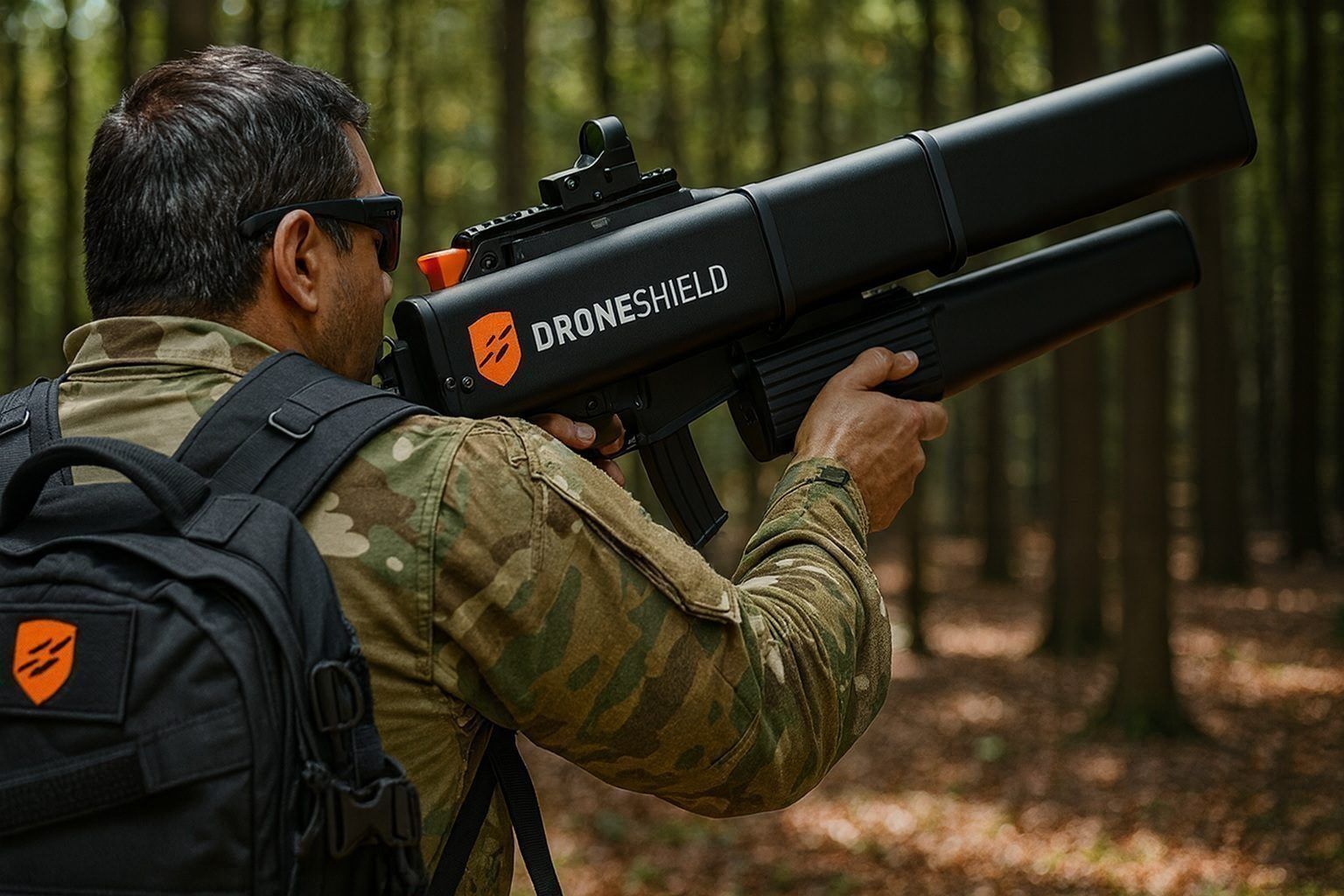
- Multiple deployments of its RfPatrol wearable detector and DroneGun Mk4 jammer across NATO and allied militaries. DroneShield
Capital Brief and MarketIndex articles from June noted that, alongside the A$61.6 million European deal, DroneShield is working with a sales pipeline of roughly A$2.4 billion across more than 260 projects, underlining how early the company still is in monetising demand for counter‑drone technology. Market Index+1
Global exposure to a booming counter‑drone market
The macro backdrop remains favourable:
- DroneShield’s own investor materials describe the global counter‑UAS market as already worth over US$10 billion, with significant room for growth as drone use in warfare and critical infrastructure attacks expands. DroneShield
- A recent MoneyWeek feature on Indo‑Pacific defence stocks highlighted DroneShield as one of three Australian names positioned to benefit from rising military spending, noting that Europe accounts for about 36% of its sales and Asia ex‑China around 29%. MoneyWeek
That geographic spread – Europe, the Indo‑Pacific and North America – helps diversify contract risk, albeit with a clear reliance on defence budgets and geopolitics.
Expansion plans: Adelaide R&D hub and production ramp‑up
DroneShield is not just signing bigger deals; it is also building the capacity to deliver them.
New A$13m research facility in Adelaide
In November, Australian media reported that DroneShield will invest A$13 million in a new research and development facility in Adelaide, South Australia. News.com.au+1
Key points from those reports:
- The site will focus on radio‑frequency electronics, electronic warfare and systems integration to support next‑generation counter‑drone and electronic‑warfare products.
- It will initially create around 20 high‑skilled engineering roles, contributing to a workforce that has almost doubled to roughly 400 employees, including about 300 engineers.
- The hub will be led by Jeff Wojtiuk, a former senior engineer at Lockheed Martin Australia, and is expected to be fully operational by March 2026. News.com.au+1
South Australian officials have billed the facility as further evidence of the state’s positioning as “the Defence State”.
Scaling production from A$500m to A$2.4bn
Separate industry coverage notes DroneShield’s ambition to ramp annual production capacity from around A$500 million to roughly A$2.4 billion by the end of 2026, including plans to establish manufacturing in Europe and the United States in addition to its Australian base. defenceconnect.com.au+1
That level of scaling would be transformative – but also introduces execution risk around supply chains, quality control and capital allocation.
DroneShield stock forecasts and analyst views for 2025–2026
Equity analyst price targets
Despite the recent rout, formal analyst coverage remains broadly positive – though much of it predates the sharp November decline and governance flare‑ups.
- Investing.com’s consensus shows two analysts with a “Strong Buy” rating, and an average 12‑month price target of about A$5.15, with estimates ranging from A$5.00 to A$5.30. Investing.com+1
- Data compiled by Fintel suggests a slightly higher average target of A$5.25, with a range from A$5.05 to A$5.56. Fintel+1
If those targets were still valid, they would imply that analysts expect the DroneShield share price to more than doublefrom current levels. However, many of these models were likely built when the stock was trading much higher and before the latest governance concerns, so investors should treat them as stale rather than precise forecasts.
Technical and quant models
Short‑term, the tone is more cautious:
- As noted earlier, StockInvest classifies DroneShield as a high‑risk “sell candidate”, projecting a statistically‑derived potential decline of roughly 22% over the next three months, with very wide possible trading ranges each day. StockInvest
Such technical models don’t factor in new contracts or governance changes; they simply extrapolate recent price and volume behaviour.
Newsletter and retail forecasts
On the more speculative side:
- The MoneyWeek feature framed DroneShield as a key way to “arm” a portfolio for the global counter‑drone boom, citing its record revenue and first‑ever net profit in early 2025. MoneyWeek
- A November article on trading platform Vocal Media, titled along the lines of “ASX DRO Stock Forecast 2026: Strong Revenue Growth, Possible 200% Upside”, argued that rapid revenue growth could justify a further multi‑bagger move, though this is opinion content rather than institutional research and should be treated accordingly. Vocal
Overall, the consensus narrative from bullish commentators is that DroneShield is building a dominant position in a fast‑growing niche, while sceptics focus on governance risk, execution challenges and an already‑dramatic rerating.
Key risks weighing on the DroneShield investment case
Even with strong fundamentals, several risks are clearly on investors’ minds:
- Governance and trust
- Large insider sales (about A$70m in disposals by top executives),
- The A$7.6m contract misclassification and subsequent withdrawal, and
- The cancellation of an investor call intended to reset the narrative. Reuters+1
- Extreme share‑price volatility
- An 800% run‑up followed by a 75% drawdown within months,
- Daily swings of 5–10%,
- Elevated short interest. Reuters+1
- Execution risk on rapid scaling
- Moving from A$57.5m revenue in 2024 to a possible A$200m‑plus run‑rate and a A$2.4bn production target within a few years is ambitious. Australian Securities Exchange+2defencecon…
- Missteps in manufacturing, supply chain or quality could damage customer relationships – particularly in the defence sector where reliability is critical.
- Dependence on defence budgets and geopolitics
- Many of DroneShield’s largest contracts depend on government defence spending cycles and geopolitical tensions (e.g., war in Ukraine, Indo‑Pacific rearmament). DroneShield+2MoneyWeek+2
- Any easing of tensions or budget reprioritisation could slow order growth.
- Customer and contract concentration
- The A$61.6m European deal and follow‑on A$5.2m order highlight reliance on a handful of large customers and resellers. EDR Magazine+2Market Index+2
- Losing one major relationship or facing delivery problems could materially affect revenue in a given year.
What could move the DroneShield share price next?
Looking ahead, several catalysts are likely to dictate where DroneShield trades:
- FY2025 results and guidance – The next major update is expected around February 2026, when investors will see whether the company met or exceeded the A$176m–A$193m revenue visibility implied by earlier commentary. raskmedia.com.au+4StockInvest+4thebull.com…
- New contract announcements – Management has indicated that from 2026 it will only announce orders above A$20m (up from A$5m previously), unless there is a special reason to highlight smaller wins. That may reduce headline noise but also means fewer incremental deal updates. EDR Magazine+1
- Governance steps – Any moves to strengthen the board, improve disclosure practices, or re‑align management incentives with long‑term shareholders could help rebuild confidence. Reuters
- Progress on the Adelaide R&D hub and international manufacturing – Evidence that DroneShield can successfully scale production while maintaining quality and margins would support the long‑term growth story. News.com.au+2Adelaide Now+2
- Changes in short interest and trading activity – A squeeze in short positions or a shift in momentum trading could trigger sharp moves in either direction. Reuters+2StockInvest+2
Is DroneShield stock a buy, hold or sell?
Only you can decide whether to buy or sell DroneShield shares, but the current setup can be thought of in terms of two competing stories.
The bull case
- Explosive revenue growth: From ~A$57.5m in 2024 to a potential A$200m‑plus run‑rate in 2025, with Q3 revenue alone approaching A$93m. Streetwise Reports+4Australian Securities …
- Positioned in a booming niche: Counter‑drone technology is now a strategic priority for NATO, the U.S. and Indo‑Pacific allies; DroneShield is one of the few pure‑play listed names. MoneyWeek+2DroneShield+2
- Large, growing pipeline: A multi‑billion‑dollar project pipeline offers substantial optionality if even a modest percentage converts into firm contracts. Market Index+1
- Analyst upside: Pre‑rout 12‑month price targets around A$5–A$5.5 suggest potential for the shares to more than double if the growth story and governance both stabilise. Fintel+3Investing.com+3TradingView+3
For high‑risk, long‑term growth investors, the current price – roughly 70% below the peak but still above the 2024 range – may look like an opportunity to back a leading player in a structurally growing defence niche.
The bear case
- Shaken trust: Insider selling, a misclassified contract announcement and a cancelled investor call have clearly damaged credibility. Reuters+2company-announcements.afr.com+2
- Execution and scaling risk: Rapidly building capacity from A$500m to A$2.4bn while maintaining quality, margins and delivery schedules is no small feat. Streetwise Reports+3defenceconnect.com.au+…
- High volatility and short interest: The share price can move 10–20% in a single day, which may not suit more conservative investors or those using leverage. StockInvest+2Reuters+2
- Valuation uncertainty: Many analyst models and bullish articles were built when sentiment was euphoric and governance concerns had not surfaced. They may overstate fair value until forecasts are refreshed.
For more cautious investors, it may make sense to wait for:
- Clearer governance improvements,
- A few quarters of consistent cash‑flow generation, and
- Signs that the share price has stabilised technically
before considering an entry.
Final thoughts
DroneShield remains one of the most fascinating – and polarising – stories on the ASX in 2025. The business is growing at extraordinary speed in a strategically important sector, but the stock is experiencing a painful reset after a period of exuberance and governance missteps.
If you are considering investing, it’s wise to:
- Treat DroneShield as a high‑risk, speculative position,
- Diversify rather than bet heavily on a single defence name, and
- Focus on your own risk tolerance, time horizon and portfolio needs.
This article is general information only and does not constitute financial advice. Always do your own research or consult a licensed financial adviser before making investment decisions.