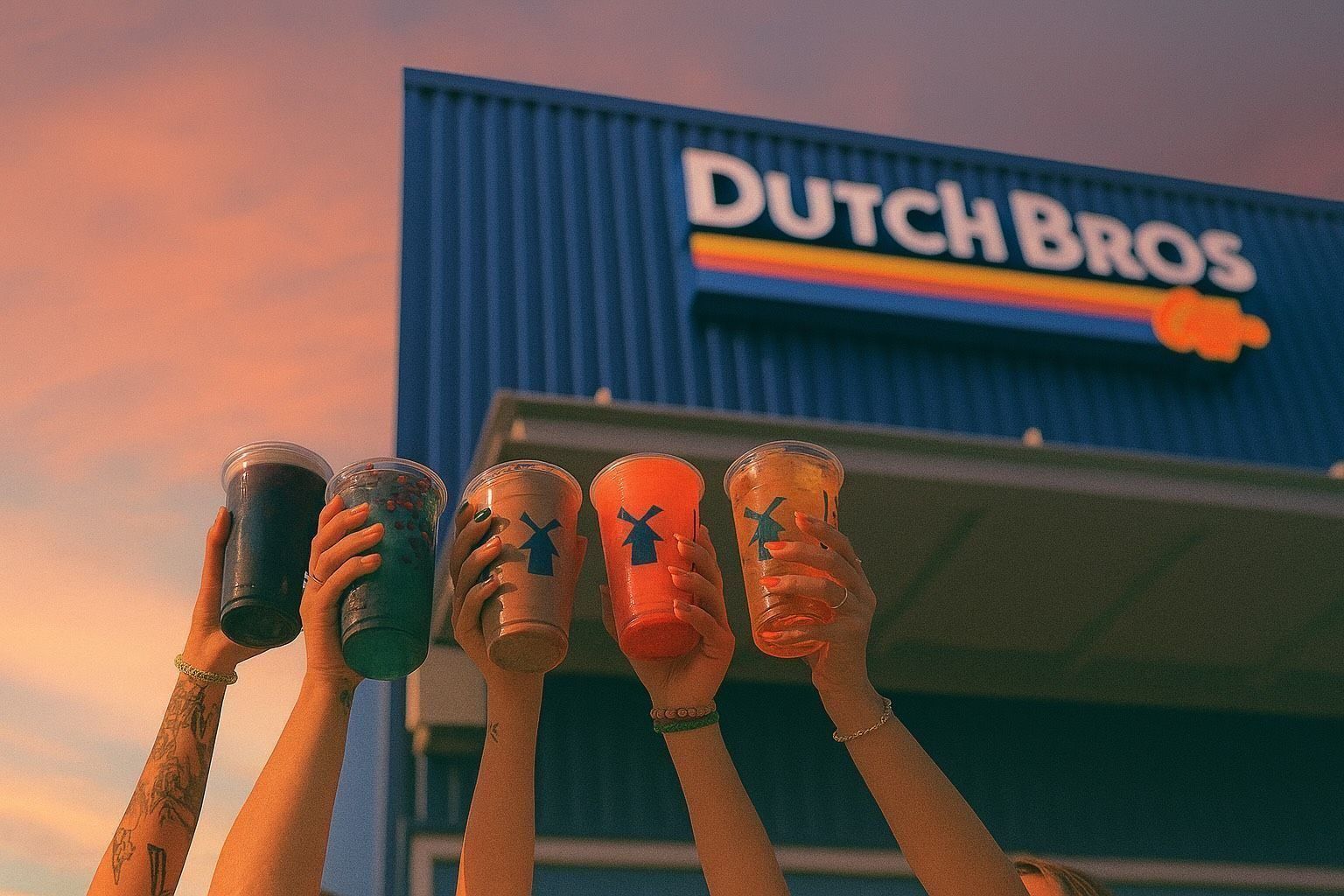
Dutch Bros Inc. (NYSE: BROS) has become one of the most closely watched consumer growth stocks on the U.S. market. As of the close on Friday, December 5, 2025, BROS shares traded at $58.43, after a roughly 4% pullback on the day, yet they remain solidly higher over the past month and year. Stock Titan+1
In the days leading up to December 7, 2025, Dutch Bros has delivered:
- A strong third quarter with ~25% revenue growth and rising same‑store sales. Stock Titan+1
- Raised full‑year 2025 guidance for revenue and same‑shop sales. Stock Titan+1
- Multiple analyst price‑target upgrades into the $70–$80+ range. MarketBeat+3MarketBeat+3StockAnalysis+3
- Fresh institutional buying — notably from HSBC Holdings PLC — alongside heavy insider selling. MarketBeat+1
- Mixed valuation signals, with fundamental models calling the stock overvalued, while Wall Street forecasts still point to 20–30% upside over the next year. TipRanks+3Simply Wall St+3MarketBeat+3
Below is a detailed, Google‑News‑style rundown of where BROS stands today and how forecasts are shaping expectations for 2026 and beyond.
BROS Stock Today: Price, Performance and Sentiment
On December 5, 2025, BROS closed at $58.43, with after‑hours trading nudging the price slightly higher. StockAnalysis+1
Recent performance highlights:
- Over the past month, BROS shares are up around 10%, outpacing an industry group that is down roughly 1%. Nasdaq
- Simply Wall St notes the stock is up about 12% over the past month and nearly 13% over the past year, compounding to an 87% gain over three years. Simply Wall St
Momentum has been driven by accelerating shop openings, strong transaction growth, rising digital engagement, and the early success of the company’s new hot‑food program. Nasdaq+1
At the same time, Dutch Bros trades at rich multiples:
- MarketBeat cites a price‑to‑earnings (P/E) ratio around 117, with a price‑to‑earnings‑growth (PEG) ratio near 3.1 and a beta of about 2.55. MarketBeat
- Zacks puts the forward 12‑month price‑to‑sales ratio at ~5.1, well above an industry average near 3.2 and ahead of peers like Starbucks, Yum China, and Texas Roadhouse. Nasdaq
In short: the market is already paying a substantial premium for Dutch Bros’ growth story.
Q3 2025 Earnings: Fast Growth and Higher Guidance
The most important recent catalyst remains Q3 2025 earnings, reported on November 5, 2025. Stock Titan
Key numbers from the quarter:
- Revenue: $423.6 million, up about 25% year over year, and ahead of consensus estimates near $415 million. Stock Titan+2MarketBeat+2
- EPS: $0.19 vs. $0.17 expected, compared with $0.16 in the prior‑year quarter. MarketBeat+1
- System‑wide same‑shop sales: up 5.7%.
- Company‑operated same‑shop sales: up 7.4%.
- Transaction growth:4.7% system‑wide, 6.8% for company shops. Stock Titan+2Nasdaq+2
- Adjusted EBITDA: $78.0 million, up over 22% year on year.
- Net income: $27.3 million. Stock Titan
- New shops: 38 openings in Q3 (34 company‑operated), adding to a system total of around 1,081 shops. Stock Titan+1
Following this performance, management raised full‑year 2025 guidance:
- Revenue: now $1.61–$1.615 billion (up from earlier guidance around the mid‑$1.5 billion range). Stock Titan+1
- Same‑shop sales: around 5% for 2025. Stock Titan+1
- Adjusted EBITDA:$285–$290 million. Stock Titan
- Shop openings: ~160 new system shops in 2025, with ~175 targeted for 2026. Stock Titan
Analysts and fundamental research sites broadly interpreted the results as confirmation that Dutch Bros is executing well on its growth playbook: growing units at a brisk pace while still delivering positive traffic and same‑store sales in a tough consumer environment. Nasdaq+1
Growth Engine: Expansion, Food, and Digital Orders
Dutch Bros’ investment thesis is more than “sell coffee, open stores.” Recent coverage highlights three pillars of the story: footprint expansion, food, and digital.
1. Aggressive Store Growth
At its 2025 Investor Day, Dutch Bros outlined a long‑term plan to reach 2,029 shops by 2029, implying mid‑teens to 20%+ annual unit growth from today’s roughly 1,000+ locations. Stock Titan+2Stock Titan+2
The company now frames its total addressable market at over 7,000 shops across the U.S., suggesting that even a 2,000‑unit footprint would leave room for further expansion. Stock Titan
A recent report in The U.S. Sun underscored that Dutch Bros, not Starbucks, is the chain planning more than 2,000 locations by 2029, drawing attention to just how quickly this “drive‑thru‑only” model is spreading. The Sun
2. National Food Rollout
The company is also leaning into hot breakfast and food to increase ticket size and morning relevance:
- Zacks reports that the hot‑food program, in roughly 160 shops, is providing about a 4% lift to comps, via both higher tickets and more transactions. Nasdaq+1
- Restaurant‑industry coverage notes that Dutch Bros plans a nationwide breakfast rollout through 2026, positioning itself as a one‑stop morning stop rather than purely a beverage destination. Restaurant Business Online+1
Food complicates operations but, if executed well, can add incremental revenue without needing a fully built‑out café format.
3. Digital, Loyalty and Order Ahead
Digital engagement is the third leg:
- Order Ahead represented about 13% of Q3 transactions, roughly double that figure in newer markets. Simply Wall St+1
- Dutch Rewards loyalty members accounted for around 72% of transactions, giving the company a powerful personalization and promotion engine. Nasdaq
Simply Wall St and Zacks both emphasize that transaction growth — not just higher prices — is driving same‑store sales, making Dutch Bros a rare “traffic outlier” in a pressured restaurant environment. Nasdaq+1
What Wall Street Expects: 12‑Month Price Targets and Earnings Forecasts
Across major brokerages and data platforms, BROS remains broadly favored, though not unanimously.
Analyst Ratings and 12‑Month Targets
Different aggregators show slightly different numbers, but the message is consistent:
- MarketBeat:
- Consensus rating: “Moderate Buy” based on 24 analysts.
- Average 12‑month price target: $76.67, implying ~31% upside from ~$58.50. MarketBeat
- StockAnalysis:
- Consensus rating: “Strong Buy” from 18 analysts.
- Average target: $77.17 – about 32% upside from $58.43. StockAnalysis
- TipRanks:
- 13 analysts in the past three months: Strong Buy.
- Average target: $74.82, implying ~28% upside from $58.43. TipRanks
Recent individual analyst moves:
- Mizuho raised its price target from $70 to $80 and kept an “outperform” rating, describing roughly 30% upside from recent levels. MarketBeat+1
- RBC Capital also moved its target from $75 to $80 while maintaining a “buy/outperform” stance. StockAnalysis+1
- TD Cowen reiterated a “buy/strong buy” with a $70 price target. MarketBeat+1
- Stifel and Piper Sandler trimmed some targets (for example, one cut from $73 to $63 with a “Hold” rating), reminding investors not all coverage is unambiguously bullish. StockAnalysis+1
Overall, Wall Street is still modeling 20–30%+ upside over the next 12 months, assuming Dutch Bros continues to deliver high‑20s revenue growth and rapidly scaling earnings.
Fundamental Forecasts: Revenue and EPS
StockAnalysis’ consensus forecast (largely in line with other sources) expects: StockAnalysis
- 2025 revenue: about $1.65 billion, up nearly 29% from an estimated $1.28 billion in 2024.
- 2026 revenue: around $2.07 billion, implying another 25% growth.
- 2025 EPS: approximately $0.70, more than doubling from around $0.34.
- 2026 EPS: roughly $0.92, another ~32% increase.
Zacks’ own consensus sits in the same ballpark, with 2025 and 2026 EPS estimates of $0.67 and $0.86, respectively, after modest downward revisions in the last month. Nasdaq
Those forecasts help explain why many analysts are willing to tolerate a premium multiple: they expect rapid earnings compounding once the heavy investment phase moderates.
The Valuation Debate: Premium Growth or Overpriced Buzz?
While brokers and growth‑oriented commentators see substantial upside, valuation‑focused platforms are more cautious.
Discounted Cash Flow and Multiples
Simply Wall St’s recent deep dive concludes that: Simply Wall St
- A two‑stage discounted cash‑flow (DCF) model yields a fair value around $47.40 per share.
- With BROS trading near the low‑$60s at the time of their analysis, they estimated the stock was roughly 29% overvalued.
- Dutch Bros trades on a P/E above 120x, far above both its hospitality‑sector peers (around 21x) and a “fair” ratio closer to 35x implied by its growth and risk profile.
Zacks likewise highlights that BROS trades at a premium price‑to‑sales multiple vs. coffee and casual‑dining peers, and that higher costs and margin pressures limit the near‑term earnings cushion at these valuations. Nasdaq
Narrative vs. Numbers
A second Simply Wall St article framed the story around “narratives”: bullish scenarios assume Dutch Bros can grow revenue to ~$2.6 billion and earnings to nearly $200 million by 2028, yielding a fair value closer to the mid‑$70s per share; more cautious narratives, focused on margin strain and market saturation, cluster nearer the low‑$70s or even below $50. Simply Wall St
The takeaway: even among fundamentally minded investors, there is wide disagreement on what fair value looks like — a hallmark of high‑growth, early‑stage consumer brands.
Ownership Trends: Hedge Funds Buy, Insiders Cash Out
The latest filings and news from early December show a split picture between institutional and insider activity.
Institutional Accumulation
A December 6 MarketBeat piece highlights that HSBC Holdings PLC boosted its stake in Dutch Bros by more than 1,000% in Q2, to roughly 67,765 shares valued at about $4.7 million. Several other institutions, including Blair William & Co. and various hedge funds, also increased or initiated positions. MarketBeat
- MarketBeat estimates that around 85–86% of BROS shares are held by hedge funds and other institutional investors, a sign that professional money managers are heavily engaged with the stock. MarketBeat+1
Insider Selling
At the same time, insiders have taken advantage of the rally to lock in profits:
- Chairman Travis Boersma sold about 1.68 million shares in late November at an average price of roughly $55.44, for proceeds of over $93 million, reducing his stake by more than 99%. MarketBeat+1
- Another major holder, DM Individual Aggregator LLC, sold ~648,000 shares at similar prices. MarketBeat+1
- Across the last 90 days, insiders sold roughly 3.47 million shares, worth nearly $190 million, though insiders still control more than 40% of the company. MarketBeat+1
Heavy insider selling does not automatically mean a negative view on fundamentals (founders often diversify after big runs), but it does reinforce the idea that the stock is no longer “undiscovered.”
Short‑Term Trading Models vs. Long‑Term Expectations
Alongside Wall Street research, algorithmic and technical forecast platforms have weighed in on BROS as of December 7, 2025 — and they are more cautious.
Technical / Quant Views
CoinCodex, which uses technical indicators and quantitative models, currently shows: CoinCodex
- Current price: $58.43.
- 5‑day prediction: about $60.00 (roughly +2.7%).
- 1‑month prediction: about $57.49, a -1.6% move from today.
- 12‑month algorithmic prediction: around $42.94, implying a ~26% decline.
- Overall sentiment: “bearish”, with slightly more bearish than bullish technical signals.
The same model projects a broad 2025 trading range between about $54.74 and $63.11, with an average price near $59.06, suggesting a mid‑single‑digit return from current levels. CoinCodex
Quant forecasts like these are not a consensus of human analysts, but they highlight that from a purely technical standpoint, the risk of a pullback is non‑trivial after the rally off 2025 lows.
Key Risks: Costs, Complexity and Competition
Recent research and commentary converge on a similar list of risk factors for BROS. Stock Titan+3Nasdaq+3AInvest+3
- Input and labor inflation
- Higher coffee prices are already a drag on margins, and are expected to remain a headwind into 2026.
- Labor‑related regulatory changes (notably in California) are adding roughly 50 basis points of margin pressure, with potential spillover into 2026. Nasdaq
- Expansion costs
- Rapid entry into new states drives pre‑opening and training expenses higher; Zacks notes pre‑opening costs were up about 60 bps year over year. Nasdaq
- Management is intentionally front‑loading investment to seed new markets — positive for long‑term growth, but a drag on short‑term profitability.
- Operational complexity from food and digital
- Scaling hot food, more complex beverage customization, and digital throughput across a 2,000‑store system increases the risk of bottlenecks and service issues. Nasdaq+1
- Rich valuation and limited margin of safety
- With BROS already trading at premium P/E and P/S multiples versus peers, several analysts and fundamental platforms argue that any stumble in execution, traffic, or margins could trigger a sharp derating. Simply Wall St+1
- Competitive landscape
- Major rivals like Starbucks, Dunkin’ and smaller regional players are all fighting for the same morning‑coffee and drive‑thru occasions.
- Commentary comparing Dutch Bros and Starbucks notes that while Dutch Bros looks like an early‑stage growth story, investors must still assume that the brand can maintain its culture and operational edge as it scales. Finviz
Upcoming Catalysts for BROS Investors
Looking beyond December 7, 2025, several catalysts could move the stock:
- Q4 2025 results and 2026 guidance (expected in early 2026): investors will look for confirmation that transaction growth, digital adoption and food attach rates remain strong, and that margin pressure is manageable. Stock Titan+1
- Progress on the national hot‑food rollout: evidence that the program scales without degrading operations should support the bull case. Nasdaq+1
- Store growth trajectory: the pace and performance of new units, especially in newer regions like the Southeast and Midwest, remains central to the 2,029‑by‑2029 narrative. Stock Titan+1
- Macro backdrop: discretionary spending, wage inflation, and interest‑rate trends could influence traffic, development costs and valuation multiples across the entire restaurant space.
Is Dutch Bros (BROS) Stock a Buy Right Now?
Recent pieces from Zacks, the Motley Fool and AInvest all land on a similar nuanced conclusion: Dutch Bros looks like a high‑quality, high‑growth brand with significant long‑run potential, but the stock already reflects a lot of that optimism. Nasdaq+2Finviz+2
A balanced framing based on the latest data as of December 7, 2025:
What the bulls see
- Sustained 20–30%+ revenue growth through at least 2026. StockAnalysis+1
- Strong same‑store sales and positive traffic, rare in today’s restaurant sector. Nasdaq+1
- A differentiated drive‑thru format, expanding food menu, and powerful loyalty/digital ecosystem. Nasdaq+2Finviz+2
- Analyst targets clustering in the mid‑$70s, with multiple brokers now at $80. MarketBeat+3MarketBeat+3StockAnalysis+3
What the skeptics point to
- Very rich valuation multiples versus peers and DCF‑based fair‑value estimates. Simply Wall St+1
- Rising coffee, food and labor costs that could cap near‑term margin expansion. Nasdaq+1
- Heavy insider selling over the past three months. MarketBeat+1
- Algorithmic/technical models projecting downside over a 12‑month horizon, even as Wall Street forecasts upside. CoinCodex+1
For growth‑oriented investors comfortable with volatility and valuation risk, Dutch Bros continues to offer a compelling, story‑driven opportunity — essentially a bet that the chain can become a nationwide beverage powerhouse while preserving its culture and unit economics.
For more valuation‑sensitive or income‑focused investors, the combination of premium multiples, cost headwinds, and insider selling may justify waiting for a better entry point or clearer margin visibility.