Workers have begun laying tracks in the desert east of Cairo, marking a visible new phase in Egypt’s first high-speed, electrified rail corridor—an ambitious “Green Line” intended to connect the Red Sea with the Mediterranean and reshape how people and goods move across the country. The Times of Israel
Egypt’s Minister of Transport and Industry, Kamel El‑Wazir, has repeatedly framed the project as a strategic national artery—calling it a “new Suez Canal on rails”—because it creates a fast, overland connection between the same two seas linked by the world-famous canal. The Times of Israel
The symbolism is bold. The engineering and economic stakes are even bigger: the “Green Line” is only the first piece of a planned, roughly 2,000-kilometer high-speed network meant to integrate seaports, logistics hubs, industrial zones, new cities, and tourism centers across Egypt. Newsweek
A 660-kilometer high-speed spine: what the “Green Line” will connect
The Green Line is planned to run about 660 kilometers (roughly 410 miles) from Ain Sokhna—an important Red Sea port—across the desert toward the Mediterranean, reaching Alexandria and extending to Marsa Matrouh. Newsweek
In reporting from Egypt’s New Administrative Capital area, construction activity is now tangible: crews are laying track and building large desert stations along a corridor expected to carry both passengers and freight, cutting coast-to-coast journeys dramatically—down to “as little as three hours,” according to the project description cited in recent coverage. The Times of Israel
The route is also designed as a city-shaping tool. As described in the AFP-based reporting carried by The Times of Israel, the line will cross two major Cairo satellite cities—the New Administrative Capital to the east and 6th of October City to the west, home to Egypt’s only dry port—positioning rail as a catalyst for new development nodes rather than simply a faster commute. The Times of Israel
The bigger plan: a nearly 2,000-kilometer national network
What’s under construction is not a standalone express line. It’s the opening segment of Egypt’s Electric Express Train (EET) high-speed rail program—a three-line buildout totaling about 1,985 kilometers and around 60 stations, with a stated goal of approximately 1.5 million passengers per day. Group
SYSTRA—one of the key firms involved in project management and supervision—describes the Green Line as one-third of the new network, linking 21 stations (10 high-speed and 11 regional), with one main depot and three auxiliary depots. It also notes the complexity of desert engineering: 25 bridges and structures totaling about 49 kilometers on the Green Line alone. Group
The planned follow-on corridors are:
- Blue Line (north–south backbone): running along the Nile corridor and stretching beyond 1,000 kilometers, with dozens of stations. Group
- Red Line (tourism and port connectivity): planned to connect Red Sea destinations (including Hurghada/Safaga) inland toward the Luxor area, requiring tunnels and viaducts in mountainous terrain. Group
Who’s building it: Siemens Mobility, Orascom, Arab Contractors—and a web of partners
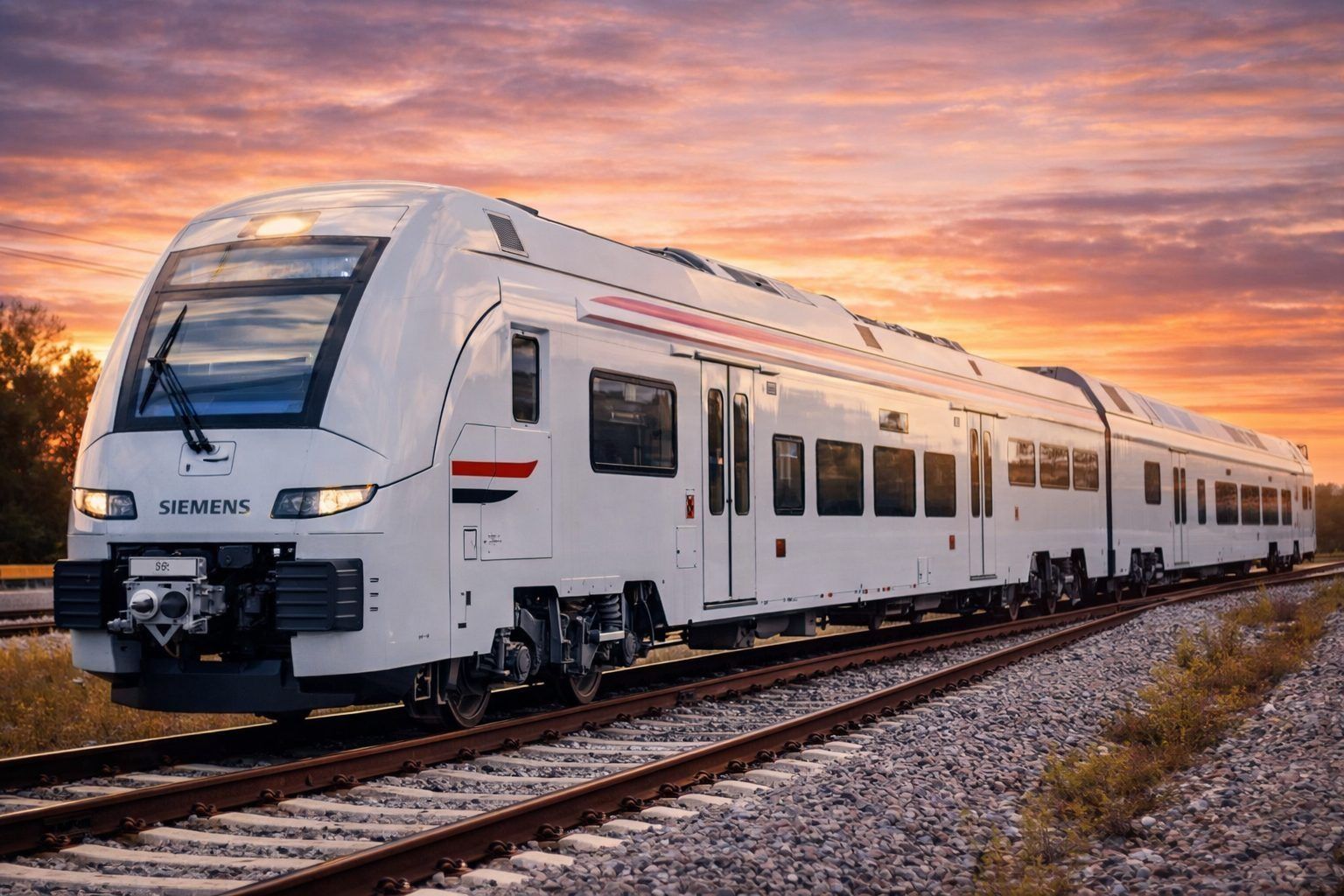
The project’s international anchor is Siemens Mobility, partnered with major Egyptian contractors Orascom Construction and The Arab Contractors. Siemens says the full program is designed to become the world’s sixth-largest high-speed rail system once completed. Siemens Press
Key milestones and contract structure, according to Siemens and project partners:
- September 2021: Siemens Mobility announced a historic turnkey contract with Egypt’s National Authority for Tunnels (NAT) for the first 660-km line, valued at roughly $4.5 billion overall, with Siemens’s share around $3 billion. The deal included design, installation, commissioning, and 15 years of maintenance. Siemens Press
- Orascom Construction’s public statement similarly characterized the first phase as a 660 km high-speed, electrified main and freight rail line, executed on an EPC + Finance basis. Orascom Construction
- May 2022: Siemens announced it had finalized a contract package for the 2,000 km system, stating Siemens’s share of the combined contract was €8.1 billion, and projecting up to 40,000 local jobs across the full scope. Siemens Press
SYSTRA adds another layer: it signed with NAT in late 2021 to act as Employer’s Representative (a project management–type role) for the Green Line, overseeing and coordinating worksites. Group
The trains and technology: Velaro, Desiro HC, ETCS Level 2—and “desert-proofing”
Egypt’s high-speed rail build is not only about track. It is also a rolling stock and signaling modernization project—aimed at reliability in extreme heat and sand, capacity at scale, and safety systems aligned with international standards.
The fleet plan
Siemens says the broader system includes:
- 41 Velaro eight-car high-speed trains
- 94 Desiro high-capacity regional trainsets
- 41 Vectron freight locomotives Siemens Press
The network is also slated for European Train Control System (ETCS) Level 2 signaling, plus a dedicated power supply system—key infrastructure for safe high-frequency operations at speed. Siemens Press
Recent progress: test runs and public unveiling
In November 2025, Siemens publicly highlighted two milestones: the debut of the Velaro high-speed train and the first train run of the Desiro regional train in Egypt—presented as a major step in the country’s transport modernization strategy. Siemens Press
In the same Siemens update, the company emphasized that the Desiro High-Capacity regional train—tailored for Egypt’s climate—offers up to 849 passenger spaces, top speeds of 160 km/h, air conditioning, and ETCS Level 2 protection. Siemens Press
On operating speeds, Siemens has said trains on the network can operate up to 230 km/h, while SYSTRA’s project figures cite high-speed trains at 250 km/h—a distinction that can reflect design capability versus planned service speed and operating patterns. Siemens Press
Why the “Suez Canal on rails” comparison matters—and where it doesn’t
The project’s nickname is compelling, but it’s important to separate metaphor from mechanics.
The rail corridor does not physically replace the Suez Canal’s maritime route. Instead, it creates a complementary, overland Red Sea–Mediterranean connection—useful for domestic mobility, port-to-port logistics, and time-sensitive cargo moving between production zones and terminals.
That “complement, not replace” framing is explicit in recent reporting: the line is described as forming a Red Sea–Mediterranean land corridor intended to support the broader Suez corridor, rather than bypass it as a substitute route for global shipping lanes. Newsweek
Still, Egypt is clearly thinking about resilience and competitiveness. Global trade disruptions in recent years—particularly in the Red Sea—have underscored how quickly chokepoints can become economic vulnerabilities. UNCTAD has noted the Suez Canal handled approximately 12% to 15% of global trade in 2023, highlighting how shocks to the corridor ripple worldwide. UN Trade and Development (UNCTAD)
Those shocks have been costly. The Associated Press reported that Egypt’s Suez Canal revenue fell sharply in 2024 compared to 2023 amid Red Sea insecurity and rerouting. AP News
By late 2025, there were signs of partial recovery: Reuters reported year-on-year revenue gains in mid-2025 as tensions eased and some traffic returned. Reuters
Cargo and passenger volumes: ambitious targets, strategic logistics
Egypt’s existing conventional rail network is heavily used, but strained. Recent coverage citing official figures described the current system as suffering infrastructure and maintenance problems—contributing to nearly 200 accidents in the prior year—an urgency that helps explain the political priority placed on a modern, safer electrified network. The Times of Israel
The new high-speed network is designed to carry both people and goods at meaningful scale:
- Authorities cited in reporting hope the overall high-speed network could carry 1.5 million passengers per day. The Times of Israel
- NAT head Tarek Goueili told AFP the revamped rail network is expected to carry about 15 million tonnes of cargo per year, described as roughly 3% of last year’s Suez Canal transit volume—a figure that underscores the canal’s enormous scale while still positioning rail freight as commercially significant inside Egypt. The Times of Israel
This “hybrid” design—high-speed passenger services plus regional and freight trains—also reflects an industrial strategy: connect seaports to dry ports and inland manufacturing and agricultural zones, reducing truck congestion and improving logistics reliability. Newsweek
Expert voices: what leaders and engineers say the project is for
The project’s champions are clear about their goals—speed, safety, sustainability, and national integration.
- Kamel El‑Wazir (Egypt’s Minister of Transport and Industry) has described the new trains as a “defining moment” for modernization, focused on reducing travel time and boosting connectivity with a modern, safe, and sustainable network. Siemens Press
- Roland Busch (President and CEO of Siemens AG) has framed the build as a landmark national system, describing it as “soon the sixth largest in the world” and emphasizing long-term mobility transformation. Siemens Press
- From the engineering and city-planning perspective, Faical Chaabane of SYSTRA said the high-speed line will “ease pressure on Greater Cairo” and help new growth hubs emerge—an explicit acknowledgement that Egypt is using rail to reshape settlement patterns as much as to shave minutes off travel. The Times of Israel
Tourism and travel: why the rail line could change domestic itineraries
Travel-industry observers are watching closely because the Green Line knits together very different tourism geographies: Red Sea beach resorts and diving, Cairo’s museums and urban economy, and Mediterranean heritage and coastal cities.
A recent travel-trade feature argued the rail project could make multi-region tourism dramatically easier—turning what is often an exhausting, day-long road journey into a faster intercity option and potentially enabling travelers to pair Red Sea resorts with Mediterranean city visits on a single itinerary. Travel And Tour World
Siemens also explicitly pitches the wider network as connecting key destinations—including Luxor and Red Sea areas—suggesting tourism and heritage access are built into the system’s economic rationale, not a side effect. Siemens Press
Operations, training, and the “last mile”: the next big tests
Building the rail lines is only part of the challenge. Operating and maintaining a high-speed network—safely, on time, in desert conditions—requires deep institutional capacity.
Egypt has moved to address that through operating partnerships. International Railway Journal reported that Egypt confirmed a 15-year operating contract for the high-speed network with a consortium of DB International Operations (DB IO) and Egypt’s Elsewedy Electric, signed with NAT on November 13, 2025. International Railway Journal
The same report highlights a key capacity-building requirement: local media said the contract calls for Egyptian staff to make up at least 95% of the operating workforce, supported by training programs designed to transfer expertise to Egyptian engineers, technicians, and drivers over time. International Railway Journal
Elsewedy Electric has also emphasized the safety and environmental logic of the shift, describing goals that include improved traffic safety and reduced air pollution, aligning with an expansion of environmentally friendly mass transit. Elsewedy Electric
Then comes the practical “last mile” issue: stations only transform mobility if passengers can reach jobs, homes, airports, and tourist districts easily. That means synchronized local transit (metro, buses, park-and-ride systems), clear ticketing integration, and freight transfer facilities that make port-to-dry-port movement efficient.
Timeline: when could Egypt’s high-speed rail “Green Line” open?
Large infrastructure timelines can shift, and public dates vary across recent reporting.
- Coverage based on AFP reporting described the Green Line project as slated for completion in 2026. The Times of Israel
- Newsweek reported that Egypt hopes to complete the high-speed rail link in 2027 or 2028, while noting ongoing construction and equipment testing. Newsweek
- International Railway Journal reported in November 2025 that the first phase is “largely complete” and that testing had started earlier in the month. International Railway Journal
The most reasonable interpretation is that initial operations could begin in stages, with testing and partial openings preceding full service levels and full network integration—especially as additional lines (Blue and Red) extend the system’s reach beyond the coast-to-coast corridor.
Bottom line: Egypt is building more than a train—it’s building a new economic corridor
Egypt’s high-speed rail megaproject is often summarized with a headline-friendly nickname. But the real story is structural: a country trying to modernize mobility, improve rail safety, strengthen logistics, and re-map economic geography—while global trade routes remain volatile and infrastructure has become a competitive advantage.
If the Green Line and its sister corridors deliver on their core promises—speed, reliability, safety, and integration—Egypt won’t just have a “Suez Canal on rails.” It will have a national mobility backbone designed for the next generation of trade, travel, and urban growth. The Times of Israel
Sources and expert statements cited
- The Times of Israel (AFP): track-laying begins; project scope; safety and urban-planning quotes. The Times of Israel
- Newsweek: network purpose; trade and Suez framing; timeline references; Siemens statements. Newsweek
- Siemens press releases and feature pages: contracts, trains, signaling, emissions and jobs claims, executive quotes. Siemens Press
- SYSTRA project pages: line lengths, stations, bridges/structures, and network figures. Group
- Orascom Construction: first-phase contract framing and EPC+Finance structure. Orascom Construction
- UNCTAD and AP: Suez Canal’s role in global trade and revenue shock context. UN Trade and Development (UNCTAD)
- Reuters: Suez Canal revenue and traffic recovery signals in 2025. Reuters
- International Railway Journal + Elsewedy Electric: operating contract and workforce/training emphasis. International Railway Journal