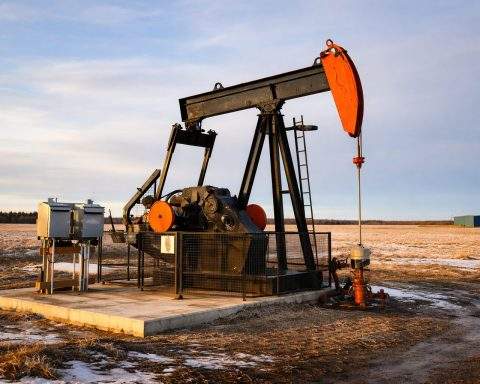
Energy stocks finished Wednesday’s session modestly higher, shrugging off another dip in crude prices as investors balanced soft oil fundamentals with a powerful new demand story coming from AI data centers and the electric grid. With the Federal Reserve’s rate decision just hours away and peace talks over Russia’s war in Ukraine in focus, the energy complex ended the day in a cautious but constructive mood.
Energy Sector Closes Higher While the Broad Market Stalls
The Energy Select Sector SPDR Fund (XLE), the main ETF tracking U.S. large‑cap energy stocks, rose about 0.26% to close near $45.82 on Wednesday, December 10, 2025.
That move extended Tuesday’s advance and kept XLE near the upper end of its recent trading range, even as major U.S. equity indices were essentially flat. Real‑time data late in the session showed the S&P 500 barely changed and the Nasdaq Composite fractionally lower, a sign that the day’s strength in energy was more sector‑specific than market‑wide.
Technical research firm StockInvest.us still classifies XLE as a “Hold/Accumulate” candidate after downgrading it from “Buy” on December 9. Their models see the ETF in a weak rising trend, with short‑term resistance just above $46 and support building around the mid‑$44 area, and they project only a modest ~2% upside over the next three months. StockInvest
In other words, from a pure ETF perspective, Wednesday’s move looked like a steady continuation of a grinding recovery rather than the start of a runaway rally.
Oil Prices: Lower Close, but No Panic
Despite the sector’s small gain, crude oil actually finished lower on the day:
- WTI crude (front‑month futures) settled around $57.93 per barrel, down about 0.55%, after trading between roughly $57.78 and $58.67.
- Brent crude futures hovered near $61.5–62 per barrel, also off around 0.6% on the session.
Earlier in the day, both benchmarks had been described as “steady” by multiple outlets: Brent briefly ticked up to about $62.05 and WTI to $58.38 before late‑session selling nudged prices back into the red. The Arabian Stories News
Oversupply Meets Geopolitics
Behind the day’s action were two competing forces:
- Oversupply concerns
- The U.S. Energy Information Administration (EIA) now expects U.S. oil production to hit a record 13.61 million barrels per day in 2025, before easing slightly to 13.53 million barrels per day in 2026.
- The EIA also nudged up its average 2025 price forecast to about $65.32 for WTI and $68.91 for Brent, but its latest outlook still describes a market where global inventories continue to rise, keeping a lid on prices.
- Geopolitical risk and Ukraine peace efforts
- Oil traders are watching peace talks aimed at ending Russia’s war in Ukraine, with Ukrainian President Volodymyr Zelenskiy preparing revised peace documents alongside European partners.
- A breakthrough could eventually loosen some sanctions and unlock additional Russian barrels, potentially adding to the supply overhang.
On the fundamental side, weekly U.S. data showed crude stocks falling by about 1.6 million barrels after a prior build, but the draw was not large enough to change the broader narrative of comfortable supply.
A Bearish 2026 Scenario for Oil – and XLE
The most stark forecast of the day came from a MarketBeat/Investing.com analysis, which highlights the EIA’s projection that Brent could drop toward $55 per barrel by the end of 2026, roughly 20% below current levels and matching a five‑year low.
The piece frames this as “bad news” for the Energy Select Sector SPDR ETF (XLE) because:
- XLE is heavily concentrated in Exxon Mobil, Chevron, and ConocoPhillips, which together account for roughly 48% of the fund’s weight.
- The sector has already underperformed, with a 7.2% year‑to‑date gain that lags the broader market and comes after a tepid 2024 and a slightly negative 2023.
If that $55 Brent scenario plays out, margins for upstream producers would likely compress further, putting pressure on both earnings and share prices in the traditional oil‑heavy part of the energy complex.
Big Individual Movers: From Traditional Power to AI‑Era Infrastructure
GE Vernova: Dividend Doubles, Guidance Jumps, Shares Soar
One of the most eye‑catching stories in the energy space on December 10 was GE Vernova (NYSE: GEV), the power, wind, and grid‑focused spin‑off from General Electric.
Before the opening bell, GE Vernova raised its 2025 free‑cash‑flow guidance, significantly lifted longer‑term targetsfor revenue and key profit metrics, doubled its quarterly dividend to $0.50 per share, and boosted its share‑buyback authorization from $6 billion to $10 billion.
Investors loved it:
- Finviz and Nasdaq data show GE Vernova shares jumping more than 10–12%, and intraday commentary from StocksToTrade highlighted the stock trading roughly 15% higher at one point.
- A detailed breakdown of its financials pointed to quarterly revenue near $10 billion, positive net income, and robust operating cash flow approaching $1 billion, supporting the richer capital‑return program.
On top of that, Reuters reported that GE Vernova is working with the U.S. government to build strategic stockpiles of the rare earth element yttrium, which is essential for high‑temperature turbine components and is currently under Chinese export controls.
Taken together, the dividend hike, buyback boost, stronger guidance and strategic supply‑chain moves cemented GE Vernova as one of the day’s standout energy‑transition winners.
NextEra Energy: AI Data Centers Turn a Utility into an “AI Power” Story
NextEra Energy (NYSE: NEE), long known as a premier U.S. utility and renewables developer, continued to evolve into an AI‑infrastructure play.
A deep‑dive from Parameter outlines how NextEra is tying its future growth to hyperscale data‑center demand:
- NextEra and Google already have about 3.5 gigawatts of generation in operation or contracted, and they’re planning new “bring‑your‑own‑generation” campuses where custom power plants sit alongside AI‑heavy data centers.
- The company sketched an ambition to deliver up to 30 gigawatts of data‑center power hubs by 2035, starting with a 1.5 GW gas‑fired project in North Dakota aimed squarely at AI workloads.
- Meta is deepening its ties as well, with about 2.5 GW of long‑term clean‑energy contracts spanning solar, storage, and hybrid projects to support its 100% clean‑energy goals.
Financially, NextEra recently tightened and raised its EPS guidance for 2025–2026 and reaffirmed at least 8% annual earnings growth through 2035, while signaling roughly 10% dividend growth through 2026, followed by mid‑single‑digit increases.
From a trading perspective:
- NEE closed Tuesday (Dec. 9) around $79.64 after a multi‑day pullback, then stabilized near $79.80 in after‑hours trade, as dip buyers looked to defend the psychologically important $80 level.
- Commentators note that the stock is now behaving like a rate‑sensitive “bond proxy” with an AI kicker—vulnerable to higher yields, but potentially leveraged to a decades‑long boom in electricity demand.
Heading into and through Wednesday’s session, energy investors were watching whether NEE could hold the high‑$70s to low‑$80s zone as a new floor in the wake of its AI‑powered growth story.
Oil Majors in Focus: Exxon Mobil and Chevron
Even as crude drifts lower, major integrated names remain at the center of the energy‑stock conversation.
Exxon Mobil: Leaning Into Low‑Cost Production
On Tuesday, Exxon Mobil (NYSE: XOM) laid out an updated corporate plan targeting $25 billion in earnings growth between 2024 and 2030, a $5 billion increase versus its prior outlook.
Key points from the Reuters report:
- Expects upstream production of about 5.5 million barrels of oil equivalent per day by 2030, up from a previous 5.4 million forecast.
- Plans to push Permian Basin output to 2.5 million boe/day, while using AI‑assisted drilling to cut costs and push the basin’s cost of supply down to about $30 per barrel.
- Targets $35 billion in cash‑flow growth by 2030, alongside about $20 billion in cost savings.
The announcement sent Exxon shares up around 3% in earlier trading, helping support the broader energy complex even as spot crude weakened.
Chevron: “Deeply Undervalued” With a 4.6% Yield?
On the Chevron side, Seeking Alpha published a bullish note arguing that Chevron (NYSE: CVX) is “deeply undervalued” despite concerns about oil slipping below $60 per barrel. Seeking Alpha
The author’s key arguments:
- Chevron offers a ~4.6% dividend yield and significant buybacks, supported by record production and the integration of Hess assets.
- Management has driven breakeven prices below $50 per barrel, giving the company downside protection if crude trades in the high‑$50s while preserving leverage if prices recover.
- The analysis calls for roughly 36% EPS growth over two years, underpinned by a “fortress balance sheet” and long‑run demand from AI‑driven energy use. Seeking Alpha
Taken together, the updated Exxon plan and the bullish Chevron thesis underscore a consistent theme: supermajors are pitching themselves as cash‑rich, low‑cost, long‑duration plays that can survive and even thrive if oil stays in the high‑$50s to mid‑$60s.
High‑Yield Energy Ideas: Chevron, TotalEnergies, and Enterprise Products Partners
A widely circulated analysis from The Motley Fool, syndicated on Nasdaq, highlighted three high‑yield energy stocksas attractive picks for income‑oriented investors:
- Chevron (CVX) – about 4.5% dividend yield, with 38 consecutive years of dividend increases and a fully integrated business spanning upstream, midstream, and downstream.
- TotalEnergies (TTE) – around 5.9% yield, similar integrated oil and gas operations, but with an increasingly important “integrated power” segment that already generates roughly 12% of operating income, reflecting a faster pivot toward electricity and renewables. Nasdaq
- Enterprise Products Partners (EPD) – approximately 6.7% yield, positioned as a toll‑taker midstream operator whose cash flows depend more on volume than commodity prices, with 27 straight years of distribution growth.
The piece reinforces a broader message from today’s coverage: even in a world of potentially lower oil prices, high‑yield, diversified energy companies remain a cornerstone of many long‑term portfolios.
ETF and Sector Outlook: A Tough Backdrop, but Pockets of Strength
The Investing.com / MarketBeat analysis on oil’s path to $55 Brent by 2026 laid out a sobering sector view:
- Over the last 11 years, energy has finished second‑worst or dead last among S&P 500 sectors seven times.
- XLE is effectively a concentrated bet on a handful of oil majors, with underperformance of Exxon, Chevron and ConocoPhillips dragging on returns despite stronger showings from names like Williams Companies and Marathon Petroleum.
- Short interest in XLE sits near 12–13% of the float, and institutional buying and selling are roughly balanced, signaling lukewarm conviction.
At the same time, today’s tape highlighted clear areas of relative strength inside the broader “energy” label:
- Grid and clean‑energy infrastructure – GE Vernova’s guidance raise, dividend doubling, and buyback expansion underline strong demand for high‑value power equipment and grid upgrades, especially as AI expands electricity needs.
- Renewables and hybrid utilities – NextEra’s AI‑linked deals with Google and Meta, and its long‑term 8%+ EPS growth target through 2035, show how a regulated utility can morph into an AI‑era power platform.
- High‑yield midstream – Enterprise Products Partners and similar pipeline operators continue to market themselves as less sensitive to daily crude moves, appealing to investors who want energy exposure but dislike commodity volatility.
What to Watch Next
As of Wednesday’s close, three big storylines are set to drive the next leg for energy stocks:
- The Federal Reserve’s Rate Decision and Guidance
- Higher or stickier long‑term yields tend to pressure dividend‑rich utilities and MLPs by making bond yields more competitive.
- Conversely, a more dovish Fed could support both broader risk appetite and levered capital‑spending plansin energy infrastructure.
- Ukraine Peace Talks and Russian Supply
- Any concrete progress on a peace framework could reshape sanction regimes, potentially allowing more Russian barrels back into the system and reinforcing the EIA’s oversupply narrative.
- AI‑Driven Power Demand vs. Fossil‑Fuel Overhang
- Companies like NextEra and GE Vernova are betting that AI data centers and grid modernization will drive decades of high‑single‑digit growth.
- Traditional oil producers and XLE remain tethered to a world where supply is ample and forecasts call for softer prices, even if near‑term technicals still support a slow grind higher.
For now, Wednesday’s session can best be summed up this way: energy stocks managed to climb a little wall of worry, posting modest gains despite another dip in crude, as investors increasingly differentiate between old‑world fossil playsand new‑world grid and AI‑power champions.
This article is for informational and journalistic purposes only and does not constitute investment advice or a recommendation to buy or sell any security. Always do your own research or consult a licensed financial professional before making investment decisions.