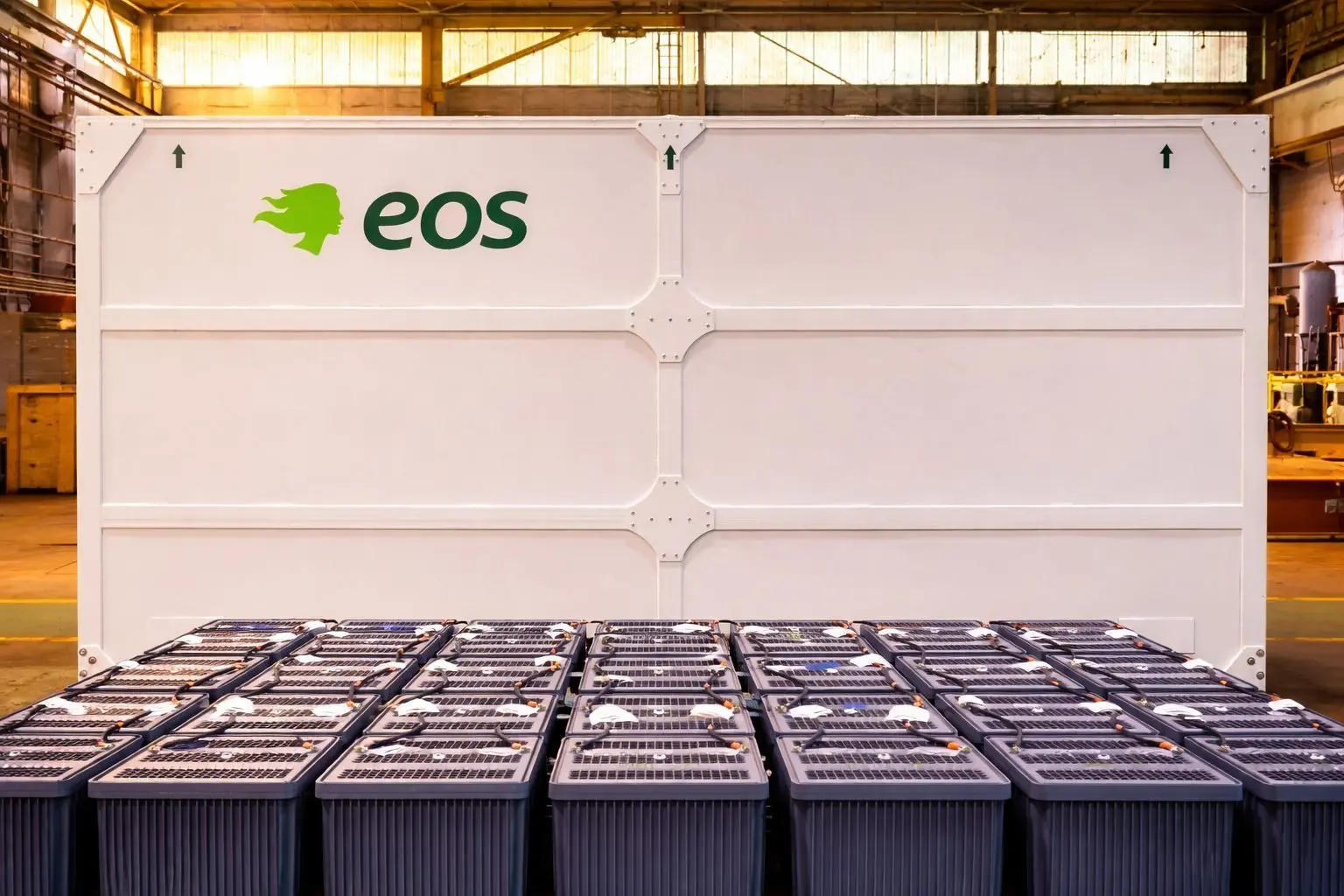
Eos Energy Enterprises, Inc. (NASDAQ: EOSE) is back in the spotlight on Tuesday, December 23, 2025—this time for a pullback. Shares traded lower in mid-day action, with trading data cited by MarketBeat showing the stock down about 4% at roughly the low-$12 level after closing the prior session near $12.89. MarketBeat
But if you’re trying to understand EOSE stock, today’s red tape isn’t a single-story headline. It’s the intersection of (1) a board leadership transition announced this week, (2) a major balance-sheet reshaping completed in late November, and (3) a “big opportunity / big execution risk” debate that’s still playing out across Wall Street coverage.
Below is a detailed breakdown of the latest Eos Energy news, the most current forecasts and analyst views circulating as of Dec. 23, 2025, and the catalysts that could decide whether EOSE’s volatility becomes a feature—or a bug.
What’s happening with EOSE stock on Dec. 23, 2025?
EOSE traded lower during Tuesday’s session after a period of extreme volatility in 2025—moves that have made the stock a magnet for both momentum traders and long-duration-energy-storage believers.
MarketBeat reported that Eos Energy Enterprises shares traded down about 4.2% during mid-day trading, with the stock hitting an intraday low around $12.36 and last trading around $12.35 at the time of its update. MarketBeat
It’s tempting to demand a single culprit for any down day. The market rarely cooperates. In Eos’s case, the near-term narrative is being shaped by corporate governance news (a board chair transition), recent dilution and financing headlines from November, and investor digestion of the company’s Q3 results and forward revenue guidance.
The big headline this week: Eos announces a board leadership transition
On Dec. 22, Eos disclosed that Russ Stidolph will step down as non-executive Chair, effective Dec. 31, 2025, and that Joseph Nigro will become non-executive Chair effective Jan. 1, 2026. SEC
A few details matter here:
- Stidolph has served as non-executive Chair since April 2018, and Eos says his firm AltEnergy has been a lead investor in Eos for the past eleven years. SEC
- Eos said Stidolph is stepping down to focus full-time on AltEnergy Acquisition Corp. SEC
- Eos positioned the handoff as continuity rather than a shake-up, noting that Nigro joined the board earlier in 2025. SEC
Why investors care (even if it’s “non-executive”)
Board leadership changes can be neutral… until they aren’t. In a manufacturing-scale story like Eos, investors watch governance for clues about confidence, oversight, and the company’s ability to execute.
Eos framed the transition as a “next phase” move, emphasizing Nigro’s background across energy, utilities, and infrastructure—including prior roles such as CFO of Exelon and CEO of Constellation (an Exelon operating company, per the company statement). SEC
And Eos used the announcement to hammer a theme it’s been leaning into hard: surging power demand from AI and electrification. In the same release, Nigro said that as power demand accelerates “with AI and electrification,” long-duration storage will be essential to strengthen the grid. SEC
That’s not a quarterly KPI. It’s a positioning statement: Eos wants to be seen as infrastructure for the coming load-growth era, not merely another battery name.
The financial overhang investors keep re-checking: November’s $1.04B financing and dilution
If you’re scanning EOSE headlines from the last month, November is unavoidable.
On Nov. 24, Eos announced it closed:
- A 1.75% convertible senior notes offering due 2031, with aggregate net proceeds of about $580.5 million, and $600 million aggregate principal issued and outstanding after the purchasers’ option was fully exercised. GlobeNewswire
- A registered direct offering of 35,855,647 shares priced at $12.78 per share, raising about $458.2 million in gross proceeds. GlobeNewswire
This matters for EOSE stock because it cuts two ways:
The bullish read: “They bought time to scale”
Eos explicitly pitched the financing as balance-sheet strengthening “needed to scale manufacturing” and convert a large opportunity pipeline into backlog and revenue. GlobeNewswire
The company also disclosed how it planned to use proceeds, including:
- Repurchasing $200 million principal of its 6.75% convertible senior notes due 2030, and
- Adding approximately $474 million of cash to the balance sheet (as adjusted for the offerings, net of certain discounts/commissions, prior to expenses). GlobeNewswire
Additionally, Eos said it issued the U.S. Department of Energy a warrant to purchase up to 570,000 shares of common stock, and noted that public warrant exercises added about $80.2 million in additional cash. GlobeNewswire
The cautious read: “Yes—but shareholders paid for it”
That equity raise is real dilution. Even if the cash runway improves, investors often re-price the stock around two questions:
- Does the added capital meaningfully increase the probability of hitting manufacturing and margin targets?
- How many more capital raises will be needed before the company becomes self-funding?
Those questions don’t get answered in a press release. They get answered in execution—quarter after quarter.
The operating story: Q3 2025 results, guidance, and the scale-up roadmap
Eos’s latest quarterly report (third quarter ended Sept. 30, 2025) is a mix of eye-catching top-line growth and continued losses typical of a scaling manufacturer.
From the company’s Nov. 5 release:
- Revenue was $30.5 million, described as the highest in company history and roughly double the prior quarter. GlobeNewswire
- Eos reaffirmed full-year 2025 revenue guidance of $150 million to $160 million, “consistent with the low end” of its previously forecasted range. GlobeNewswire
- Eos reported a commercial opportunity pipeline of $22.6 billion (about 91 GWh of demand) and $644.4 million in orders in backlog as of Sept. 30, 2025. GlobeNewswire
Just as important: Eos tied the pipeline growth directly to data-center demand. The company said data-center expansion accounted for roughly 22% of the total pipeline as of that update. GlobeNewswire
The operational “tell”: production ramp targets
Eos stated that automation and throughput gains positioned it to ramp production to an annualized rate of 2 GWh per year by year-end 2025. GlobeNewswire
That line—2 GWh annualized—is one of the clearest “watch this” metrics Eos has put in public view. If you want a single execution yardstick for 2026, it’s whether Eos can hit volume goals while pulling costs down fast enough to improve margins.
Today’s analysis theme: EOSE is becoming a “prove-it” stock again
After big upside moves earlier in 2025, today’s pullback fits a familiar rhythm in emerging energy infrastructure names:
- A compelling macro thesis (grid reliability + AI load growth + domestic supply chain),
- A huge opportunity pipeline,
- A balance sheet built to survive the ramp, and then…
- The market demanding proof that production, reliability, and margins can scale in real deployments.
Eos itself leaned into the “energy super-cycle” framing in its Q3 commentary, linking AI infrastructure growth to the need for “baseload energy storage” and grid resilience. GlobeNewswire
This is the heart of the EOSE debate: Is Eos early to an enormous need—or early to a need that’s real but harder to monetize than it looks?
Analyst forecasts and price targets for Eos Energy stock: what’s current as of Dec. 23, 2025?
Analyst views on EOSE are notably scattered—both in rating tone and in price target ranges. Here’s what’s circulating most prominently in late December 2025:
JPMorgan initiates coverage: Neutral, $16 target
JPMorgan initiated coverage with a Neutral rating and a $16 price target (as reported in multiple market roundups). TipRanks+1
A key nuance from the initiation note as summarized by The Fly: JPMorgan pointed to Eos’s mostly domestic supply chain and limited critical-minerals exposure as potential advantages for U.S. incentives and geopolitical risk—but flagged “above-average execution risk.” TipRanks
Stifel: Buy, $22 target (per market summaries)
Investing.com’s recap of recent coverage cited Stifel maintaining a Buy rating with a $22.00 price target, tying part of the thesis to balance sheet restructuring and scaling expectations. Investing.com
Aggregators show different “consensus” snapshots
Different data aggregators can show different analyst counts, update timing, and consensus math. On Dec. 23, that dispersion is part of the story:
- Zacks posted an average price target around $15.86 (based on targets from seven analysts, per its page). Zacks
- StockAnalysis showed a consensus rating of “Buy” and an average price target around $12.79 (with a wide low-to-high range shown on the same page). StockAnalysis
- MarketBeat, in its Dec. 23 trading update, described the consensus rating as “Hold” with an average price target around $12.44 and highlighted the mixed distribution of Buy/Hold/Sell ratings in its dataset. MarketBeat
What should you do with this?
Don’t average the averages. Instead, notice what the spread implies:
- Some analysts are underwriting an infrastructure-scale winner if manufacturing execution clicks.
- Others are treating Eos as a high-risk ramp where dilution, losses, and production friction can easily overwhelm the macro story.
A quick reality check: why Eos can look “cheap” and “expensive” at the same time
EOSE is a poster child for a market paradox:
- If you focus on the size of the pipeline and the macro demand story, the stock can look like an early ticket to a massive market. GlobeNewswire+1
- If you focus on current profitability and the history of needing external capital to fund scaling, it can look risky—especially post-dilution. GlobeNewswire
Even Eos’s Q3 results included enormous net loss figures driven largely by non-cash fair value mark-to-market impacts tied to the stock price and capital structure mechanics—an illustration of how financial statements can get weird when a company is scaling with complex financing. GlobeNewswire
What catalysts could move EOSE stock next?
Here are the catalysts most likely to matter to investors looking past today’s tape:
1) Manufacturing throughput and cost-down execution
Eos has told the market what it wants to hit: an annualized 2 GWh production rate by year-end 2025. GlobeNewswire
Updates that show real throughput improvement (and fewer project margin surprises) tend to matter more than polished slide decks.
2) Backlog conversion into revenue (not just pipeline growth)
Eos reported $644.4 million of backlog as of Sept. 30, 2025. GlobeNewswire
Investors will watch whether recognized revenue begins to track that backlog in a smoother, more predictable curve.
3) AI/data center-linked demand signals
Eos explicitly called out data centers as a growing portion of its pipeline, and the company continues to frame long-duration storage as a grid necessity in the AI era. GlobeNewswire+1
Contracts tied to data center load growth—especially with credible counterparties and financeable project structures—could be meaningful sentiment drivers.
4) Capital structure stability (and “do we need another raise?” anxiety)
The Nov. 24 financing strengthened liquidity and repurchased some higher-coupon obligations, but it also increased share count. GlobeNewswire
Future quarters that show improving gross margin trajectory and reduced cash burn can calm dilution fears; the opposite can reignite them quickly.
5) Governance and oversight under the new chair
The chair transition to Joseph Nigro becomes effective January 1, 2026. SEC
Investors will look for signs that board oversight is pushing toward operational discipline—especially around manufacturing scale, project execution, and risk controls.
The risk list that keeps EOSE a high-volatility stock
EOSE’s upside thesis is big—but so are the ways the story can wobble:
- Execution risk at manufacturing scale (yield, reliability, unit economics, delivery cadence)
- Project financing risk across customers (utility and infrastructure projects can slip)
- Dilution risk if cash needs persist beyond current liquidity plans
- High volatility (EOSE has traded like a high-beta story stock, not a sleepy industrial) Investing.com+1
- Competitive pressure, particularly from lithium-ion incumbents and alternative chemistries competing for long-duration use cases
In other words: the physics of grid storage may be straightforward, but the economics of scaling a manufacturing business rarely are.
Bottom line on Eos Energy (EOSE) stock on Dec. 23, 2025
EOSE is down today, but the deeper story is that Eos is transitioning from “promise” to “proof.”
This week’s board leadership transition is a governance milestone. SEC
Last month’s billion-dollar financing package was a survival-and-scale milestone. GlobeNewswire
And the next milestone—the one that ultimately decides the stock’s long-run shape—is whether Eos can reliably convert its pipeline and backlog into revenue while improving manufacturing economics at scale. GlobeNewswire