December 6, 2025
The global fire restoration industry has crossed a powerful new threshold in 2025, hitting an estimated $15 billion in market value as climate‑driven wildfires, aging infrastructure and surging insurance claims fuel demand for rapid recovery services.Red94+1
At the same time, one of California’s most painful recent disasters—the 2021 Caldor Fire, which burned more than 221,000 acres and destroyed over 1,000 structures in the Sierra Nevada—has entered a pivotal new phase: large‑scale restoration.Wikipedia On December 5, 2025, the U.S. Forest Service formally opened a 30‑day public comment period on a draft environmental assessment (EA) for the Caldor Fire Restoration Project in the Lake Tahoe Basin, covering about 11,700 acres of national forest land.US Forest Service
Together, these developments capture how AI, drones and green practices are reshaping what post‑fire recovery looks like—from the global market level down to specific burned watersheds and communities.
A $15 Billion Fire Restoration Market Built on Climate Risk
Recent market research and industry reporting show that fire damage restoration has become one of the fastest‑growing segments in disaster recovery:
- The broader disaster restoration services market is estimated at $42.93 billion in 2025, projected to reach $55.53 billion by 2030, a 5.28% compound annual growth rate (CAGR).Mordor Intelligence
- Within that, fire and water restoration services are expected to grow at roughly 8.1% CAGR from 2025–2032, outpacing the rest of the sector.LinkedIn+1
- A separate analysis of fire damage restoration services projects the segment at or near $15 billion in 2025, climbing toward $18 billion by 2028.Market Report Analytics
This growth reflects hard realities on the ground. The Caldor Fire alone burned 221,835 acres in El Dorado, Amador and Alpine counties, becoming one of California’s most destructive fires on record and forcing more than 50,000 people to evacuate.Wikipedia+1
Across the West, similar megafires are becoming more common as hotter, drier conditions lengthen fire seasons and increase fuel aridity. Researchers have documented a trend toward more severe tree mortality and larger burn scars in California’s forests since the 1980s, with the Caldor Fire frequently cited as a stark example.biology.utah.edu
For insurers, municipalities and property owners, this translates into:
- Higher claim volumes and increasing loss severity.
- Greater demand for specialized restoration contractors who can clear debris, stabilize structures, and remove smoke contamination quickly.
- Intensifying pressure to modernize workflows to keep both costs and downtime under control.
That pressure is one of the reasons AI‑powered tools, drones and remote sensing are migrating from experimental pilots to everyday tools across the fire restoration value chain.
AI and Drone Technology Are Transforming Fire Damage Assessment
Until recently, post‑fire assessment often meant days of manual inspections in dangerous conditions—especially around unstable structures, standing dead trees and steep slopes. Now, a rapidly growing ecosystem of AI‑enabled drones and imaging platforms is rewriting that playbook.
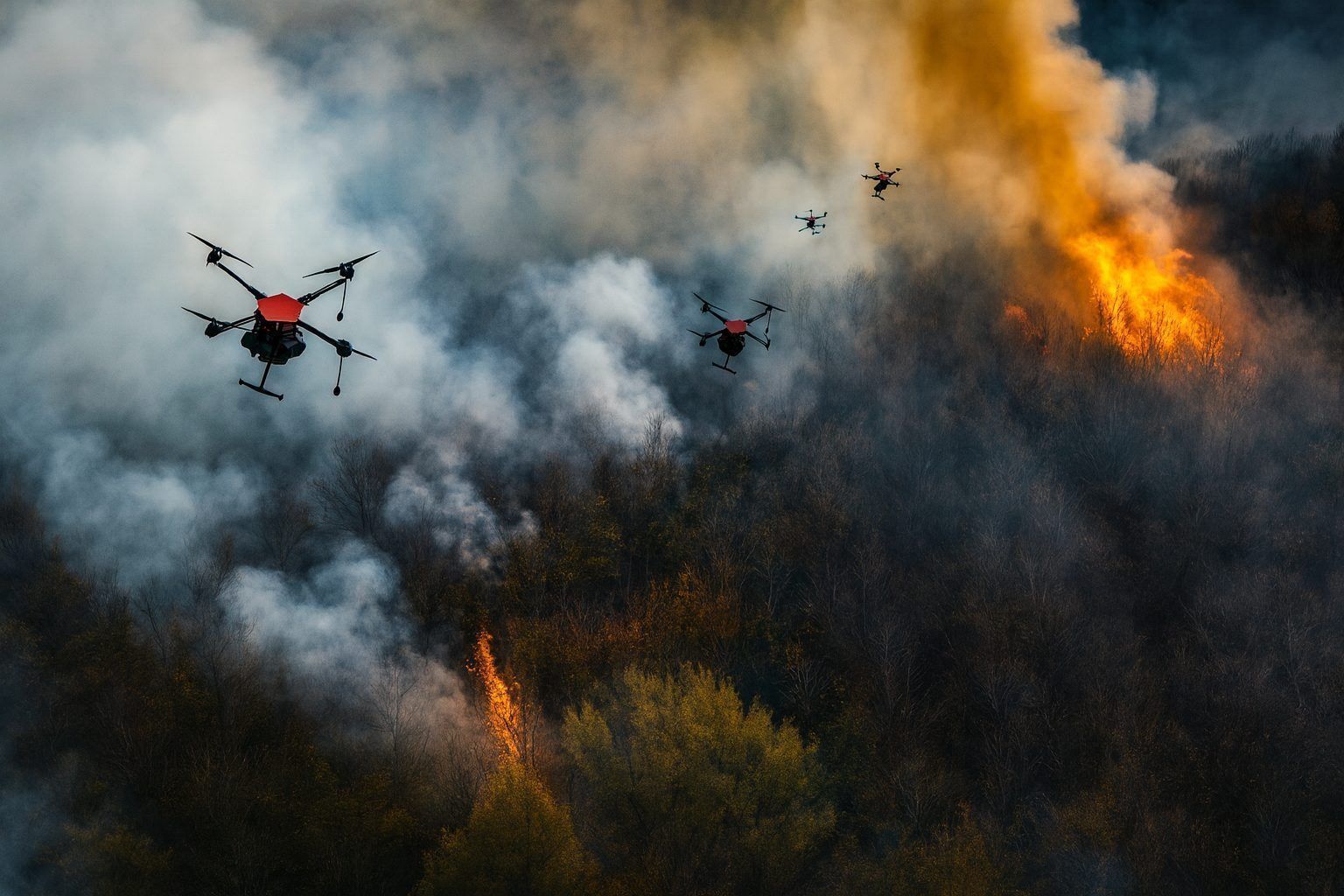
According to recent coverage of the industry’s $15 billion milestone, restoration firms are increasingly deploying commercial drones equipped with LiDAR, thermal imaging and multispectral cameras to capture high‑resolution 3D data over burned properties and landscapes. Automated analytics then generate “digital twins” of structures and terrain, allowing teams to:Red94
- Map damage in three dimensions with millimeter‑level accuracy.
- Detect hidden moisture, heat anomalies and structural compromise that might be invisible from the ground.
- Produce detailed scopes of work and cost estimates that plug directly into project management and insurance claim systems.
The Restoration Industry Association notes that computer vision now triages damage from drones, satellites, 3D cameras and smartphones in minutes, compressing what used to be days of preliminary assessment into near real‑time insight. Insurance carriers and public agencies are increasingly comfortable using AI‑generated damage data in their initial evaluations and claim workflows.restorationindustry.org
Globally, a parallel revolution is underway on the wildfire detection and firefighting side. In March 2025, German company Dryad Networks unveiled Silvaguard, an AI-based autonomous drone designed to work in tandem with a network of solar‑powered gas sensors called Silvanet. The system detects smoke in the smoldering phase, then dispatches drones to beam back infrared and optical video along with precise coordinates to firefighting teams—dramatically shortening the time between ignition and effective response.AP News
Market research firms project the autonomous firefighting drones market alone to be worth roughly $2.6 billion by 2025, with forecasts of more than 16% annual growth through 2035 as thermal imaging, AI modeling and swarm coordination become standard.Fact.MR+1
For the fire restoration industry, these capabilities are already reshaping business fundamentals:
- Response times: Drone‑equipped teams can deliver same‑day, full‑site assessments instead of waiting for manual inspection windows.Red94
- Safety: Robots and UAVs can operate in still‑smoldering or structurally compromised zones, reducing human exposure.
- Documentation quality: Insurers gain time‑stamped, georeferenced imagery and models, cutting down disputes and re‑inspections.
- Project controls: Repeated overflights allow AI systems to track progress, compare reality to plans and flag deviations early.
In short, AI is becoming the first responder for data, even as firefighters and restoration crews remain the first responders on the ground.
Green Fire Restoration and Regenerative Forestry Move Center Stage
Alongside digitization, sustainability is rapidly becoming a competitive advantage in fire restoration.
On the built‑environment side, leading firms are shifting toward:
- Low‑toxicity, biodegradable cleaning agents for soot and smoke.
- Energy‑efficient drying and dehumidification equipment to cut emissions during large‑loss projects.
- Increased use of recycled or low‑carbon materials when rebuilding, aligning with corporate ESG goals.Red94
On the landscape side, post‑fire recovery is converging with long‑term forest health and climate policy:
- California’s Forest Health Program and related CAL FIRE grants have directed tens of millions of dollars annually to projects that thin overgrown stands, restore habitat and replant native species across large landscapes.CAL FIRE+1
- In September 2025, UC Santa Cruz announced a $972,000 share of a $7 million Forest Health Grant to fund vegetation management and habitat restoration on campus and adjacent lands, as part of a broader statewide package of nearly $72 million in forest health awards.News
- Nationwide, the USDA Forest Service is investing $200 million in 58 community projects through the Community Wildfire Defense Grant Program, part of a planned $1 billion over five years to reduce wildfire risk on non‑federal lands.USDA
Meanwhile, academic work is upgrading the science behind where and how to restore first. A 2025 study in the journal Remote Sensing introduced the GRESTO Index, a geospatial decision‑support tool that blends fire severity, vegetation, topography and climate data to flag high‑priority restoration zones in Mediterranean ecosystems, achieving about 81% agreement with expert‑planned restoration activities.MDPI
Taken together, these trends point toward a future in which post‑fire restoration is not just about cleanup, but about re‑engineering forests and communities for resilience—and doing it in a way that satisfies both environmental and economic objectives.
Caldor Fire Restoration: From Megafire to Long‑Term Recovery
Few places illustrate the stakes as clearly as the Caldor Fire footprint west of Lake Tahoe.
The 2021 blaze:
- Burned about 221,835 acres across Eldorado National Forest and nearby lands.
- Destroyed roughly 1,000 structures and damaged dozens more.Wikipedia+1
- Devastated landscapes ranging from the US Highway 50 corridor to the Sierra‑at‑Tahoe ski resort, where about 1,600 of 2,000 skiable acres burned.SFGATE
Four years on, locals still navigate blackened slopes, hazard trees and closed recreational areas—even as some places, like Sierra‑at‑Tahoe, have staged striking comebacks with rebuilt infrastructure and altered, more open terrain.SFGATE+1
What the New Caldor Fire Restoration Proposal Covers
The Caldor Fire Restoration Project now under review for the Lake Tahoe Basin Management Unit (LTBMU) focuses on about 11,700 acres of national forest lands within and around the burn area. According to the Forest Service’s December 5, 2025 press release, the draft environmental assessment proposes actions to:US Forest Service+1
- Remove fire‑killed and severely damaged trees, especially near roads and neighborhoods, to reduce hazards.
- Treat live trees with active insect or disease issues to prevent further die‑off.
- Prepare sites for planting by treating competing vegetation and creating microsites for native seedlings.
- Thin surviving stands and nearby unburned trees to reduce fuel loads and improve forest structure.
- Use prescribed fire under controlled conditions to maintain resilience.
- Restore streams, meadows and aquatic habitat, including channel repairs and improvements for aquatic organism passage.
- Improve wildlife habitat, including sensitive Protected Activity Centers, and restore aspen stands that rely on disturbance but suffer under conifer encroachment.
Crucially, the agency is invoking an Emergency Action Determination under the Infrastructure Investment and Jobs Act, citing the continued deterioration of burned stands and the need to move quickly. That emergency authority streamlines implementation starting in January 2026 and exempts the decision notice from pre‑decisional administrative review, although the EA is still out for public comment.US Forest Service+1
Phase 1: Eldorado National Forest and Contracting Progress
The Lake Tahoe Basin work sits alongside a broader Caldor Fire Restoration Project on the Eldorado National Forest (ENF), where the Forest Service signed a Decision Notice and Finding of No Significant Impact (FONSI) for Phase 1 in March 2025, marking the completion of the NEPA process for that portion of the effort.US Forest Service+1
Implementation there includes:
- Hazard fuels reduction and fuel break maintenance.
- Hazard tree abatement, temporary roads, road repairs and decommissioning.
- Recreation site reconstruction and trail repairs.
- Watershed improvements and aquatic habitat restoration.The Great Basin Institute
The Great Basin Institute has issued multiple requests for bids and addenda for various units across the burn scar, signaling that on‑the‑ground restoration contracting and timber removal are already underway on ENF lands.The Great Basin Institute+1
Public Input, Salvage Logging Debates and Community Priorities
The new LTBMU draft EA comes with a 30‑day comment window, calculated from the legal notice in the Tahoe Daily Tribune dated December 5, 2025. Practically, that gives residents, tribes, environmental organizations, recreation groups and local governments until early January 2026 to submit feedback via the Forest Service’s project webpage or by mail.US Forest Service+1
Several points of tension and interest are already visible from earlier rounds of scoping and advocacy around Caldor recovery:
- Salvage logging and habitat: An online petition organized by conservation advocates warns that large‑scale salvage logging in parts of the Caldor footprint could degrade critical wildlife habitat, including areas important for species such as the California spotted owl, and could undermine natural regeneration dynamics in high‑severity burn patches.actionnetwork.org+1
- Motorized access and recreation: The California Four Wheel Drive Association, in a detailed comment letter, has urged the Forest Service to keep off‑highway vehicle (OHV) roads and trails open, repair any damage from restoration operations, and treat hazard trees along these routes out to at least 200 feet. The group frames motorized access as a key accessibility issue for people with disabilities and a major contributor to the local outdoor recreation economy.California Four Wheel Drive Association
- Economic recovery and fuel management: The same letter highlights how catastrophic wildfire has imposed tens of billions of dollars in losses on California, arguing that robust fuel reduction, timber harvest and vegetation management in the Caldor area are necessary to avoid future megafires and to support jobs in forestry, recreation and tourism.California Four Wheel Drive Association+1
From a broader policy perspective, the Caldor restoration planning is unfolding against a turbulent national backdrop. In early 2025, a temporary federal funding freeze disrupted wildfire prevention and fuels reduction projects across the West, including some supported by the Inflation Reduction Act and Bipartisan Infrastructure Law, before pressure from lawmakers and industry groups pushed for exemptions.Reuters+1
That political volatility reinforces why many local stakeholders want binding commitments and clear timelines embedded in restoration decisions—whether for fuel treatments, habitat protections, or recreation infrastructure.
How AI, Drones and Green Practices Could Shape Caldor’s Next Chapter
Although the Caldor Fire Restoration EA does not read like a tech brochure, the same tools driving the broader restoration industry’s $15 billion surge are likely to play a quiet but crucial role in Tahoe’s recovery:
- Pre‑treatment planning: LiDAR and multispectral imagery can help planners map burn severity, erosion risk and remaining canopy in detail, mirroring approaches used in the GRESTO Index research to prioritize restoration zones.MDPI+1
- Hazard tree operations: Drone surveys and AI‑based detection of leaning or structurally compromised trees can improve worker safety along roads, trails and campgrounds.
- Watershed monitoring: Repeated drone flights and satellite analysis can track sedimentation in streams and meadow recovery, helping agencies adjust treatments over time.
- Smoke and emissions accounting: As prescribed burns ramp up, remote sensing can support more accurate measurement of emissions and downwind smoke impacts, feeding into climate and public health assessments.
Layered on top of this technical substrate are green restoration practices that align with state and federal climate policies:
- Favoring native species reforestation that reflects future climate conditions rather than simply replanting what was there before.
- Structuring timber removal to prioritize hazard reduction and ecological outcomes, rather than maximizing short‑term volume.
- Designing recreation and road networks with fire‑adapted landscapes in mind—wider fuel breaks, strategic openings, and better integration with defensible space around communities.
Outlook: A Rapidly Professionalizing, Highly Scrutinized Sector
Looking beyond Caldor, several trends emerge from the latest news, forecasts and analyses as of December 6, 2025:
- Steady, climate‑driven market growth
Forecasts for disaster restoration consistently point toward multi‑billion‑dollar growth over the next decade, with fire and water segments leading and residential restoration alone expected to grow from roughly $36.9 billion in 2025 to $60 billion by 2035.WiseGuy Reports+1 - Acceleration of AI‑driven workflows
From the Silvaguard wildfire detection system in Germany to AI triage of drone imagery after U.S. disasters, the expectation is that AI will shift from an experimental add‑on to the default assessment layer for many insurers, public agencies and large restoration chains by 2030.AP News+1 - Tighter coupling of restoration with climate and forest‑health policy
Programs like CAL FIRE’s Forest Health grants and the USDA’s Community Wildfire Defense Grants are explicitly tying funding to resilience outcomes, not just hazard cleanup. Projects like the Caldor Fire Restoration are likely to be judged on their long‑term ecological and social outcomes, not merely acres treated.News+2USDA+2 - Growing scrutiny from both environmental and access advocates
As seen around Caldor, restoration plans now face parallel critiques: one camp wary of over‑aggressive salvage logging and herbicide use, another demanding more extensive fuel reduction and sustained access for recreation and rural economies. That tension will shape how “green” and “restorative” projects are defined on the ground.California Four Wheel Drive Association+1 - Professionalization and consolidation
With national chains expanding, franchise models maturing and private equity interest rising, restoration is shifting from a patchwork of small operators to a more consolidated, tech‑heavy industry—though regional firms still play a major role, especially in rural and wildland‑urban interface communities.Red94+1
For communities living with the charred aftermath of fires like Caldor, these trends are not abstract. They will determine how quickly forests regrow, whether wildlife rebounds, how safe roads and trails become, and how much control local residents have over the future of their landscapes.
As the public weighs in on the Caldor Fire Restoration EA this month, and as the fire restoration industry leans deeper into AI, drones and green practices, the central question is increasingly clear:
Can technology and capital‑intensive restoration genuinely deliver healthier, more resilient forests and communities—or will they simply make recovery faster and more profitable without addressing the roots of wildfire risk?
That answer will be written not just in market reports, but in the slopes, streams and neighborhoods of places like the Tahoe Basin over the decade ahead.