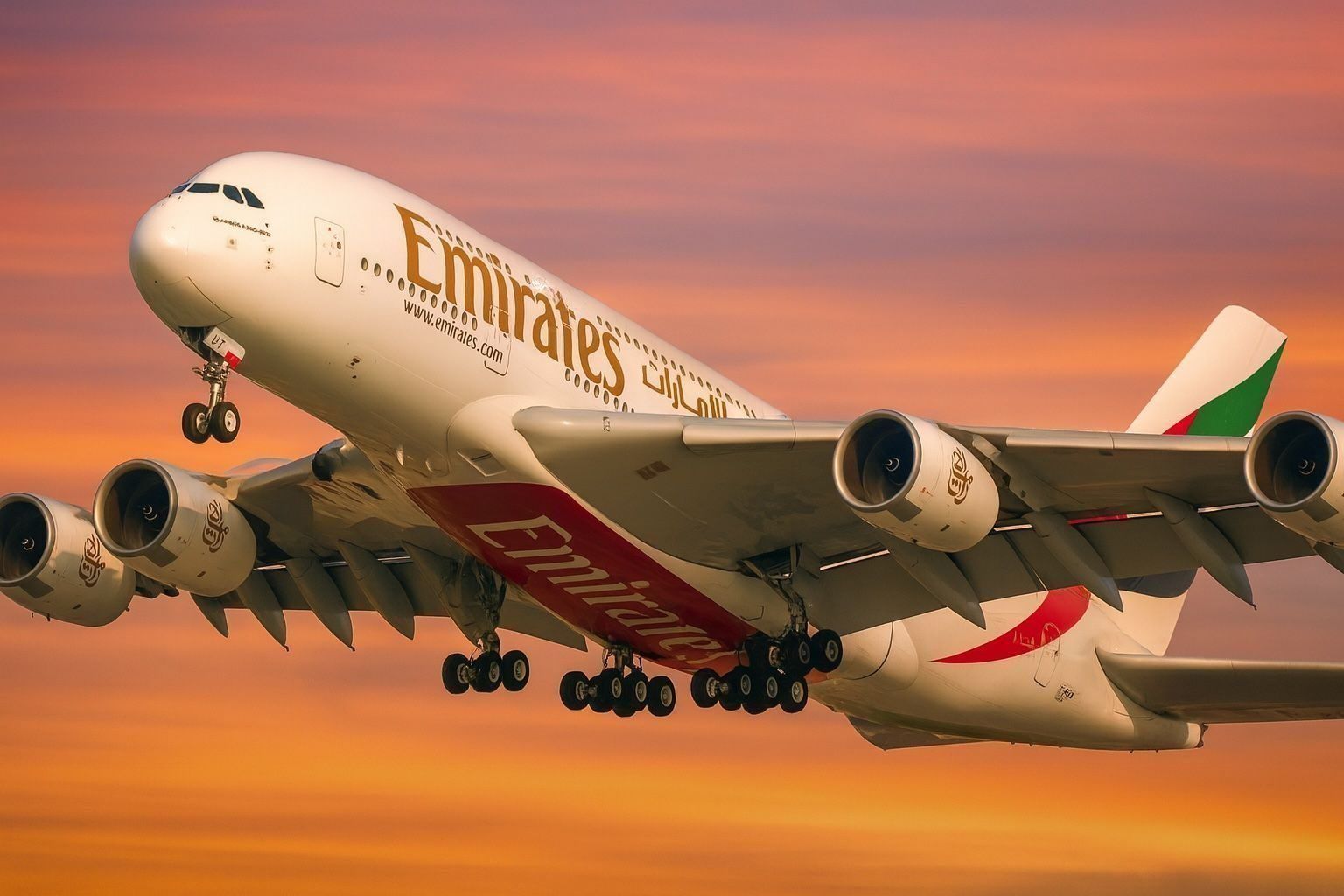
Manchester, UK – As of 3 December 2025, Emirates’ Airbus A380 services between Manchester and Dubai are back to normal after a dramatic ground collision between a fuel truck and a superjumbo on 28 November 2025. The incident damaged the aircraft’s engine cowling and forced the cancellation of a busy UK–Dubai flight, but no injuries were reported and the aircraft has since returned to service following repairs. Aviation Today+2Travel And Tour World+2
Below is everything we currently know about the incident, its impact on passengers, and what it means for future travel plans.
What Happened at Manchester Airport?
On Friday 28 November 2025, an Emirates Airbus A380‑842, registration A6‑EVP, arrived at Manchester Airport (MAN) from Dubai as flight EK17. While the aircraft was parked at Gate 213 in Terminal 1 during routine turnaround preparations for its return as EK18 to Dubai, a fuel truck struck one of its Rolls‑Royce Trent 900 engines. Travel And Tour World+2Aviation Today+2
The impact damaged the No. 1 engine intake cowling on the left wing, leaving a visible tear or hole in the engine’s leading lip – images of which quickly circulated on aviation forums and social media. Aviation Safety Network+2Facebook+2
According to multiple aviation reports and eyewitness posts, no fuel leak, fire, or injuries occurred, and the airport did not activate major emergency procedures, though engineering and safety teams immediately secured the stand. Facebook+2Aviation Today+2
Timeline: From Touchdown to Grounding
Arrival and Turnaround
- ~10:46 GMT, 28 November 2025 – EK17 from Dubai lands at Manchester ahead of schedule and taxis to a stand in Terminal 1. Travel And Tour World+1
- Standard ground activities begin: passenger disembarkation, baggage off‑loading, cleaning, catering and refuelling.
Fuel Truck Collision
During refuelling, a fuel truck (bowser) maneuvering near the left wing made contact with the A380’s outer engine, impacting the intake lip. The force of the impact was enough to deform the cowling and tear part of the metal skin, but initial assessments suggested that damage was confined to the engine nacelle structure rather than the core engine. Aviation Today+2Facebook+2
Social media footage and photos show a very wet apron, consistent with reports that the ramp was slick and visibility reduced at the time – factors some commentators believe may have contributed to the collision, although this has not been officially confirmed. Travel And Tour World+2TS2 Tech+2
Flight EK18 Cancelled
With visible damage to the engine intake and pending a full structural assessment, Emirates cancelled EK18 – the scheduled afternoon departure back to Dubai on the same aircraft – leaving hundreds of passengers stranded at Manchester. Travel And Tour World+2Travel And Tour Wor…
How Many Flights and Passengers Were Affected?
The A380 can carry around 500–600 passengers, depending on configuration, so cancelling just one sector has a big knock‑on effect for both origin and connecting travellers. TS2 Tech+1
Based on current reporting:
- EK18 on 28 November was cancelled outright after the collision. Aviation Today+2Travel And Tour World+2
- Emirates re‑accommodated passengers on later Manchester–Dubai flights and via other European gateways, with some travellers experiencing overnight delays and missed onward connections. Travel And Tour World+2Aviation A2Z+2
- Subsequent Dubai–Manchester services continued, operated by other A380s in the fleet, though with minor delays on 29–30 November while the grounded aircraft remained at the stand for inspection and repairs. Travel And Tour World+1
Passengers posted on forums and social media about long queues for rebooking desks, hotel arrangements and voucher distribution, which is typical after a high‑capacity long‑haul cancellation. Reddit+1
Damage to the Emirates A380: Serious but Localised
Aviation incident databases and technical reports describe the damage as a tear and deformation to the engine intake lip / cowling on the No. 1 engine. Aviation Safety Network+2Facebook+2
While this may look alarming in photographs, experts note that:
- The damage appears localized to the nacelle structure (the outer fairing), not the rotating fan blades or core engine. Aviation Today+1
- Even relatively small dents in an intake lip can affect airflow and must be treated seriously, especially on a large, high‑bypass turbofan. TS2 Tech+1
- Safety rules require immediate grounding until engineers inspect for hidden structural issues and confirm that any repairs meet manufacturer and regulatory standards. TS2 Tech+1
That combination—visually dramatic but structurally contained damage—is why the aircraft could be repaired within days rather than months, but still could not depart on EK18.
Emirates’ Response and the Current Status (as of 3 December 2025)
According to Travel And Tour World, the damaged A380 underwent checks at Manchester and returned to commercial service on 30 November, operating flight EK20 from Manchester to Dubai after repairs. Travel And Tour World+2TS2 Tech+2
AviationToday.in’s latest coverage, published on 2 December 2025, independently confirms that the aircraft re‑entered service after technical inspections and structural work on the engine intake cowling, with no further operational restrictions reported. Aviation Today+1
Key points from airline and media reporting:
- No passengers, crew, or ground staff were injured. Facebook+2Aviation Today+2
- Airport emergency protocols beyond local engineering and safety responses were not fully activated, as no fuel spill or fire occurred. Aviation Today+1
- Passengers on EK18 were rebooked and provided assistance in line with Emirates’ customer service policies (meals, accommodation where required and alternative flights). Travel And Tour World+2Travel And Tour Wor…
- Social‑media posts quoting an Emirates spokesperson highlight the airline’s standard position that “the safety of our passengers and crew” is the top priority, and that it is cooperating with airport authorities. Instagram+2TS2 Tech+2
Operationally, data compiled by TS2 Tech from flight‑tracking services shows that Emirates continues to operate multiple daily A380 services on the Manchester–Dubai route, with no sign of a lasting schedule cut specifically related to the incident. TS2 Tech+1
Investigation: What Caused the Collision?
As of 3 December 2025, the UK Air Accidents Investigation Branch (AAIB) has not yet released a formal bulletin on the incident. TS2 Tech+1
Current reporting and expert commentary indicate that investigators are expected to look at: TS2 Tech+1
- The route and speed of the fuel truck around the stand
- Ground crew communication and marshalling procedures near the A380’s wing
- Weather and apron surface conditions, including the wet ramp seen in images and videos
- Training, fatigue and staffing for ground handlers working the busy Emirates flights
- The layout and congestion around Gate 213 when the collision occurred
Some travel and aviation outlets have floated possible factors such as human error, poor visibility and slick pavement, but they also stress that any firm conclusion before the AAIB’s findings would be speculative. Travel And Tour World+2Travel And Tour Wor…
Social posts from aviation news accounts note that neither Emirates nor Manchester Airport has provided a detailed public explanation of the root cause, beyond confirming the event and the absence of injuries. Threads+2X (formerly Twitter)+2
Is It Still Safe to Fly on Emirates’ A380s?
From a safety perspective, this incident falls into the category of ground damage with no injuries – serious from an engineering and cost standpoint, but far from a catastrophic accident. Aviation Safety Network+1
Important context:
- Emirates is the world’s largest A380 operator, with around 96 superjumbos in service by late 2025, and an extensive maintenance and safety infrastructure. TS2 Tech+1
- Manchester is a long‑established A380 station, handling up to three daily Emirates A380 flights under normal schedules. TS2 Tech+1
- Industry data from groups such as IATA and the Flight Safety Foundation shows that commercial aviation remains extremely safe, with accidents per million departures at historically low levels, even as ground‑handling incidents are under increased scrutiny. TS2 Tech+1
The fact that A6‑EVP has already operated at least one revenue flight after repairs, with further inspections expected at Emirates’ Dubai facilities, suggests that regulators and engineers are comfortable that its condition meets all airworthiness standards. TS2 Tech+1
For passengers, there is no indication of an elevated safety risk when flying Emirates’ A380s to or from Manchester compared with before the incident.
Passenger Rights: Refunds, Rebooking and Possible Compensation
For travellers booked on EK18 from Manchester, the collision resulted in a same‑day cancellation. That raises an obvious question: what are passengers entitled to?
1. Basic Care and Re‑routing
Under UK air passenger rights (UK261), flights departing from a UK airport are covered regardless of airline nationality. Civil Aviation Authority+2GOV.UK+2
This typically means affected passengers should receive:
- Re‑routing at the earliest opportunity or a refund of the unused ticket portion
- Meals and refreshments while waiting, proportional to the delay
- Hotel accommodation and transport between airport and hotel, if an overnight stay becomes necessary
- Access to communication, such as phone calls or emails, where needed
2. Financial Compensation
Whether passengers are entitled to cash compensation (on top of rerouting and care) is more complicated. UK261 generally provides compensation for cancellations within 14 days of departure when the airline is responsible and the problem is not due to “extraordinary circumstances”. One Mile at a Time+2Flight Delayed+2
Ground collisions with airport vehicles often fall into a grey area:
- If the incident is deemed to result from airport or third‑party ground‑handling error, airlines may argue that it is outside their control and therefore exempt from compensation. Civil Aviation Authority+1
- Regulators and courts sometimes disagree, especially if the ground handler is contracted by the airline. Outcomes can be case‑specific.
For now, passengers who were on EK18 and believe they may be owed compensation can:
- Submit a claim directly to Emirates, referencing flight number EK18 on 28 November 2025 and explaining the disruption.
- Consult UK CAA guidance or a specialist claims service to understand whether the circumstances are likely to qualify under UK261. Civil Aviation Authority+2AirHelp+2
(This section is for general information only and does not constitute legal advice.)
Ground‑Vehicle Collisions: A Wider Industry Problem
While the Manchester incident did not cause injuries, it fits into a broader pattern that worries safety experts: ground vehicles damaging parked aircraft.
Industry estimates cited by IATA and other aviation bodies suggest that ground damage costs airlines around US$5 billion per year, with a significant share linked to equipment—such as fuel trucks, baggage loaders and tugs—striking stationary airframes. Travel And Tour World+2TS2 Tech+2
Key themes include:
- Crowded aprons as airports handle more wide‑bodies and tightly‑timed banks of departures
- Human factors, such as fatigue, high workload and communication failures among crews on the ramp
- Aging ground support equipment, not always fitted with modern collision‑avoidance systems
- Cost pressure, which magnifies the impact of any incident on schedules and finances
Notably, 2025 has already seen another headline‑grabbing vehicle collision involving an aircraft linked to the Emirates brand: Emirates SkyCargo Flight 9788, a Boeing 747‑400 freighter, overran the runway in Hong Kong in October 2025 and collided with a ground patrol vehicle, killing two airport workers (all four crew survived). TS2 Tech
There is no evidence that the Manchester and Hong Kong events share a common cause, but having two vehicle‑related collisions in one year will likely sharpen Emirates’ and regulators’ focus on apron risk management, supplier oversight and ground‑handler training. TS2 Tech+1
What This Means for Future Travel Between Manchester and Dubai
For most travellers booking Emirates flights between Manchester (MAN) and Dubai (DXB) in the coming weeks:
- The immediate operational disruption is over. Replacement A380s have been operating EK18 and other rotations normally since late November. Travel And Tour World+2TS2 Tech+2
- Emirates continues to list multiple daily MAN–DXB services, primarily using A380s, with no official notice of capacity reductions due to the collision. TS2 Tech+1
- There is no indication that bookings for Christmas and early‑2026 travel are affected beyond the one‑day disruption and immediate rebooking wave. TS2 Tech+1
Practical tips for upcoming passengers:
- Check your flight status in the Emirates app or on the airline’s website on the day of travel. TS2 Tech+1
- Arrive early at the airport in case residual ramp‑operations issues cause minor delays during busy periods.
- Ensure your contact details with the airline are up to date so you receive SMS or email alerts if anything changes.
Key Takeaways (as of 3 December 2025)
- An Emirates A380 (A6‑EVP) was struck by a fuel truck at Manchester Airport on 28 November 2025 while parked at the gate between flights EK17 and EK18. Aviation Today+2Travel And Tour World+2
- The collision caused localized damage to the No. 1 engine intake cowling, forcing Emirates to cancel EK18 and ground the aircraft for inspections and repairs. Aviation Safety Network+2Facebook+2
- No injuries and no fuel spill were reported, and emergency services did not respond to a major incident level. Facebook+2Aviation Today+2
- After repairs in Manchester, the A380 returned to service on 30 November as EK20 to Dubai and has since resumed normal flying. Travel And Tour World+2TS2 Tech+2
- The AAIB investigation is ongoing, with no official cause published yet; Emirates and Manchester Airport have not released detailed explanations beyond standard safety statements. TS2 Tech+2Travel And Tour World+2
- Passengers affected by the cancelled EK18 were rebooked, and some may have UK261 rights to care, rerouting or compensation depending on how regulators classify the incident. Civil Aviation Authority+2One Mile at a Ti…
For now, the Manchester fuel‑truck collision stands as a vivid reminder that a lot of aviation safety happens on the ground, not just in the air—and that even a minor misstep around a parked superjumbo can ripple through hundreds of travel plans in an instant.