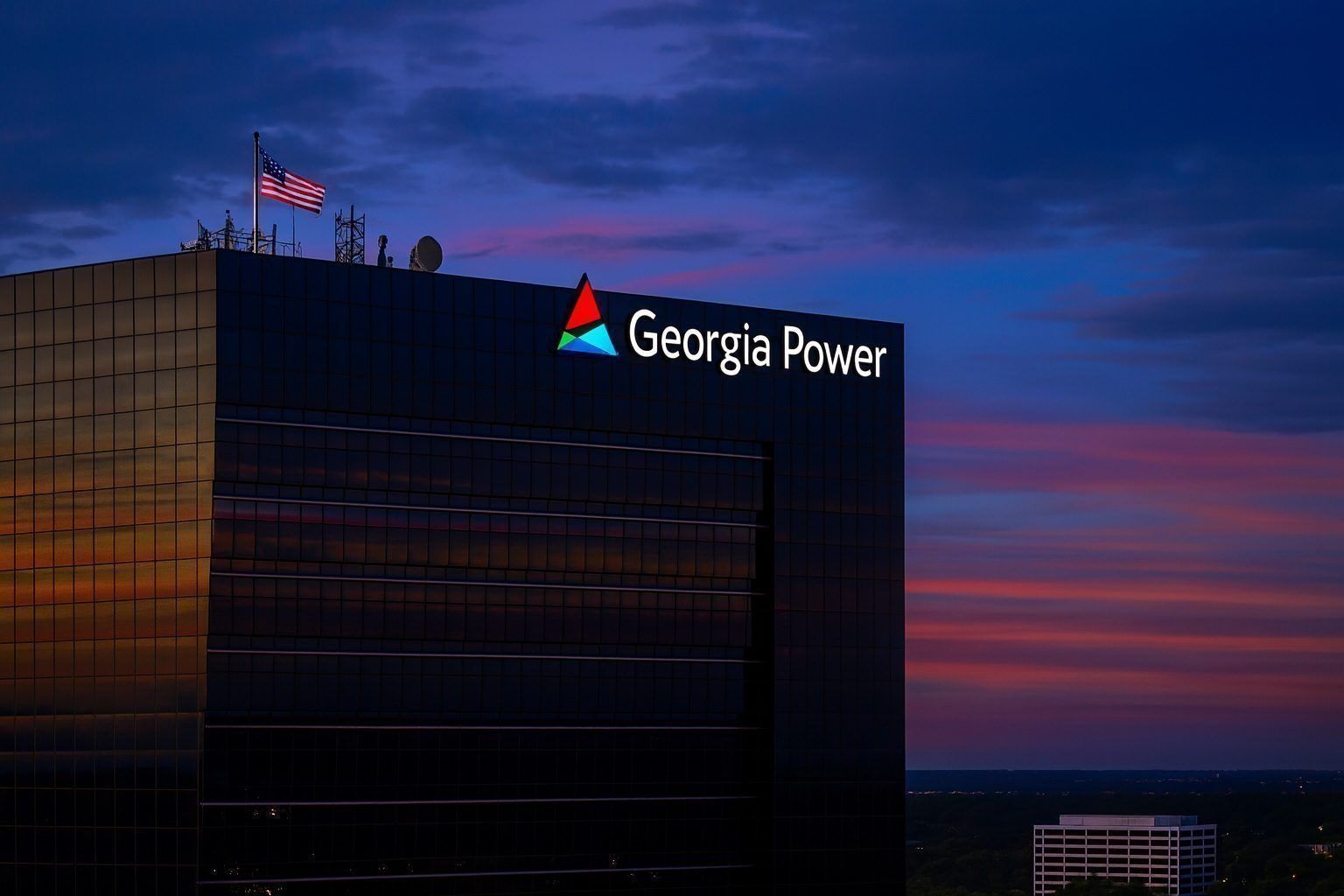
As of December 1, 2025, Georgia Power sits at the center of a rare collision of forces: a once‑in‑a‑generation data center boom, sharply higher electricity bills, and a newly reshaped Georgia Public Service Commission (PSC) that voters just used to vent their frustration.
Over the next few weeks, regulators will decide whether to let Georgia Power add roughly 10 gigawatts (GW) of new capacity—about the equivalent of ten nuclear reactors at Plant Vogtle—mainly to serve AI and cloud data centers flocking to the state. Consumer groups warn the move could lock in billions of dollars of costs and raise household bills for years; Georgia Power insists the expansion is essential to keep the lights on in a fast‑growing economy. FOX 5 Atlanta+2AJC+2
Below is a detailed look at the latest news, forecasts and analyses around Georgia Power as of December 1, 2025—what’s already been decided, what’s still on the table, and what it all could mean for customers, investors and climate policy in Georgia.
Georgia Power’s 10 GW Expansion Request: The Regulatory Flashpoint
Georgia Power is asking the PSC to approve about 10,000 megawatts of new power resources over the next five years, the largest single capacity request in the commission’s history. AJC+1
Key elements of the proposal, spread across multiple regulatory filings, include:
- New and existing natural gas plants with decades‑long lifespans
- Expanded battery energy storage systems (BESS) and some additional solar‑plus‑storage
- Purchases of power from third‑party generators (power‑purchase agreements, or PPAs)
Georgia Power argues this build‑out is needed to meet surging electricity demand, particularly from large data centers, and to maintain reliability as the state adds more variable renewables. georgiapower.com+1
What PSC staff say
Professional staff at the PSC have pushed back hard. In written testimony summarized by Georgia Public Broadcasting and other outlets, staff experts say: Georgia Public Broadcasting+1
- Georgia Power is “vastly overestimating” future demand from data centers.
- If the full 10 GW is built and the load doesn’t materialize, household customers could be on the hook for the costs anyway.
- Staff estimate the plan could require around $3.5 billion in additional annual revenue by 2030, translating into about $20 more per month for the average household customer.
Instead, staff recommend that commissioners:
- Approve only 30–40% of the requested new capacity
- Prioritize purchased power from existing plants over building new Georgia Power‑owned facilities, which would add more to the company’s rate base and long‑term costs for customers
Local TV and regional outlets report similar concerns, with PSC analysts warning that Georgia Power’s proposal could raise monthly bills “by about $20” despite a separate base‑rate freeze. FOX 5 Atlanta+1
Georgia Power’s response
Georgia Power strongly disputes the staff’s conclusions. In recent testimony and statements, the company says its demand projections are grounded in signed commitments from large industrial and data center customers and necessary to preserve reliability as Georgia grows. The utility argues that: FOX 5 Atlanta+1
- Its large‑load commitments helped enable a base‑rate freeze through 2028.
- Delaying or sharply cutting the plan could jeopardize future reliability and the state’s economic growth.
In new testimony filed in late November, Georgia Power called claims of a guaranteed $20 monthly increase “flatly incorrect,” pointing to protections it says will prevent existing customers from unfairly subsidizing new large loads. https://www.wrdw.com
Key dates
- Dec. 10–12, 2025: Public hearings on the capacity request and staff recommendations
- Dec. 19, 2025: PSC scheduled vote on the expansion and associated certifications Georgia Public Broadcasting+2FOX 5 Atlanta…
Environmental groups have asked the PSC to delay the vote until late January, so two newly elected Democratic commissioners can participate. AJC
Data Centers Are Driving Unprecedented Electricity Demand
Georgia is experiencing the highest electricity demand growth in its history, and most of it is tied to data centers, especially AI‑driven facilities in and around metro Atlanta. The Guardian+1
Recent analyses and testimony indicate:
- Georgia Power’s planning assumes nearly 7 GW of new data center demand by 2031. NRDC
- The utility projects about 8,200–8,500 MW of total load growth by 2030, far above earlier forecasts. georgiapower.com+2World Nuclear News+2
- Guardian reporting notes that roughly 80% of Georgia Power’s 10 GW request is driven by data centers, with an estimated project cost of nearly $16 billion. The Guardian
Data centers are energy‑intensive. A single large facility can require 100 megawatts or more, equivalent to powering tens of thousands of homes. FOX 5 Atlanta+1
Advocacy groups and some lawmakers argue that if these loads don’t fully materialize—or if contracts lack transparency—traditional residential customers could be left paying for “ghost capacity” baked into rates for decades. Georgia Public Broadcasting+2The Guardian+…
Why Georgia Power Bills Are High Despite a Rate Freeze
Many customers are understandably confused: the PSC approved a base‑rate freeze through at least 2028, yet bills are still rising and feel significantly higher than just a few years ago. georgiapower.com+1
What changed
- Since 2022, the PSC has approved six separate increases affecting Georgia Power bills, including adjustments for fuel costs and other riders. FOX 5 Atlanta+1
- Fox 5 Atlanta calculates that the average residential customer is paying about $43 more per month than in 2022, or roughly $516 more per year. FOX 5 Atlanta
- A typical Georgia Power customer using 1,000 kWh now pays around $171 per month on average, with summer bills near $266 in hot months like July. FOX 5 Atlanta
- Reuters reports that summer bills for a 1,000‑kWh customer have jumped about 41% since 2021, a statistic that became central in this year’s PSC elections. Reuters
The key nuance:
- The base‑rate freeze covers only part of the bill.
- Separate line items—for fuel, environmental compliance, storm recovery and now potentially data‑center‑related grid upgrades—can still change with PSC approval. georgiapower.com+2The Current+2
Because those riders can move independently, customers can experience higher total bills even while the underlying base rate is technically frozen.
Vogtle and the Nuclear Bet Behind Georgia Power’s Future
Plant Vogtle, long a flashpoint in Georgia’s energy debates, is now fully online.
- Vogtle Unit 4 entered commercial operation in April 2024, following Unit 3’s startup in 2023.
- With all four reactors running, Vogtle is billed as the largest generator of clean energy in the United States, expected to produce more than 30 million megawatt‑hours of electricity annually. georgiapower.com
Nuclear already provided more than a quarter of Georgia Power’s generation in 2023; that share is rising with Units 3 and 4 online. georgiapower.com
But the project’s cost and delays loom over the current rate and capacity debates:
- The expansion ended up costing around $35 billion, more than double initial estimates. Reuters
- Analysts cited by regulators have estimated that customers could pay $36–$43 billion more over the reactors’ 60‑year life than they would have if Georgia had relied on gas‑fired power instead. Reuters
In its 2025 Integrated Resource Plan, Georgia Power proposes further nuclear uprates—power upgrades at Vogtle Units 1 & 2 and at the Hatch plant—to squeeze more carbon‑free generation from existing reactors, adding roughly 112 MWe of capacity between 2028 and 2034. World Nuclear News+1
The company also signals that new nuclear capacity could be selected in most of its long‑term planning scenarios as early as the late 2030s, though it acknowledges substantial financial and execution risks after Vogtle’s experience. World Nuclear News
The 2025 Integrated Resource Plan: Georgia Power’s Official Roadmap
On July 15, 2025, the PSC approved Georgia Power’s 2025 Integrated Resource Plan (IRP), the state‑mandated blueprint for how the utility will meet customer needs over the next 20 years. georgiapower.com+1
The approved IRP projects:
- ≈8,500 MW of load growth and about 2,600 MW in additional peak demand by 2030
- Ongoing investment in existing plants for reliability
- Expansion of a “diverse mix” of generation: nuclear, natural gas, coal (with some retirements delayed), and renewables such as solar and battery storage georgiapower.com+2The Current+2
Specific resource moves include:
- Certifying around 9,900 MW of new resources, including PPAs, new gas turbines, and BESS projects across the state The Current
- Approving nuclear uprate investments at Vogtle Units 1 & 2 to add 54 MW of additional carbon‑free capacity georgiapower.com+1
- Expanding battery storage, with construction underway on multiple sites and additional BESS planned at at least ten more locations The Current+1
Georgia Power is also running a 500 MW storage tender, with projects required to provide at least two hours of discharge and potentially paired with renewables. This builds on plans to add more than 1.5 GW of battery storage and to move toward longer‑duration systems (four‑hour and even 12‑hour storage) from 2028 onward. Energy Storage
Critics call it “planning malpractice”
Environmental groups, including NRDC, the Southern Alliance for Clean Energy and the Sierra Club, argue that the 2025 IRP locks in too much fossil fuel capacity and doesn’t adequately explore cheaper, cleaner alternatives: NRDC+1
- They say Georgia Power is making a “massive bet” on speculative data center growth without robust scenario analysis.
- Their expert testimony warned that the plan could trigger tens of billions of dollars in unnecessary investments in new gas plants and transmission.
- Advocates argue the IRP underfunds energy efficiency and demand‑side programs, even after earlier commitments tied to the Vogtle settlement.
The PSC approved the IRP unanimously, but these critiques directly feed into today’s fight over the 10 GW expansion and how much of that build‑out should be owned by Georgia Power versus procured from independent generators. NRDC+2georgiapower.com+2
New PSC Commissioners and a Political Backlash Over Bills
This fall’s special election for the PSC transformed what is often a low‑profile regulatory race into a statewide referendum on Georgia Power bills and energy policy.
- On November 5, 2025, voters ousted two Republican incumbents, Tim Echols and Fitz Johnson, and elected Democrats Alicia Johnson and Peter Hubbard, each winning more than 60% of the vote. Reuters+1
- Reuters and local outlets noted that summer bills for typical Georgia Power customers have risen over 40% since 2021, driven by Vogtle costs, fuel adjustments and other increases. Reuters+1
- Environmental and voter‑mobilization groups poured resources into campaigns like “My Power Bill’s Too High”, hammering the PSC’s approval of six rate increases in two years. Georgia Recorder+1
When Johnson and Hubbard are sworn in on January 1, 2026, the PSC will remain Republican‑majority (3–2), but the all‑GOP streak will be broken for the first time in nearly two decades. AJC+1
In the wake of those victories, groups such as the Sierra Club and Southern Alliance for Clean Energy have formally asked the PSC to postpone the December 19 vote on Georgia Power’s capacity request until at least January 20, arguing that newly elected commissioners should help decide “the largest resource procurement in Commission history.” AJC
The outcome of that delay request—and the Dec. 19 vote itself—will be watched nationally as a test of how much public anger over bills can reshape the balance of power between utilities and regulators.
Community Assistance, Discounts and Holiday Programs
Even as it seeks large new investments, Georgia Power is highlighting bill‑relief and community programs, some of which have been in place for decades.
Project SHARE at 40
In November, Georgia Power and The Salvation Army celebrated the 40th anniversary of Project SHARE, one of the first fuel‑fund programs in the U.S.: georgiapower.com+1
- Since 1985, Project SHARE has helped more than 425,000 families and over 1.1 million individuals across Georgia.
- The program has delivered over $84 million in assistance for utilities, housing, food and medical needs.
- Georgia Power currently matches customer donations at 150%, and customers can add contributions directly to their electric bills.
Targeted bill discounts
A “Discount and Resource Day” scheduled for December 6, 2025, in Statesboro will help eligible Georgia Power customers enroll in a $33.50 monthly bill discount, targeted at seniors, people receiving disability benefits or housing vouchers, and others meeting income criteria. thegeorgiavirtue.com
Seasonal engagement
During the holiday season, Georgia Power is also partnering with the Atlanta Falcons on a “Light Up the Holidays” contest running on Instagram from November 28 to December 27. The promotion combines energy‑efficiency messaging and holiday safety tips with prizes such as Falcons sideline tickets and charity donations funded by Georgia Power. Stock Titan+1
These initiatives don’t reverse the impact of rising rates, but they are central to Georgia Power’s message that it is investing in both the grid and the communities it serves.
Financial Performance and Analyst Forecasts
Georgia Power’s parent company, Southern Company (NYSE: SO), is performing strongly in 2025, even as political and regulatory pressures escalate.
- For Q3 2025, Southern reported $1.7 billion in earnings, or $1.55 per share, up from $1.5 billion and $1.40 a year earlier.
- Excluding special items, adjusted EPS was $1.60, a 7–8% beat over analyst forecasts and $0.17 higher than Q3 2024. PR Newswire+1
The company attributed a sizable portion of its earnings growth to:
- Higher retail sales and usage at its state‑regulated electric utilities (including Georgia Power)
- Strong revenue impacts from rate structures and customer growth PR Newswire+1
Yet Wall Street is not uniformly bullish. After the PSC election:
- Jefferies downgraded Southern Company stock from “Buy” to “Hold”, citing increased regulatory risk and the possibility that the new PSC composition will make it harder to push through future rate increases. Reuters
From an investor perspective, Georgia Power faces a classic risk‑reward trade‑off:
- If the PSC approves most of the 10 GW expansion with strong cost‑recovery mechanisms, Georgia Power could secure a larger, more profitable rate base for decades.
- If regulators significantly scale back or restructure the plan—especially under public pressure for data centers to shoulder more of the costs—earnings growth could slow, even as demand continues to rise. Georgia Public Broadcasting+2The Guardian+…
What Could Happen Next: Scenarios for 2026 and Beyond
While the final PSC decisions are still ahead, several plausible paths are emerging from the current analyses and filings:
1. Full or near‑full approval of Georgia Power’s request
If the PSC largely grants the 10 GW request:
- Expect continued or renewed upward pressure on bills over time, particularly after the base‑rate freeze expires in 2028, as new plants and grid upgrades are added to the rate base. Georgia Public Broadcasting+2The Current+2
- Georgia Power would move quickly to secure long‑lead projects, including gas plants and BESS, to meet its projected 8+ GW load growth. georgiapower.com+2The Current+2
- The political debate would likely shift toward who pays—data centers versus residential and small business customers—and how revenues are shared. The Guardian+1
2. Partial approval aligned with PSC staff recommendations
If commissioners lean toward staff testimony and advocacy group proposals: Georgia Public Broadcasting+1
- The PSC might approve only 30–40% of the new capacity, emphasizing power‑purchase agreements from existing plants and a smaller set of utility‑owned assets.
- This could limit long‑term bill impacts and shift more risk onto data center developers and independent generators.
- Georgia Power would likely respond by emphasizing reliability risks and might seek to revisit the plan sooner if load growth outpaces the scaled‑down approval.
3. Delayed decision with new PSC voices
If the Sierra Club/SACE request succeeds and the key vote is pushed into 2026: AJC+1
- Newly seated commissioners Johnson and Hubbard would gain a formal say in shaping the largest resource procurement in PSC history, though they would still be outnumbered 3–2.
- The commission could pursue a compromise package, pairing a smaller Georgia Power build‑out with stronger requirements that data centers fund grid upgrades and with expanded efficiency or rooftop‑solar programs for households.
In all scenarios, Georgia’s unique mix of rapid economic development, heavy data center investment, and already‑high bill increases makes it a bellwether for national debates over how to power AI and cloud computing without pricing out residential customers. The Guardian+2NRDC+2
What Georgia Power Customers Should Watch
For Georgia Power customers and observers trying to keep up, these are the most important things to track over the coming weeks and months:
- PSC Hearing and Vote Outcomes
- Watch what the PSC does with staff’s recommendation to cut back the 10 GW request, and whether the Dec. 19 vote moves forward or gets delayed into 2026. Georgia Public Broadcasting+1
- How Much Data Centers Pay
- Follow discussions on cost‑allocation rules and any legislation or PSC rules that would force data centers to bear more of the cost of new generation and grid upgrades. The Guardian+2The Guardian+2
- Bill Riders and Add‑Ons
- Even with base rates frozen, pay attention to PSC proceedings on fuel, storm and infrastructure riders, which can significantly change the “all‑in” monthly bill. georgiapower.com+2The Current+2
- New Efficiency and Assistance Programs
- Programs like Project SHARE, discount days, and Georgia Power’s energy‑efficiency offerings (including home upgrades and bill‑management tools) can help blunt some of the impact of higher rates, particularly for low‑income households. georgiapower.com+2thegeorgiavirtue.com+2
- Future IRP Updates
- Georgia Power must continue filing load forecasts and IRP updates. Shifts in those forecasts—especially if data center demand falls short of projections—could reshape future investment and rate decisions. georgiapower.com+2NRDC+2
For now, Georgia Power’s story in December 2025 is one of tension and transition: between rapid technological growth and household affordability, between long‑lived nuclear assets and new gas plants, and between an incumbent utility and a public that has started using the ballot box to express its anger over soaring electric bills.