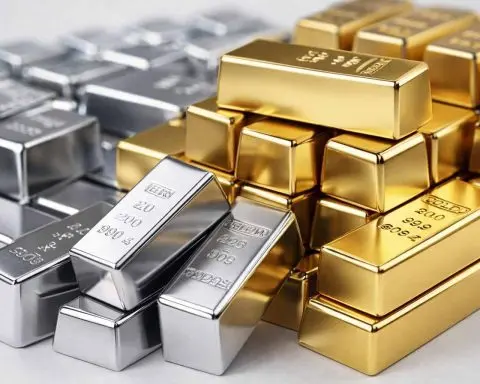
On Tuesday, 9 December 2025, India’s precious metals market hit a patch of turbulence. MCX gold futures slipped by more than ₹800 per 10 grams and silver fell over ₹1,400 intraday, even as global prices hovered near record territory around $4,200 an ounce ahead of the crucial US Federal Reserve meeting. A mix of profit‑booking, uncertainty over the pace of US rate cuts, and softer wedding‑season demand weighed on domestic prices. AajTak+2Moneycontrol+2
At the same time, data from bullion associations and price trackers show that physical bullion and retail jewellery rates moved only modestly. IBJA’s benchmark 24‑carat rate eased by around ₹800, while most large cities including Delhi, Mumbai, Jaipur, Chennai and Bengaluru quoted 24K gold roughly in the ₹1.30–1.31 lakh per 10‑gram bracket and 22K around ₹1.19–1.20 lakh. AajTak+2The Financial Express+2
Silver, in contrast, continued to shine. Nationally, wholesale prices climbed back toward record territory near ₹1.90 lakh per kilogram, even as MCX contracts briefly corrected, underlining the metal’s dual role as both safe haven and industrial workhorse. Goodreturns+1
Below is a detailed look at gold and silver prices on 9 December 2025, city‑wise trends in India and Rajasthan, and what analysts expect next as the Fed meets this week.
MCX gold and silver: sharp intraday fall from record highs
According to Aaj Tak’s commodity desk, MCX gold futures on 9 December were trading about ₹800 lower on the day, near ₹1,29,101 per 10 grams, while silver dropped more than ₹1,400 to around ₹1,80,100 per kilogram at the session’s low. AajTak
The correction looks larger when set against recent record highs. On MCX, gold had touched a record around ₹1,34,024 per 10 grams just days earlier, meaning prices are still roughly ₹4,900 below that peak. Silver’s all‑time high near ₹1,85,234 per kilogram is about ₹5,200 above Tuesday’s intraday low. AajTak
Real‑time data from GoodReturns paints a similar picture: at around 11:43 a.m. IST on 9 December, the December MCX gold contract was trading near ₹1,29,120 per 10 grams, down ₹842 or 0.65 per cent from the previous close after opening close to ₹1,30,045. Goodreturns
On the spot side, Aaj Tak, citing early IBJA bullion rates, put 24K (999 purity) gold at about ₹1,27,409 per 10 grams on 9 December, roughly ₹800 lower day‑on‑day, while silver’s wholesale benchmark eased by around ₹2,000 to ₹1,77,054 per kilogram. AajTak Moneycontrol later reported IBJA’s 999‑purity quote moving to around ₹1,28,592 per 10 grams in the 12:30 rate session, underscoring how quickly intraday benchmarks are fluctuating. Moneycontrol
In short: MCX futures are reacting aggressively to global cues and leveraged positioning, while IBJA spot rates and physical markets are registering a more gradual cooling after an extraordinary rally.
Gold price today in India: 24K and 22K city‑wise rates
GoodReturns’ all‑India dashboard shows that on Tuesday, 9 December:
- 24K gold in India was quoted around ₹13,009 per gram – roughly ₹1,30,090 per 10 grams – after a modest ₹33 per gram correction from Monday’s spike.
- 22K gold slipped by ₹30 per gram to around ₹11,925, or ₹1,19,250 per 10 grams.
- 18K gold eased to about ₹9,757 per gram (about ₹97,570 per 10 grams). Goodreturns
Financial Express, using IBJA’s evening rate card, reported broadly similar levels across the big metros with small variations. On 9 December, 24K gold per 10 grams was quoted at approximately: The Financial Express
- Delhi: ₹1,29,700
- Mumbai & Pune: ₹1,29,930
- Chennai: ₹1,30,300
- Bengaluru: ₹1,30,030
- Ahmedabad & Surat: ₹1,30,100
In the same list, 22K rates clustered around ₹1,19,200–₹1,19,450 per 10 grams, while 18K jewellery gold hovered near ₹97,500–₹97,700. The Financial Express
A Rajasthan‑focused roundup from Shekhawati Live, which collated 9 December sarafa rates in ten big Indian cities, shows slightly higher street‑level quotes once jeweller margins and local taxes are added. In that survey: Shekhawati Live
- 24K gold was about ₹1,30,580 per 10 grams in Delhi, Lucknow and Jaipur,
- around ₹1,30,430 in Mumbai, Kolkata, Bengaluru and Hyderabad, and
- ₹1,31,340 in Chennai.
Corresponding 22K rates ranged between ₹1,19,560 and ₹1,20,390, while 18K gold in Delhi, Jaipur and Lucknow was pegged near ₹97,980 per 10 grams. Shekhawati Live
The differences between IBJA benchmarks, MCX futures and local jeweller quotes highlight just how fragmented pricing has become: wholesale spot indices show a mild pullback, while retail showrooms often build in a premium to account for volatility, hedging costs and expectations that prices could rebound after the Fed decision.
Spotlight on Rajasthan: Jaipur and key sarafa markets
For Rajasthan – the focus of several Hindi‑language updates – Tuesday’s trading brought only modest relief to buyers after months of relentless price rises.
The Shekhawati Live grid indicates that Jaipur’s 24K gold price stood around ₹1,30,580 per 10 grams, with 22K at about ₹1,19,710 and 18K near ₹97,980, broadly in line with Delhi and Lucknow. Shekhawati Live
Regional coverage from Hello Rajasthan suggests that across the state’s main bullion hubs – Jaipur, Bikaner, Udaipur, Jodhpur, Ajmer, Kota and Bharatpur – 24K gold was marginally cheaper than earlier in the week, while silver recorded a day‑on‑day gain of roughly ₹616 per kilogram on 9 December. Hello Rajasthan
Dealers quoted in these local reports also flag an important demand‑side shift: even in the peak wedding season, many middle‑class households are trimming budgets or delaying purchases because of the steep price level, leading to weaker‑than‑expected jewellery offtake. Aaj Tak echoes this theme, noting that muted wedding‑season demand has been an additional drag on prices alongside global factors. AajTak
Silver price today: record levels even as MCX corrects
While gold has paused for breath, silver continues to steal the limelight.
GoodReturns data shows that on 9 December: Goodreturns
- The benchmark silver price in India hit about ₹1,90,000 per kilogram, up ₹1,000 from Monday’s ₹1,89,000 and marking one of the highest levels on record.
- Per‑gram rates moved from ₹189 to ₹190, with 10 grams priced around ₹1,900.
Shekhawati Live’s Delhi snapshot points to similar levels, with the capital’s retail silver rate around ₹1,88,900 per kilogram, down about ₹100 on the day but still extremely elevated versus earlier in the year. Shekhawati Live A separate Financial Express feature earlier this year highlighted that silver prices have roughly doubled in about eleven months, comfortably outpacing gold’s rally. The Financial Express+1
On the futures side, Aaj Tak’s MCX‑focused piece underlines that the December silver contract slid more than ₹1,400 to around ₹1,80,100 per kilogram intraday before recovering, even as physical and retail rates held near record territory. AajTak
Under the hood, fundamentals remain supportive. The Times of India notes that silver ETFs have seen year‑to‑date inflows equivalent to over 4,100 tonnes, while warehouse stocks at Chinese exchanges have dropped to around decade‑low levels – a combination that has squeezed available supply and helped fuel the rally. The Times of India Its commodity desk remains bullish, arguing that, barring a sharp deterioration in risk appetite, spot silver could extend toward $62–65 per ounce in the coming weeks or months, albeit with high volatility. The Times of India+1
Global gold market: parked near $4,200 ahead of the Fed
Globally, gold is still trading in rarefied air.
Moneycontrol reported spot gold at about $4,196 an ounce early on 9 December, up roughly 0.13% over the previous 24 hours, even as Indian MCX futures slipped on rupee strength and local profit‑taking. Moneycontrol+1
Analyses from FXStreet and DailyForex describe the current phase as a bullish trend taking a breather: gold is “comfortable” above $4,200 but reluctant to break higher while traders wait for the Federal Reserve’s final policy decision of 2025. Technical strategists see strong support zones around $4,160–4,110–4,070 per ounce, with resistance near $4,240–4,300 and the existing all‑time high region around $4,380–4,381. DailyForex+2The Times of India+2
Tuesday’s macro backdrop was mixed. The US Dollar Index hovered around the high‑90s, while the 10‑year US Treasury yield climbed above 4.1% on heavy government bond issuance – both typically headwinds for gold. Yet Fed funds futures and FedWatch probabilities still imply roughly a 90% chance of a 25‑basis‑point rate cut at the 10 December Fed meeting, with markets expecting another cut by April. The Times of India+1
The World Gold Council’s 2026 outlook underlines just how extraordinary 2025 has already been: by late November, gold had delivered about a 61% total return, driven by an unusually balanced mix of four key factors – economic expansion, heightened risk and uncertainty, changes in opportunity cost (real yields and currency moves) and powerful price momentum. World Gold Council+1 The Council cautions that such outsized gains raise the odds of sharp pullbacks, but argues that persistent geopolitical and macro risks mean gold is still likely to play a central role in diversified portfolios next year.
What analysts are saying: buy the dip or stay cautious?
A detailed gold‑price outlook published by The Times of India on 9 December strikes an overall constructive tone for the metal in the near term. The piece highlights: The Times of India
- Rate‑cut expectations (markets see a 25 bps Fed cut this week and another by April),
- Rising US fiscal concerns and growing term premia on Treasuries,
- A deteriorating US job market, and
- Trade flows disrupted by tariff wars and geopolitics,
as the core supports for bullion. It notes that global gold ETF holdings have climbed about 18% year‑to‑date to their highest levels since October, even as eligible COMEX inventories have fallen nearly 19% from their April 2025 peak – a combination pointing to tight supply in “investable” gold. The Times of India
The same analysis points out that China’s central bank (PBoC) has now extended its gold‑buying streak to a 13th consecutive month, recently adding roughly one tonne to its reserves. At the same time, the Bank for International Settlements (BIS) has warned that surging retail demand has made gold behave more like a speculative asset than a pure safe haven, with both equities and gold rallying together in a way rarely seen over the past half‑century. The Times of India
GoodReturns quotes derivatives strategists who argue that gold “remains well‑positioned for further gains” as long as it holds above the key technical support band around $4,160, with deeper monetary easing, renewed geopolitical flare‑ups or a sustained drop in real yields all capable of reigniting the up‑trend. Goodreturns+1 Their base case, similar to the TOI view, is that sizeable dips towards those support zones are likely to attract fresh buying.
On silver, analysts are even more upbeat. Times of India’s commodity desk continues to recommend a “buy on dips” approach, suggesting downside risk limits just below $56–54 per ounce and upside targets around $62 in the coming weeks or months, bolstered by strong ETF inflows, low inventories and a supportive gold‑to‑silver ratio. The Times of India+1
Why MCX prices are falling despite strong long‑term fundamentals
Given this broadly bullish backdrop, why did Indian futures tumble on 9 December?
One key reason is positioning. Gold has delivered between 60% and over 100% gains over the past three years depending on the starting point, so many leveraged traders on MCX are quick to lock in profits ahead of big macro events like a Fed meeting. GoodReturns notes that Tuesday’s pullback comes immediately after a single‑day jump of about ₹2,500 per 10 grams, leaving the market vulnerable to even a small wobble in sentiment. Goodreturns+1
Aaj Tak’s report also stresses domestic factors. It cites:
- Confusion over the Fed’s exact rate‑cut path,
- Wedding‑season jewellery demand that is weaker than expected, and
- Lack of progress in US–India tariff negotiations
as drivers of the latest correction. AajTak+1 Meanwhile, Moneycontrol and GoodReturns both highlight that the rupee has strengthened slightly toward ₹90 per US dollar, which naturally eases local import costs and helps cap domestic gold prices even when dollar‑denominated bullion is steady or rising. Moneycontrol+1
Put together, the 9 December slide looks less like the start of a structural bear market and more like a textbook “event‑risk shake‑out” after an overheated rally.
What it means for Indian buyers and investors
For jewellery buyers
For families planning weddings in 2026, the latest dip is welcome – but it doesn’t magically make gold “cheap” again. Despite the correction, 24K gold around ₹1.30 lakh per 10 grams and 22K near ₹1.19 lakh remain far above levels seen even a year ago. City‑wise spreads show that shopping around can save you a few hundred rupees per 10 grams – Jaipur, Delhi and Lucknow, for instance, share similar rate bands – but not thousands. The Financial Express+1
If your jewellery purchase is date‑bound (for a fixed wedding or festival), most advisers suggest:
- Splitting purchases into tranches instead of betting everything on a single day’s dip,
- Locking in core pieces early, and
- Leaving only optional items to “timing” the market.
For long‑term investors
For long‑term investors using gold ETFs, digital gold, or sovereign gold bonds, the day‑to‑day noise is less important than your overall allocation. Research from the World Gold Council emphasises gold’s role as a strategic diversifier, particularly in regimes of elevated macro and geopolitical uncertainty like 2025–26. World Gold Council+1
A simple, evidence‑based approach is to:
- Decide on a target gold allocation (for example, 5–10% of your portfolio, depending on your risk profile),
- Build that position gradually via SIP‑style investments, and
- Rebalance periodically instead of chasing every spike or dip.
For silver enthusiasts
Silver offers higher potential upside – and higher risk. With prices near record rupee levels and analysts talking about $62–65 per ounce targets, the metal can move very fast in both directions. The Times of India+2The Times of India+2 Retail investors considering silver ETFs or futures should:
- Be prepared for large swings,
- Use clear stop‑loss levels, and
- Avoid over‑concentrating in a single volatile asset.
A final word of caution
All the numbers in this article are indicative snapshot rates from 9 December 2025. Actual prices will vary by city, jeweller, purity, and time of day, and can change multiple times within a single session. None of the forecasts or levels cited here are guarantees.
Before making any large gold or silver purchase – whether for investment or for jewellery – it’s wise to:
- Cross‑check live prices with your local jeweller or trading app, and
- Consult a qualified financial adviser who understands your goals, time horizon and risk appetite.
Gold and silver may both be glittering near record highs, but the smartest strategy is still the old one: buy thoughtfully, diversify sensibly, and never risk money you can’t afford to lose.