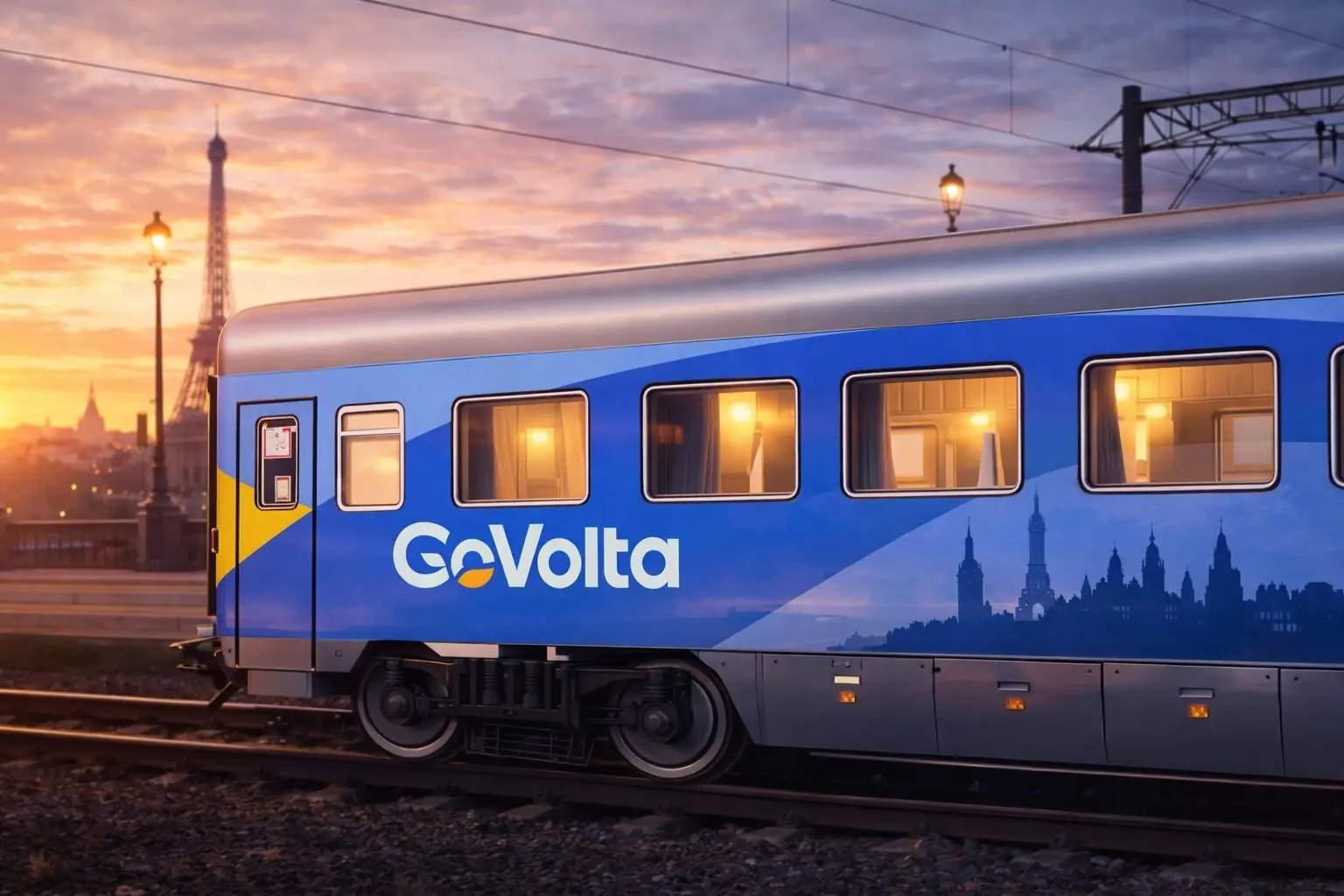
As of December 14, 2025, Europe’s rail travel conversation is shifting toward price, simplicity, and cross-border competition—just as the Netherlands moves into a new national rail timetable for 2026. IamExpat in the Netherlands
Into that moment steps GoVolta, a new privately owned Dutch international rail company positioning itself as a budget-friendly alternative to flying and driving, with direct daytime trains from Amsterdam to Berlin and Hamburg starting in March 2026—and an Amsterdam–Paris expansion planned for December 2026. Dutchnews
GoVolta at a glance
GoVolta’s pitch is simple: low headline fares, a guaranteed seat, and direct routes—paired with optional “airline-style” extras like paid large luggage and seat upgrades. The Independent
Here’s what’s confirmed so far:
- Launch dates: Amsterdam–Berlin starts March 19, 2026; Amsterdam–Hamburg starts March 20, 2026. International Railway Journal
- Frequency at launch: Berlin 3x weekly (Tuesday, Thursday, Sunday); Hamburg 3x weekly (Monday, Wednesday, Friday). International Railway Journal
- Planned upgrade: both routes are expected to scale up to daily service from summer 2026. International Railway Journal
- Entry pricing: fares from €10 one-way in the lowest category; GoVolta and multiple reports describe €10 seats as a limited allocation, with the rest priced dynamically. keolis.nl
- Network plan: a daily Amsterdam–Paris service is targeted for December 2026, with longer-term ambitions including routes toward Frankfurt, Munich, Copenhagen, Bruges and Basel. Railvolution
Why this matters for travelers right now
International rail has a reputation for being hard to compare and expensive at peak times, especially on popular corridors like Amsterdam–Berlin. GoVolta’s founders say they’re trying to make international train travel feel as straightforward as booking a flight—“affordable tickets and always a guaranteed seat,” as co-founder Maarten Bastian puts it. The Independent
That message has landed quickly: Railvolution reports that when ticket sales went live during a press event in Breda, GoVolta counted 452 tickets sold within the first hour. Railvolution
At the same time, the Dutch rail network is entering a new timetable cycle (effective December 14, 2025) with expanded services and adjusted departures—meaning travelers are already paying attention to what changes in rail travel look like in 2026. IamExpat in the Netherlands
Routes and stops: where GoVolta trains will call
GoVolta is launching with two daytime international routes from Amsterdam Centraal, stopping at several Dutch and German cities along the way.
Amsterdam–Berlin will stop at: Amersfoort, Deventer, Hengelo, Bad Bentheim, Osnabrück, Hannover, and terminate initially at Berlin Gesundbrunnen (with a planned switch to Berlin Spandau later in 2026). International Railway Journal
Amsterdam–Hamburg will stop at: Amersfoort, Deventer, Hengelo, Bad Bentheim, Bremen, and run through to Hamburg-area stations (including Hamburg Hbf and Hamburg-Harburg, depending on the working). International Railway Journal
A key traveler-facing detail: the services are designed as same-day return trips—departing Amsterdam in the morning and returning from Germany later the same day. International Railway Journal
Timetables: the published departure and arrival times
International Railway Journal (IRJ) has published specific scheduled times for both routes:
- Amsterdam–Berlin: depart 08:34, arrive 15:20; return departs 15:46, arriving Amsterdam 23:55. International Railway Journal
- Amsterdam–Hamburg: depart 08:05, arrive 13:26; return departs 14:21, arriving Amsterdam 20:26. International Railway Journal
These times give GoVolta a clear “day train” identity: early starts, city-center to city-center travel, and late arrivals back in Amsterdam.
How the €10 tickets work — and what you’ll likely pay in practice
The headline that’s getting attention is the €10 fare. Multiple reports, including IRJ and Railvolution, say about 10% of seats will be sold at €10, with the remainder priced via a dynamic pricing model that rises with demand (similar to airline revenue management). International Railway Journal
GoVolta and Keolis also state that the average one-way fare on Amsterdam–Berlin is expected to be around €30. Keolis
DutchNews.nl frames the €10 offer more concretely as “the first 100 seats” at the lowest price point, suggesting early-booking availability is central to how travelers will actually secure the cheapest fares. Dutchnews
What’s included and what costs extra
GoVolta’s “low-cost” approach isn’t only about cheaper base fares—it’s also about charging for specific add-ons.
Guaranteed seat, with seat selection tools
A consistent promise across coverage and official statements is that every passenger gets a reserved seat—no standing-room tickets. Railvolution
Keolis and GoVolta also describe a seat map feature during booking, letting travelers pick their seat. Keolis
Two classes, plus an “XL Duo Seat” option
GoVolta plans two onboard classes:
- Economy Class (standard seating)
- Comfort Class (quieter environment, more space, including a 2–1 layout) Keolis
There’s also an unusual add-on: the XL Duo Seat, where two passengers can book the opposing seats in a four-seat bay for extra space (or to control orientation). International Railway Journal
Luggage rules like an airline
The basic ticket includes two pieces of hand luggage, while large or extra luggage must be booked in advance for a fee—a model repeatedly compared to budget airlines. DutchNews.nl
Lounge car and onboard services
Each train is planned to include a lounge car offering drinks, snacks, and light meals. Railvolution
One trade-off: DutchNews.nl reports there will be no Wi‑Fi on board. Dutchnews
Speed and journey time: cheaper, but slower
Part of how GoVolta keeps costs down is operating on classic routes and using rolling stock with lower top speeds than high-speed rail.
DutchNews.nl reports journey times of 6h 35m Amsterdam–Berlin and 7h 45m on the return, noting this is slower than the current NS/Deutsche Bahn offering. Dutchnews
Euronews also highlights that GoVolta’s trains are expected to top out at 160 km/h, which can add time compared with faster services. euronews
For many budget travelers—especially those prioritizing price over shaving off an hour—the value proposition is still clear: direct routes, city-center stations, and pricing designed to compete with budget flights.
How GoVolta compares with today’s Amsterdam–Berlin and Amsterdam–Hamburg options
The competitive impact is clearest on two fronts:
Amsterdam–Berlin already has trains, but pricing and complexity frustrate travelers
DutchNews.nl says NS and Deutsche Bahn currently operate seven services a day between Amsterdam and Berlin—so the route is well served, but not always cheap or easy for casual travelers to price-shop. Dutchnews
For context on pricing, NS International advertises Amsterdam–Berlin tickets from €38 (with a fastest journey time listed around 5h 51m). NS International
Amsterdam–Hamburg becomes a direct daytime route
DutchNews.nl notes that the connection to Hamburg is “entirely new” in direct daytime form—today, travelers typically need at least one change on NS/DB. Dutchnews
If GoVolta executes reliably, the Hamburg route could be the sleeper hit: it’s not just about cheaper fares, but about eliminating transfers for a major city-pair.
Open-access rail and the rules behind it
GoVolta is described as an open-access operator—meaning it runs commercial services on existing infrastructure rather than operating under a public service contract. Railvolution
Two policy details matter to passengers:
- No domestic trips within the Netherlands: Railvolution says GoVolta’s trains are only accessible for international passengers, and travel solely within the Netherlands on these services is not allowed (a cabotage restriction tied to Dutch concession rules). Railvolution
- Regulatory change and competition: DutchNews.nl connects the launch to regulatory changes allowing new operators on international routes previously served exclusively by NS. Dutchnews
Railvolution also reports that applications related to “economic equilibrium” checks have been submitted to the Dutch rail regulator (ACM) as GoVolta looks toward future expansion. Railvolution
Rolling stock, operations, and who runs the trains
GoVolta isn’t building trains from scratch. IRJ reports the company has purchased 11 second-hand Belgian type I10 coaches from SNCB, including two first class (Comfort), eight second class (Economy), and one lounge car, and plans significant refurbishment. International Railway Journal
Operationally, the model is partnership-driven:
- Keolis Netherlands: train operations (including drivers, planning, daily execution). Keolis
- Brouwer Technology: engineering and maintenance responsibilities (as described in official communications). Keolis
IRJ adds that services are expected to run under Keolis’s safety certificate, with plans to ensure the approvals needed for German operation by launch. International Railway Journal
Paris next: what the Amsterdam–Paris plan looks like
GoVolta’s next confirmed step is an Amsterdam–Paris route planned for December 2026, positioned as a budget alternative to existing high-speed options. GoVolta
Railvolution says GoVolta intends to avoid high-speed lines and instead take a “classic route” with a border crossing at Roosendaal, with route variants still to be finalized (including potential paths via Brussels/Mons/Aulnoye-Aymeries/Creil or Ghent and Lille). Railvolution
That choice strongly suggests GoVolta’s Paris service is aimed at travelers for whom price beats speed—especially those who would otherwise fly.
What travelers should watch before booking
If you’re considering GoVolta for a spring or summer 2026 trip, the biggest practical questions are:
- How quickly the €10 allocation sells out on popular days, given the limited number of lowest-price seats. International Railway Journal
- Total trip cost after add-ons (large luggage, seat choices, upgrades). DutchNews.nl
- Journey time trade-offs versus ICE/Eurostar-style services—especially if you’re connecting onward the same day. Dutchnews
- Distribution and booking channels: tickets are sold via GoVolta’s own platform, with IRJ and Railvolution noting distribution via other channels including DB, while not being available via NS. International Railway Journal
Bottom line
GoVolta’s upcoming €10 Amsterdam–Berlin and Amsterdam–Hamburg trains are shaping up to be one of the most talked-about European rail launches for 2026—because they go after the two biggest pain points in cross-border rail: price and planning friction. DutchNews.nl
If the operator can deliver reliability while keeping fares consistently attractive—even when the €10 seats are gone—it could force a broader rethink of how international rail is sold in Northwest Europe. And with Paris on the roadmap for late 2026, GoVolta is clearly betting that “low-cost rail” can become a category travelers actively search for, not just a once-in-a-while bargain. GoVolta