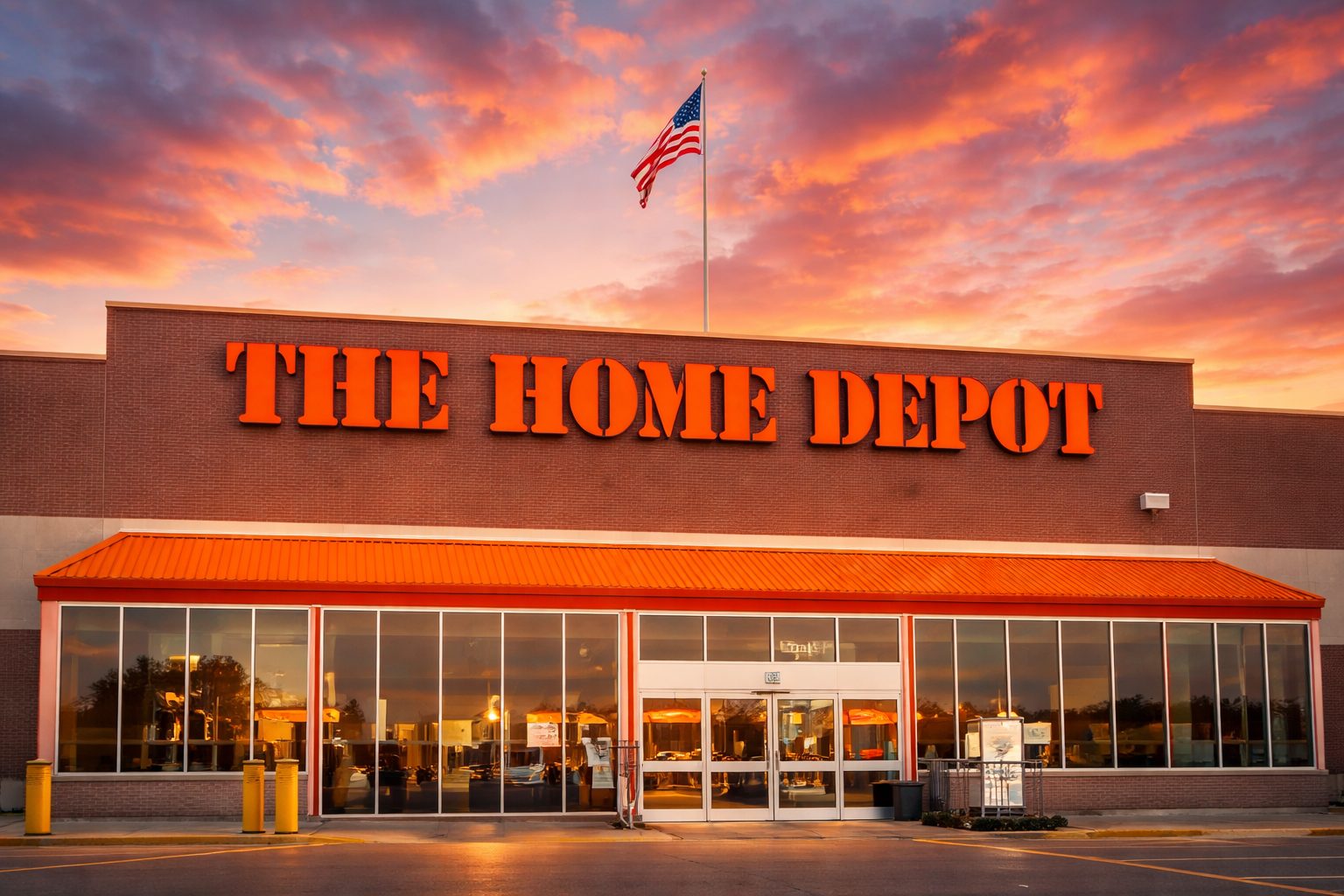
On December 25, 2025—Christmas Day—The Home Depot, Inc. (NYSE: HD) is off the retail grid in the most literal sense: the company’s U.S. stores are closed for the holiday, with operations set to resume as normal afterward.
But Wall Street isn’t taking the day off from reassessing what Home Depot has been signaling for weeks: a cautious baseline outlook for fiscal 2026, a still-sluggish home improvement cycle, and a strategy that is increasingly defined by two words executives keep circling back to—the Pro customer.
Below is a full roundup of the current news, forecasts, and market analysis shaping Home Depot as of December 25, 2025, written in a publication-ready style for Google News and Discover.
Today’s headline reality: Home Depot is closed on Christmas, but the 2026 outlook debate is wide open
Home Depot published its official 2025 holiday store hours, confirming it would close on December 25, 2025, following an early close on Christmas Eve.
For investors, however, the bigger “today” story is the one that started earlier this month: Home Depot’s December 9 strategic update and investor-day messaging, which set expectations for 2026 that are best described as “steady, not surging.” Home Depot Investor Relations
That conservative tone is why Home Depot remains one of the most watched bellwethers for the U.S. consumer, housing turnover, and big-ticket discretionary spending—especially heading into 2026, when many investors had hoped for a cleaner rebound.
The big forecast: What Home Depot is projecting for fiscal 2026
At its December strategic update, Home Depot laid out two key scenarios investors are now using as the framework for 2026:
1) The baseline fiscal 2026 outlook (cautious)
Home Depot’s preliminary guidance for fiscal 2026 includes:
- Total sales growth:2.5% to 4.5%
- Comparable sales (comps):flat to up 2%
- Diluted EPS:flat to up 4%
2) The “market recovery case” (if housing turns)
Home Depot also provided an upside scenario tied to a stronger market environment—essentially arguing that a housing and larger-project recovery would quickly change the narrative.
Independent coverage of that investor-day message underscored the same takeaway: Home Depot is not assuming the home improvement market suddenly snaps back in 2026, even if borrowing costs ease.
How that compares to Wall Street expectations
Reuters reported that Home Depot’s 2026 comps range came in below what analysts were modeling at the time (LSEG data), and that the EPS growth outlook also trailed consensus growth assumptions.
This gap—between “what the Street hoped” and “what management is willing to underwrite”—is why Home Depot’s 2026 story is being treated less like a rebound trade and more like a timing and execution test.
Where Home Depot stands now: Q3 fiscal 2025 results and updated 2025 guidance
The other anchor for the 2026 discussion is Home Depot’s most recent quarterly performance.
In its third quarter fiscal 2025 results (reported November 18, 2025), Home Depot posted:
- Net sales:$41.352 billion, up 2.8% year over year
- Comparable sales:flat overall (with U.S. comps slightly positive)
- Adjusted diluted EPS:$3.74
Those results were paired with updated full-year expectations that signaled continued pressure in big-ticket and discretionary projects.
Updated fiscal 2025 guidance (reaffirmed again on Dec. 9)
Home Depot’s fiscal 2025 guidance (a 52-week year) includes:
- Total sales growth: ~3%
- Comparable sales growth:slightly positive
- Diluted EPS: expected to decline ~6% versus fiscal 2024
- Adjusted diluted EPS: expected to decline ~5% versus fiscal 2024
Reuters also framed the November update in the context of tariff-driven uncertainty, higher costs, and a consumer still deferring larger projects—pressures that help explain why Home Depot has not yet put a bold recovery number on 2026.
Strategy focus: Home Depot is doubling down on Pros—and using acquisitions to do it
If you want the simplest explanation of Home Depot’s medium-term plan, it’s this:
DIY may stabilize the business, but Pros are the growth algorithm.
Home Depot has been building out what it describes as a more complete Pro ecosystem—one that supports everything from quoting and fulfillment to jobsite delivery and credit.
The acquisitions that define the “Pro flywheel”
A major recent milestone: Home Depot (through its specialty distribution subsidiary SRS Distribution) completed the acquisition of GMS Inc. on September 4, 2025, at an enterprise value of about $5.5 billion.
Home Depot positioned GMS (drywall, ceilings, steel framing and related products) as a complementary expansion that helps SRS serve the Pro across more categories and project types—explicitly highlighting cross-selling and deeper Pro “share of wallet” goals. Home Depot Investor Relations
This is strategically important because it reflects a shift away from relying solely on consumer-driven DIY cycles. Instead, Home Depot is increasingly tying its growth to professional repair/remodel and trade distribution—segments that can remain active even when home sales slow.
Tech and productivity: AI tools and “one-stop” quoting aim to make Home Depot stickier for contractors
Home Depot’s Pro story is not just about product breadth—it’s also about workflow.
On November 19, 2025, the company announced an AI-powered Blueprint Takeoffs solution designed to speed up material lists and quotes for single-family project blueprints, reducing what it says used to take weeks down to a timeline measured in days.
The implication is straightforward: if Home Depot can become the fastest path from blueprint → quote → cart → delivery, it can win more of the Pro’s spending even in a slow housing market—because time savings and reliability matter more when demand is uncertain.
New revenue streams: Home Depot’s Creator Portal pushes further into performance marketing
Home Depot also used December to highlight a different kind of growth lever: monetizing influence and demand generation.
On December 10, 2025, the company introduced a Home Depot Creator Portal, framing it as a way to connect creators and influencers with home improvement audiences and create “new revenue opportunities.” Home Depot Investor Relations
In the same announcement, Home Depot reiterated its scale as the world’s largest home improvement specialty retailer, citing:
- 2,356 retail stores
- over 1,200 SRS locations
- more than 470,000 associates
For investors, initiatives like this typically sit in the broader bucket of retail media, affiliate commerce, and digital monetization—areas where big retailers increasingly try to add higher-margin revenue streams without needing the underlying home improvement market to boom.
Cybersecurity becomes part of the Home Depot narrative again
One of the most notable “risk headlines” of December didn’t come from earnings—it came from cybersecurity reporting.
What was reported
A security researcher said a private GitHub access token tied to a Home Depot employee had been exposed online for an extended period—potentially enabling access to internal code repositories and other systems—before being revoked after media outreach.
Why this matters for business coverage:
- Even without confirmed customer impact, stories like this can elevate scrutiny on governance and controls.
- Home Depot’s long-term thesis leans heavily on digital execution (fulfillment, inventory visibility, Pro workflows), which makes operational trust and resilience more central to valuation than in a purely store-based retail model.
This issue also echoes a broader corporate reality: large companies increasingly face “soft underbellies” in developer tooling, credentials management, and third-party access—especially as software supply chains become more complex.
Reputational and social pressure: store environment controversy and boycott calls
Home Depot also appeared in non-financial headlines this month.
- A report focused on a Los Angeles Home Depot location drew criticism from advocates regarding the installation of high-pitched noise devices, with Home Depot saying they were related to safety and preventing overnight parking.
- Separately, a broader holiday-season boycott campaign referenced Home Depot among retailers targeted by some activist groups.
For most investors, these stories don’t change near-term comps. But they can influence brand perception and raise questions about store-level decision-making and communications—especially in a cycle where demand is already sensitive.
Shareholder returns: Home Depot declared another quarterly dividend
On November 20, 2025, Home Depot declared a quarterly cash dividend of $2.30 per share, payable December 18, 2025, and noted it was the company’s 155th consecutive quarter paying a cash dividend.
In an uncertain demand environment, Home Depot’s continued dividend cadence is part of what keeps the stock on the radar for income-focused investors—particularly those who view housing-linked weakness as cyclical rather than structural.
Analyst forecasts and sentiment: what the market is watching heading into 2026
As of December 25, most “HD stock” analysis is converging on a short list of variables:
1) Housing turnover and big-ticket project demand
Home Depot itself has been clear that the recovery requires a catalyst in housing activity—and that the company hasn’t seen it yet.
2) Comparable sales trajectory
Investors are focused on whether comps can reliably move from “slightly positive” in fiscal 2025 into the upper half of the 2026 range—or whether the company stays stuck near flat. Home Depot Investor Relations
3) Margin pressure vs. productivity gains
Tariffs, wages, and logistics costs were among the pressures highlighted in coverage around Home Depot’s November earnings update, reinforcing why 2026 EPS expectations are being debated so intensely.
4) Pro ecosystem execution (SRS + GMS integration)
Home Depot is telling the market it can grow with Pros across entire project lifecycles. The integration and cross-selling reality—over the next several quarters—will be a key proof point.
5) Street-level price targets
Analyst price targets vary by methodology, but aggregation services in late December generally show:
- A consensus rating around “Moderate Buy”
- Average 12-month price targets clustering in the low $400s
These numbers are best read as a sentiment snapshot, not a guarantee—especially in a rate- and housing-sensitive category where expectations can reset quickly.
The takeaway for December 25: Home Depot is positioning for a recovery—but refusing to bet on its timing
As Christmas 2025 closes out, Home Depot is effectively delivering two messages at once:
- Near term: The home improvement market is still under pressure, and Home Depot is managing expectations with a cautious 2026 baseline.
- Medium term: When housing and larger projects normalize, Home Depot believes its Pro-focused ecosystem, distribution acquisitions (SRS + GMS), and productivity tools can power a stronger rebound than the baseline suggests.
In other words, the Home Depot story heading into 2026 is not “can it grow?”—it’s when the market gives it room to accelerate, and whether the company can keep building structural advantages while it waits.
This article is for informational purposes and reflects publicly reported information available as of December 25, 2025.