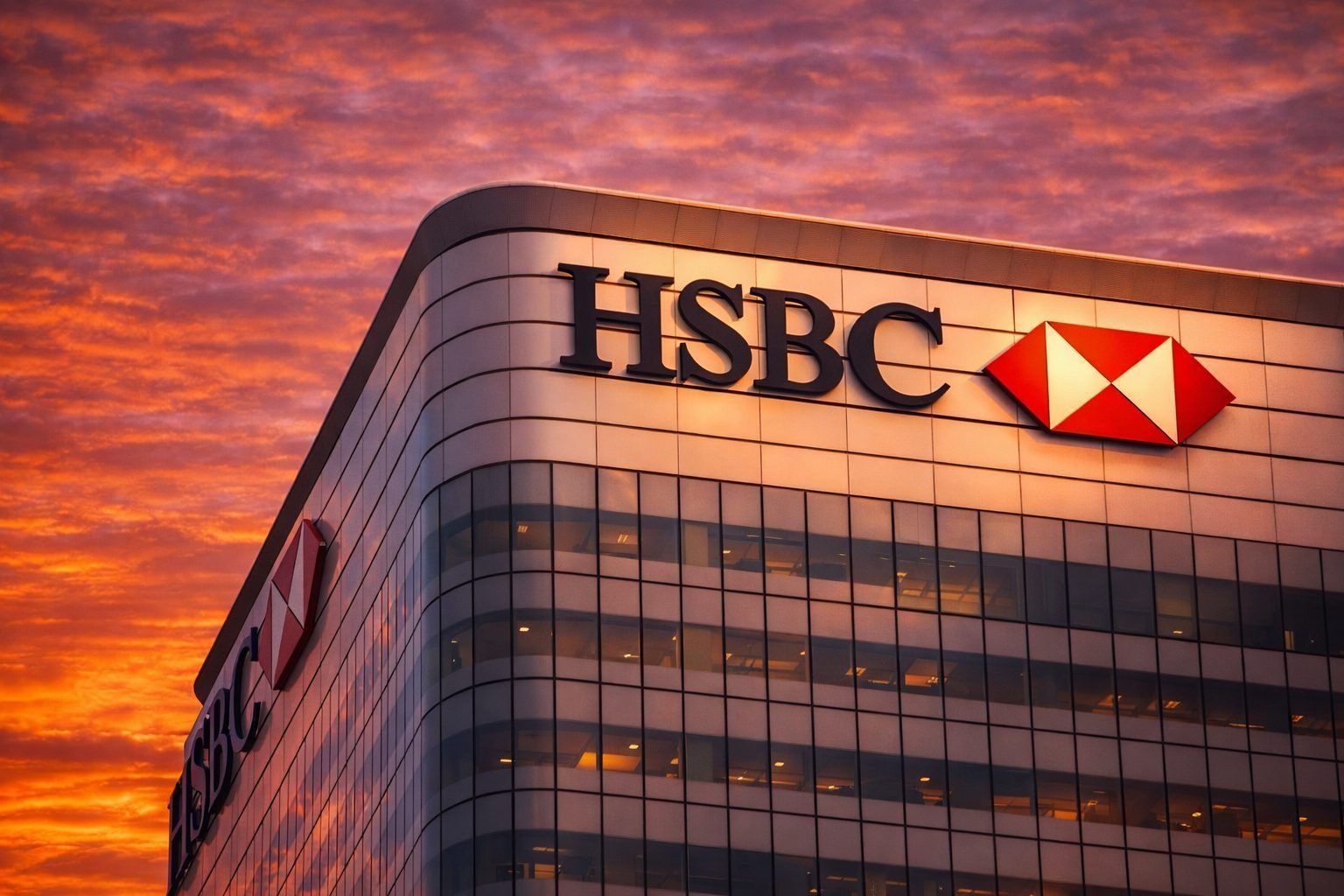

HSBC Holdings plc is heading into Christmas Eve with its shares hovering around multi-month highs across its major listings — and the story behind that strength is less about a single headline and more about a bunch of moving parts snapping into place at once: leadership changes in wealth, a major Hong Kong deal moving toward a vote, continued investment in automation and AI, and the late‑2025 interest‑rate backdrop that’s reshaping bank earnings expectations for 2026.
As of 07:26 GMT on 24 Dec 2025, HSBC’s investor site showed the group’s key listings at 1,175.20p in London (HSBA), HK$123.80 in Hong Kong (0005), and $79.28 in New York (NYSE: HSBC ADR) (prices delayed at least 15 minutes).
What’s happening with HSBC stock on Dec. 24, 2025
On the final stretch into the holiday break, HSBC’s London shares pushed to a fresh 52‑week high in the latest session ahead of Dec. 24. MarketWatch reported that on Tuesday, 23 Dec 2025, HSBC rose 0.69% to £11.75, beating the broader market on the day — but with notably lighter trading volume than usual (common around holiday schedules).
That “new high on lower volume” combo isn’t inherently bullish or bearish — it’s just a reminder that Christmas‑week price moves can look bigger than they are, because fewer institutions are putting on new risk.
More importantly, the fundamental narrative investors are trading right now is fairly clear:
- HSBC’s leadership team is doubling down on wealth and fee income (a strategic choice that matters more when policy rates are expected to drift lower).
- A controversial but strategically important Hong Kong transaction — the proposed Hang Seng Bank privatization — has moved from “big idea” to “scheduled vote.”
- The bank is leaning harder into productivity tech, including a multi‑year generative AI partnership.
- Litigation and regulatory costs are still real, but HSBC has been working through them with explicit provisioning and capital guidance.
Wealth management: HSBC makes a high-profile private bank hire
One of the most market-friendly developments late in December is HSBC’s decision to bring in Ida Liu, formerly Citi’s global head of private banking, as CEO of HSBC’s private banking division, effective 5 January 2026. Reuters reported the appointment as part of HSBC’s broader push to become a preferred bank for ultra‑high‑net‑worth clients and sophisticated entrepreneurs — exactly the kind of fee-heavy business mix banks like when net interest margins are under pressure.
HSBC’s wealth push isn’t new — but this kind of hire signals that the bank is treating wealth as a front‑and‑center growth engine, not a side hustle.
Governance: board changes as the chair succession settles
HSBC’s board story has also been in the headlines, and markets tend to like it when governance uncertainty gets resolved.
- Reuters reported that Ann Godbehere, the senior independent director who led the chair search, is expected to retire at HSBC’s 2026 AGM, after a prolonged succession process that drew scrutiny.
- Earlier in December, Reuters also covered HSBC’s move to appoint Brendan Nelson as the permanent chair, after he served in an interim capacity. The chair’s job, among other things, is to oversee CEO Georges Elhedery’s strategy — including a shift toward fee-based income as rate cuts reduce the tailwind from interest income.
This matters for the stock because bank valuations are partly a confidence game: investors want to believe strategy will outlast headlines, and stable governance helps.
The big strategic swing: the Hang Seng Bank privatization vote is now on the calendar
If you want the single “largest domino” risk/reward factor in the HSBC story right now, it’s the planned buyout of minority investors in Hang Seng Bank.
HSBC announced in October that it intends to buy the 36.5% of Hang Seng Bank it does not already own, offering HK$155 per share — a deal Reuters pegged at roughly HK$106.1 billion (about $13.6 billion) and a valuation around $37 billion for Hang Seng. Reuters also reported HSBC planned to pause share buybacks for about three quarters to build capital for the transaction.
Since then, the deal has progressed:
- On 15 Dec 2025, Reuters reported Hang Seng’s independent board committee found the offer fair and reasonable and recommended minority shareholders vote in favor.
- HSBC’s own December shareholder newsletter says a Scheme Document was published on 15 Dec, and that two Hang Seng shareholder meetings are scheduled for 8 January 2026 in Hong Kong, with results expected the same day.
Why investors care (and why it’s not a “free lunch”)
The strategic argument is straightforward: fully owning Hang Seng could simplify group structure and let HSBC align product manufacturing, distribution, and the international network more tightly in its home market of Hong Kong.
But it’s not without controversy. A Reuters Breakingviews column (republished via TradingView) laid out why some investors initially balked: the offer implies Hang Seng is valued at up to ~1.8x book value, while HSBC traded around ~1.3x book, meaning HSBC is paying a meaningful premium without providing precise synergy targets. The same analysis flagged the sensitivity around Hang Seng’s commercial real estate exposure — noting Hong Kong property price declines since 2021 and a sharp rise in problem loans.
For HSBC shareholders, the near-term tradeoff is basically:
- Pros: strategic control, potential longer-term cost/income benefits, and simplification of a long-running “parent/subsidiary double listing” structure.
- Cons: the temporary buyback pause, execution risk, and increased direct exposure to Hang Seng’s credit cycle — particularly anything tied to Hong Kong and mainland Chinese property.
If your investment time horizon is measured in quarters, the buyback pause and deal uncertainty loom large. If it’s measured in years, the strategic value could look more attractive — if credit losses stay contained.
Technology and efficiency: HSBC’s Mistral AI deal is a quiet (but important) lever
On 1 Dec 2025, Reuters reported HSBC signed a multi‑year partnership with French AI firm Mistral AI to accelerate generative AI adoption across the bank, aiming to boost automation, productivity and client service.
HSBC’s own media release adds detail on what the bank actually wants to do with it: support client-facing teams with faster tailored communications, improve financial analysis in document-heavy lending processes, provide multilingual reasoning/translation, and speed up development cycles — with deployment designed around HSBC’s internal systems and governance standards.
Investors shouldn’t treat this as “AI will double earnings next quarter.” Banks are too regulated and too operationally complex for that kind of magic trick. But the market does care about whether large incumbents can bend their cost base without breaking controls — and modern tooling is increasingly part of that story.
Litigation and provisions: HSBC continues to clean up legacy risks
HSBC’s earnings power isn’t only about rates and fees; it’s also about what’s leaking out of the hull.
In late October, HSBC disclosed a major litigation development tied to the Madoff fraud. In a Hong Kong stock exchange announcement dated 27 Oct 2025, HSBC said it would recognize a US$1.1 billion provision in its Q3 2025 consolidated results, estimating an ~15 bps impact on its CET1 ratio — and explicitly stating the provision would be treated as a notable item and would not impact FY25 RoTE excluding notable items or any dividend.
Separately, Reuters reported in December that HSBC was preparing to pay about $300 million to settle a French criminal investigation linked to the “Cum‑Cum” tax scandal (per a Bloomberg report cited by Reuters), with HSBC having already set aside provisions related to the investigation. Reuters
These aren’t small numbers — but for investors, the key question is whether such costs are contained and well-telegraphed, or whether they continue to surprise.
The macro backdrop on Dec. 24: rates and FX are a real part of the HSBC thesis
HSBC is a global bank with deep exposure to the UK, Hong Kong and international trade flows. That makes it unusually sensitive to the shape of global rates and to currency translation effects.
Two macro themes dominate the end‑2025 tape:
- The dollar’s sharp 2025 decline. Reuters reported on 24 Dec 2025 that the U.S. dollar was set for its worst year since 2003, down 9.9% against a basket of currencies — with markets watching 2026 rate expectations closely.
- A broad easing cycle from major central banks in 2025. Reuters reported that major central banks delivered the fastest and largest pace of cuts since the financial crisis era, totaling 850 bps across 32 cuts among G10 central banks in 2025 (Japan being the notable outlier).
For HSBC stock, this macro setup creates a push-pull:
- Rate cuts can pressure net interest income over time (depending on deposit betas and asset repricing).
- FX moves can help or hurt reported results when translated back into USD/GBP.
- Volatile macro often supports demand for wealth advice and cross-border banking, which fits HSBC’s strategy — as long as markets don’t freeze.
Forecasts: what analysts (as compiled by HSBC) expect for 2025–2027
Now for the “numbers people” part.
HSBC publishes a company-compiled consensus built from sell-side analyst estimates. In its 14 Nov 2025 consensus document (based on estimates from 14 analysts), HSBC showed expectations for relatively stable net interest income — but rising fee income and improving profitability through 2026 and 2027.
Key consensus highlights (all figures are HSBC’s company-compiled consensus):
- Banking net interest income (NII):$43.4bn (2025), $43.0bn (2026), $43.6bn (2027) — basically flat.
- Fee and other income:$23.9bn (2025) rising to $27.6bn (2026) and $29.4bn (2027).
- Profit before tax:$28.7bn (2025), $34.3bn (2026), $36.6bn (2027).
- Earnings per share (EPS):$1.16 (2025), $1.51 (2026), $1.67 (2027).
- Dividends per ordinary share:$0.71 (2025), $0.76 (2026), $0.83 (2027).
- CET1 ratio:14.6% (2025), 14.2% (2026), 14.3% (2027).
The interesting “tell” in these forecasts is the mix: analysts are effectively betting HSBC will replace some rate-driven momentum with fee-driven momentum, while keeping credit losses (ECL) near roughly $4bn per year and holding operating expenses broadly stable-to-down. HSBC
Guidance context: HSBC already raised its 2025 NII outlook
HSBC has also been explicit about what it expects in the near term.
In its Q3 2025 reporting cycle, Reuters reported HSBC raised its 2025 net interest income outlook by $1 billion to $43 billion, even while booking a substantial charge tied to litigation.
That $43bn figure matters because it lines up neatly with the 2025 consensus NII — suggesting the market isn’t assuming heroic upside in NII from here. The “upside argument” for the stock, therefore, leans more on fees, costs, capital discipline, and strategic execution than on rates doing something dramatic.
What investors will watch next
Between now and late February, HSBC has three obvious “next catalysts”:
- Hang Seng vote — 8 January 2026. HSBC has flagged the shareholder meetings date in Hong Kong, and investors will be watching both the result and any updated commentary around timing and capital effects.
- HSBC Annual Results 2025 — 25 February 2026. HSBC’s investor calendar lists the annual results date, which should also clarify how management frames 2026 in a lower-rate world.
- Macro reality checks in early 2026. Markets are pricing shifting rate paths and FX moves — and for a global bank with a big international footprint, those cross-currents can matter as much as any single internal initiative.
Bottom line: why HSBC stock is strong — and what could break the story
HSBC’s late‑2025 strength is built on a coherent narrative: simplify the business, focus on Asia and wealth, defend profitability as rates ease, and keep capital robust even while pursuing selective acquisitions.
But the stock is also “priced like a bank that’s doing the hard parts well.” The main ways that narrative could wobble in 2026 are:
- Deal execution risk (Hang Seng) and the possibility that credit losses linked to property are worse than markets expect.
- Faster-than-expected margin pressure if rate cuts accelerate and deposit pricing dynamics shift.
- Further legal/regulatory surprises, even with proactive provisioning.
None of that guarantees trouble — but it does explain why HSBC can hit a new high and still have investors obsessing over January and February dates on the calendar.