
New York, May 19, 2026, 12:26 EDT
- Hut 8 shares dropped 5.5% by midday on Nasdaq. Bitcoin was mostly flat.
- The company plans to put about $16 million into water infrastructure at its River Bend AI data center site in Louisiana.
- The move puts more focus on what investors want to see—if Hut 8 can actually turn big AI-data-center deals into fully funded projects delivered on schedule.
Hut 8 Corp. stock slipped Tuesday, handing back part of this month’s rally. The drop came as the company said it would invest $16 million in infrastructure for its River Bend AI data center campus in Louisiana.
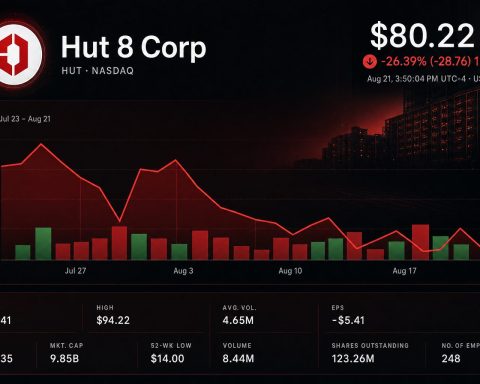
Shares dropped 5.5% to $90.88 on Nasdaq by 12:11 p.m. EDT, moving in a range from $86.91 to $96.20 so far. Bitcoin hovered at $76,486. The price action points to pressure on Hut 8 and related crypto-infrastructure stocks, not on Bitcoin itself.
Timing is key here. Investors are looking to value Hut 8 beyond just a bitcoin miner, betting on the company’s push into power and data-center projects after it locked down major AI campus leases in Louisiana and Texas. That could give Hut 8 a higher valuation. But that relies on the market buying into long-term bets on construction, power supply, and future demand that could take years to play out.
Hut 8 has a deal with West Feliciana Parish to add water capacity around River Bend. The plan features a new well, roughly eight miles of water main, and other upgrades. Once done—expected later in 2026—the parish will get the system, with no charge to taxpayers.
Hut 8 said the upgrades have the potential to help over 4,000 households and more than 200 businesses, according to U.S. Census Bureau numbers. CEO Asher Genoot said the company was building out “not just for ourselves.” West Feliciana Parish President Kenny Havard said it was an investment that aims to expand service “without adding cost for our residents.” PR Newswire
Hut 8 is banking on River Bend as its push into AI infrastructure. The company said the first phase should see about 1,000 construction workers at its peak and create at least 75 permanent roles when up and running. The site is set to use a closed-loop cooling system designed to reuse water and cut long-term demand on the local supply.
Hut 8 shares got their biggest lift this month after it signed a $9.8 billion, 15-year base-term lease for the initial part of its Beacon Point AI data center campus in Texas. The company said the move bumped its contracted AI data center capacity up to 597 megawatts and pushed its total base-term contract value to about $16.8 billion. One megawatt measures power capacity, and in data centers it’s a loose estimate of the computing power a location can handle.
Genoot told Reuters the Beacon Point deal is a 15-year “take-or-pay” and “triple-net” contract from a high-investment-grade counterparty. With take-or-pay, the customer pays for the full contracted capacity even if unused. Triple-net generally means the tenant covers taxes, insurance and maintenance. Reuters
Wall Street is showing more interest in the sector. Jefferies analyst Jonathan Petersen and his team said last week that interconnected power remains “one of the largest bottlenecks,” so bitcoin miners moving into AI data centers have an advantage by using the power they had for mining. Jefferies has started coverage on Hut 8, Cipher Digital, and TeraWulf with buy ratings. Riot Platforms got a hold. That’s according to Investopedia. Investopedia
AI-and-crypto infrastructure names slipped on Tuesday, taking peers with them. Riot dropped 4.1%, TeraWulf shed 3.8%, and Cipher Digital lost 5.6%. The group pulled back after a quick rally.
Hut 8’s first-quarter revenue jumped to $71.0 million from $21.8 million last year, as compute revenue drove the results. The company still posted a net loss of $253.1 million for the quarter, hit by $295.7 million in mostly unrealized digital asset losses. Bitcoin exposure remains part of the picture.
Downside risk for Hut 8 is clear. The miner needs to execute on big, energy-intensive builds in areas where project developers can easily get tripped up by permitting, delays, supply chains, grid limits and rising financing costs. Hut 8 flagged its own risks in the latest update—data center building, getting financing, adding power capacity, cybersecurity, swings in bitcoin price and regulation all came up.
For now, the stock isn’t just trading as a bitcoin stand-in—it’s acting more like an execution name. The fall on Tuesday showed that local infrastructure updates aren’t moving the needle when the sector is out of favor and investors focus on how fast those leases can turn into revenue.