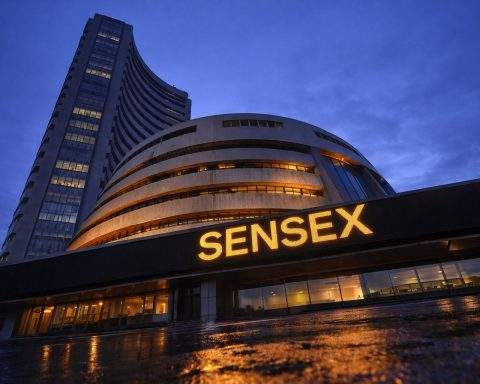
Mumbai | December 24, 2025 — India’s stock market traded with a cautious, year-end calm on Wednesday, as the Sensex and Nifty 50 moved in a tight range on Christmas Eve. Early gains—helped by upbeat global cues after strong U.S. growth data—faded as IT shares slipped, while banks, select metals and pockets of defensives helped keep the downside limited. Reuters+2Business Standard+2
By around midday, the Nifty 50 hovered near 26,185–26,195 and the Sensex stayed close to 85,525–85,560, indicating a “wait-and-watch” session with subdued volumes ahead of the holiday break. Business Standard+1
A key practical factor: Indian exchanges are shut on December 25 for Christmas, with trading resuming on Friday, December 26—a calendar reality that often compresses risk-taking and encourages traders to protect gains into year-end. Moneycontrol
Where Sensex and Nifty 50 stood today: early pop, then consolidation
The day began with a slight positive bias, tracking firmer Asian cues after Wall Street’s fresh highs. In early trade, Nifty 50 rose to 26,216 and the Sensex to 85,628 (around 10:10 a.m. IST), but momentum cooled as the session progressed. Reuters
Around 12 p.m., benchmarks were largely unchanged, and the broader market (mid- and small-caps) showed mild outperformance—another sign that investors are rotating selectively rather than chasing the headline indices. Business Standard+1
This “range-first” tone also reflected weekly derivatives expiry dynamics, which can amplify intraday swings even when broader sentiment is stable. Business Standard
What moved the market: global optimism vs. domestic caution
1) Global cues: U.S. growth lifts sentiment, but inflation lingers
A major tailwind for Asian risk appetite was the latest U.S. data showing Q3 GDP growth at 4.3%, with the S&P 500 closing at a record—supportive for equities broadly, including emerging markets. AP News
However, the same global backdrop includes a “higher-for-longer” inflation debate (with U.S. inflation indicators still elevated), which can keep global rates and bond yields sensitive—often a restraint for high-valuation pockets of equities. AP News
2) Domestic anchor: RBI’s liquidity “firepower” enters the equation
One of the strongest India-specific signals into today’s session was the Reserve Bank of India’s announcement of additional liquidity measures—including ₹2 lakh crore of government bond purchases (OMO) and a $10 billion USD/INR buy-sell swap. Moneycontrol+1
Markets interpreted this as a move to ease tightness caused by tax-related outflows and other liquidity drains. The RBI-linked liquidity narrative mattered for equities because easier liquidity tends to:
- support banking/credit growth sentiment,
- help keep domestic rates from rising too sharply, and
- stabilize risk appetite when foreign flows are inconsistent. The Economic Times+1
Bond markets reacted quickly: benchmark yields fell sharply after the RBI’s plan, reflecting expectations that the OMO calendar could improve demand-supply dynamics. The Economic Times
Sector check: Financials, metals and realty hold up; IT and pharma drag
With volumes thin and conviction limited, sector leadership became the real story:
- Gaining traction: pockets of financials, media, and realty helped keep the market steady. Realty, in particular, rebounded after the prior session’s decline. Business Standard+1
- Under pressure:IT remained a key drag, and pharma also softened during the session. Business Standard+1
The sharpest headline explanation for IT weakness came from the U.S., where regulatory changes around the H‑1B visa selection process weighed on the sector’s near-term sentiment. Reuters
Stocks in focus today: the headlines traders tracked on Dec 24
Even in a flat tape, several individual names and themes stood out:
Coal India spikes on subsidiary listing plan
Coal India rose after its board gave in-principle approval for listing subsidiaries South Eastern Coalfields and Mahanadi Coalfields, a corporate action that investors often interpret as value-unlocking. Reuters+1
Ajanta Pharma jumps on semaglutide marketing pact
Ajanta Pharma gained after announcing a pact with Biocon to market semaglutide—a drug that remains in focus globally due to weight-loss/diabetes themes. Reuters+1
Vikran Engineering surges on large solar EPC order
Vikran Engineering rallied sharply after a major order win tied to 600 MW solar power projects in Maharashtra, highlighting how renewable-linked EPC and infra counters can outperform even on muted market days. Reuters+1
VIP Industries jumps amid large trades
VIP Industries saw a sharp move higher amid heavy trading volumes and large transactions, becoming one of the more watched momentum counters of the morning. Business Standard+1
What led and lagged in the large-cap pack
Among large-caps, NTPC, Bajaj Finance, Adani Ports, Trent, BEL, Axis Bank were among names offering support at different points, while Infosys/Tech Mahindra/HCL Tech were notable IT laggards. Business Standard+1
Rupee and liquidity signals: why traders kept one eye on FX
Even on an “equity day,” India’s currency and liquidity signals stayed central. After the RBI’s swap announcement, rupee forward premiums eased from elevated levels, while the spot rupee traded in a tight band near 89.7 per dollar in global reporting—suggesting the market expects calmer year-end conditions after earlier volatility. Reuters
For equities, this matters because:
- stable FX reduces near-term stress for foreign investors and import-heavy sectors,
- calmer forwards can ease hedging costs for corporates,
- and liquidity actions can spill over into risk assets (especially banks and rate-sensitive segments). Reuters+1
Forecasts and technical outlook: key Nifty and Sensex levels to watch next
With price action narrow, “levels” did much of the talking today—across both technical charts and derivatives positioning.
Nifty 50: 26,200 is the immediate hurdle; 26,000 the key cushion
Multiple technical takes converged on a similar map:
- Resistance zone:26,200 is a near-term ceiling; sustaining above it would open room toward 26,300–26,400. Moneycontrol+1
- Support zone:26,000 remains a key support area and is also strongly defended in options data. Moneycontrol+1
Reuters also cited a constructive short-term tone, with one analyst flagging potential for the Nifty to extend toward 26,330 despite consolidation. Reuters
Options positioning: “buy on dips” bias shows up in OI
Derivatives commentary indicated heavy call positioning near 26,200 (an overhead supply zone) and strong put positioning around 26,000 (a downside buffer). mint
Low volatility also stayed in focus, with India VIX readings cited as near historic lows—often consistent with consolidation phases rather than breakouts. mint
Sensex: key breakout band and upside resistance
Technical commentary highlighted 85,200–85,300 as an important support region for the Sensex, while 85,800–86,000 remains a nearby resistance zone to watch if momentum returns after the holiday. mint
Bank Nifty: still range-bound
Analysts described Bank Nifty as consolidating in a defined band, awaiting a clearer trigger—an important tell, since banks often decide whether India’s indices can trend strongly. mint
Analyst lens: why a big breakout may still be difficult in year-end trade
The market’s underlying tone has improved, but not everyone expects a straight-line rally into the close of 2025.
One strategist noted that India appears to be in a “consolidation phase with an upward bias,” supported by domestic flows and expectations of better earnings visibility, but with foreign investors potentially selling into rallies—making sharp breakouts harder in the near term. The Economic Times
That same view also highlighted RBI liquidity steps as supportive for banking stocks and credit growth—one reason financials held up better than some other sectors today. The Economic Times
What to watch next after the Christmas holiday
With markets closed on Dec 25 and reopening Dec 26, traders will likely return to a familiar checklist:
- Follow-through above 26,200 on Nifty (or another dip toward 26,000 support)
- IT sector reaction to the U.S. visa-rule narrative and broader global tech cues Reuters
- RBI liquidity transmission into money markets and bond yields (and whether banks continue to outperform) Moneycontrol+1
- Rupee and forward premiums as year-end positioning plays out Reuters
- The market’s pivot toward Q3 earnings season as the next major domestic catalyst