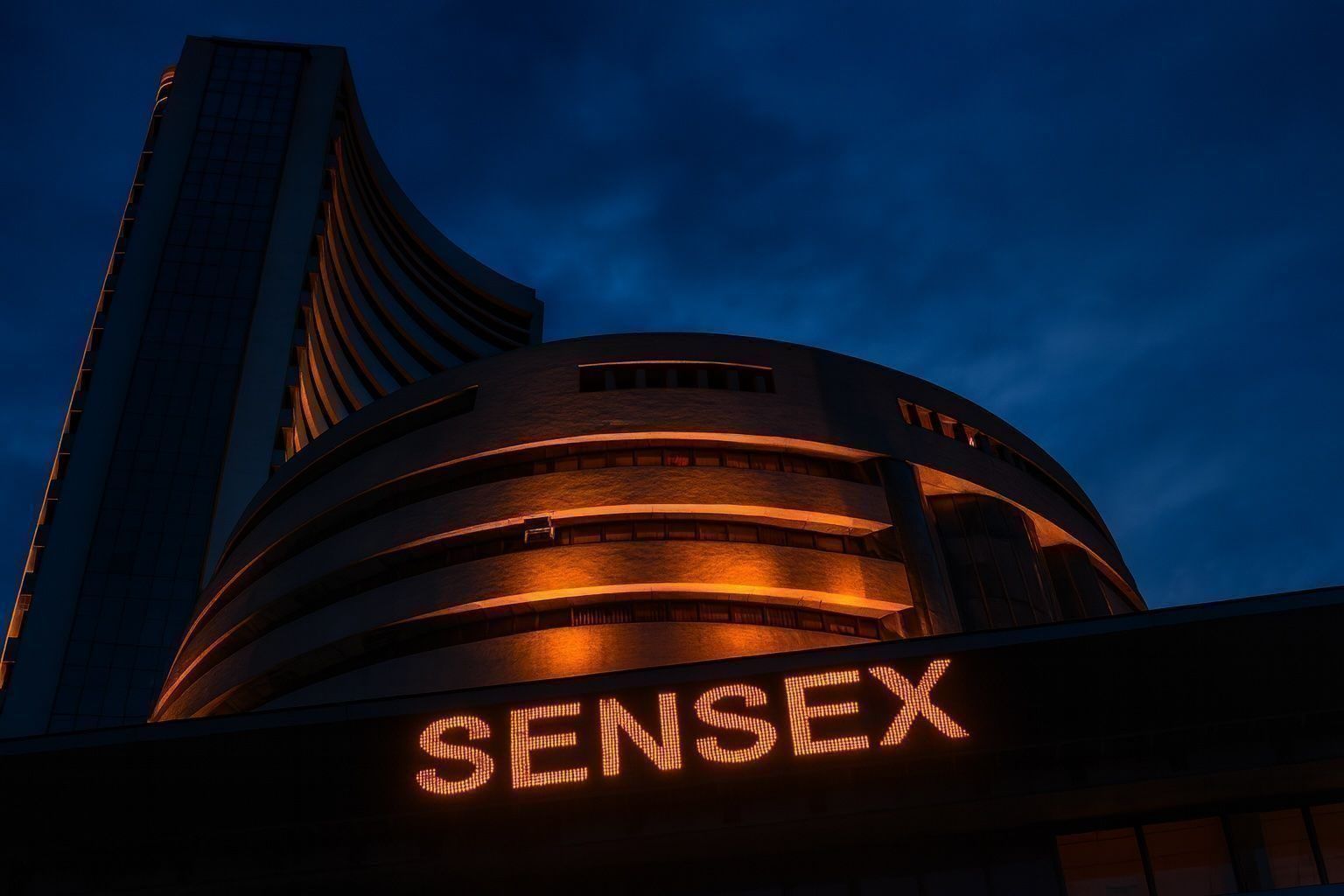
On Thursday, December 11, 2025, India’s stock market tried to shake off a three‑day losing streak, with benchmark indices staging a sharp afternoon rebound after the US Federal Reserve’s third straight rate cut – even as the rupee slid to a fresh record low against the dollar.
By around 3:00 p.m. IST, the Sensex was up about 0.5% near 84,800 and the Nifty 50 was hovering just below 25,900, recovering a chunk of Wednesday’s losses. Midcap and smallcap indices were trading 0.4–0.7% higher, with all major sectoral indices in the green, led by auto, pharma, banking, metals and realty. Moneycontrol+1
Sensex, Nifty Today: From Three-Day Slide To Afternoon Bounce
The rebound comes after a nervous start to the week. On Wednesday, December 10, the market fell for the third straight session, with:
- Sensex closing at 84,391.27, down about 275 points (‑0.32%)
- Nifty 50 closing at 25,758, down roughly 82 points (‑0.32%) Business Standard+1
Broader indices also corrected, extending what analysts are calling India’s worst smallcap slump in seven years: the BSE smallcap index is down around 9.45% in 2025, after a multi‑year surge that left valuations stretched. The Economic Times
On Thursday morning, trading remained choppy. By about 10:07 a.m. IST, Nifty was barely positive at 25,770 while Sensex was fractionally lower near 84,382, as profit‑taking persisted in most sectors even after a relief rally at the open. Reuters
It took stronger global cues and a broad‑based surge in banks, autos and metals through the afternoon to push the headline indices decisively higher. By 3 p.m., Nifty was up over 130 points around 25,895, and Sensex had gained more than 400 points to trade above 84,800. Moneycontrol+1
Global Backdrop: Fed’s Third Rate Cut Lifts Risk Sentiment
Overnight, the US Federal Reserve cut interest rates by 25 basis points for the third time in a row, bringing the fed funds target range down to 3.50–3.75%, the lowest in nearly three years. Policymakers signalled that further cuts are likely to be slower, with projections pointing to only one more cut in 2026. mint+1
For global markets, that combination – a rate cut plus a hint of a pause – has a mixed effect:
- It supports risk assets by easing borrowing costs and weakening the dollar, which helped metals and emerging‑market equities. Reuters+1
- But it also keeps investors cautious, because the Fed is still worried about elevated inflation and a cooling labour market, suggesting global growth won’t be smooth. AP News
Indian equities initially reflected that caution: a Reuters morning note described benchmarks as “flat”, with 13 of 16 sectors declining even as metals rallied on the weaker dollar. Reuters
By mid‑session, however, the Fed decision was being interpreted more positively on Dalal Street. A Financial Express market wrap flagged four key drivers behind the afternoon rally: bottom‑fishing after recent losses, slowing FPI selling, optimism about future earnings and the global tailwind from the Fed’s cut and softer oil prices. The Financial Express
Rupee At Record Low And FPI Selling: The Big Overhang
The feel‑good from the Fed is being offset by serious stress in India’s currency and external account.
- On December 11, the rupee hit a fresh record low near 90.47 per US dollar, breaking past its previous low of 90.42.
- The currency is now down over 5% year‑to‑date, making it Asia’s worst‑performing currency in 2025. Reuters+1
According to Reuters, the slide is driven by:
- The absence of a US–India trade deal amid high US tariffs (around 50%) on many Indian exports,
- A record trade deficit and weaker exports,
- Corporate dollar outflows, and
- Only “light” intervention by the Reserve Bank of India (RBI), which is trying to slow, not defend, the rupee’s fall. Reuters
Foreign portfolio investors (FPIs) have voted with their feet.
- FPIs have sold about $18 billion of Indian equities in 2025, according to Reuters. Reuters+1
- In just the first week of December, they pulled out ₹11,820 crore, taking total 2025 outflows to roughly ₹1.55 lakh crore, data collated by Indian media show. The Times of India+1
- Reuters also notes that foreign investors have offloaded $1.56 billion in December so far, contributing to the 1.6% slide in Nifty and Sensex over the last three sessions. Reuters
Brokerage Emkay Global warns that the stress is no longer confined to the currency or bond markets:
The equity market is “finally feeling the pinch” as both global funds and local investors turn cautious, with extreme near‑term volatility likely to persist until there is clarity on the trade front. Business Standard
Emkay argues that only a substantive India–US trade agreement that cuts tariffs meaningfully is likely to offer a “lasting solution” for financial markets and the rupee. Business Standard
Domestic Money Cushions The Blow: SIPs And Mutual Fund Flows Stay Strong
If FPIs are the sellers in this story, domestic investors are the shock absorbers.
Fresh AMFI data show that:
- Equity mutual fund inflows jumped about 21% month‑on‑month in November to ~₹29,911 crore, reversing a three‑month soft patch. The Economic Times+1
- Contributions via Systematic Investment Plans (SIPs) stayed near record levels, around ₹29,445 crore in November, with stoppage ratios still manageable. Moneycontrol+1
Reuters notes that since February 2021, equity funds have seen net inflows every single month, with SIPs and domestic long‑term money offsetting roughly $18 billion in FPI outflows this year. Reuters
That steady domestic bid is a big reason why the headline indices are still near all‑time highs, despite the rupee shock and a brutal smallcap correction.
Sector Check: Banks, Autos, Metals Lead Today’s Recovery
Thursday’s action was broad‑based rather than narrow. By mid‑afternoon:
- All NSE sectoral indices were in the green, with auto, pharma, PSU and private banks, metals and realty up around 0.5–1%. Moneycontrol
- BSE Midcap and Smallcap gauges were up roughly 0.5% and 0.4%, respectively, stabilising after days of relentless selling. Moneycontrol+1
Stock‑specific movers that shaped the day included:
- Kotak Mahindra Bank: jumped about 3.5%, snapping a three‑day losing streak and emerging as one of the strongest Nifty gainers, as value‑buyers stepped in without any major stock‑specific trigger. Moneycontrol+1
- Hindustan Zinc: surged around 4% to ₹532, extending a three‑session rally on the back of record global silver prices. Its parent Vedanta also gained. The Financial Express+1
- Samvardhana Motherson: climbed roughly 3% to a fresh 52‑week high near ₹120, as strong volume and improving auto‑sector sentiment kept the uptrend intact. The Financial Express
- Tejas Networks: gained over 2.5% after announcing it had secured IP routing contracts for seven of the 12 BharatNet Phase‑III packages, positioning it as the largest supplier in this tender. The Financial Express
- Prestige Estates and Bank of India: both rose around 2% after deal‑ and capital‑raising news boosted interest in real estate and PSU banking names. The Financial Express
- On the flip side, Dixon Technologies remained under pressure, down about 28% year‑to‑date, reflecting the broader mid‑ and smallcap valuation reset. The Financial Express+1
Earlier in the session, Reuters also highlighted IndiGo sliding over 3% after trimming its near‑term capacity and revenue guidance amid operational disruptions, another reminder that stock‑specific news is still driving sharp moves. Reuters
Technical Picture: Nifty Trapped Between 25,650 Support And 26,000 Resistance
Technically, today’s bounce has not yet broken the consolidation pattern that has dominated December.
Nifty 50
Analysts at both Mint and Moneycontrol broadly agree on the following near‑term map: mint+1
- Support zones
- First key support: 25,650–25,700, aligned with the 50‑day moving average.
- Stronger support: 25,500, where heavy Put open interest is parked.
- Resistance zones
- Immediate resistance: 25,900–25,960, which the index has repeatedly failed to clear.
- Major ceiling: 26,000, where the highest Call open interest (~1.3 crore contracts) sits, indicating significant overhead supply.
Derivatives data show aggressive Call writing at 26,000 and Put writing at 25,500, a classic range‑bound configuration that supports a “sell on rise, buy on deep dips” stance for short‑term traders. Moneycontrol
Sensex
For the Sensex, market technicians expect the index to oscillate in a narrow 84,000–85,000 band, with: mint
- Support in the 84,000–84,100 zone, and
- Resistance around 85,000–85,100, where profit‑booking tends to emerge.
Thursday’s move toward 84,800 keeps the index near the upper half of this range, but a decisive breakout has not yet materialised. Moneycontrol+1
Bank Nifty
Bank Nifty remains the weak link:
- It recently slipped below its 20‑day moving average for the first time in weeks.
- Immediate support is seen near 58,750–58,775, while resistance lies around 59,300, coinciding with the 10‑day EMA. mint+1
Technical analysts warn that a break below 58,700–58,800 could intensify selling in financials, while only a sustained move above 59,300 with improving momentum would confirm a near‑term turnaround. Moneycontrol
Smallcaps: Worst Year In Seven, But Bargain Hunters Are Surfacing
Beyond the front‑line indices, smallcap investors have had a punishing 2025:
- The BSE smallcap index is down roughly 9.45% this year, the sharpest annual drop in seven years. The Economic Times+1
- The correction follows a multi‑year rally where smallcaps massively outperformed, leaving many pockets trading at rich earnings multiples.
Economic Times analysis links the slump to earnings disappointments, stretched valuations and a shift in liquidity back to safer largecaps, as FPIs and even some domestic investors de‑risk. The Economic Times+1
Today’s modest bounce in mid‑ and smallcaps – up about 0.3–0.7% – appears more like short‑covering and selective bottom‑fishing than a full‑blown trend reversal. Brokerages continue to advise caution on broader‑market valuations, especially in pockets where earnings visibility is still cloudy. Moneycontrol+1
Strategy Views: How Analysts See 2026 After A Volatile 2025
Despite the near‑term nervousness, most institutional strategists remain constructive on India over a 12–24 month horizon, though they disagree on how bumpy the path will be.
Emkay Global: “Extreme Near-Term Volatility”
Emkay Global’s latest note, published Thursday afternoon, paints a picture of markets walking a tightrope: Business Standard
- Near term (next few weeks):
- Expect “extreme volatility” as currency, bond and equity markets digest rupee weakness, widening current account deficit and FPI selling.
- RBI and Fed rate cuts may offer temporary relief rallies, but these can be overwhelmed quickly by external pressures.
- 3–6 month view:
- Emkay expects a US–India trade deal that meaningfully lowers tariffs on key Indian exports within three to six months, which could stabilise the rupee and revive foreign interest.
- Positioning:
- Increase exposure to defensive pockets such as IT, pharmaceuticals and private banks.
- Trim small‑ and midcap allocations given high valuations and liquidity risk.
- Over the longer term, remain positive on consumer‑discretionary plays once volatility subsides.
Avendus Wealth: Nifty 28,500–30,000 By End‑2026
In an interview published this morning, Saurabh Rungta, CIO at Avendus Wealth, argues that if corporate earnings grow in the mid‑teens into FY27, the Nifty could be around 28,500–30,000 by end‑2026. Business Standard
Key points from his outlook:
- Macro backdrop: RBI’s recent rate cut, OMOs and USD swap operations have, in his view, kept the macro environment “constructive”, with benign inflation, strong domestic demand and a healthy banking system. Business Standard
- Triggers for upside in 2026:
- A growth‑oriented Union Budget 2026,
- A favourable US–India trade deal, and
- A restart of strong FII inflows.
- Preferred portfolio mix (3–5 year horizon):
- Roughly 50% largecaps,
- 50% selectively chosen mid‑ and smallcaps, focusing on earnings visibility and governance quality, not momentum. Business Standard
Kotak Securities: Bull-Case Nifty 32,000+
A fresh strategy piece from Kotak Securities goes even further, sketching a bull‑case Nifty target of about 32,032 by December 2026, with a base case around 29,120. The Economic Times
Kotak’s assumptions include:
- Strong earnings growth: Nifty‑50 EPS forecast to grow 8.2% in FY26, 17.6% in FY27 and 14.8% in FY28. The Economic Times
- Robust macro fundamentals: India’s real GDP growth around 7.8% in FY26, outpacing most peers. The Economic Times
- Inflation “well anchored”: CPI projected near 2.1% for FY26, helped by lower food costs and GST rate cuts. The Economic Times
- RBI easing cycle: The repo rate has already been cut by 125 bps to 5.25%, with scope for another small cut in early 2026. The Economic Times
Essentially, the bullish case rests on India delivering strong, broad‑based earnings growth while maintaining macro stability, even if global conditions stay choppy.
What India Stock Market Today Means For Investors
Put together, December 11, 2025 on Dalal Street looks like a classic “tug of war” day:
- Positives
- A Fed rate cut and slightly weaker dollar,
- Resilient domestic flows via SIPs and mutual funds,
- Early signs of value‑buying in beaten‑down sectors,
- Constructive medium‑term earnings and GDP forecasts. Reuters+2Business Standard+2
- Negatives
- A record‑weak rupee with open questions about the timing and scope of a US–India trade deal,
- Persistent FPI outflows,
- A deep smallcap correction that could still have room to run if earnings disappoint again,
- Technicals that still point to range‑bound, “sell‑on‑rise” dynamics below 26,000 on Nifty. Moneycontrol+3Reuters+3The Times of India+…
For individual investors, the main takeaways are:
- Expect volatility, not a straight line up. Short‑term moves will likely remain sensitive to rupee headlines, FPI flows and news around any trade negotiations with the US. Business Standard+1
- Largecaps are generally viewed as safer ground than frothy pockets of the smallcap universe, especially for new money. The Economic Times+2Business Standard+2
- Domestic SIP and mutual fund participation is still robust, which helps provide a floor on deep corrections – but it doesn’t eliminate price risk. Reuters+1
- Medium‑term strategist targets (Nifty near 28,500–30,000 in base cases, or 32,000+ in bull cases by end‑2026) are scenarios, not guarantees, and depend heavily on earnings delivering as forecast. Business Standard+1
This article is for information and news purposes only and is not investment advice. Anyone considering investing should evaluate their own risk profile and, ideally, consult a qualified financial adviser before acting on market moves or brokerage forecasts.