
SANTA CLARA, California, August 17, 2026, 15:48 PDT — U.S. cash markets were closed.
- Intel closed at $103.49, up 0.97% and 8.9% above its offering price.
- The base offering raised $20 billion through 210.5 million new shares.
- CEO Lip-Bu Tan’s disclosed purchase showed an estimated $894,000 paper gain.
Intel Corporation NASDAQ:INTC ended Monday at $103.49. That put the shares $8.49 above last week’s $95 offering price. The 8.9% premium is the clearest near-term signal that investors absorbed the new stock.
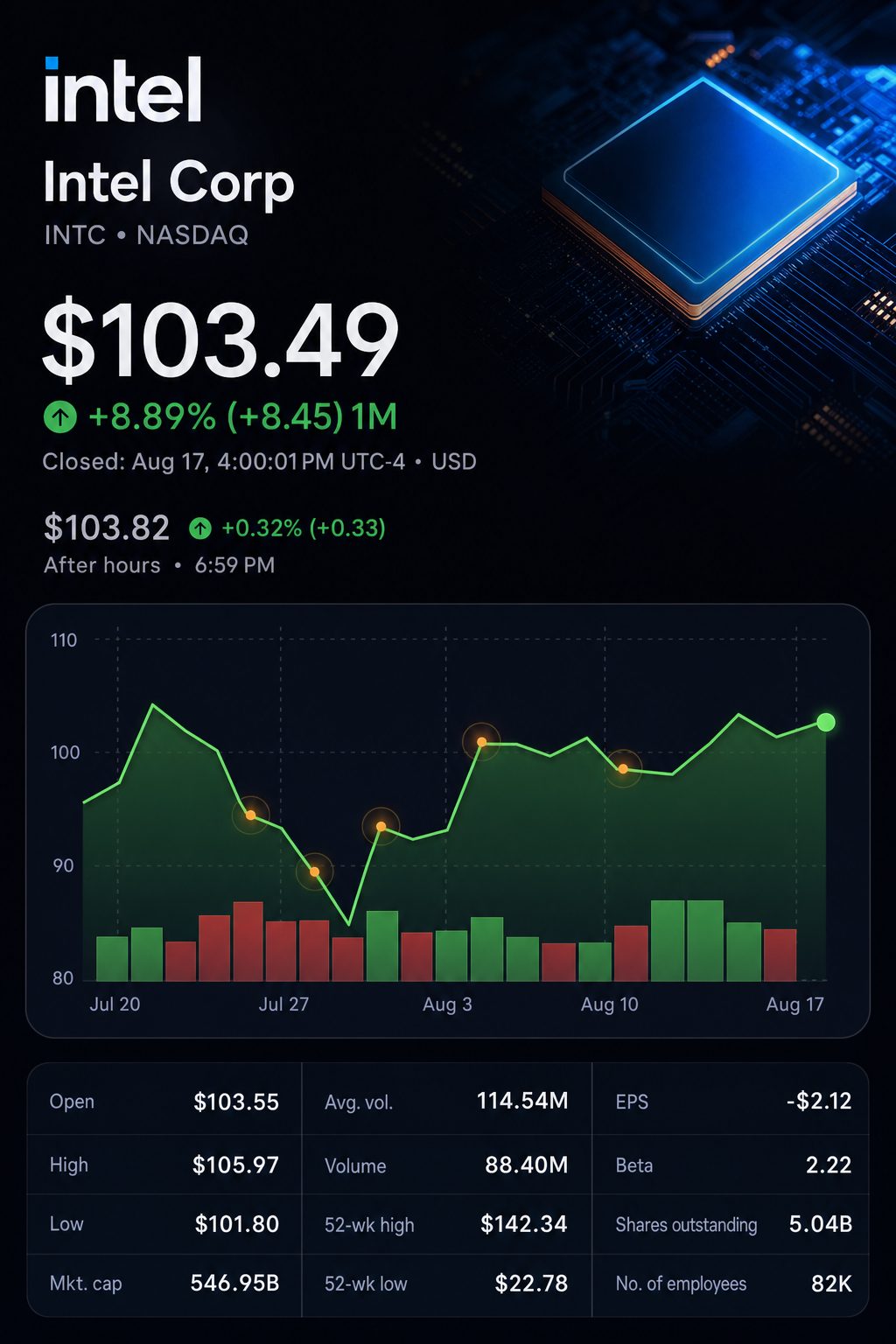
The math is notable. Intel sold 210,526,315 shares in the base deal. Their market value has risen about $1.79 billion since pricing, based on Monday’s close. That gain belongs to the new investors, not Intel.
| Offering and market measure | Latest value | Investor meaning |
|---|---|---|
| Public offering price | $95.00 | Capital-raise benchmark |
| August 17 close | $103.49 | Up 8.9% from pricing |
| Base shares sold | 210,526,315 | About 4.18% of reported shares outstanding |
| Gross proceeds | $20.0 billion | Funds manufacturing expansion |
| New shares’ gain at Monday’s close | About $1.79 billion | Shows strong deal absorption |
| Underwriters’ option | 31,578,947 shares | Up to $3.0 billion more gross proceeds |
Intel upsized the offering from $15 billion. It also granted underwriters a 30-day option for another 31.6 million shares. Full exercise would lift potential gross proceeds to roughly $23 billion.
Tan bought 105,263 shares at $95 through a family trust, an SEC Form 4 showed. The purchase cost just under $10 million. At Monday’s close, its paper value was about $10.89 million.
The signal is meaningful but small. Tan’s disclosed purchase represented about 0.05% of the base offering. A prospectus said Tan and one family member agreed to buy $12 million altogether, leaving a roughly $2 million difference not covered by his Form 4.
| Q2 operating measure | Q2 2026 | Q2 2025 | Change |
|---|---|---|---|
| Revenue | $16.1 billion | $12.9 billion | Up 25% |
| GAAP gross margin | 40.4% | 27.5% | Up 12.9 points |
| Intel Products operating income | $4.82 billion | $2.69 billion | Up 79% |
| Foundry operating loss | $2.09 billion | $3.17 billion | Loss narrowed 34% |
| Cash from operations | $7.0 billion | $2.1 billion | More than tripled |
The capital raise follows stronger operating results. Second-quarter revenue rose 25% to $16.1 billion. GAAP gross margin improved by 12.9 percentage points. Cash from operations reached $7.0 billion.
“AI is driving unprecedented demand for compute,” CEO Tan said with the results. He cited CPUs, ASICs, advanced packaging and foundry services. Intel guided third-quarter revenue to $15.8 billion to $16.8 billion.
The foundry remains the central valuation test. Its second-quarter loss narrowed to $2.09 billion from $3.17 billion. Yet external foundry revenue was only $293 million. Most segment sales still came from Intel’s own product units.
Product economics were much stronger. Data Center and AI revenue rose 59% to $6.26 billion. Segment operating income reached $2.47 billion, versus $633 million a year earlier. Server prices rose 48% as premium products gained share.
| Analyst or consensus | Recommendation | Price target | Upside/downside vs. $103.49 |
|---|---|---|---|
| S&P Global consensus | Hold | $114.88 | +11.0% |
| Bank of America | Buy | $145 | +40.1% |
| UBS | Hold | $112 | +8.2% |
| Mizuho | Hold | $109 | +5.3% |
| Truist | Hold | $108 | +4.4% |
| J.P. Morgan | Sell | $85 | -17.9% |
Wall Street remains divided. The 48-analyst consensus is Hold, with an average $114.88 target. Bank of America sees 40% upside. J.P. Morgan’s $85 target implies an 18% decline.
The week ahead has no scheduled Intel earnings report. Investors will instead watch for any underwriter-option filing and further foundry customer disclosures. Monday’s premium suggests funding risk has eased. Execution risk has not.
Risks: The offering dilutes existing holders, and the over-allotment could add more shares. Foundry losses remain large. Supply constraints, higher capital spending and unconfirmed external demand could pressure future returns.
Related articles: NASDAQ:INTC