Intel Corporation (NASDAQ: INTC) is ending 2025 as one of the market’s most polarising mega‑cap tech stocks. The share price has roughly doubled this year on the back of government support, big‑name strategic investors and renewed AI ambitions, yet Wall Street’s consensus still calls for downside from current levels.
Below is a deep dive into all the key news, forecasts and analyses influencing Intel stock as of December 10, 2025.
Intel stock price and valuation snapshot
Intel shares are trading around the $40 mark this week. On Monday, December 8, the stock fell 2.7% to close near $40.30, after touching an intraday low of $39.70. Over the past 12 months, INTC has traded between $17.67 and $44.02, underscoring just how violent the 2025 rebound has been.
MarketBeat data shows Intel recently changing hands at $39.67 as of mid‑morning Eastern time, giving the company a market cap around $193 billion. With GAAP earnings still distorted by unusual items and thin profitability, Intel’s trailing P/E ratio exceeds 4,000, a quirk that reflects near‑zero net margins more than any “AI bubble” valuation. MarketBeat+1
Despite the big rally, the stock remains well below its historic highs — but also well above where many analysts think it should trade in the near term.
Q3 2025 earnings: revenue growth, better margins and cautious guidance
On October 23, 2025, Intel reported a third quarter that finally looked like a real turnaround on paper:
- Revenue: $13.7 billion, up 3% year‑over‑year (from $13.3 billion).
- GAAP EPS:$0.90, versus a loss of $3.88 a year earlier.
- Non‑GAAP EPS:$0.23, versus a loss of $0.46 in Q3 2024.
- Gross margin: GAAP margin expanded from 15.0% to 38.2%; non‑GAAP from 18.0% to 40.0%.
- Operating margin: Improved from ‑68.2% to +5.0% GAAP (11.2% non‑GAAP).
- Cash from operations: About $2.5 billion in the quarter.
Segment performance shows where the recovery is and isn’t happening:
- Client Computing Group (PC chips): $8.5B, up 5% YoY.
- Data Center & AI (server CPUs and accelerators): $4.1B, down 1%.
- Intel Foundry: $4.2B in revenue, down 2%.
- Total net revenue: $13.7B, up 3%.
For Q4 2025, Intel guided for:
- Revenue: $12.8–$13.8 billion.
- GAAP EPS:–$0.14.
- Non‑GAAP EPS:$0.08.
Analysts currently expect Intel to post a small full‑year loss of about –$0.11 per share, highlighting that the turnaround is still fragile despite better sequential performance.
Intel has also warned that Q3 numbers could be revised because the accounting for its U.S. government transactions is unusually complex and is under consultation with the SEC staff. That adds an extra layer of uncertainty on top of the headline improvement.
A historic move: the U.S. government takes a 10% equity stake
The single most dramatic development for Intel in 2025 is Washington’s direct equity investment in the company.
On August 22, 2025, President Donald Trump announced that the U.S. government will acquire 9.9% of Intel for $8.9 billion, paying $20.47 per share, roughly a $4 discount to the prior close of $24.80.
Key details from the Reuters report on the deal:
- The purchase is funded by $5.7 billion in unpaid CHIPS Act grants plus $3.2 billion for Intel’s Secure Enclave defense program.
- The government stake is officially passive — no board seat, and Washington must generally vote in line with Intel’s board, with limited exceptions.
- The U.S. also receives a five‑year warrant at $20 per share for an additional 5% stake, exercisable if Intel loses control of its foundry business.
- The goal is to shore up Intel’s loss‑making foundry unit, which needs massive capital to catch up with TSMC and attract external customers.
This follows a year in which Intel booked an $18.8 billion loss in 2024, its first annual loss since 1986, and continued pressure in 2025.
Intel’s own Q3 press release emphasises “accelerated funding from the U.S. Government” and calls the deals with Washington and other partners “meaningful steps” to strengthen the balance sheet. Intel
What this means for investors
- Upside: The government stake dramatically reduces existential risk and helps fund advanced fabs without extreme equity dilution or crippling debt. It also signals that Intel is now treated as critical infrastructure, which may support additional subsidies and design wins.
- Downside: This is an unprecedented level of political involvement in a U.S. blue‑chip. Reuters notes growing concern that Trump’s interventionist approach could create new categories of corporate risk, from politicised capital allocation to constraints on strategic decisions.
Big‑ticket backers: Nvidia and SoftBank jump in
Q3 also brought two other heavyweight investors onto Intel’s cap table:
- Nvidia agreed to invest $5.0 billion in Intel common stock and to co‑develop multiple generations of custom data‑center and PC products, integrating Intel CPUs with Nvidia’s AI platforms via NVLink.
- SoftBank Group added a $2.0 billion stake in Intel, bolstering confidence in Intel’s role as a U.S. manufacturing champion.
These deals effectively turn Intel into a hub of a government–Big Tech–Big Capital coalition aimed at reshoring advanced semiconductor manufacturing.
AI and foundry strategy: 18A, Apple rumors and SambaNova
18A roadmap and new products
Intel is betting its turnaround on hitting an aggressive manufacturing roadmap and re‑emerging as a high‑end foundry:
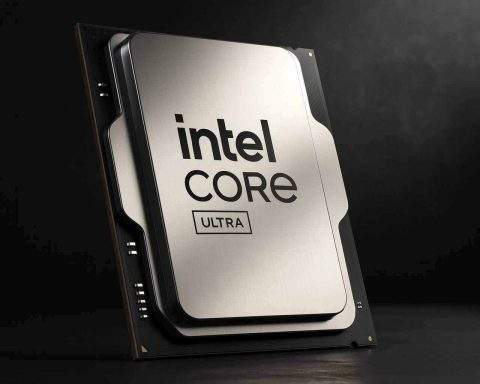
- It unveiled Intel® Core™ Ultra series 3 (Panther Lake), the first client SoCs built on its Intel 18A process.
- It showed Intel® Xeon® 6+ (Clearwater Forest) for servers on Intel 18A, promising major power and performance gains.
- It announced a new inference‑optimized GPU, “Crescent Island,” targeting AI inference workloads.
- Fab 52 in Chandler, Arizona is now fully operational, producing Intel 18A wafers — currently the most advanced logic process developed and manufactured in the United States.
These steps are crucial for winning external foundry customers and closing the technology gap with TSMC.
Rumors of Apple as a future customer
On November 28, an Investopedia report highlighted a social media post by noted TF International Securities analyst Ming‑Chi Kuo, claiming that the likelihood of Apple becoming an Intel foundry customer “has recently improved significantly.” Industry surveys cited by Kuo suggest Intel could start shipping processors to Apple as soon as 2027. Investopedia
That article notes Intel was the best‑performing stock in the S&P 500 on the shortened Black Friday session, surging more than 10% as the rumor spread. Shares have roughly doubled in 2025, fueled by high‑profile deals like the Nvidia partnership.
Apple has not confirmed anything, and there is no formal contract yet. But even the prospect of a marquee design win underscores how central the foundry story is to the bull case.
Intel reportedly nearing SambaNova acquisition
Adding to the AI narrative, a December 10 report says Intel is close to acquiring AI chip startup SambaNova Systems. According to Seeking Alpha, citing Wired, Intel has signed a term sheet with SambaNova, though the deal has not yet been finalised.
SambaNova designs AI accelerators and systems aimed at competing with Nvidia and other specialist players. A successful acquisition would:
- Deepen Intel’s AI hardware portfolio beyond Xeon and Gaudi.
- Potentially bring in software and customer relationships in enterprise AI.
- Reinforce Intel’s case as a diversified AI and foundry platform rather than a pure CPU comeback story.
Until the transaction closes and terms are disclosed, however, it remains a speculative upside catalyst.
Legal overhang: EU fine reduced but not eliminated
On December 10, Europe’s General Court upheld the European Commission’s 2023 antitrust decision against Intel but cut the fine by about a third.
Key points from the Reuters coverage:
- The EU had imposed a €376 million fine in 2023 for so‑called “naked restrictions” — payments to HP, Acer and Lenovo between 2002 and 2006 to halt or delay rival products.
- The court reduced the penalty to €237 million, citing the relatively limited number of computers affected and the long gaps between some of the anti‑competitive practices.
- Both Intel and the Commission can still appeal to the EU Court of Justice.
The cash impact is manageable given Intel’s new funding sources, but the case keeps regulatory and reputational risk in the narrative at a time when the company is trying to pitch itself as a trusted global foundry partner.
What Wall Street is saying: ratings and price targets
MarketBeat: “Reduce” with double‑digit downside
MarketBeat aggregates 34 analyst ratings on Intel and assigns an overall consensus of “Reduce” — effectively a cautious stance between Sell and Hold. The breakdown: MarketBeat
- 8 Sell
- 24 Hold
- 2 Buy
The average 12‑month price target is $34.84, versus a current price near $39.67, implying about 12% downside. Targets span from $20 on the low end to $52 on the high end.
Recent actions include:
- Tigress Financial raising its target from $45 to $52 with a Buy rating.
- Several big brokers (Citigroup, Weiss, Raymond James, Bernstein, Cowen, Deutsche Bank) reiterating Sell, Neutral or Market Perform ratings through late 2025.
TipRanks: Hold with modest downside
TipRanks data, based on 35 analysts over the last three months, also shows an overall Hold rating:
- 5 Buy
- 24 Hold
- 6 Sell
The average price target is $37.04, about 8% below the last quoted price of $40.30, with a high of $52 and a low of $20.
Public.com: Hold and a lower “Street” target
Retail brokerage platform Public.com summarises the Street view slightly more conservatively:
- 25 analysts give Intel an overall Hold rating as of December 10, 2025.
- Their compiled price target is $32.82, implying meaningful downside from current levels even though Public’s UI labels that as a 0% change.
KGI upgrade and fund sentiment
Not all the news is negative. On December 9, KGI Securities upgraded Intel from Hold to Outperform, as reported via Fintel and Nasdaq.
Fintel’s own aggregated data points to:
- An average one‑year target of $36.63 (about 9% below the then‑current $40.30 price).
- 3,089 funds and institutions reporting positions in Intel, up roughly 4.75% from the previous quarter.
- A put/call ratio of 0.70, suggesting options traders are leaning bullish.
Taken together, Wall Street’s message is clear:
Analysts largely see Intel as fully valued or slightly overvalued here, with only a small minority calling it a buy — but options and fund flows show that some institutional investors are quietly positioning for further upside.
Institutional investors: quietly building positions
Multiple filings compiled by MarketBeat show that institutional ownership now accounts for roughly 64.5% of Intel’s shares.
Recent moves reported on December 10 include:
- Daiwa Securities Group increasing its stake by 8.8%, now holding about 1.36 million shares worth just over $30 million.
- Gabelli Funds boosting its position by 18.7% to nearly 239,000 shares.
- Additional increases by smaller wealth managers and asset managers, plus a large stake taken earlier in the year by Norges Bank, while Vanguard remains Intel’s largest shareholder with nearly 386 million shares.
These flows reinforce the idea that “smart money” hasn’t given up on Intel, even if the Street’s official ratings remain lukewarm.
The bear case: execution risk and valuation worries
Several recent articles lay out why some analysts still see Intel as an “AI stock to sell.”
A piece syndicated via Finviz and Motley Fool argues that Intel trades well above its historical valuation multiples, citing a bearish price target around $20 from one major broker — implying potential downside of roughly 50% from the $40 area.
Other bearish themes echo long‑running concerns:
- Market share erosion: Intel continues to lose CPU share to AMD in both PCs and data centers, while Nvidia dominates AI accelerators.
- Manufacturing missteps: Commentaries highlight years of process delays and ongoing questions about 18A yields, suggesting that catching TSMC remains an uphill battle despite progress in 2025.
- Foundry economics: Intel Foundry still runs at a loss, and critics worry the business may never reach the scale and efficiency of dedicated foundries without continued government lifelines.
- Regulatory and political risk: The U.S. stake and EU antitrust history expose Intel to policy shifts, antitrust scrutiny and politicised decision‑making in multiple jurisdictions.
Even one “hypothetical” scenario piece from MarketMinute — which imagines Intel plunging on December 9, 2025 — leans heavily on very real challenges: share losses, manufacturing delays, and doubts about the foundry strategy. FinancialContent
Summed up, the bear case says: Intel is still structurally disadvantaged versus TSMC, AMD and Nvidia, and today’s valuation assumes a turnaround that is far from guaranteed.
The bull case: balance‑sheet rescue and AI optionality
Bulls, on the other hand, point to a combination of liquidity, technology progress and strategic positioning that few chipmakers can match:
- Balance‑sheet backstop
- About $8.9–10 billion from the U.S. government, $5 billion from Nvidia and $2 billion from SoftBank provide a capital cushion that dramatically reduces near‑term solvency risk and funds the multi‑year 18A build‑out.
- Improving fundamentals
- Q3 2025 showed revenue growth, massive margin expansion and positive EPS, after a brutal 2024. While guidance remains conservative, the direction is finally up instead of down.
- AI and foundry optionality
- Intel now has a realistic path to being a geopolitically preferred, leading‑edge foundry in the U.S., particularly for government and defense contracts.
- Rumored Apple foundry business, the potential SambaNova acquisition, and the Nvidia collaboration all create real optionality that is not fully reflected in current consensus estimates.
- Under‑owned turnaround narrative
- Despite the big YTD run, analysts still cluster around Hold/Sell, and multiple data providers project single‑digit negative returns over the next year. If Intel executes even modestly better than feared, that skepticism could unwind into a sentiment re‑rating.
In this view, Intel is no longer a slow‑growth PC dinosaur, but a levered bet on U.S. industrial policy and AI infrastructure, with meaningful upside if execution tracks the roadmap.
Key catalysts to watch after December 10, 2025
For traders and long‑term investors alike, several near‑ and medium‑term catalysts will likely drive the next leg of Intel’s share‑price journey:
- Final SEC view on Q3 accounting
- Any required restatement of Q3 due to the government‑funding accounting could hit reported earnings, even if the underlying cash flows are unchanged.
- Closing — or collapse — of the SambaNova deal
- A completed acquisition with clear strategic synergies would strengthen the AI story; a breakdown could raise fresh questions about Intel’s M&A execution and capital priorities.
- Concrete foundry design wins
- Watch for announcements confirming Apple or other marquee customers on Intel 18A, beyond the Nvidia partnership that does not yet include firm foundry volumes.
- Q4 2025 earnings and 2026 guidance
- Investors will focus on whether Intel hits its $12.8–13.8B revenue and $0.08 non‑GAAP EPS guide and how 2026 looks in terms of margins and capex.
- Regulatory developments
- Any appeal of the EU fine, as well as future antitrust or industrial‑policy actions in the U.S. and Europe, could alter Intel’s cost base and strategic flexibility.
Bottom line: Intel stock on December 10, 2025
As of December 10, 2025, Intel stock sits at the intersection of national security policy, AI hype and a high‑stakes manufacturing turnaround.
- The government’s 10% stake, Nvidia and SoftBank investments, and 18A roadmap make Intel a central player in the West’s push for secure, domestic chip production.
- Q3 results show real operational improvement, but guidance and consensus forecasts still point to thin profitability and modest revenue growth.
- Most analysts see limited upside or mild downside from current levels, even as institutional investors accumulate shares and options sentiment trends bullish.
For now, INTC looks less like a classic value stock or a pure AI momentum trade and more like a high‑beta policy‑driven turnaround:
- Bulls are betting that 18A execution, AI deals and government support will eventually justify much higher earnings and valuations.
- Bears argue that competition, execution risk and political entanglements could keep Intel stuck in a low‑profit, high‑capex trap.
Either way, Intel is once again one of the most consequential stories in global semiconductors, and December’s headlines underscore just how much is riding on what the company does next.