Intel Corporation (NASDAQ: INTC) heads into Monday’s U.S. session as one of 2025’s hottest big‑cap tech stories: the stock has roughly doubled this year, is trading near 52‑week highs, and sits at the center of AI, geopolitics and U.S. industrial policy all at once. PortfoliosLab+1
But that momentum comes with fresh questions about supply bottlenecks, valuation risk and whether Intel’s AI‑driven turnaround can keep up with expectations.
Here’s a concise, news‑grade briefing on Intel stock before the bell on Monday, December 8, 2025.
Intel stock price today: pre‑market snapshot
- Last close (Friday, Dec. 5, 2025):
Intel closed at $41.41, up 2.25% on the day. The stock traded between $41.16 and $42.83, a 4.06% intraday range, with about 99 million shares changing hands. StockInvest - Pre‑market trade (Dec. 8, 2025):
Early Monday, extended-hours quotes show Intel around the mid‑$41s — roughly $41.65–$41.75, up about 0.6–0.8% from Friday’s close. MarketBeat shows Intel at $41.65 (+0.58%) as of 08:12 a.m. ET, while MarketWatch lists $41.75 (+0.82%) just before 7:00 a.m. ET. MarketBeat+2MarketWatch+2 - Year‑to‑date and 1‑year performance:
According to PortfoliosLab, Intel is up about 106% year‑to‑date and roughly 98% over the past 12 months, far outpacing the S&P 500’s ~17% YTD gain. PortfoliosLab - Trading range and technical context:
- 52‑week low: $17.67
- 52‑week high: $44.02 TechStock²+1
- 50‑day moving average: $37.66
- 200‑day moving average: $28.15 – both well below the current price, underscoring a strong uptrend. MarketBeat+1
- Short‑term forecast for today’s session:
Technical service StockInvest.us expects a “fair” opening price around $41.80 (about 0.9% above Friday’s close) and models a potential intraday range of roughly $40.38–$42.44, implying about ±5% possible swing within the session. StockInvest+1
Taken together, Intel enters Monday as a high‑beta, high‑momentum AI and semiconductor name, already priced near the top of its recent range.
Fresh headlines moving Intel before the bell
1. Intel admits it can’t get enough wafers to meet demand
At last week’s UBS Global Technology and AI Conference, Intel said it cannot fully meet client demand for its latest high‑performance processors because it does not have enough wafer supply. Investorsobserver
Key points from InvestorsObserver’s Monday recap: Investorsobserver
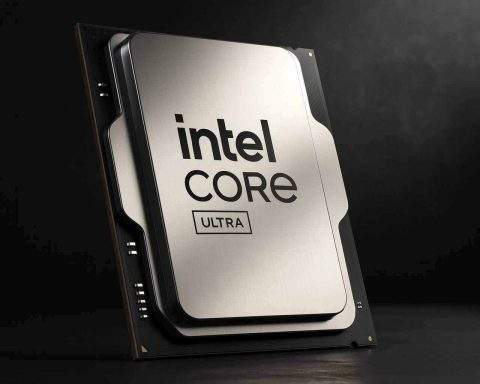
- Intel lacks sufficient wafers for its Core Ultra 200‑series “Arrow Lake” and “Lunar Lake” chips for PCs and edge computing.
- The logic tiles for these CPUs are manufactured by rival TSMC, whose advanced fabs are running near full capacity, limiting how quickly Intel can ramp supply.
- Intel’s PC‑centric client computing business generated about $30.3 billion in 2024 revenue, roughly 57% of total revenue, underscoring how important these chips are.
- The article suggests Intel “may have dug itself into a hole” by under‑ordering wafers, raising the risk that it can’t fully capitalize on expected demand in Q4 and into 2026.
For today’s session, this creates a good‑problem/bad‑problem narrative: demand for Intel’s new AI‑ready PC chips looks healthy, but supply constraints could cap near‑term upside and weigh on margins.
2. Tata Electronics signs Intel as first major customer for India’s $14B chip foray
Overnight, Reuters reported that India’s Tata Electronics has signed up Intel as the first major customer for its planned $14 billion semiconductor foray, which includes a wafer fab in Gujarat and an advanced packaging facility in Assam. Reuters+1
The deal:
- Positions Tata’s new fab project as a potential long‑term manufacturing partner for Intel products.
- Supports India’s push to become a global semiconductor hub, giving Intel another geographic diversification option beyond the U.S., Europe and East Asia. Business Today
Indian business media highlight that the two companies aim to “create a silicon and compute ecosystem” in India around AI PCs, data‑center infrastructure and advanced packaging. Business Today
Why it matters today:
For investors, the Tata news reinforces the idea that Intel is building a multi‑node, multi‑geography manufacturing network — important as geopolitical risks around Taiwan (TSMC) and U.S.–China tech restrictions remain elevated.
3. Intel deepens AI retail partnership in China
On Monday, a GlobeNewswire release detailed that China‑based SED Initta Technology and Intel have deepened their long‑standing partnership to accelerate AI‑driven retail transformation. GlobeNewswire
Highlights:
- The announcement came at Intel’s Technology Innovation and Industrial Ecosystem Summit in Chongqing, marking Intel’s 40th anniversary in China.
- SED Initta was named one of the inaugural “Prestige Partners” within the Intel Partner Alliance, Intel’s top partnership tier.
- The companies plan to scale AI, edge computing and cloud‑native retail solutions across smart stores, supply chains and customer analytics. GlobeNewswire
While not a huge revenue driver by itself, the deal adds to today’s narrative that Intel is pushing AI at the edge (retail, PCs, devices) – a key pillar of its strategy reset.
4. Wedbush calls Intel an AI “loser” as sector bifurcates
Balancing the bullish headlines, Wedbush Securities published a note (via Seeking Alpha) listing Intel among a group of companies it sees as “AI losers” — names that could be structurally disadvantaged as AI spending flows to leaders like Nvidia and AMD. Seeking Alpha+1
The article frames AI as a powerful tailwind for some, but warns investors that not every tech incumbent will benefit equally from the surge in AI data‑center and infrastructure spending.
Implication for today:
This kind of thematic call can cap rallies or trigger profit‑taking, especially after a 100%+ run year‑to‑date, even if it doesn’t change the underlying business fundamentals overnight.
5. Rising AI‑driven memory costs could squeeze margins
A separate GuruFocus piece out today highlights Intel as one of the chip makers facing pressure from rising DRAM and NAND flash memory prices, driven by heavy AI infrastructure build‑outs. GuruFocus+1
The article notes:
- AI data centers are pushing up memory prices, which could raise Intel’s cost base.
- Intel’s recent financial metrics still reflect challenged profitability and uneven revenue growth, even as the company invests heavily to revive its manufacturing business. GuruFocus+1
For investors, this reinforces the idea that Intel’s turnaround is playing out in a rising‑cost environment, not a benign one.
Strategy reset under new CEO Lip‑Bu Tan
A central thread in today’s analysis coverage is Intel’s AI strategy reset under CEO Lip‑Bu Tan, who took over in March 2025. Reuters+1
A new Motley Fool article, “Should Investors Give Intel Stock Another Look After Its AI Strategy Reset?”, lays out the story: Finviz
- Intel spent years missing big shifts such as the smartphone boom and repeatedly delaying advanced CPU launches, leading to mounting losses and market share erosion.
- Tan’s early moves included flattening management, stripping out bureaucracy and refocusing Intel’s roadmap on AI inference (using AI models in production) rather than only AI training.
- He argues AI inference will ultimately be a larger market than training, as enterprises deploy smarter models at scale across PCs, edge devices and servers. Finviz
On the numbers side:
- In the first half of 2025, Intel generated about $25.5 billion in revenue but still posted a $3.7 billion net loss.
- By Q3 2025, revenue ticked up to $13.7 billion (up ~3% YoY) and Intel swung back to profit with $4.1 billion in net income, a dramatic improvement versus its 2024 loss. Finviz+1
However, Motley Fool stresses that the stock’s valuation has surged in tandem:
- Intel’s P/E multiple has skyrocketed in 2025 as the share price outran still‑recovering earnings.
- For comparison, Taiwan Semiconductor (TSMC) trades at a lower forward P/E, even while retaining a “wide moat” as the dominant advanced foundry. Finviz+1
The article’s bottom line: Intel looks like a promising AI turnaround story, but at current prices, it may not be a bargain — a note of caution heading into today’s trade.
Heavyweight backers: U.S. government, SoftBank and Nvidia
Part of the bull case showing up in pre‑market commentary is the sheer scale of capital behind Intel’s transformation.
A recent Reuters investigation detailed how the U.S. government, SoftBank and Nvidia have collectively injected billions into Intel: Reuters+2TechStock²+2
- U.S. government stake:
In August, the U.S. agreed to purchase a 9.9% equity stake in Intel for $8.9 billion (about $20.47 per share), converting CHIPS Act grants and secure‑foundry funding into stock. The stake is formally “passive,” with no board seat, but it gives Intel significant federal backing to expand U.S. fabs. Reuters - SoftBank and Nvidia:
- SoftBank committed around $2 billion to Intel.
- Nvidia invested $5 billion, reportedly at about $23.28 per share for roughly 4% of Intel’s equity, tied to joint work on custom data‑center CPUs and AI PCs that pair Intel CPUs with Nvidia GPU chiplets. Finviz+1
These backers are widely interpreted as validation of Intel’s foundry and AI ambitions, but they also raise expectations: with this level of support, the market will demand clear progress on products, customers and profitability.
Technical picture and today’s setup
Short‑term technical services still classify Intel as a momentum “Buy or Hold”, but with rising risk. StockInvest+1
From StockInvest.us: StockInvest
- Intel has risen in 8 of the last 10 sessions and is up about 23% over the past two weeks.
- Both short‑ and long‑term moving averages are trending higher, generating multiple technical buy signals.
- Key support levels sit near $38.28, then $35.50 and $33.99.
- Short‑term resistance clusters just above Friday’s close around $41.53, with additional resistance near $42.83–$43.47, and the 52‑week high around $44.02.
- Friday’s advance came on falling volume, which the service flags as a potential negative divergence — an early warning that momentum could be tiring.
For today, their modelled range of $40.38–$42.44 provides a rough guide to where volatility could concentrate if macro headlines or new Intel‑specific news hit the tape. StockInvest+1
Wall Street view and valuation check
Analyst aggregators updated through this weekend paint a cautious consensus:
- MarketBeat:
- Average 12‑month price target around $34.84 (range $20–$52), implying double‑digit downside from $41+.
- Consensus rating: “Reduce”, with only a handful of buys versus many holds and sells. TechStock²
- StockAnalysis.com:
- 25‑analyst average target at $31.98, suggesting ~23% downside from current levels.
- Overall rating: “Hold.” TechStock²
- Independent valuation models:
- Simply Wall St estimates “fair value” around $37.27, concluding Intel is roughly 11% overvalued at $41.41 even after factoring in the Apple/Nvidia narrative. TechStock²
At the same time, performance metrics from PortfoliosLab show Intel delivering ~106% YTD returns vs ~17% for the S&P 500, with a notably higher Sharpe ratio over the past year — impressive, but also a reminder that much future optimism is already in the price. PortfoliosLab
Macro backdrop: Fed week and AI sector jitters
Today’s session doesn’t happen in a vacuum. The Federal Reserve is holding its final meeting of 2025 this week, with markets widely expecting a third consecutive interest‑rate cut on Wednesday, bringing the policy rate toward the 3.5–3.75% range. Investopedia
Investopedia notes that: Investopedia
- U.S. indexes posted modest gains last week, with the Nasdaq leading.
- Investors are on edge for Fed Chair Jerome Powell’s press conference, hoping for clues about rate policy heading into 2026.
Meanwhile, AI‑heavy tech remains in the spotlight, with new pieces warning that some “unstoppable” AI stocks could suffer steep pullbacks if expectations reset. MarketBeat’s Intel news dashboard flags these AI‑valuation concerns as a negative sentiment factor for the whole group, even when the articles aren’t Intel‑specific. MarketBeat
For a high‑beta name like Intel — now heavily owned by institutions and tied to AI narratives — Fed communication and broader risk sentiment can amplify intraday swings.
Bull vs. bear framing for Intel at today’s open
Putting all of this together, here’s how the pre‑market story stacks up.
Bullish arguments
- Demand is real: Intel is literally short of wafers for its new AI‑ready PC chips, suggesting strong customer appetite for Arrow Lake, Lunar Lake and the freshly launched 18A‑based Panther Lake. Investorsobserver
- Big‑ticket backers: The U.S. government’s 9.9% stake plus billions from SoftBank and Nvidia provide both capital and strategic validation for Intel’s foundry and AI roadmap. Reuters+1
- New geographies and partners:
- The Tata Electronics deal deepens Intel’s access to India’s budding semiconductor ecosystem. Reuters+1
- The SED Initta partnership highlights growing AI‑edge opportunities in Chinese retail. GlobeNewswire
- Operational progress: Intel has moved from large losses in 2024 to returning to profitability in Q3 2025, as Tan’s restructuring and AI focus begin to show up in the numbers. Finviz
Bearish arguments
- Valuation stretched vs. fundamentals: Many formal price targets cluster in the mid‑ to high‑$30s, and multiple independent models put fair value below today’s price. Even bullish commentary like Motley Fool’s AI‑reset piece concludes that now may not be the ideal entry point. TechStock²+1
- Execution and supply risk:
- The wafer shortage means Intel could miss out on some near‑term demand it worked hard to generate. Investorsobserver
- Intel still relies on TSMC for some critical manufacturing steps, even as it tries to compete with TSMC’s leading‑edge nodes. Investorsobserver+1
- Competitive position in AI:
- Wedbush’s “AI loser” list underscores skepticism that Intel will capture as much AI value as Nvidia, AMD or TSMC. Seeking Alpha+1
- Rising memory costs and overall AI‑infrastructure inflation could squeeze margins just as Intel ramps capex for new fabs. GuruFocus
- Policy and concentration risk: Government equity support and strategic partners are a double‑edged sword: they help fund the turnaround but also politicize the story and raise the bar for success. Reuters+1
What to watch in Intel stock today
Going into the December 8, 2025 open, here are the key things traders and long‑term investors are likely to watch:
- Price action around $41–$42.50
- Can Intel hold above Friday’s close and push toward resistance in the $42.80–$44 zone, or does profit‑taking appear as Fed‑week nerves set in? StockInvest+1
- Any follow‑up on Tata and Apple/foundry narratives
- Confirmation, delay or denial of rumored Apple foundry work or further detail on the Tata partnership could move the stock sharply. TechStock²+2CoinCentral+2
- Commentary on wafer constraints
- Any updated guidance on Arrow Lake/Lunar Lake supply — or on how soon Intel can secure additional capacity — will be scrutinized, especially by investors focused on AI PCs. Investorsobserver
- Sector‑wide AI and macro headlines
- With the Fed decision looming and AI valuations under the microscope, Intel could move in sympathy with Nvidia, AMD, TSMC and the broader Nasdaq, even on non‑Intel news. Investopedia+1
As always, this article is for informational purposes only and is not investment advice. Intel has become a highly volatile, news‑sensitive stock: anyone considering trading or investing in INTC around today’s open should carefully weigh their risk tolerance, time horizon and independent research — or consult a qualified financial adviser.