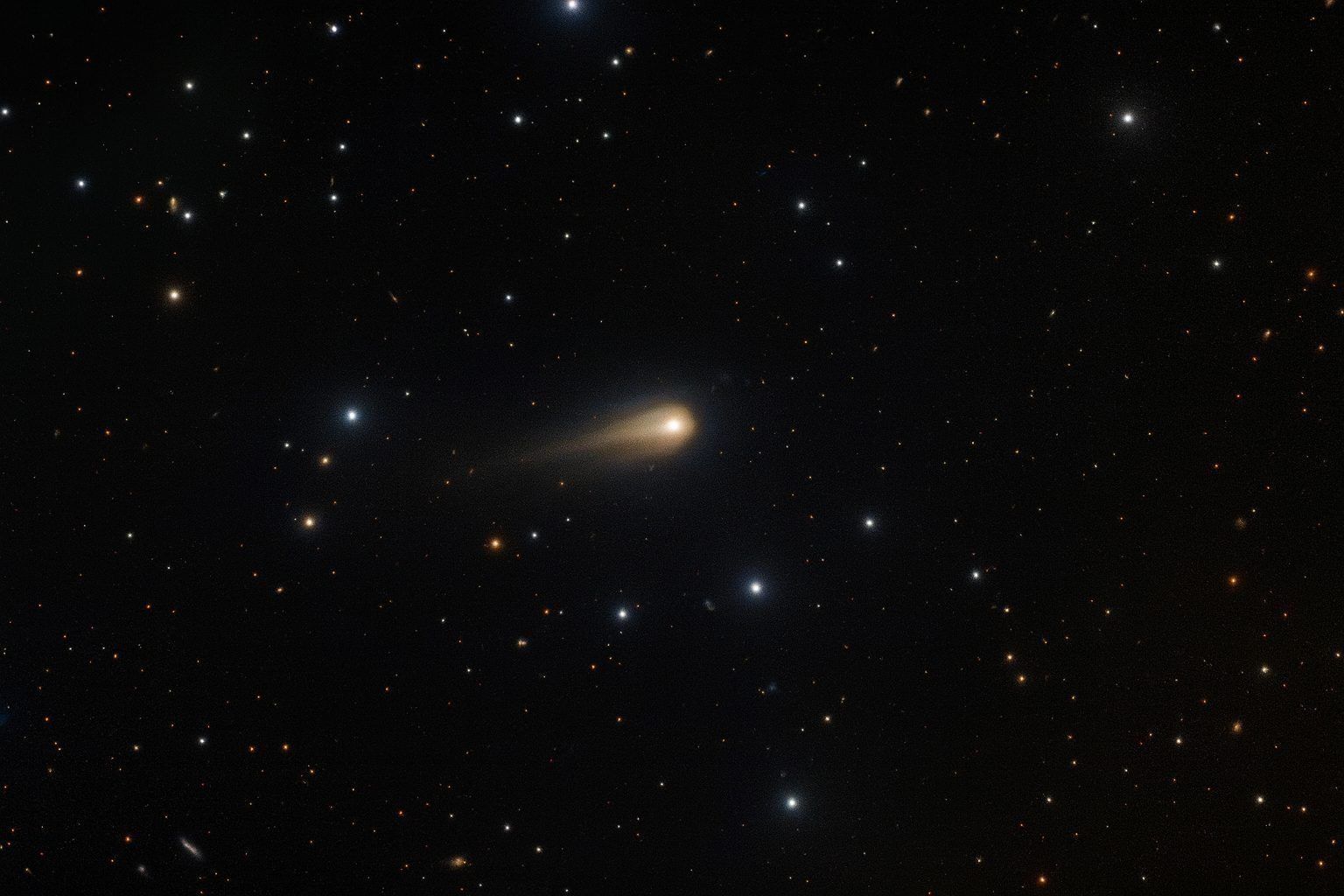

December 15, 2025 — A rare visitor from beyond our solar system is making its final, headline-worthy sweep through the inner neighborhood — and the countdown to its closest pass by Earth is nearly over.
Interstellar comet 3I/ATLAS (also designated C/2025 N1 (ATLAS)) will reach its closest approach to Earth on Friday, December 19, 2025, staying a safe ~1.8 astronomical units away — about 270 million kilometers (167–170 million miles), roughly twice the average Earth–Sun distance. It poses no threat to Earth, but the timing is ideal for professional observatories — and for skilled backyard stargazers with telescopes — to squeeze out precious data before the comet continues outward on an escape trajectory that will eventually carry it back into interstellar space.
What makes this week different from earlier updates isn’t just the flyby. Today’s coverage brings together several major developments at once: a global tracking push tied to the United Nations-backed International Asteroid Warning Network (IAWN), and new reports highlighting X‑ray observations that are giving scientists a fresh way to probe what 3I/ATLAS is made of — including gases that are difficult to detect in visible light.
Why 3I/ATLAS Is Such a Big Deal
3I/ATLAS is only the third confirmed interstellar object ever observed passing through our solar system, after 1I/ʻOumuamua (2017) and 2I/Borisov (2019). Unlike ordinary comets that formed in the Sun’s distant outskirts, interstellar comets originate around other stars and get flung out — becoming deep-freeze time capsules drifting through the Milky Way until a chance encounter brings them near the Sun.
It was first spotted on July 1, 2025 by the NASA-funded ATLAS survey telescope in Río Hurtado, Chile, and quickly flagged as interstellar because its hyperbolic (unbound) orbit shows it is moving too fast to be captured by the Sun’s gravity. In other words: it’s not “looping around” to return someday — it’s passing through once. NASA Science+2NASA Science+2
How Close Will 3I/ATLAS Get — and Will You Be Able to See It?
Despite the phrase “closest approach,” 3I/ATLAS will still be extremely far away in human terms. But by comet standards, this is a valuable observing window.
- Closest approach to Earth: ~270 million km, Dec. 19, 2025 AP News+2NASA Science+2
- No hazard: both NASA and ESA emphasize the comet remains far away and does not endanger Earth or other planets NASA Science+1
- Viewing: NASA says it can be observed from the ground with a small telescope in the pre-dawn sky and should remain observable into spring 2026 (though visibility depends heavily on location, sky conditions, and the comet’s fading activity).
One important nuance: ESA notes that during its closest approach, the comet will be on the other side of the Sun from Earth — which helps explain why this is not expected to become a bright naked-eye spectacle.
For those who prefer to follow along online, Space.com reports that Italy-based astronomer Gianluca Masi’s Virtual Telescope Project plans a free livestream timed to the flyby window (weather permitting).
What Scientists Know About 3I/ATLAS Right Now: Size, Speed, and Origins
Because comets surround themselves with a bright coma of gas and dust, measuring the true size of the solid nucleus is notoriously tricky — and interstellar comets add extra pressure because they don’t stick around.
Size (best current estimates):
- NASA’s compiled “Facts and FAQs” puts the nucleus diameter somewhere between ~440 meters and ~5.6 kilometers, based on Hubble-linked analysis limits. NASA Science
- AP reporting today echoes that same range as the working estimate while noting the comet is fading as it departs.
- An AAS Nova feature also highlights Hubble constraints from early-target observations, reporting a nucleus radius range of ~0.22 to 2.8 km (which is consistent with a wide uncertainty band).
Speed:
3I/ATLAS is moving extraordinarily fast — and speed is one reason it’s categorized as interstellar.
- NASA says it traveled about 221,000 km/h at discovery and sped up to about 246,000 km/h near perihelion.
- ESA’s FAQ describes ~250,000 km/h near closest approach to the Sun, calling it the highest recorded for a solar system visitor.
Trajectory and sky “origin direction”:
NASA notes the comet approached from the general direction of the constellation Sagittarius (the direction of the Milky Way’s central region in the sky), though that doesn’t identify a specific parent star system — just its incoming direction as seen from Earth. NASA Science
Key recent milestones already logged:
- Closest approach to Mars: ~29 million km, Oct. 3, 2025 European Space Agency
- Closest approach to the Sun (perihelion): late October (Oct. 29–30 depending on the solution/source), at ~1.4 AU European Space Agency+1
The Freshest Scientific Twist: 3I/ATLAS Seen in X‑ray Light
Comets can glow in X‑rays — not because they’re “hot,” but because of an interaction between the solar wind (charged particles streaming from the Sun) and neutral gases flowing off the comet. The collision triggers a process called charge exchange, producing X‑ray emission.
What’s new in December: 3I/ATLAS is now tied to a major first.
ESA: First Interstellar Comet Imaged in X‑rays
ESA reports that the Japan-led XRISM mission observed 3I/ATLAS for 17 hours between Nov. 26–28, 2025, producing an X‑ray image from its Xtend instrument — and describing 3I/ATLAS as the first interstellar comet to have been imaged in X‑ray light. ESA says the X‑rays appear to come from a region around ~400,000 km surrounding the nucleus, possibly linked to a diffuse gas cloud, with early analysis indicating signs of carbon, nitrogen, and oxygen.
ESA: XMM‑Newton Adds a Second X‑ray View
ESA also confirms its X‑ray observatory XMM‑Newton observed 3I/ATLAS on Dec. 3, 2025 for about 20 hours, when the comet was roughly 282–285 million km from the spacecraft. The observation used XMM’s EPIC‑pn camera, and ESA explains the X‑ray glow is expected from solar-wind collisions with gases such as water vapor, carbon dioxide, or carbon monoxide — while emphasizing X‑ray observations are especially sensitive to gases like hydrogen and nitrogenthat can be difficult to spot at optical/UV wavelengths.
BBC Sky at Night Magazine, also reporting today, underscores the same Dec. 3 XMM‑Newton observation window and frames the result as a new “view” of an interstellar visitor — a reminder that for 3I/ATLAS, the story is increasingly about multi-wavelength forensics, not just pretty tail photos. Sky at Night Magazine
The UN and NASA Angle: Why a Global Network Is Tracking This “Harmless” Comet
If you’ve seen headlines suggesting a “planetary defense drill” around 3I/ATLAS, here’s the grounded reality: tracking comets precisely is hard, and 3I/ATLAS is a perfect real-world test case.
Live Science reports today that the U.N.’s International Asteroid Warning Network (IAWN) is actively monitoring 3I/ATLAS as part of a campaign designed to strengthen techniques for measuring sky positions — astrometry — for objects that don’t behave like clean, point-like asteroids. The article says NASA coordinates IAWN, and quotes campaign leadership describing the effort as a way to improve tracking methods that could matter for future visitors (including planning potential spacecraft missions to similar objects).
The IAWN’s official campaign page explains why comets complicate orbit prediction: their comae and tails can shift the apparent center of light, introducing systematic errors. It confirms the observing campaign timeline as Nov. 27, 2025 through Jan. 27, 2026, and notes this is the 8th IAWN observing exercise since 2017, typically conducted about once per year.
In plain terms: 3I/ATLAS isn’t being treated as a threat — it’s being treated as a rare calibration opportunity for the systems and collaborations that would matter if a future object ever did raise concern.
What Happens After Dec. 19?
The December 19 flyby is not the end of the comet’s tour — just the closest Earth checkpoint.
- Jupiter encounter: AP reports 3I/ATLAS will pass much closer to Jupiter in March 2026, within about 53 million km (33 million miles).
- Leaving the solar system: AP quotes NASA’s Near-Earth Object Studies leadership indicating it will be the mid‑2030s before 3I/ATLAS fully reaches interstellar space again — a reminder that “leaving” is not a doorway you step through, but a long outward cruise. AP News
- Observations continue: NASA says it should remain observable (with telescopes) into spring 2026, offering continued opportunities to track how its activity fades as solar heating decreases with distance.
Key Dates to Know for Interstellar Comet 3I/ATLAS
- July 1, 2025: Discovery reported by ATLAS (Chile) NASA Science+1
- Oct. 3, 2025: Closest approach to Mars (~29 million km) European Space Agency
- Oct. 29–30, 2025: Perihelion (closest to the Sun; ~1.4 AU) European Space Agency+1
- Nov. 26–28, 2025: XRISM X‑ray observations (17 hours) xrism.jaxa.jp+1
- Dec. 3, 2025: XMM‑Newton X‑ray observations (~20 hours) European Space Agency+1
- Dec. 19, 2025: Closest approach to Earth (~270 million km) AP News+2European Space Agency+2
- March 2026: Close pass by Jupiter (reported by AP) AP News+1
The Bottom Line
On December 15, the story of interstellar comet 3I/ATLAS is no longer just “a rare object is passing by.” It’s now a full-spectrum scientific campaign: a safe but scientifically priceless flyby, a coordinated international tracking effort sharpened under the UN-linked IAWN umbrella, and an emerging X‑ray data set that may help answer one of the biggest questions interstellar visitors bring with them:
Do comets from other star systems behave like ours — or are they made of something fundamentally different?European Space Agency+2European Space Agency+2