New York time check: As of 2:07 p.m. ET on Friday, December 26, 2025, U.S. markets are open and trading normally (a full session today following the Christmas holiday).
IonQ, Inc. (NYSE: IONQ) is seeing a sharp intraday pullback in a session already prone to exaggerated moves: holiday-thinned liquidity, year-end positioning, and a market hovering near record territory. At 2:07 p.m. ET, IonQ stock was trading around $46.29, down roughly 7% from the prior close, after ranging between about $46.13 and $50.08 on the day.
The selling is notable because it lands just days after arguably “good news” for IonQ: a 100‑qubit Tempo system agreement in South Korea and another major partnership expansion in Europe. But with speculative growth themes—especially quantum—investors often react less to headlines and more to pricing, expectations, and what’s still unknown (such as revenue timing, margins, and delivery schedules).
Stock market backdrop: records nearby, but holiday trading can magnify volatility
Today’s tape is shaped by a familiar late-December mix: light participation and sensitivity to flows. The Associated Press reported U.S. stocks were slightly lower around midday in quiet post-Christmas trading, with volume expected to remain light. AP News
Zooming out, Reuters notes that major U.S. indexes are near record levels to close out a strong year, with the S&P 500 about 1% from 7,000 and on track for a long monthly winning streak. Reuters also highlighted that year-end portfolio adjustments in low-volume conditions can amplify price swings—exactly the kind of environment where high-beta names like IonQ can see outsized moves. Reuters
IonQ stock today: why a “good-news” name can still fall hard
IonQ’s intraday drop is happening while the broader market is relatively steady—suggesting the move is more stock-specific than macro-driven. That said, three dynamics can coexist:
- Profit-taking and positioning in a volatile, high-momentum theme (quantum computing stocks have been prone to sharp runs and sharp retracements).
- Headline digestion: investors may like the strategic direction but still question near-term financial impact.
- Valuation and expectations: when a story stock is priced for big outcomes, even solid announcements may not be “enough” to sustain the bid.
Motley Fool’s coverage today reflects this tension directly—calling the South Korea system sale “impressive,” while emphasizing that the company did not disclose financial specifics and arguing that meaningful quantum advantage still requires vastly more scale (and error correction) than today’s systems. The Motley Fool
Biggest current catalyst: IonQ’s 100‑qubit Tempo system agreement in South Korea
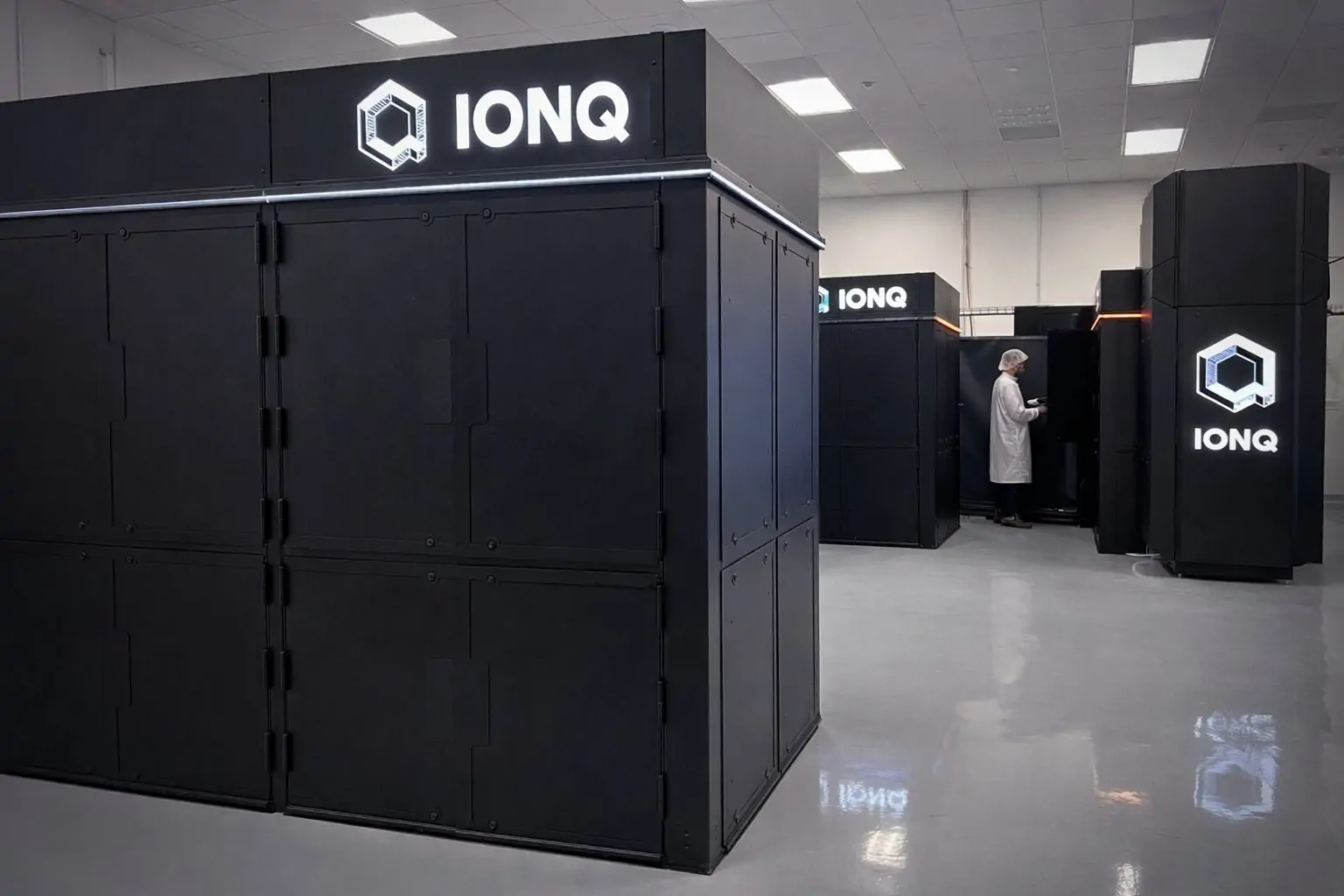
The most market-moving IonQ-specific development this week is the company’s announcement that it will deliver a 100‑qubit IonQ Tempo quantum system under a finalized agreement with the Korea Institute of Science and Technology Information (KISTI). The company says the system will be integrated into KISTI‑6 (“HANKANG”), described as Korea’s largest HPC cluster—creating the country’s first onsite hybrid quantum‑classical integration. IonQ Investors
IonQ framed the deal as a “defining moment,” with CEO Niccolo de Masi saying the partnership will deliver infrastructure and expertise to unlock long-term value from IonQ’s systems. KISTI President Dr. Sik Lee positioned it as a leap forward for national quantum ambitions, including use cases across areas like healthcare, finance, and materials science. IonQ Investors
What investors are still looking for: The announcement is strategically meaningful—but the market often wants the missing details:
- What is the revenue value and margin profile of a Tempo 100 system deployment?
- When will delivery occur and when does the project convert into recognized revenue?
- Will this lead to follow-on deployments or recurring services?
Those unanswered questions can be enough to spark “sell the news” behavior, especially in thin trading.
Europe expansion: QuantumBasel partnership grows to $60M+ through 2029
IonQ also announced on December 17, 2025 that it expanded its long-term partnership with QuantumBasel in Switzerland. IonQ said the extension brings total deal value to over $60 million and extends IonQ’s on-site presence through 2029, while securing ownership arrangements for systems including IonQ Forte Enterprise and a next-generation Tempo system. IonQ
The company also described new collaborative research workstreams focused on optimizing large language models and hybrid quantum-classical techniques—signaling a push to connect quantum compute to near-term enterprise workloads and AI experimentation. IonQ
Investor takeaway: This reinforces a key part of the IonQ equity story—IonQ is not only selling cloud access; it’s also trying to place physical systems and build regional hubs that can drive long-cycle adoption.
Financial reality check: Q3 revenue surge, higher 2025 guidance, and a very large cash buffer
IonQ’s most recent quarterly report remains central to the “can the story fund itself?” debate.
In its Q3 2025 release, IonQ reported:
- Revenue of $39.9 million, which it said was 222% year-over-year growth and 37% above the high end of its guidance range. IonQ Investors
- Raised full-year 2025 revenue guidance to $106 million to $110 million. IonQ Investors
- Reported a net loss of $1.1 billion, including significant non-GAAP disclosures (Adjusted EBITDA loss and Adjusted EPS). IonQ Investors
- Highlighted technical milestones including 99.99% two-qubit gate performance and #AQ 64 on Tempo ahead of schedule. IonQ Investors
- Reported pro-forma cash, cash equivalents, and investments of $3.5 billion after a $2 billion equity offering that closed in October 2025. IonQ Investors
That last point matters: IonQ has runway. But it also reminds investors that capital raises can be part of the long journey in pre-profit frontier tech.
Analyst forecasts: Jefferies goes to $100, but targets span a wide range
Jefferies: Buy, $100 target, long-term roadmap framing
One of the biggest recent “bull” signals was Jefferies initiating coverage with a Buy and a $100 price target. Jefferies emphasized IonQ’s trapped-ion architecture and laid out an aggressive scaling roadmap toward 2030. Jefferies also said its target was derived from discounted 2030 revenue projections and referenced a very rich valuation framework (including a multiple of enterprise value to sales). Investing.com
Jefferies also flagged the volatility profile—citing a high beta—and noted IonQ’s lack of profitability alongside strong liquidity. Investing.com
JPMorgan: Neutral, $47 target cited
The same report also referenced JPMorgan initiating with a Neutral rating and a $47 price target, underscoring that not all major coverage sees the risk/reward the same way at current levels. Investing.com
“Consensus” snapshots from tracking services
Price-target aggregators show a wide spread:
- MarketBeat shows an average target around the low $70s with a high of $100 and a low as low as $30 (depending on included analysts). MarketBeat
- TipRanks shows an average in the mid-$70s with a high of $100 and a low around the high $40s (based on its tracked set). TipRanks
How to read this: For IonQ stock, dispersion is the point. When outcomes depend on multi-year technology milestones and commercialization pacing, “fair value” varies dramatically by assumptions.
Insider selling headlines: what the SEC filings actually show
Another potential contributor to today’s pressure: recent Form 4 activity that can generate bearish headlines, especially in thin markets.
SEC filings show IonQ director Kathryn K. Chou reported transactions in December, including activity tied to a Rule 10b5‑1 trading plan adopted in September 2025. SEC+1
Investor nuance: 10b5‑1 plans and option-related transactions can be routine and not necessarily a fundamental signal. But in momentum-driven stocks, “insider selling” headlines can still weigh on sentiment.
Another fresh local catalyst: Maryland grant tied to IonQ headquarters buildout
IonQ also surfaced in local and industry coverage this week after Maryland approved a $5 million grant supporting design and construction of IonQ’s planned global headquarters in College Park. Quantum Computing Report described the grant as part of Maryland’s “Capital of Quantum” initiative and tied it to the state’s 2026 capital budget. Quantum Computing Report
A Prince George’s County economic development update similarly reported Maryland awarded $5 million to assist IonQ with buildout of a forthcoming headquarters facility. PGCEDC
This type of news typically isn’t a near-term revenue driver, but it can reinforce the “strategic national/regionally-supported industry” narrative that’s been lifting quantum names.
What investors should watch into the close and heading into next week
Because the exchange is open right now, the more useful question is: what matters before the next full round of liquidity returns?
1) Watch whether the move is “thin tape” or real distribution
Reuters explicitly warned that year-end adjustments in low volume can exaggerate moves. Reuters
If IonQ stabilizes as volume normalizes next week, that’s one kind of signal; if selling accelerates with stronger participation, that’s another.
2) Look for follow-up details on the Tempo 100 deal
The South Korea KISTI announcement is strategically important, but investors may keep pressing for:
- delivery timing,
- revenue recognition expectations,
- whether this is a template for additional national HPC integrations. IonQ Investors
3) Track technical posture after the recent run
Investor’s Business Daily recently noted IonQ’s Relative Strength Rating improved to 85 and described the stock as extended beyond an identified buy range—suggesting pullbacks and new base-building could matter for technical traders. Investors.com
4) Know what’s coming on the macro calendar
Reuters highlighted that Fed minutes next week could affect rate-cut expectations—and that the market is highly focused on the path of policy into 2026. Reuters
High-duration, high-volatility growth names like IonQ can be especially sensitive to shifting rate narratives.
5) Mark the next earnings window—but confirm the date
Third-party calendars currently disagree on the exact next earnings date for IonQ:
- Zacks lists an expected report around Feb. 25, 2026. Zacks
- MarketBeat also estimates Feb. 25, 2026 (noting it as an estimate based on past schedules). MarketBeat
- TipRanks and Investing.com display later timing (late March / early April in their interfaces). TipRanks+1
Until IonQ posts a confirmed schedule on its IR events page, investors should treat calendar dates as estimates. IonQ Investors
Bottom line: IonQ remains a high-upside, high-volatility quantum bellwether
IonQ’s late-2025 story has real momentum: system deployments (South Korea), deeper European partnerships (QuantumBasel), accelerating revenue versus guidance, and a large cash cushion. IonQ Investors+2IonQ+2
At the same time, the stock’s reaction today is a reminder that the market is constantly repricing two questions:
- How quickly do strategic wins translate into durable revenue and improving unit economics?
- How much of that future is already embedded in today’s valuation?
In a quiet year-end session, those questions can move IonQ stock more than the headlines themselves.