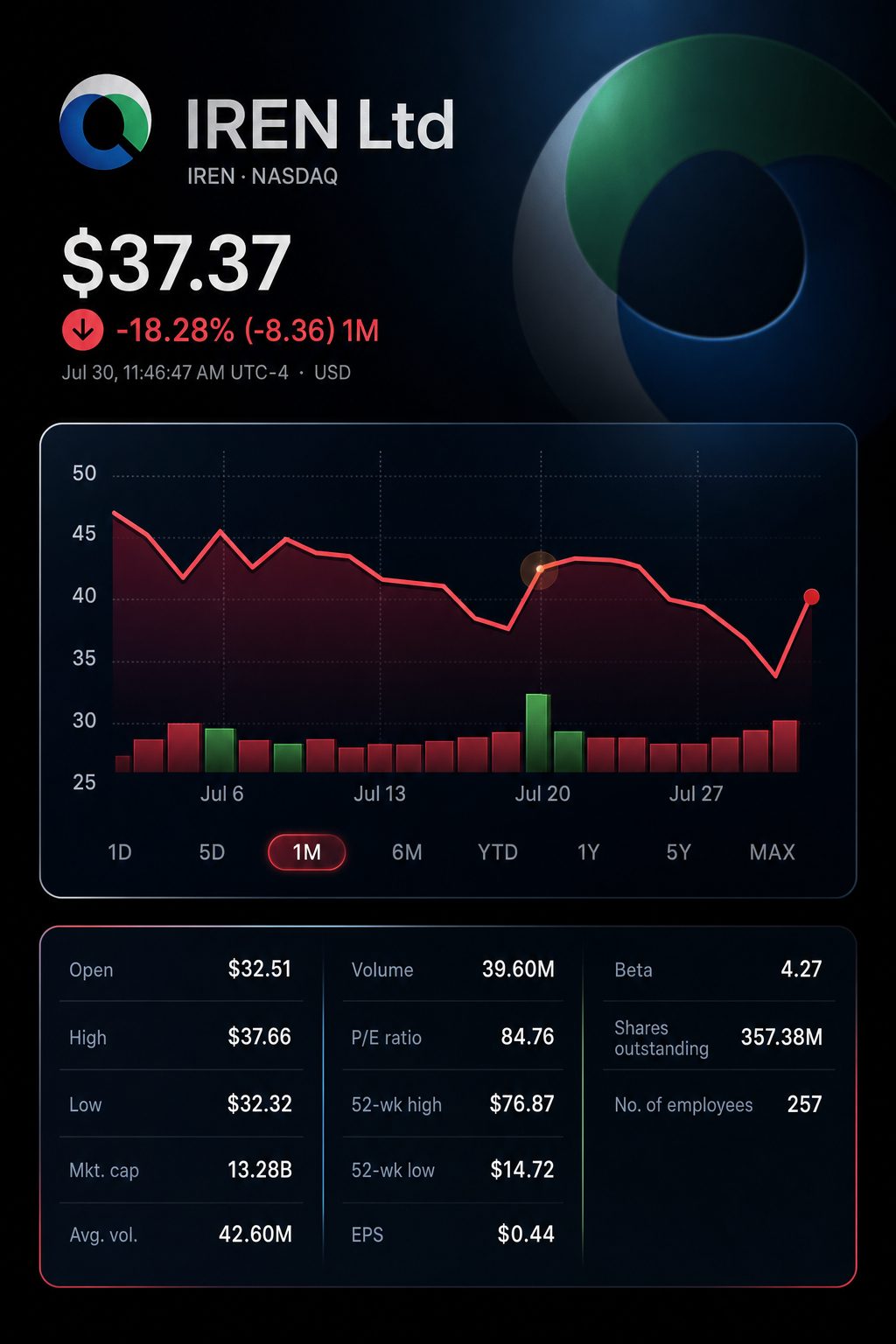
NEW YORK, July 30, 2026, 11:01 a.m. EDT – Shares in IREN NASDAQ:IREN jumped 26% after the company outlined a 5GW AI roadmap, reigniting discussion about its valuation.
Shares of IREN advanced 26.3% to $37.03 during morning trading. TeraWulf NASDAQ:WULF was up 18.2%, and Applied Digital NASDAQ:APLD increased by 19.6%.
IREN’s 2026 revenue goal suggests annual revenue exceeding $8.3 million for each reported megawatt.
The rate is about 3.5 times higher than TeraWulf’s Anthropic lease and five times that of Applied Digital’s most recent similar lease.
Shares of IREN Ltd NASDAQ:IREN jumped 26.3% on Thursday morning, bouncing back after a 13.6% drop the previous day. AI infrastructure stocks rallied with gains seen across the wider technology sector.
The advance was not enough to offset losses from July. IREN, TeraWulf, and Applied Digital started Thursday having fallen more than 30% over the past month.
Shares of Microsoft NASDAQ:MSFT climbed roughly 15% following its outlook, which alleviated worries over AI expenditure. The Nasdaq Composite added 2.2%, and the Philadelphia semiconductor index advanced 6.7%.
Security
Delayed price
Thursday move
Prior one-month move
IREN
$37.03
up 26.3%
down 33%
TeraWulf
$17.84
up 18.2%
down 38%
Applied Digital
$27.78
up 19.6%
down 36%
Global X Data Center & Digital Infrastructure ETF (NASDAQ:DTCR)
$27.63
up 4.0%
down 13%
Prices reflected a delay until roughly 10:46 a.m. EDT. Changes for the month were logged in Wednesday’s trading session.
IREN shares also recovered after updated remarks from co-CEO Daniel Roberts, who stated that demand is outpacing buildable capacity and confirmed that 85% of the 2026 target remains under contract.
The key differentiator for investors is revenue density. IREN aims for over $4 billion in annualized run-rate revenue (ARR) by year’s end, with a total of 480 megawatts in gross AI cloud capacity.
That amounts to over $8.3 million per revealed megawatt. The Anthropic agreement by TeraWulf suggests roughly $2.37 million per megawatt, while Applied Digital’s Delta Forge 2 lease points to $1.65 million.
Company
Disclosed economics
Capacity basis
Approximate annual revenue per MW
Business model
IREN
ARR of over $4 billion in 2026
480 MW gross
Above $8.33 million
Managed GPU cloud
TeraWulf
$19 billion across 20 years
401 MW critical IT load
$2.37 million
AI infrastructure lease, long-term
Applied Digital
$5.2 billion spanning 15 years
210 MW critical IT load
$1.65 million
Take-or-pay data center lease
The comparison is intended as directional rather than directly equivalent. IREN provides figures for gross capacity and runs the GPU cloud stack. In contrast, both peers report critical IT load under leases characteristic of property arrangements.
The increased revenue goal is due to this stack. IREN provides managed compute, storage, orchestration, and customer support, instead of just offering powered data-center space.
The move also brings greater execution risk. ARR is not recognized as revenue according to generally accepted accounting principles. It relies on GPU delivery, commissioning, testing, customer approval, usage, and pricing.
On July 20, Roberts stated the platform was “scaling at pace.” IREN expanded from around 3 MW to 480 MW provided this year, and aims to reach 1.2 GW by 2027. IREN
Development stage
Disclosed capacity
Increase
Current description
Roughly 12 months before
About 3 MW
Base level
AI cloud capacity built in-house
End-2026 goal
480 MW
160-fold
In progress
Target for 2027
1,200 MW
2.5x 2026
Ongoing scale-up efforts
Long-term plan
5,000 MW
10.4x 2026
Worldwide capacity and site pipeline
The 5 GW target is still classed as a strategic pipeline rather than active capacity. In May, NVIDIA NASDAQ:NVDA committed to backing deployments across this pipeline through its AI infrastructure architecture.
With a market capitalisation of $12.36 billion on Thursday, IREN was valued at less than 3.1 times its declared ARR goal. Factoring in the 85% contracted proportion results in over $3.4 billion, indicating a market-cap-to-contracted-ARR multiple of under 3.7 times.
IREN’s funding buffer is significant. As of June 30, the company disclosed preliminary, unaudited cash holdings of $7.6 billion. This total comprises $1.7 billion reserved specifically for financing linked with its contract with Microsoft. Approximately 45% of the related GPU capital expenses were paid in advance by recent clients.
Delivery and funding continue to be where most risks are focused. Delays in construction, reduced utilization rates, reliance on a small number of customers, or high costs of capital may further increase the difference between ARR and recognized revenue. The 5 GW roadmap provides limited room for error.
Thursday’s action shifts sentiment but does not alter execution. A lasting re-rating requires turning IREN’s increased revenue-per-megawatt approach into cash flow while avoiding significant dilution.
How is IREN stock performing today, and what factors are influencing its movement?
As of 11:02 a.m. ET, IREN shares stood at approximately $36.79, gaining 25.5%. The stock moved between $29.71 and $37.64 with a volume of 34.9 million shares. QQQ advanced 2.5%, while MARA increased 16.8% and Core Scientific was up 20.0%. The company’s most recent release remains the July 20 contract update. Wednesday’s 13.6% drop allowed scope for a strong sector-driven rebound.
Does IREN primarily remain a Bitcoin miner, or has it transitioned into an AI-focused stock?
From a financial standpoint, the company is still primarily a Bitcoin miner. Over nine months to March, mining generated $511.5 million out of total revenue of $569.8 million. AI Cloud brought in $58.3 million, representing about 10% of sales. SEC Still, executives target 480MW of AI capacity for 2026 and 1.2GW for 2027. The share price currently reflects a coming shift that is scarcely visible in the financial results so far.
What is the scale of IREN’s AI contract pipeline?
On July 20, IREN disclosed new multiyear contracts worth $2.8 billion. About 85% of its year-end annual recurring revenue (ARR) goal of over $4 billion has been contracted. Notable clients include Microsoft, NVIDIA, Perplexity, Figure AI, Together AI and others. The average weighted contract duration in the portfolio is nearly four years. Recently signed customers prepaid roughly 45% of related GPU capital expenditures. These metrics offer greater visibility, but contract amounts and ARR are not recognized as GAAP revenue.
Is it feasible for IREN to achieve over $4 billion in ARR by 2026?
The projection relies on 480MW of total AI Cloud capacity slated for completion by the end of the year. Revenue will be recognized only following commissioning, testing, and customer approval. This puts scheduling for construction and rollout at the forefront of risk. Contracts limit demand uncertainty, but execution risk remains. SEC A separate NVIDIA rollout is scheduled for early 2027 and has the potential to push ARR close to $4.4 billion. Considered feasible, but not assured.
What insights were provided by the most recent quarterly results?
Revenue for the March quarter totaled $144.8 million, compared to $184.7 million in the previous period. AI Cloud revenue surged to $33.6 million from $17.3 million. Bitcoin mining revenue declined to $111.2 million from $167.4 million. IREN posted a net loss of $247.8 million, which included $140.4 million in impairments. Adjusted EBITDA stayed positive at $59.5 million, and operating cash flow was $75.3 million. While the transition is accelerating, profit figures continue to show volatility.
Is IREN's cash position sufficient to support its growth plans?
IREN disclosed $7.6 billion in cash as of June 30, with $1.7 billion reported as restricted. After accounting for the restricted amount, about $5.9 billion remains available. SEC The Microsoft-backed $3.65 billion GPU facility features a blended rate of 6.00%. Customer prepayments cover 96% of the $5.81 billion total earmarked for Microsoft GPU outlays. Funding appears robust. The most recent quarterly balance sheet filed was for March 31, predating these financings.
What is the extent of risk from dilution and convertible debt?
The number of shares outstanding climbed to 357.4 million by April, compared with 258.1 million last June—a jump of 38.5% in ten months. SEC IREN continued its at-the-market program, allowing for up to $6 billion in stock sales. In May, an extra $3.0 billion convertible-note offering brought further equity-linked funding. SEC While capped calls offset some conversion-related dilution, the protection only applies within certain price boundaries. Fast-paced expansion still carries persistent dilution risk.
To what extent does Bitcoin continue to impact IREN’s stock price?
Bitcoin continues to be the main contributor to reported revenue. Mining accounted for approximately 90% of revenue for the nine months ending in March. The average operating hashrate was 41.4 EH/s, close to twice the level of the previous year. SEC Bitcoin last traded around $64,641, edging up 0.9%. IREN’s 25.5% rally significantly outpaced Bitcoin’s daily rise. Nonetheless, a weaker Bitcoin price would impact mining cash flow during the ongoing transition.
Is IREN currently undervalued?
Based on April’s last reported 357.4 million shares and the current price, IREN is valued at around $13.1 billion. That figure is roughly 3.3 times management’s ARR target of over $4 billion. It is also 22.7 times the March-quarter revenue annualized. SEC ARR is a non-GAAP metric that counts capacity pending commissioning. The contrast is notable. IREN’s valuation appears low only versus delivered future capacity, but remains high when measured against current revenue.
What target price do analysts predict for IREN?
Public.com cites an average price target of $76.62 based on 13 analyst estimates. Investing.com gives a $81.73 consensus from 15 analysts, with individual targets between $41 and $131. Public The projections vary, leaving no clear consensus value. Both averages are about 108% to 122% higher than the current $36.79 price. The lowest analyst target suggests an 11% gain; the highest points to approximately 256% upside. Analyst expectations are widely spread.
Jerzy Lewandowski is a senior markets editor at TS2.tech. His coverage ranges from stocks and semiconductors to AI and the broader global markets. He studied economics at the University of Warsaw and worked in investment analysis before becoming a financial journalist. Follow Jerzy Lewandowski on Google News.