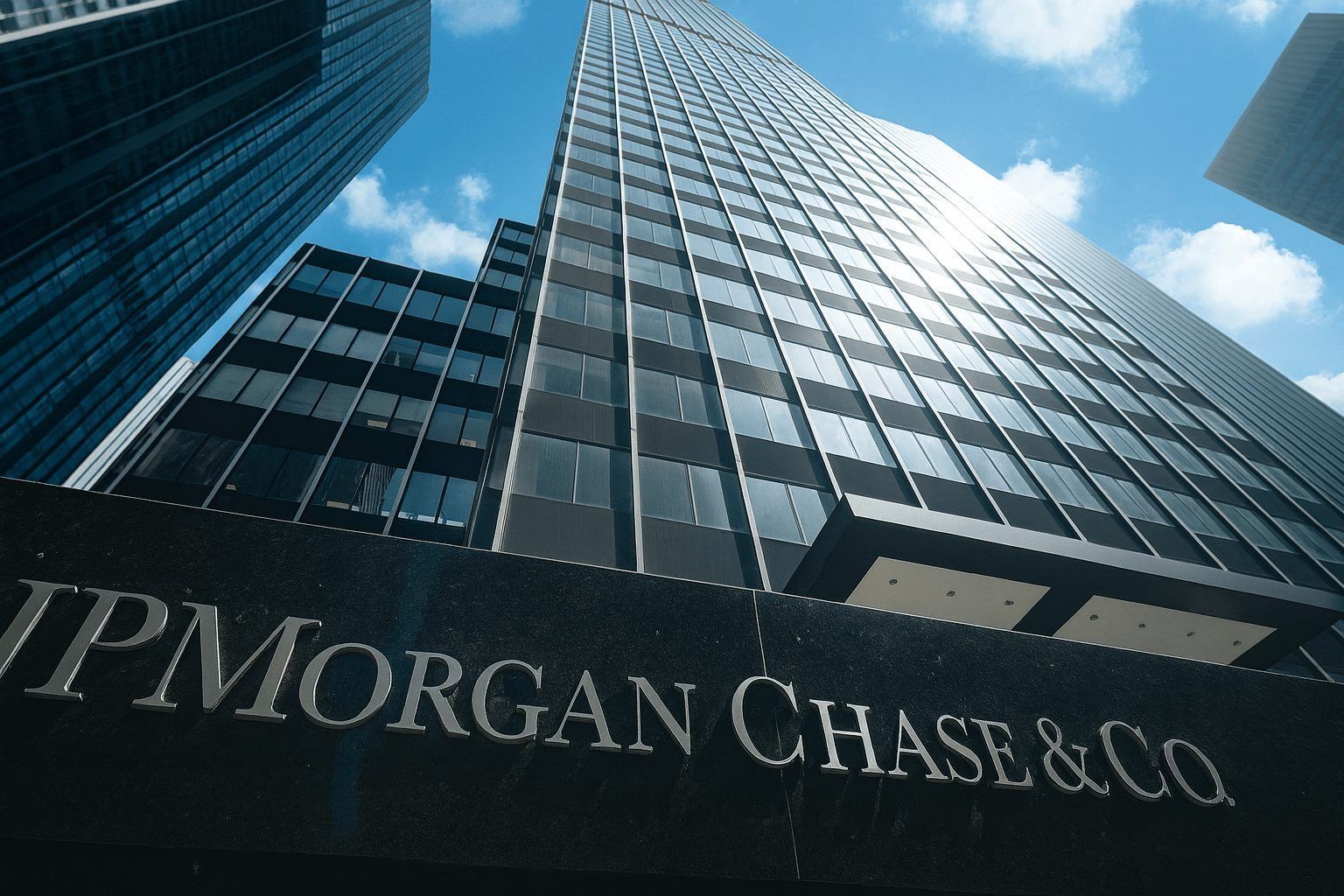
JPMorgan Chase & Co. (NYSE: JPM) is starting the week with fresh momentum. On Monday, December 15, 2025, JPMorgan stock touched new record territory as investors weighed a cluster of same-day catalysts—from a new blockchain-based money-market product to updated consumer-credit metrics—against an outlook that still includes one of Wall Street’s biggest open questions for the bank: how higher 2026 expenses will translate into earnings power.
As of 15:04 UTC (10:04 a.m. ET) on Dec. 15, JPM shares traded around $320.63, up about 0.7% on the day, after reaching an intraday high of $322.79.
Below is what’s driving JPM stock today, what the latest forecasts imply, and the key risk factors investors are tracking into year-end and the Q4 earnings report.
What’s happening with JPMorgan stock today
1) JPMorgan stock hit an all-time high.
Investing.com reported JPMorgan stock reaching an all-time high of $322.44 on Dec. 15, with the bank’s market capitalization cited as exceeding $875 billion and a one-year gain of about 33.84%.
(Real-time feeds can differ slightly by venue; JPM’s intraday high in the same session was $322.79 per market data. )
2) J.P. Morgan Asset Management launched its first tokenized money-market fund on Ethereum.
The bank’s asset-management arm announced the launch of My OnChain Net Yield Fund (MONY) on the public Ethereum blockchain, positioning it as a way for qualified investors to access on-chain money-market exposure via the firm’s Morgan Money liquidity platform.
3) New consumer credit data hit the tape.
A Reuters “flash” update tied to SEC filing data noted JPMorgan’s credit card delinquency rate was 0.86% at November-end, alongside a credit card charge-off rate of 1.76% in November. TradingView
4) Analysts continue to inch targets higher—even as “cost” remains the debate.
MarketBeat reported TD Cowen raised its price target on JPMorgan to $375 from $370 while maintaining a Buy rating, and also cited a consensus view closer to the low-to-mid $320s. MarketBeat
Why the tokenized money-market fund matters for JPM stock
JPMorgan’s Dec. 15 announcement isn’t just a “crypto headline.” It’s a strategic signal about where the bank believes institutional finance is going—especially around cash management, collateral, and settlement.
Here are the details that investors are focusing on:
- The product: My OnChain Net Yield Fund (MONY), a tokenized money-market fund launched by J.P. Morgan Asset Management.
- Where it lives: The fund is available on the public Ethereum blockchain.
- What it holds: The press release says MONY invests only in U.S. Treasury securities and repurchase agreements fully collateralized by U.S. Treasuries—a classic “cash-like” risk profile, but delivered via tokenization. PR Newswire
- How transactions work: The fund supports subscription and redemption via cash or stablecoins through Morgan Money, with tokens delivered to investors’ blockchain addresses and features such as daily dividend reinvestment.
- The plumbing: MONY is “powered by” Kinexys Digital Assets, JPMorgan’s tokenization solution. PR Newswire+1
- Initial scale: JPMorgan seeded the fund with $100 million.
Barron’s framed the move as a notable “Wall Street meets blockchain” moment, highlighting that tokenized money-market funds are increasingly attractive to investors who want yield while keeping assets on-chain, and noting the product’s availability to qualified investors under specific wealth thresholds described in the report. Barron’s
The stock-market takeaway
In the near term, MONY is unlikely to move JPMorgan’s earnings by itself. But it strengthens an investment narrative that’s mattered for JPM stock in 2025: the bank is trying to lead (not follow) in the institutional version of digital assets—where payments, fund administration, and collateral management can become more efficient if tokenization scales.
That effort has been building all month. Just last week, Reuters reported JPMorgan arranging a short-term debt issuance on a public blockchain (Solana) for Galaxy Digital—another step in testing “real world” issuance and settlement rails. Reuters
JPM stock forecast: what analysts are signaling right now
There’s no single “official” JPMorgan forecast, but investors typically triangulate from (a) price targets and ratings, and (b) the next earnings cycle.
Price targets and ratings
- TD Cowen: Target raised to $375, Buy maintained.
- Broader consensus: MarketBeat cited a consensus target around $327 and a consensus view in the “Hold” neighborhood, implying more limited upside after JPM’s strong run. MarketBeat
- MarketScreener’s snapshot: A separate consensus snapshot showed an average target price around $327.35 with a small implied upside from recent levels and a consensus leaning “outperform.” MarketScreener
How to read that: After a move to record highs, many models effectively say: JPM is a high-quality franchise, but the stock is closer to “priced well” than “priced cheap.”
Next big checkpoint: Q4 earnings
JPMorgan has confirmed it will report fourth-quarter 2025 results on Tuesday, Jan. 13, 2026, with results scheduled around 6:45 a.m. ET and a conference call at 8:30 a.m. ET.
That matters because JPM stock often reacts less to broad “beats” and more to the specific forward-looking line items investors care about most right now:
- expense trajectory and headcount/pay trends
- net interest income sensitivity if rates fall further
- credit quality in card/auto and small business
- investment banking and markets activity levels
The biggest swing factor: JPMorgan’s expense outlook for 2026
A record stock price does not mean investors have forgotten December’s biggest JPM headline before today: higher costs.
On Dec. 9, Reuters reported JPMorgan expects about $105 billion in expenses in 2026, above analysts’ average expectations (cited by Reuters at $100.84 billion). JPM shares fell sharply on that update, even as management pointed to Q4 tailwinds in investment banking and markets revenue.
The Financial Times similarly reported that the expense outlook drove JPM’s biggest decline in months, while highlighting management commentary that investment banking fees and trading revenue were trending higher in Q4.
Why this matters for JPM stock now
JPMorgan is big enough that it can “spend into strength” (AI, branches, marketing, adviser compensation, platform build-outs) while still producing strong profitability. But once a stock reaches record highs, markets tend to demand proof that incremental spending leads to incremental earnings—not just “strategic positioning.”
So as JPM rallies on Dec. 15, investors are simultaneously asking: Will this week’s innovation headlines translate into operating leverage in 2026?
Credit check: what today’s delinquency and charge-off data suggests
JPMorgan’s consumer-credit performance is one of the most closely watched “real economy” signals among large U.S. banks.
On Dec. 15, a Reuters update reported:
- Credit card delinquency rate:0.86% at November-end
- Credit card charge-off rate:1.76% in November (per SEC filing data referenced by Reuters)
Those figures are important for two reasons:
- Credit costs drive earnings volatility. Even if revenue is strong, rising charge-offs can quickly reprice a bank stock, especially after a big run-up.
- They shape the “consumer resilience” debate. In October, Reuters quoted JPMorgan executives describing consumer metrics as stable and “slightly better than expected,” while cautioning about uncertainty around inflation and rates. Reuters
Rates and the economy: the macro backdrop into 2026
JPMorgan stock remains highly sensitive to the rate path and the yield curve.
On Dec. 15, Reuters reported U.S. indexes opened higher as investors prepared for a “data-packed week” that could influence the outlook for interest rates. Reuters
The reason JPM investors care: net interest income (NII)—the spread between what the bank earns on loans/securities and what it pays on deposits—can expand or compress meaningfully depending on how rates move.
At JPMorgan’s third-quarter report in October, Reuters reported:
- JPM raised its full-year net interest income forecast to roughly $95.8 billion (from $95.5 billion).
- The bank also expected interest income excluding markets of $95 billion in 2026, driven by balance-sheet growth but partially offset by the impact of lower rates.
Practical implication for a JPM stock forecast:
If the market shifts toward faster or deeper rate cuts, JPM’s NII outlook becomes a bigger debate—especially while the bank is simultaneously signaling higher expense spending in 2026.
What to watch next for JPM stock
Here are the catalysts most likely to shape JPMorgan’s share price over the next several weeks:
- Q4 2025 earnings (Jan. 13, 2026): The next major “reset” moment for forward guidance, including expenses, NII sensitivity, and credit. JPMorgan Chase
- Dividend timeline: JPMorgan declared a quarterly dividend of $1.50 per share, payable Jan. 31, 2026, to shareholders of record Jan. 6, 2026.
- Follow-through on tokenization: Investors will watch whether MONY becomes a platform story (repeatable issuance, broader client adoption, more on-chain liquidity products) or remains primarily a “headline product.” PR Newswire+1
- Expense confidence vs. skepticism: The market may reward JPM’s strategy if revenue momentum stays strong—but at record highs, the bar for execution is higher.
- Consumer-credit trendline: Today’s delinquency/charge-off snapshot will be monitored alongside broader credit signals into early 2026.
Bottom line
JPMorgan Chase stock is entering the final full trading weeks of 2025 with a powerful setup: record-high prices, strong year-to-date performance, and a fresh innovation headline around tokenized cash-management products.
But the “JPM bull case” and “JPM bear case” are both unusually clear right now:
- Bulls see an unmatched franchise with diversified earnings engines (markets, investment banking, consumer, wealth/asset management) and a leadership position in institutional-grade blockchain infrastructure.
- Bears (or cautious holders) see a stock that has already priced in much of the good news, with the next debate centered on whether higher 2026 expenses can still deliver strong operating leverage if the rate environment turns less favorable.