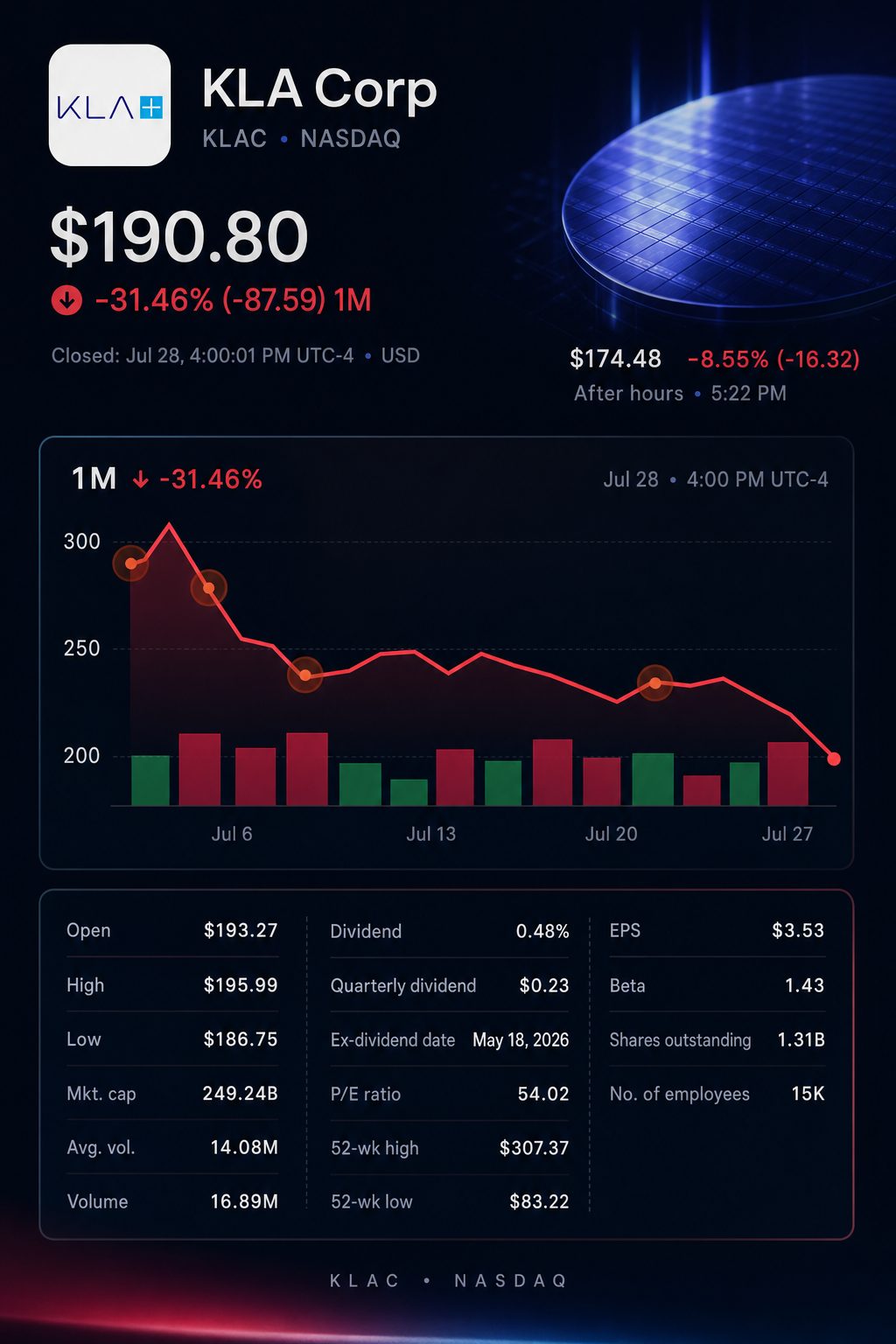
NEW YORK, July 28, 2026, 16:58 EDT – Shares in KLA NASDAQ:KLAC declined as the company’s cash flow came in below expectations despite higher sales supported by artificial intelligence demand.
KLA shares declined 8.98% in after-hours trading to $173.67, following a 6.18% drop to $190.80 at the close. The after-hours fluctuation is initial.
Revenue climbed 15.2% in the fourth quarter to $3.66 billion. Adjusted earnings reached $1.05 per share, surpassing the $1.00 consensus forecast.
First-quarter outlook topped analysts’ expectations, but free cash flow for the quarter declined 23.2% year-over-year.
KLA Corporation NASDAQ:KLAC stock fell almost 9% in after-hours trading on Tuesday. Shares dropped even as the company posted results and an outlook that topped analysts’ expectations. U.S. markets had ended regular trading, but after-hours activity continued.
The response indicates investors were seeking something beyond a slight outperformance. KLA approached the results having climbed more than 57% during the year. Market data showed its trailing price-to-earnings ratio stood in the mid-50s.
The midpoint for first-quarter revenue was around 2% above consensus. Adjusted profit guidance surpassed the mean estimate by about 1.8%. This resulted in only limited support for the valuation.
A less immediate concern involved cash conversion. Free cash flow, which is operating cash net of capital expenditures, declined by 23.2%. Meanwhile, revenue rose by 15.2%, further increasing the gap.
Measure
Q4 FY2026
Q4 FY2025
Year-on-year change
Revenue
$3.658 billion
$3.175 billion
up 15.2%
GAAP net income
$1.363 billion
$1.203 billion
up 13.3%
Adjusted EPS
$1.05
$0.94
up 11.7%
Free cash flow
$817 million
$1.065 billion
down 23.2%
Free-cash-flow margin
22.3%
33.5%
down 11.2 points
KLA’s per-share data reflect adjustments for the stock split in June. All percentages are based on figures provided by the company.
Operating cash flow was reduced by approximately $1.22 billion due to receivables, inventories and other assets. Deferred system revenue provided a $312 million boost, partially countering that impact. KLA’s statement did not specify the reason for the change in working capital.
Revenue for the quarter came in above the analyst consensus of $3.60 billion. Adjusted earnings topped estimates by five cents. GAAP net income increased 13.3% to $1.36 billion.
Semiconductor process control continued to drive results, with revenue up 13.2% to $3.257 billion. The segment accounted for roughly 79% of KLA’s overall sales growth.
The PCB and component inspection segment posted a 56.5% increase. Revenue totaled $241 million, up $87 million from a year earlier.
Chief Executive Rick Wallace stated that the growth drivers “are strengthening.” Wallace anticipates increased momentum in the second half of 2026, with the trend likely continuing throughout 2027. He pointed to investment in foundry, logic, memory, and advanced packaging as key contributors. KLA Corporation
KLA projected its first-quarter revenue at $4.0 billion, with a margin of plus or minus $200 million. The midpoint suggests sequential growth of 9.4%. Guidance for adjusted EPS stands at $1.16, reflecting a 10.5% increase from the previous quarter.
Revenue for fiscal 2026 increased by 11.7% to $13.58 billion. Free cash flow rose a modest 0.5% to $3.77 billion. The yearly free-cash-flow margin declined to 27.7% from 30.8%.
KLA returned 88.9% of its yearly free cash flow to shareholders. The company allocated $2.29 billion for buybacks and $1.06 billion for dividends. While this benefits investors, it reduces the company’s remaining cash generated internally after payouts.
KLA’s $7 billion buyback authorization was not unveiled on Tuesday. It originates from March 12, adding to a previously approved authorization. The company’s 10-for-1 stock split was finalized on June 11.
The drop in the regular session was also driven by sector performance. Shares of Applied Materials Inc. NASDAQ:AMAT dropped 7.82%, and KLA declined 6.18%. Meanwhile, the S&P 500 rose 0.21%.
Nonetheless, the drop after the market closed was more pronounced and particular to the company. The after-hours price of $173.67 was 14.6% less than the closing level on Monday. This level suggests the primary issue is elevated expectations, not a drop in reported demand.
Risks: Orders may be affected by export regulation, reliance on key customers, and fluctuations in semiconductor investment. Trading after regular hours often sees thinner liquidity and larger bid-ask spreads, so Tuesday’s shift is not definitive.
Cash conversion has become the main focus. Consistent revenue around $4 billion would back KLA’s AI-driven growth story. A further significant working-capital drain would challenge the justification for its premium valuation.
How is KLAC performing in trading following its earnings report?
KLAC finished Tuesday, July 28, at $190.80, dropping 6.18%. In after-hours trading, the price slipped further, trading around $175, a decline of about 8%. The S&P 500 added 0.21%, leaving KLAC to significantly lag behind the broader index. Its regular session close landed 37.9% under its June 30 peak of $307.37. Volume totaled 16.5 million shares, notably above its recent average. Prices during extended hours are subject to significant fluctuations before Wednesday’s opening bell.
Did KLA surpass Wall Street’s estimates for the fourth quarter?
Both headline figures beat estimates. Revenue totaled $3.66 billion, surpassing LSEG's forecast of around $3.60 billion. Adjusted EPS came in at $1.05, ahead of the $1.00 consensus. Revenue climbed 15.2% from a year earlier, and adjusted EPS rose 11.7%. GAAP net income stood at $1.36 billion, with GAAP EPS of $1.04.
What led to KLAC's decline even though the results surpassed expectations?
LSEG estimates indicate that both reported figures and September guidance topped analyst consensus. This suggests that citing a guidance miss alone does not fully capture the reasons for the drop and may mislead. The fall was probably driven by stronger unofficial expectations, a high valuation, and broader sector weakness. Prior to the results, KLAC had already declined 6.18%, and Applied Materials slipped 7.82%. The precise impact of each factor is unclear.
How robust is KLA's outlook for the September quarter?
KLA projected revenue at $4.0 billion, with a margin of plus or minus $200 million. This midpoint surpasses LSEG’s consensus forecast of $3.92 billion. The company’s adjusted EPS outlook is $1.16, plus or minus $0.10, with the midpoint above the consensus estimate of $1.14. The revenue guidance midpoint indicates sequential growth of 9.4% and roughly 24.6% year-over-year growth. The provided guidance is a projection and not yet realized.
Does KLAC represent a bargain following the recent decline?
On a trailing basis, the valuation is elevated. KLAC closed at $190.80, putting its fiscal 2026 GAAP EPS multiple near 52. In after-hours trading, shares slipped to about $175, lowering the price-to-earnings ratio to around 48. Fiscal 2026 revenue was up 11.7%, while GAAP EPS rose 20.4%. That still leaves the stock expensive, despite the steep pullback. Analyst forecasts for fiscal 2027 could change significantly as models are updated.
What proportion of KLA’s growth is linked to AI investment?
Executives report that AI infrastructure is supporting growth in leading-edge logic, memory, and packaging demand. Semiconductor Process Control posted $3.26 billion, making up roughly 89% of the quarter’s total revenue. KLA’s systems help detect defects and measure ever-more complex chip structures. Expanding use of high-bandwidth memory and sophisticated packaging introduces further process-control requirements. Management anticipates sustained momentum through 2027; however, this outlook is forward-looking. Customer capital investment patterns remain subject to rapid changes.
Do cash flow and returns to shareholders remain robust?
KLA generated $3.77 billion in free cash flow for fiscal 2026. The company distributed $3.35 billion to shareholders through buybacks and dividends, accounting for about 89% of its annual free cash flow. Of that, KLA spent $2.29 billion on repurchases and $1.06 billion on dividends. Its current $7 billion share repurchase authorization remains optional, not a commitment. The company plans to declare a $0.23 split-adjusted quarterly dividend in August.
Which major risks should investors be monitoring at this time?
Valuation presents the main risk following a strong AI-fueled rally. Export controls could limit sales and service to select Chinese clients. KLA also notes exposure to customer concentration, the cyclical nature of semiconductors, and risk of supply chain disruptions. The most recent earnings report did not specify a new impact from China. Policy decisions are still unclear. Margin performance remains key, with non-GAAP gross margin for September projected around 62.5%.
Have KLA’s earnings numbers been modified to account for the stock split?
All per-share data shown are adjusted for the stock split. KLA executed a 10-for-1 split after the close on June 11. Adjusted earnings per share for the fourth quarter were $1.05, equivalent to $10.50 before the split. The company's market value remained unchanged, as only the share count and price shifted. The coming quarterly dividend is projected at $0.23 per split-adjusted share.
What factors might influence KLAC over the next week?
Markets will see their first full-session response to KLA’s results at Wednesday’s open. Lam Research is scheduled to hold its earnings call at 5:00 p.m. Eastern on Wednesday. Updates on memory, foundry, equipment spending, and China from Lam could influence KLAC shares. Results from sector peers are set to either reinforce or question KLA’s 2027 growth story. Chip-equipment stocks remain volatile following Tuesday’s sector-wide selloff.
Mateusz Kaczmarek is a financial and technology journalist at TS2.tech. His coverage ranges from stocks and artificial intelligence to semiconductors and developments across global markets. He graduated from the Poznań University of Economics and Business and worked in financial analysis before becoming a business journalist. Follow Mateusz Kaczmarek on Google News.
A figure above or below the 12.0 consensus could impact Treasury yields, the dollar, and cyclical stocks by influencing short-term growth outlooks.
#2
NAHB Housing Sentiment
A reading above or below 33 will influence expectations for housing demand, mortgage rate trends, and homebuilder stocks.
#3
Fabrinet After the Close
Investors are focusing on revenue, margins, and comments on datacom as key factors for companies involved in optical networking and AI infrastructure supply chains.