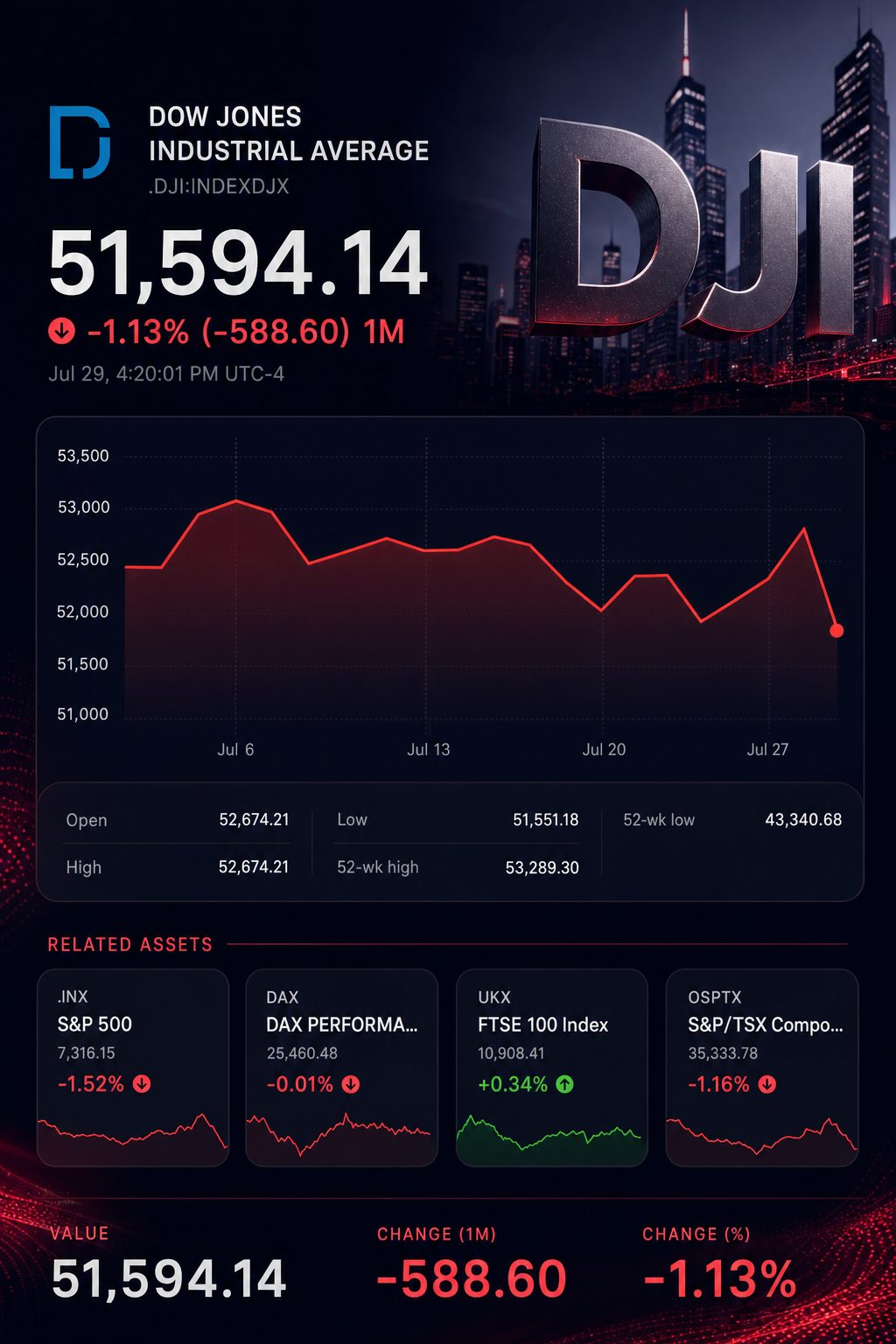
Preliminary closing data showed the Dow down 2.18%, the S&P 500 off 1.51% and the Nasdaq lower by 1.74%.
The Federal Reserve held rates at 3.50%-3.75%. Three of 12 policymakers wanted a quarter-point increase.
Brent crude jumped 7.3% to $88.09. The 10-year Treasury yield rose to about 4.64%.
U.S. stocks closed sharply lower Wednesday after a late selloff erased a brief post-Fed rally. The Dow lost about 1,152 points. Technology shares also retreated.
The reversal carried the clearest investor signal. The S&P 500 briefly gained about 0.1%, then closed 1.51% lower. That 1.6-percentage-point swing showed oil and long-term yields outweighed relief over no immediate rate increase.
The figures below were preliminary at 16:04 EDT.
Benchmark
Preliminary close
Point change
Percentage change
Dow Jones Industrial Average
51,594.86
-1,152.46
-2.18%
S&P 500
7,316.38
-112.40
-1.51%
Nasdaq Composite
24,442.94
-433.97
-1.74%
Russell 2000
2,905.27
-48.53
-1.64%
The Fed maintained its target range in a 9-3 vote. Beth Hammack, Neel Kashkari and Lorie Logan favored a quarter-point increase. The statement said inflation remained elevated, partly because of energy supply shocks.
“The economy is showing impressive resilience,” Fed Chair Kevin Warsh said. Yet the 10-year Treasury yield rose to 4.64%, from about 4.61% Tuesday. Higher long-term borrowing costs weakened the initial equity rebound. The Wall Street Journal
Brent crude settled 7.3% higher at $88.09 a barrel. Renewed Middle East fighting revived concern that energy costs could slow disinflation.
Long-dated bonds delivered another warning. The 30-year Treasury yield climbed about 10 basis points to 5.2%. The VIX volatility index rose nearly 11% to 20.19.
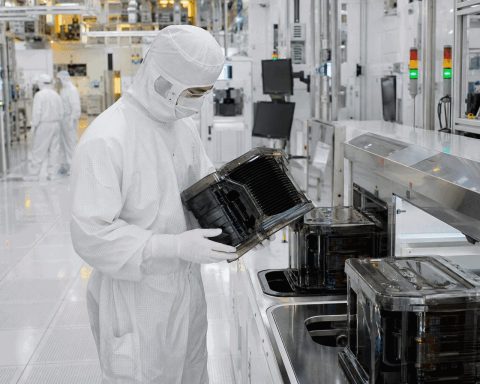
AI hardware absorbed some of the hardest selling. Vertiv Holdings NYSE:VRT fell 17.4%. KLA NASDAQ:KLAC lost 10.3%, while Micron Technology NASDAQ:MU dropped 9.3%.
Microsoft NASDAQ:MSFT and Meta Platforms NASDAQ:META were due to report shortly after the close. Options pricing implied moves of 6.6% and 7.8%, respectively. Microsoft’s implied swing equaled roughly $190 billion in market value.
“This earnings season is about AI execution, not AI enthusiasm,” Mindset Wealth Management’s Seth Hickle said. Investors now want revenue and cash-flow evidence from rising capital spending. Reuters
That bar remains high. Analysts currently estimate S&P 500 second-quarter earnings grew 40% from a year earlier. AI-related stocks account for much of that expected growth. The index still trades near 20 times forward earnings, versus a 10-year average near 19.
The Dow’s decline exceeded the S&P 500’s by 0.67 percentage point. Its price-weighted structure magnified losses among expensive components. Caterpillar NYSE:CAT, one of the index’s highest-priced shares, fell about 7%.
Risks remain two-sided. Cooling oil prices or strong Big Tech results could reverse Wednesday’s decline. Renewed fighting, higher long-term yields or growing pressure for a September rate increase would weigh on valuations again.
The next test begins in after-hours trading. Amazon.com NASDAQ:AMZN and Apple NASDAQ:AAPL are due later this week, extending the debate over AI spending and investment returns.
The S&P 500 closed at 7,316.15, falling 1.52% during Wednesday’s session. The Dow finished at 51,609.28, losing 2.16% across the day. The Nasdaq Composite ended at 24,442.94, down 1.74% after late selling. The Nasdaq 100 dropped 2.06%, closing the session at 27,192.31. Volatility rose sharply during the final trading hour. The VIX settled at 20.12, gaining 10.49% for the full session.
Why did stocks fall after the Federal Reserve held rates steady?
The Fed maintained its target range between 3.50% and 3.75%, as expected. Three of twelve policymakers preferred a quarter-point rate increase instead. That unusually large dissent kept another increase firmly within market expectations. The two-year Treasury yield held near 4.28% after the decision. The ten-year yield rose toward 4.64%, tightening financial conditions further.
How important was Wednesday’s oil-price shock for equities?
Brent settled at $90.74, rising 7.91% on renewed supply fears. WTI closed at $84.46, gaining 6.56% during a volatile session. U.S. crude inventories fell 7.2 million barrels to 404.5 million. That marked the lowest reported inventory level since 2018. Higher oil threatens corporate margins and complicates the Fed’s inflation outlook.
Has the technology market entered a formal correction?
The Nasdaq 100 finished more than 10% below its June 2 peak. The Nasdaq Composite closed only about 58 points above its correction threshold. The PHLX semiconductor index fell 2.2% to an early-May low. Vertiv dropped roughly 15% after missing quarterly revenue expectations. The damage is serious. However, a 20% bear-market decline has not been confirmed.
Did Microsoft’s earnings improve the after-hours market picture?
Yes, but only partly. Azure revenue grew 43%, topping the 39.98% consensus estimate. At 4:06 p.m. ET, Microsoft traded near $402.87, up roughly 2.4% on the day. Options had priced a 6.6% move, making the initial response modest. Management’s 5:30 p.m. ET conference call could still change that direction.
Why did Meta shares fall despite beating the revenue estimate?
Meta reported $60.80 billion in revenue, above the $60.22 billion consensus. Diluted earnings were $6.18 per share, versus an expected $7.19. Legal and severance charges totaled $3.58 billion, complicating that comparison. Operating margin fell to 31% from 43%, while free cash flow reached $784 million. Meta narrowed 2026 capital spending guidance to $130 billion–$145 billion. At 4:06 p.m. ET, Meta traded near $550.64, down 7.21% on the day. Its 4:30 p.m. conference call remained a major source of uncertainty.
Has the selloff made the broader market clearly inexpensive?
Not yet, based on current valuation. The S&P 500 still trades near twenty times expected forward earnings. Its ten-year average remains roughly nineteen times expected earnings. Analysts forecast second-quarter profit growth near 40%, led heavily by AI companies. That outlook provides support, but it also concentrates disappointment risk. Wednesday’s decline improved entry prices without creating obvious broad-market value.
What is the forecast for Thursday’s major indexes and earnings stocks?
The S&P 500 base range is 7,250–7,400, centered near 7,325. The Nasdaq 100 base range is approximately 26,900–27,500. Microsoft’s preliminary range is $390–$415, pending management guidance. Meta’s preliminary range is $535–$575, pending its conference call. Strong guidance and softer oil could push the S&P toward 7,450. Weak guidance, Brent above $90, or higher yields could test 7,200. These are scenario ranges, not precise targets, because both calls remain pending.
Iwona Majkowska is a financial markets journalist at TS2.tech. She covers stocks, artificial intelligence and technology, with a focus on the stories moving U.S. and global markets. Before turning to financial journalism, she worked in equity research and financial analysis. She is a graduate of the Warsaw School of Economics. Follow Iwona Majkowska on Google News.
Surprising starts and permits data can impact homebuilders, mortgage-sensitive stocks, Treasury yields, and the dollar if results deviate significantly from consensus estimates.
#02
Home Depot Q2
The results and outlook provide key insights into housing turnover, renovation demand, professional customer activity, and U.S. discretionary spending.
#03
09:15 ET industrial production
A robust or disappointing factory or utilities report can shift expectations for economic growth, cyclical stocks, bond yields, and the Federal Reserve’s policy direction.