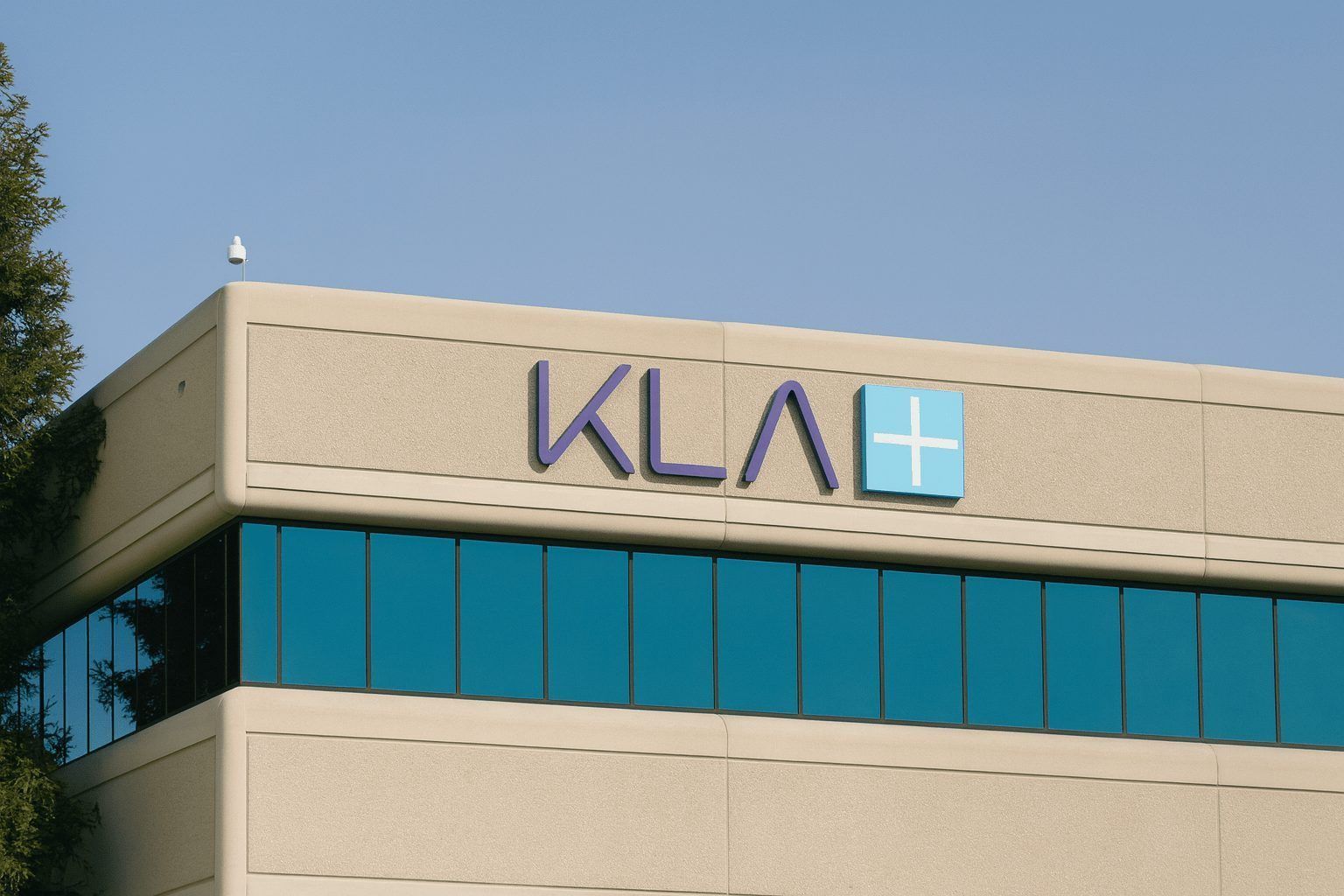
December 15, 2025 — KLA Corporation (NASDAQ: KLAC) is back in the spotlight after a notable Wall Street upgrade pushed KLA stock higher in Monday trading, extending a powerful 2025 run for the semiconductor equipment leader. By midday, shares were trading around $1,239, up roughly 3.8% on the session, after moving between about $1,212 and $1,254 intraday. Investing.com
The immediate catalyst: Jefferies upgraded KLA to “Buy” from “Hold” and lifted its price target to $1,500, arguing that the next phase of AI-driven spending will accelerate demand for leading-edge wafer manufacturing and advanced packaging tools—exactly where KLA has deep exposure. TradingView+1
Below is a detailed breakdown of today’s key headlines, the freshest analyst forecasts, and what the latest company guidance says about the road into 2026—plus the risks investors should keep on the radar.
Why KLA stock is moving today
KLA shares jumped Monday after Jefferies issued a bullish 2026 outlook note that named AI as a multi-year driver for semiconductor capital equipment, with spending expected to strengthen into calendar 2026 and 2027. In Jefferies’ view, AI demand is expected to push capacity additions beginning in the second half of 2026, lifting demand across leading-edge foundry, memory (including DRAM), and packaging. TradingView+1
Market coverage quickly echoed the same theme: AI chips are not just “more chips,” they’re more complex chips, and complexity tends to increase the amount of process control and inspection needed to maintain yield—KLA’s home turf. Investors.com+1
Broader market context mattered too. A midday market wrap distributed via Nasdaq noted KLA was among the day’s notable movers, with KLAC “up more than +4%” at one point following the Jefferies upgrade. Nasdaq
The Jefferies call: Upgrade to Buy and a $1,500 price target
Jefferies’ upgrade did two things at once:
- Changed the rating on KLA to Buy
- Raised the price target to $1,500 (from $1,100) Investors.com+1
In an Investing.com summary of the note, Jefferies argued that hyperscaler capital expenditures (capex) are accelerating and ASIC adoption is inflecting, building a longer runway for semiconductor capital equipment. The firm emphasized KLA’s “outsized exposure” to the leading edge and said the company is well-positioned as AI drives further capacity expansion. Investing.com
Jefferies also laid out explicit long-range assumptions behind the target: the $1,500 target was framed using a 30x multiple on calendar 2028 EPS of $50, and the firm said KLA’s valuation premium vs. peers had recently “reset.” Investing.com
Just as important for investors tracking the industry rather than a single ticker: Reuters coverage of the same Jefferies note highlighted that the firm didn’t stop at KLA—it raised targets across several semiconductor equipment names, reinforcing the idea that the call is fundamentally a “semi-cap upcycle into 2026/2027” thesis. TradingView
Barron’s: Jefferies’ “best chip stocks to buy for 2026” list includes KLA
Barron’s also picked up the Jefferies framework, describing Broadcom, Nvidia, and KLA as top ideas for 2026 and repeating the $1,500 target for KLA. Barron’s
The “forecast gap”: Wall Street’s consensus target vs. Jefferies’ $1,500
Here’s where things get interesting—and where many investors get tripped up by headline targets.
MarketBeat’s analyst snapshot (updated 12/15/2025) shows:
- Consensus rating: “Moderate Buy”
- Ratings split: 13 “Buy” and 13 “Hold” (0 “Sell”)
- Consensus 12‑month price target:$1,273.62
- High / Low target range:$1,500 high and $800 low MarketBeat
At around $1,238–$1,239 today, that consensus target implies only about ~2.8% upside—basically “you’re close to fully priced” in the aggregate. MarketBeat
Jefferies is effectively arguing the opposite: that the market is underestimating how durable the AI-driven equipment cycle could be as the industry moves into the next wave of leading-edge nodes and advanced packaging—hence the $1,500 upside case (roughly ~21% above ~$1,238). Investing.com+1
That split—high conviction bull case vs. consensus “near fair value”—is one of the big reasons KLA stock is such a lively debate right now.
Technical picture: KLAC near a key level after a volatile week
From a market-structure standpoint, KLA is also sitting near a level traders care about.
Investor’s Business Daily reported that KLAC was approaching a buy point of 1,284.47 within a cup-base pattern, after the Jefferies upgrade lifted the stock more than 3% on the day. Investors.com
That 1,284.47 number is also echoed elsewhere as a key recent high: MarketWatch noted KLAC’s 52-week high of $1,284.47 (reached Oct. 30, 2025) and highlighted that the stock had fallen 4.19% on Friday, Dec. 12, snapping a five-day win streak. MarketWatch
So the setup going into the close (and into year-end) looks like this:
- Momentum: strong on a multi-month basis
- Short-term: choppy, with sharp down days still possible
- Overhead reference point: the ~$1,284 area MarketWatch+1
Fundamentals: What KLA’s latest earnings and guidance say
While upgrades dominate today’s headlines, investors still need to anchor the story to what KLA itself is reporting.
In its fiscal 2026 first quarter results (quarter ended Sept. 30, 2025), KLA reported:
- Revenue:$3.21 billion
- GAAP diluted EPS:$8.47
- Non-GAAP diluted EPS:$8.81
- Operating cash flow:$1.16 billion
- Free cash flow:$1.07 billion
- Capital returns:$799.1 million (quarter) KLA Corporation
KLA also issued second quarter fiscal 2026 guidance (quarter ending in December), including:
- Revenue:$3.225 billion ± $150 million
- Non-GAAP gross margin:62.0% ± 1.0%
- Non-GAAP EPS:$8.70 ± $0.78 KLA Corporation
Management’s AI thesis (straight from the company)
In the same earnings release, CEO Rick Wallace described the “AI infrastructure buildout” as a profound shift in high-performance computing and said KLA is positioned to benefit via solutions addressing challenges for AI compute across leading-edge foundry/logic, memory, and advanced packaging. KLA Corporation
That statement aligns closely with Jefferies’ rationale today, which is why the upgrade landed with force: the sell-side narrative and the company narrative are now marching in the same direction.
Capital returns: Buybacks, dividends, and the size of the “shareholder yield” lever
KLA has also been returning substantial cash to shareholders.
From its fiscal Q1 release, the company broke out:
- Dividends paid:$254.0 million (quarter)
- Common stock repurchases:$545.1 million (quarter) KLA Corporation
In its quarterly filing detail, KLA disclosed that its board-authorized repurchase program (which includes a $5.0 billion increase authorized in fiscal Q4 2025) had $4.47 billion remaining available for repurchases as of Sept. 30, 2025. KLA Corporation
This matters for KLAC stockholders because buybacks can amplify EPS growth in periods when revenue growth is steady rather than explosive—though buybacks also become more controversial when a stock is trading at a higher earnings multiple.
The core bull case: Why KLA is an “AI picks-and-shovels” stock
KLA isn’t a chip designer. It’s the company selling the tools that help chipmakers figure out whether they’re making chips correctly.
In plain English: as transistors get smaller and packaging gets more exotic, it becomes harder to manufacture reliably. That raises the value of inspection, metrology, and process control—KLA’s specialty.
Today’s bullish commentary leans on three overlapping ideas:
- Leading-edge nodes: More patterning complexity increases process steps and measurement requirements.
- Memory and HBM buildouts: AI servers need enormous memory bandwidth; that tends to pull forward investment in advanced memory.
- Advanced packaging: AI performance is increasingly about how chips are stitched together (chiplets, interposers, and other packaging approaches), not just the silicon node itself. Investing.com+2KLA Corporation+2
Jefferies framed this as a multi-year runway, even calling AI its “favorite group” for 2026, and explicitly tied KLA’s upside to stronger leading-edge and packaging demand. Investing.com+1
The bear case: When a great business meets a demanding valuation
When a stock is up nearly 90% year to date (as multiple reports have noted), investors should expect valuation to become part of the conversation—because the market often “pre-pays” for great news. TradingView+1
A Simply Wall St analysis published Dec. 15, 2025 described KLA as near record highs and highlighted valuation tension:
- It cited KLA trading at about 37x earnings (in line with the U.S. semiconductor average in that analysis)
- It also presented a model-based “fair value” estimate near $1,287.27 (a modest premium to the referenced close), while warning that upside assumptions can be sensitive to execution and geopolitical factors. Simply Wall St
Meanwhile, MarketWatch’s recap of Friday’s selloff is a reminder that even strong momentum names can drop sharply in a single session when markets risk-off. MarketWatch
In other words: KLA can be a high-quality company and still be a high-expectations stock.
Risks to watch: China exposure, regulation, and cyclicality
KLA itself flags a wide range of risks typical for global semiconductor equipment leaders: macro weakness, customer concentration, supply-chain disruptions, and the cyclicality of semiconductor capex.
But one risk has been especially central across 2024–2025 and remains prominent in KLA’s disclosures: U.S. Department of Commerce rules and regulations affecting sales and service in China. The company explicitly calls out evolving BIS rules and their impact on its ability to sell products and provide services to certain customers in China. KLA Corporation
Jefferies’ own model underscores why this matters: in coverage summarized by Investing.com, the firm still expects China to remain a meaningful slice of revenue (it cited ~25% China revenue for CY2026 in that write-up), even as leading-edge and packaging expand. Investing.com
Layer on the basic reality that wafer fab equipment spending is cyclical—even in an AI era—and you have the core risk cocktail for KLAC:
- policy/regulatory uncertainty,
- region and customer mix shifts,
- and capex cycles that can turn faster than investors expect.
What’s next for KLA stock: Key dates and catalysts
For near-term watchers, the next big potential volatility event is earnings.
Multiple market calendars estimate KLA’s next earnings report around January 29, 2026 (based on historical schedules and third-party estimates). Nasdaq+2MarketBeat+2
Between now and then, investors will likely be tracking:
- Whether the semiconductor equipment group keeps leadership into year-end
- Any new signals on hyperscaler AI capex and memory spending
- Updates on export controls, tariffs, or cross-border trade rules
- How close KLAC gets to (or beyond) the ~$1,284 level referenced as a recent high/buy point Investors.com+1
Bottom line
Today’s KLA stock move is a classic market moment: a strong company, a strong theme (AI-driven semiconductor investment), and a fresh catalyst (Jefferies’ upgrade) all aligning on the same day.
The bullish case says KLA is positioned for a new leg of demand as AI pushes semiconductor manufacturing toward greater complexity—especially at the leading edge and in advanced packaging—supporting multi-year equipment spending. Investing.com+1
The cautious case says the market already knows KLA is great, and the current price reflects a lot of that greatness—making execution, macro conditions, and geopolitics more important than ever. MarketBeat+2Simply Wall St+2