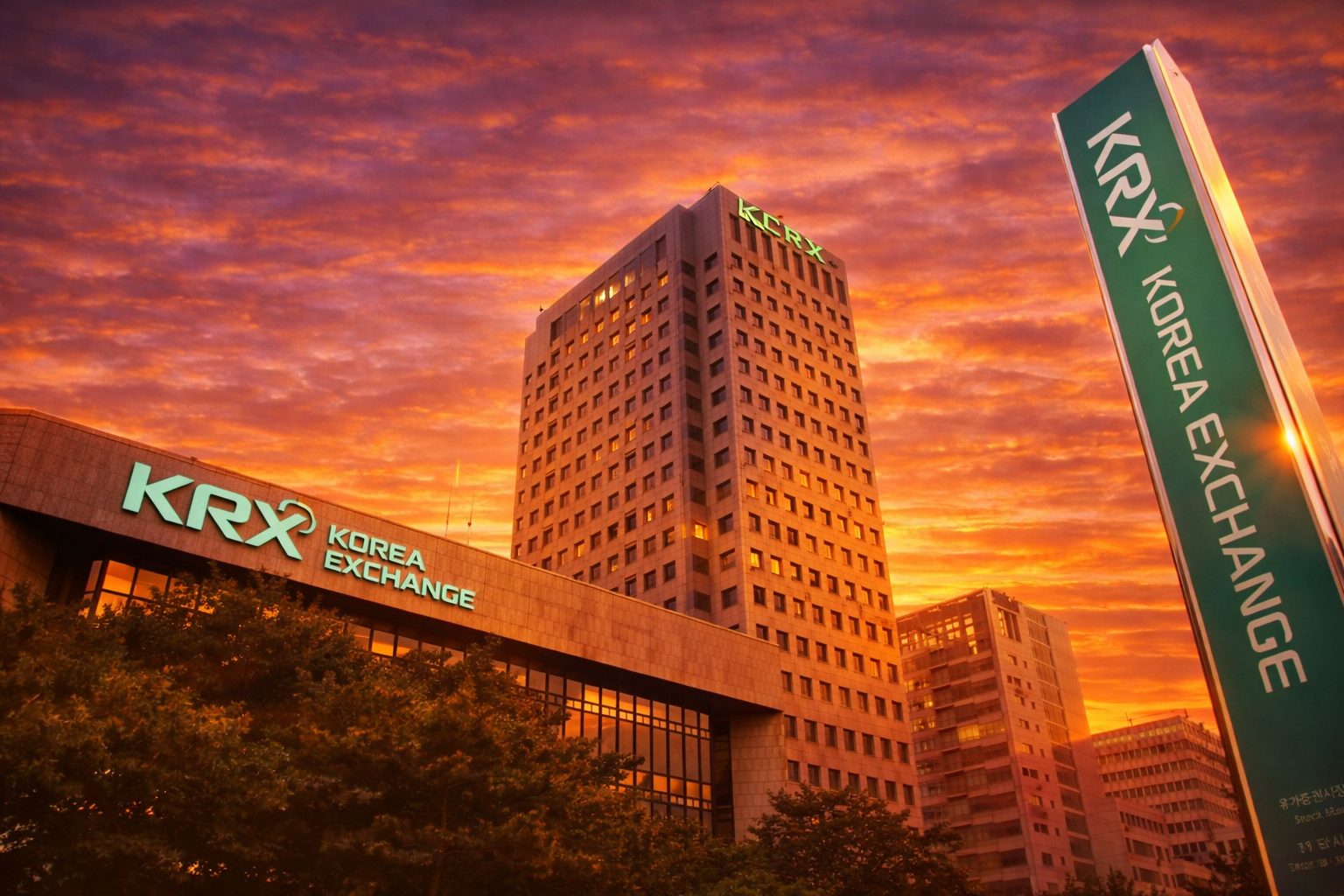
SEOUL — December 21, 2025 — The Korea Exchange (KRX), operator of South Korea’s main equity markets including KOSPI and KOSDAQ, is heading into year-end with a rare mix of momentum and stress tests: a roaring 2025 rally, intensifying competition from the alternative trading system Nextrade (NXT), and a regulatory drive to clean out “zombie” listings that’s colliding with court delays. Global KRX+2AJU PRESS+2
Today’s headlines paint a picture of a market infrastructure that’s modernizing fast—but discovering that the hardest part of reform isn’t writing new rules. It’s making the whole ecosystem (brokers, courts, issuers, investors, and rival venues) move at the same speed. MK News+2Daum+2
1) KRX vs. Nextrade: KRX fee cuts are already changing where orders go
A week after the KRX began temporarily cutting stock trading fees, early data suggests the move is pulling liquidity back from Nextrade—raising awkward questions about whether South Korea’s new “multi-venue” era will produce durable competition or simply trigger a race to the lowest fee. Daum+1
What the KRX changed
KRX’s fee reduction runs from Dec. 15, 2025 through Feb. 13, 2026, shifting from a single fee rate to a differentiated structure and lowering costs by roughly 20%–40%, in part to match Nextrade’s pricing. 아주경제
KRX has also been explicit that the fee move is tightly time-boxed and linked to the market-structure shakeup triggered by Nextrade’s entry. 아주경제
The immediate impact: Nextrade’s share shrinks
On December 21, Korean financial media reported that during the first five trading days after the KRX fee cut (Dec. 15–19), Nextrade’s trading value share relative to KRX fell to about 21.3%, down from 31.3% for Dec. 1–12—and far below October’s ~49.4% average. Daum
A separate report cited Nextrade’s average daily trading value for Dec. 15–19 at 5.6719 trillion won, down 28.3% from 7.9085 trillion won the prior week—another indicator that the order-routing tide turned quickly once KRX matched the pricing advantage Nextrade had been using to win flow. eToday+1
Why this matters beyond fees: SOR turns microeconomics into macro market share
South Korea’s growing reliance on smart order routing / best execution systems (SOR) means venue competition can look “sudden” rather than gradual: brokers’ systems route orders based on the total cost and likelihood of execution, so a fee tweak can redirect a lot of volume in a hurry. 아주경제
Today’s key takeaway: Nextrade’s early market-share story is no longer just about longer hours and a new venue—it’s about whether it can keep a structural advantage once the incumbent is willing to discount. Daum
2) Market surveillance is colliding with venue competition: the SK hynix “investment warning” ripple
The other force squeezing Nextrade isn’t price—it’s regulation.
KRX’s Market Monitoring Committee has been active in flagging overheated stocks, and those designations can restrict how, when, and where a stock trades—especially when alternative venues are involved. MK News
The SK hynix warning, in plain English
In December, KRX designated SK hynix (and in some reporting, SK Square) as an “investment warning” name after a sharp run-up, citing criteria such as a stock price more than 200% higher than a year earlier and concentration signals involving top accounts. MK News
Those warnings can impose tougher trading conditions (including higher collateral requirements) and, crucially for market-structure competition, can limit access to certain trading sessions or venues. Daum
Why it hit Nextrade’s numbers
A Dec. 21 report tied part of Nextrade’s trading-value drop to large-cap names being excluded from pre/after-market trading following investment-warning actions—an example of how “market quality” regulation can unintentionally become a competitive lever that shifts liquidity back to the incumbent exchange. Daum+1
Separately, the Korea Times reported investor frustration around such warning designations and said the KRX indicated related regulations would be revised—suggesting the rulebook is still being tuned in real time as the bull market meets a more complex market structure.
3) Delistings are accelerating—until they reach the courthouse
If fee competition is the fast-moving story, delistings are the slow-moving one.
KRX has clearly sped up decisions to delist weak firms in 2025, aligning with the government’s push to improve market credibility. But the final “exit” is increasingly stuck at the last gate: court injunctions and overloaded dockets. MK News+2MK News+2
The headline numbers from Dec. 21
According to Maeil Business Newspaper reporting on Dec. 21:
- 49 companies received delisting decisions (11 on KOSPI + 38 on KOSDAQ), but only 12 had actually been pushed through to real exit so far. MK News
- On KOSPI, 11 insolvent listed companies received delisting decisions in 2025, yet only 3 were finally delisted after court rulings on provisional injunctions. MK News+1
- On KOSDAQ, 38 companies received delisting decisions; 27 were still waiting on court judgments after seeking injunctions, leaving many cases trapped in procedural limbo. MK News+1
This is not an abstract paperwork problem. Companies in limbo can remain suspended, tying up capital and amplifying investor frustration—exactly the opposite of the “cleaner market” narrative reforms are trying to deliver. MK News+1
KRX tightened the rules—and delisting decisions surged
The same reporting noted that forced delisting cases rose sharply versus 2024, after KRX strengthened requirements like market cap, sales standards, and screening:
- Forced delistings in the securities market rose from 3 last year to 11 this year (excluding voluntary delistings). MK News+1
- In KOSDAQ, forced delisting cases nearly doubled from 20 to 38. MK News+1
That’s the “KRX decision speed” side of the story. The “actual exit speed” side is where the system jams. MK News+1
Courts are becoming the bottleneck
Maeil Business also pointed directly at the Seoul Southern District Court, describing a workload surge and staffing strain:
- Applications for delisting-related provisional dispositions more than doubled versus last year, and total provisional disposition cases rose about a third. MK News+1
- One figure cited applications rising from roughly 500 to about 700 by end-November. MK News+1
The legal mechanics show up in KRX’s own disclosures too. A KRX KIND notice (Dec. 1) for a KOSDAQ name explicitly states that trading suspension can last until the court confirms a decision on an injunction request to suspend the effectiveness of a delisting decision. KIND
Bottom line: KRX can accelerate decisions, but if courts don’t accelerate rulings, the reform loses its punch—and investors get the worst of both worlds: more suspensions, fewer clean exits. MK News+1
4) KOSDAQ overhaul: pensions, tax incentives, and a “high birth, high death” market
The KOSDAQ market—still seen as more retail-driven and more volatile—has become a policy priority precisely because KOSPI has been flying while KOSDAQ’s “trust gap” lingers. 아시아경제+2Korea Times+2
FSC’s plan: change who buys, and change who gets to stay
On Dec. 19, the Financial Services Commission (FSC) announced a KOSDAQ trust and innovation plan focused on:
- expanding institutional participation (including pension funds),
- revising listing/delisting systems,
- strengthening KOSDAQ’s autonomy within KRX. 아시아경제+1
A key lever: building KOSDAQ into fund performance measurement, so big allocators must consider it instead of treating it as optional. The plan includes reflecting the KOSDAQ index in benchmark returns used in fund evaluation guidelines (notably for 2026). 아시아경제+2Chosunbiz+2
Tax incentives and new vehicles
The FSC plan also includes expanding tax benefits for KOSDAQ venture funds and considering tax support for Business Development Companies (BDCs) expected to be introduced next year. 아시아경제+1
“Many births and many deaths”: faster listing for tech, faster removal for failures
Reform language is getting blunt: build a market where innovative firms list more easily and underperformers exit faster.
Measures include expanding “technology exception” listing standards beyond biotech into sectors such as AI, space, and energy, while also tightening delisting triggers—especially for companies that change their business away from the technology they used to qualify for listing. 아시아경제+1
The KOSDAQ 1,000 dream—and the identity problem
KOSDAQ’s push toward the psychologically important 1,000-point level is part rally, part policy, part branding challenge.
A Dec. 15 Korea Times report noted KOSDAQ’s 2025 high-water marks (including a close at 937.34) alongside a tension: key winners may “graduate” to KOSPI (Alteogen’s planned move was cited), which can drain the very stars the index needs to break through 1,000. Korea Times
That same report also pointed to political discussion of changes to KOSDAQ’s operating structure—another sign that KRX’s role as a unified operator is being debated, not taken for granted. Korea Times
5) Sector snapshot: the KRX “Autos” index leads December’s year-end rally
While policy and plumbing dominate the institutional conversation, investors still live in the real world of sector rotation.
On Dec. 21, a Korean market report cited KRX data showing the KRX Autos index rose 9.64% between Dec. 1 and Dec. 19 (closing 2,294.57 → 2,515.84), the largest gain among KRX’s single-industry indices for the period. mbnmoney.mbn.co.kr
Autos have had macro help too. Reuters reported earlier this month that the United States would lower import duties on South Korean autos to 15%, retroactive to Nov. 1, aligning with tariffs applied to Japan and the EU—an external tailwind for the sector as 2025 closes. Reuters
6) 2026 outlook: KOSPI 5,000 forecasts are multiplying—but so are the conditions
KRX’s market infrastructure drama is unfolding against a giant backdrop: the market has already repriced meaningfully in 2025, and now the debate is whether 2026 is “second act” or “hangover.”
What forecasters are saying
A Dec. 15 outlook roundup reported:
- KOSPI hovered around 4,000 in December after a ~64% year-to-date surge. AJU PRESS
- Across 11 local brokerages, the average upper-end 2026 outlook was around 4,979 (with a lower-end average around 3,737). AJU PRESS
- Major foreign banks cited in the report included targets of 5,000 (JPMorgan), 5,500 (Citi), and 6,000 (Macquarie)—with even a 7,500 bull-case scenario entering market discourse. AJU PRESS
The bullish logic is familiar: earnings expansion led by semiconductors and AI-linked sectors, plus policy reforms that reduce the “Korea discount.” AJU PRESS+1
The fine print: FX volatility is the spoiler risk nobody gets to ignore
A bull market can survive a lot, but it struggles when the currency starts behaving like a stress indicator.
Reuters reported on Dec. 19 that South Korea’s central bank announced temporary measures to boost dollar supply after the won hit its weakest level since April, down over 8% in the second half of 2025. Measures included paying interest on certain reserve deposits and temporarily easing some deposit obligations tied to FX stability, alongside reported market intervention via dollar selling. Reuters
That matters for KRX because foreign flows, earnings translations, inflation expectations, and the “risk-on” feel of the entire KOSPI narrative can all wobble when FX looks disorderly. Reuters+1
Reuters also reported earlier that the Bank of Korea and the National Pension Service agreed to extend an FX swap arrangement through the end of 2026, explicitly framed as a stabilization tool while the won trades near multi-year weak levels. Reuters
What to watch next for the Korea Exchange
As the last full trading weeks of 2025 approach, the KRX story is less about a single index level and more about whether reform turns into durable market quality:
- Will KRX’s fee cut remain temporary—or become a template for permanent “maker-taker” pricing? 아주경제
- Can Nextrade regain momentum without a clear fee advantage—and under constraints like large-cap warning exclusions and stock-coverage limits? Daum+1
- Will the judiciary bottleneck on delistings be addressed (staffing, procedures, specialization), or will suspensions and delays become the new normal? MK News+2MK News+2
- How quickly do the FSC’s KOSDAQ reforms translate into real institutional allocation—especially via benchmark changes? 아시아경제+1
- Does won volatility calm, and do policy measures reduce the market’s “FX anxiety tax”? Reuters+1
In 2025, South Korea’s equity story has been one of ambition—higher valuations, stronger governance narratives, and a reform agenda that aims to make KOSPI’s gains feel “earned,” not fleeting. Financial Times+1
On Dec. 21, the Korea Exchange sits right at the hinge of that ambition: it’s fighting for liquidity in a newly competitive market, tightening standards to raise credibility, and learning (the hard way) that market reform is a relay race—and the baton can’t move faster than the slowest institution in the chain. Daum+2MK News+2