CINCINNATI — December 4, 2025
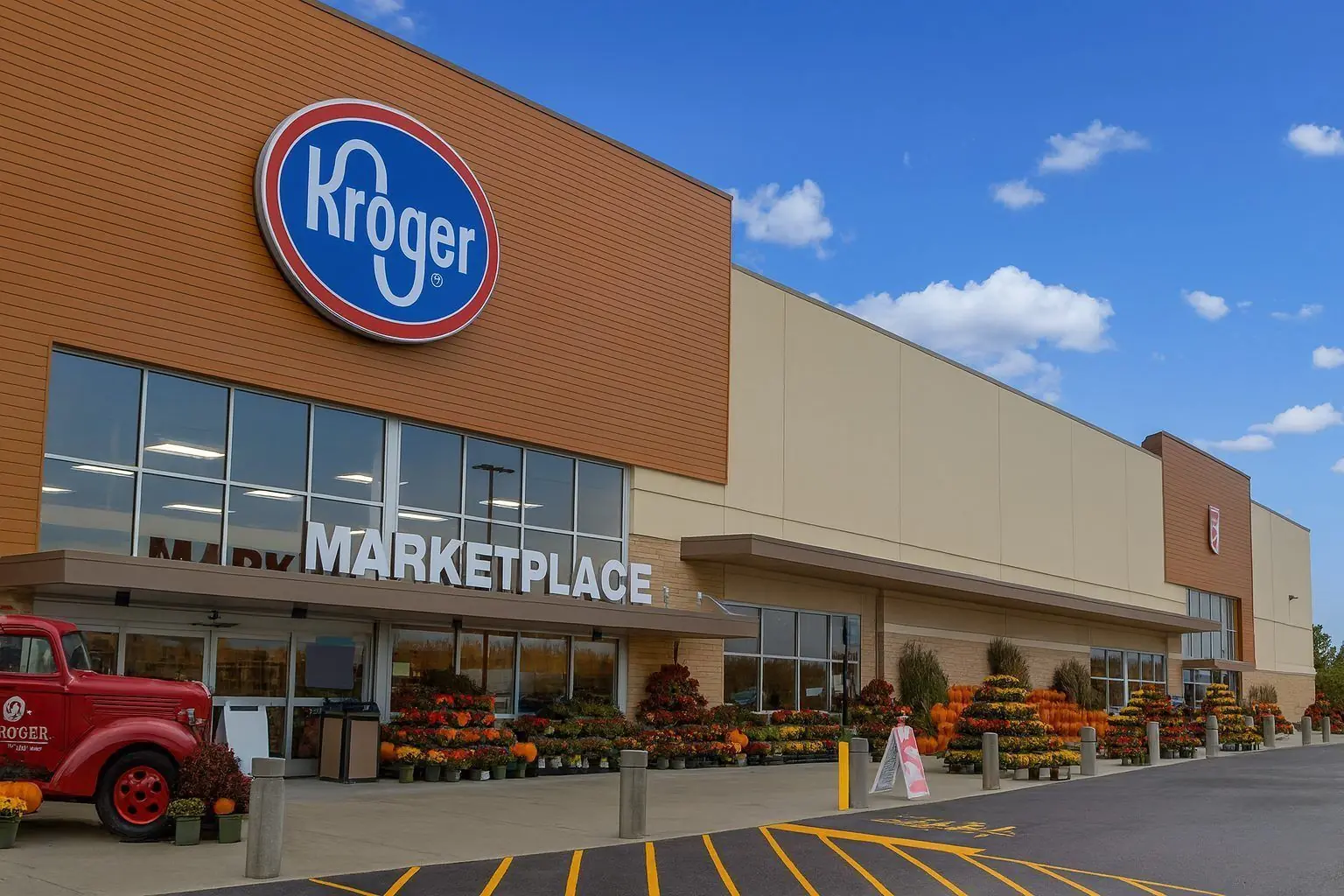
Kroger Co. (NYSE: KR) shares dropped roughly 4–5% on Thursday after the supermarket giant reported third‑quarter 2025 results that featured a sizable $2.6 billion impairment charge, a slight sales miss and a narrowed full‑year sales outlook — even as profits and margins came in strong and guidance for earnings per share was nudged higher. Kroger Investor Relations+2Reuters+2
The move comes at a delicate moment for both the company and U.S. consumers: food inflation has cooled but grocery affordability remains a top concern, federal SNAP food benefits have been disrupted this fall, and price competition from Walmart, Target and other national chains is intensifying. Reuters+1
How Kroger Stock Is Trading After Earnings
As of late trading on December 4, 2025, Kroger stock changed hands around $63.12, down about 4.6% on the day. The shares traded between $60.96 and $67.48 intraday on heavy volume of more than 13 million shares.
From a longer‑term perspective:
- 14.6% below its 52‑week high of $74.90.
- Down 5.7% over the past three months, versus a 2.3% decline for the Consumer Staples Select Sector SPDR ETF (XLP).
- Up 4.6% year‑to‑date and up 6.8% over the last 12 months, outperforming XLP, which is slightly down over the same period. Barchart.com
The stock has also slipped below its 200‑day moving average since mid‑September, a signal that some technical traders read as a loss of momentum in the short term. Barchart.com
Q3 2025: Strong Underlying Business, Big One‑Time Charge
Kroger’s third quarter of fiscal 2025 ended November 8 and delivered a mixed but nuanced picture.
Headline numbers
According to the company’s official earnings release: Kroger Investor Relations
- Total sales: $33.9 billion, up from $33.6 billion a year ago. Excluding fuel and the now‑divested Kroger Specialty Pharmacy business, sales rose 2.6% year‑over‑year.
- Identical sales (ex‑fuel):+2.6%, better than last year’s +2.3%, but slightly below Wall Street expectations of about +2.9%. Reuters+1
- GAAP operating loss:$(1.54) billion, versus a $828 million operating profit a year earlier, driven by a $2.6 billion impairment and related charges on its automated fulfillment network.
- GAAP EPS:$(2.02) vs. $0.84 a year ago, reflecting the one‑time charge.
- Adjusted EPS:$1.05, up from $0.98 last year and slightly ahead of consensus estimates around $1.03–$1.04. Kroger Investor Relations+2Nasdaq+2
- Adjusted FIFO operating profit:$1.09 billion, versus $1.02 billion in the prior‑year quarter. Kroger Investor Relations
Zacks notes that Kroger has now beaten EPS expectations four quarters in a row, even as revenue has modestly undershot consensus for several quarters. Nasdaq
Margin improvement despite promotions
Kroger also surprised positively on profitability:
- Gross margin: rose to 22.8% of sales from 22.4% a year earlier.
- FIFO gross margin (ex fuel, rent, D&A): expanded by 49 basis points, helped by the sale of Kroger Specialty Pharmacy, lower supply chain costs, better performance from private‑label “Our Brands,” and lower shrink. Kroger Investor Relations+1
- LIFO charge: increased to $44 million from just $4 million a year ago, reflecting inventory cost dynamics. Kroger Investor Relations+1
This margin expansion is particularly notable because Kroger has been cutting prices on roughly 3,500 items to stay competitive and appeal to cost‑conscious shoppers. Reuters+1
eCommerce and strategic reset
Digital continues to be a bright spot:
- eCommerce sales grew 17% in the quarter, marking another strong performance for the online business. Kroger Investor Relations+2Benzinga+2
However, that growth comes alongside a major strategic pivot:
- Kroger is shuttering three of its eight automated fulfillment centers built with UK partner Ocado, and taking a $2.6 billion impairment as it moves to a more flexible “hybrid” fulfillment model and leans harder on partners like Instacart, DoorDash and Uber Eats. Reuters+1
- Management says this reset is designed to make eCommerce profit‑positive by 2026, after a strategic review of its digital operations. Kroger Investor Relations+1
Interim CEO Ron Sargent framed the quarter as evidence of “meaningful progress” on strategic priorities and insisted Kroger is “building a strong foundation for long‑term growth,” even while absorbing the impairment. Kroger Investor Relations+1
Guidance: Narrower Sales, Slightly Higher EPS
The market reaction on Thursday was driven less by the EPS beat and more by subtle but important changes in Kroger’s 2025 outlook.
From Kroger’s updated full‑year guidance: Kroger Investor Relations+2Benzinga+2
- Identical sales (ex‑fuel)
- Old range (Sept 11, 2025): 2.7% – 3.4%
- New range (Dec 4, 2025): 2.8% – 3.0%
→ The midpoint is now lower than Wall Street’s expectation of roughly 3.1% growth, signaling a more cautious top‑line outlook. Kroger Investor Relations+2Reuters+2
- Adjusted EPS
- Old range: $4.70 – $4.80
- New range: $4.75 – $4.80
→ Kroger raised the low end of its profit forecast, implying confidence in margins and cost control. Kroger Investor Relations+1
- Operating profit: unchanged at $4.8 – $4.9 billion.
- Free cash flow: unchanged at $2.8 – $3.0 billion.
- Capex: unchanged at $3.6 – $3.8 billion. Kroger Investor Relations
This combination — slower sales growth but slightly higher earnings — helps explain Thursday’s split investor reaction: income‑oriented and value investors may welcome the EPS upgrade and margin resilience, while growth‑oriented investors worry about revenue momentum in a tougher consumer environment.
Consumers Are Stressed, and Grocers Feel It
Kroger’s toned‑down sales outlook reflects growing signs of strain on U.S. households:
- Interim CEO Ron Sargent said middle‑income shoppers are now feeling the same pressure as lower‑income families, making smaller and more frequent trips, and cutting back on discretionary items. Reuters+1
- The company highlighted cuts and a brief lapse in SNAP (food‑stamp) benefits on November 1 during a federal shutdown; roughly 6% of Kroger’s sales are tied to these benefits, so interruptions hit results. Reuters+1
- A Barron’s preview note ahead of the earnings call underscored the broader backdrop: nearly half of Americans say it’s hard to afford groceries, and more than a quarter report skipping or reducing meals. Barron’s
At the same time, large competitors have turned more aggressive:
- Walmart and Target have slashed prices in recent months to win and retain cost‑conscious shoppers.
- Kroger has responded with its own price cuts and promotions, including the “12 Merry Days” holiday savings event (December 3–14), which offers a new digital coupon deal every day across holiday hosting items, fresh food and seasonal merchandise. Reuters+1
This tug‑of‑war between value‑seeking consumers and margin‑protecting grocers is central to how investors are now re‑rating Kroger and its peers.
Leadership & Strategy: Post‑Merger, Post‑McMullen Kroger
Today’s report also lands in the shadow of two major events over the past year:
- The failed Albertsons merger
- In December 2024, courts blocked Kroger’s proposed $24.6 billion acquisition of Albertsons, and the deal was ultimately terminated, leaving Kroger to pursue a standalone strategy and defend share against both big‑box rivals and discounters. TPSS Co-op+1
- CEO transition after conduct probe
- In March 2025, long‑time CEO Rodney McMullen resigned after a board investigation concluded that his personal conduct violated company policies (though it did not involve financial reporting or other employees).
- Board member Ronald (Ron) Sargent, former Staples CEO, stepped in as interim CEO, while the board launched a search for a permanent replacement. Reuters
The Q3 report is therefore one of the first big tests of this interim leadership team’s strategy: de‑risking the automation bet, resetting digital, and using a mix of share buybacks, dividends and targeted promotions to keep investors and customers on side.
Capital Allocation: Buybacks and a Growing Dividend
Kroger continues to lean on shareholder returns as a key part of its investment case.
Share repurchases
- In late fiscal 2024, Kroger launched a $5 billion accelerated share repurchase (ASR) as part of a $7.5 billion buyback authorization.
- The ASR was completed in Q3 2025, and Kroger is now repurchasing stock in the open market under the remaining $2.5 billion authorization, which management expects to fully deploy by year‑end 2025. Kroger Investor Relations+2Benzinga+2
- Despite the ASR, Kroger’s net total debt to adjusted EBITDA currently sits at 1.73x, still below its target range of 2.3x–2.5x, suggesting room to keep funding both investment and buybacks. Kroger Investor Relations
Dividend profile
Kroger also remains a steady dividend payer:
- Quarterly dividend:$0.35 per share, or $1.40 annualized. Kroger Investor Relations+2Kroger Investor…
- Yield: roughly 2.1%–2.2% at current prices. MacroTrends+1
- The board raised the annual dividend from $1.28 to $1.40 earlier this year (a 9% increase), and Kroger has a dividend growth streak of well over a decade. Kroger Investor Relations+2StockAnalysis+2
- Payout ratio: about 34% of earnings, leaving room for reinvestment and buybacks. StockAnalysis
For income‑focused investors, that combination of roughly a 2%+ dividend yield and an ongoing multi‑billion‑dollar buyback program is a key part of the bull case.
How Wall Street Now Rates Kroger Stock
Analysts entered this earnings report generally constructive on Kroger, and early post‑earnings commentary suggests that stance is broadly intact, though with an eye on consumer and sales risks.
Consensus rating: “Buy” with mid‑teens upside
Across multiple aggregators:
- Public.com: 15 analysts, “Buy” consensus and an average price target of $72.80 as of December 4, 2025. Public
- MarketBeat: 19 analysts, average 12‑month target of about $74.39, with a high of $85 and a low around $63 — roughly 18% upside versus a recent quote near $63. MarketBeat
- TipRanks: 14 analysts, average target $78.07, range $70–$85, implying about 15–16% upside from recent levels. TipRanks
- StockAnalysis: 14 analysts, consensus rating “Buy”, with an average target of $73.79, around 16–17% above the current price. StockAnalysis
Telsey Advisory Group recently reaffirmed an “Outperform” rating on KR with a one‑year price target of $78.40, representing mid‑teens upside from where the stock traded in mid‑November (and now somewhat more after today’s pullback). Nasdaq+1
Earnings and revenue projections
Looking ahead, analyst models still assume moderate growth:
- Zacks‑compiled consensus:
- Next quarter (Q4): EPS of about $1.21 on $35.4 billion in revenue.
- Full fiscal 2025: EPS of $4.78 on $148.75 billion in revenue. Nasdaq
- StockAnalysis forecasts point to:
- Revenue rising from ~$147.1B (FY 2024) to $153.2B in FY 2025 and $157.5B in FY 2026.
- EPS climbing from $3.67 to $4.95 this year, then to $5.45 next year — implying high‑single‑ to low‑double‑digit earnings growth from here. StockAnalysis
Zacks currently assigns Kroger a Rank #3 (Hold) and notes that the Retail – Supermarkets industry sits in the bottom 41% of its industry rankings, suggesting the sector as a whole is not expected to lead the market near‑term. Nasdaq
Is Kroger Stock a Buy After This Sell‑Off?
Whether Thursday’s drop in Kroger stock proves to be a buying opportunity depends largely on how you weigh three competing forces:
- Structural strengths
- Massive scale with more than 11 million customers served daily. Kroger Investor Relations+1
- Growing eCommerce channel, now advancing at a mid‑teens rate with a clearer path to profitability by 2026. Kroger Investor Relations+2Benzinga+2
- Consistent margin improvement, disciplined capital allocation, and a long history of dividend growth and buybacks. Dividend.com+3Kroger Investor Relations+3K…
- Real headwinds
- Consumers at all income levels are trading down, buying less, and focusing on promotions. Reuters+2Reuters+2
- SNAP disruptions and policy uncertainty weigh on a not‑trivial slice of Kroger’s customer base. Reuters+1
- Intense price competition from Walmart, Target and dollar stores keeps a lid on how much Kroger can raise prices without losing share. Reuters+1
- Valuation and risk‑reward
- KR now trades materially below its 52‑week high, yet has outperformed staples peers over the past year. Barchart.com
- With a roughly 2%+ dividend yield and double‑digit expected EPS growth over the next couple of years, some analysts argue Kroger doesn’t need explosive growth to justify mid‑teens annual total returns — provided it can execute on its margin and eCommerce plans. StockAnalysis+2StockAnalysis+2
For now, Wall Street’s overall stance is cautiously optimistic: valuation looks reasonable, the dividend is well‑covered, and the balance sheet remains solid, but near‑term sales trends and consumer health will be critical data points in upcoming quarters.
Quick FAQ: Kroger (KR) After Q3 2025 Earnings
Is Kroger profitable if you exclude the impairment?
Yes. On an adjusted basis, Kroger posted EPS of $1.05 and adjusted FIFO operating profit of $1.09 billion, both up versus last year and ahead of analyst EPS forecasts. The GAAP loss stems from the one‑time $2.6 billion charge on its automated fulfillment network. Kroger Investor Relations+2Benzinga+2
Why did KR stock fall if earnings beat expectations?
Investors focused on slower‑than‑expected sales growth, a narrowed full‑year sales outlook, and commentary about pressured consumers, even as margins and EPS guidance improved. That mix signals a tougher demand environment and more reliance on cost cuts and efficiency gains to grow profits. Nasdaq+3Reuters+3Reuters+3
What’s the consensus price target for Kroger stock?
Most aggregators place the 12‑month target in the low‑ to mid‑$70s, implying roughly 15–20% upside from current levels, with most analysts rating the stock a Buy or Outperform. Public+3MarketBeat+3TipRanks+3
How attractive is Kroger’s dividend right now?
Kroger pays $0.35 per share quarterly ($1.40 annually), for a yield just above 2%, with an 18‑year‑plus record of raising the payout and a modest ~34% payout ratio. That leaves room for continued dividend growth alongside share repurchases. Kroger Investor Relations+2StockAnalysis+2
Is this article investment advice?
No. This article summarizes publicly available information about Kroger’s business, stock performance and analyst opinions as of December 4, 2025. It is not investment advice or a recommendation to buy or sell any security. Always do your own research or consult a licensed financial advisor before making investment decisions.