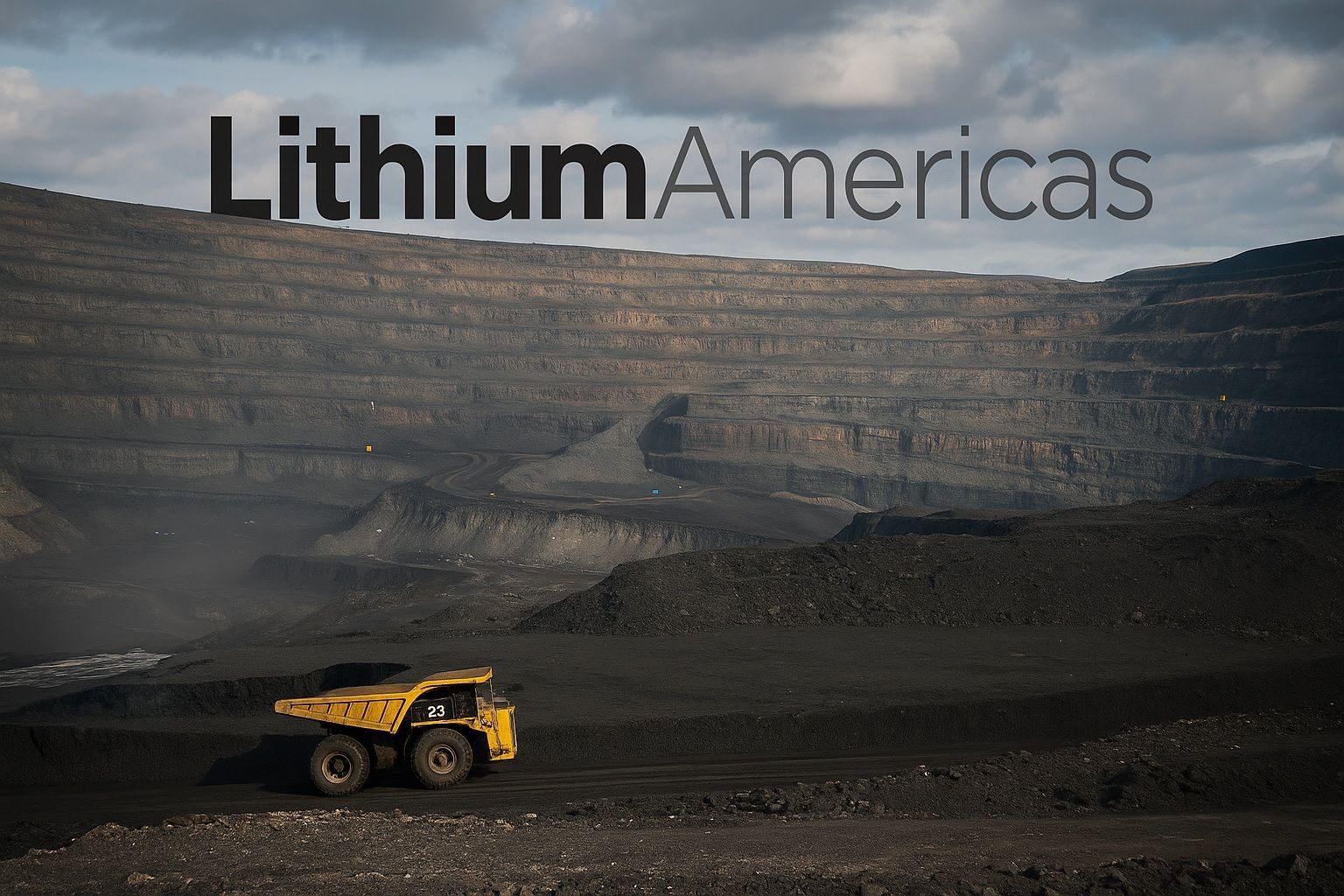
On December 2, 2025, Lithium Americas Corp (NewCo) (NYSE: LAC) is trading around $5.34, up fractionally on the day, with intraday volume above 8.2 million shares.
That small move hides a huge year: LAC is up roughly 75–80% year‑to‑date, after a dramatic autumn rally driven by three big forces:
- The U.S. government has become a 5% equity holder in Lithium Americas and in its Thacker Pass joint venture with General Motors.
- The company has drawn its first $435 million tranche from a massive $2.23 billion Department of Energy (DOE) loan.
- Lithium prices jumped more than 18% in November, igniting speculative interest in high‑beta names like LAC.
Below is a detailed, Google‑News‑ready rundown of where LAC stock stands today, what’s driving it, and how analysts see the 2026–2030 story.
(This article is for information only and is not investment advice.)
1. LAC stock today: price, performance and volatility
- Latest price (Dec 2, 2025): about $5.34
- Intraday range: $5.24 – $5.42
- Volume: ~8.3 million shares, in line with LAC’s recent active trading.
According to MarketBeat, Lithium Americas started 2025 near $2.97; at today’s levels around $5.30, the stock is up about 78% year‑to‑date.
Other key trading stats from recent coverage:
- 52‑week range: roughly $2.3 – $10.8, highlighting extreme volatility.
- Market cap: about $1.5–1.6 billion.
- Valuation: negative P/E around ‑4.8 (pre‑revenue) and beta > 3 in some analyses, making LAC far more volatile than the broad market.
Recent pieces from Insider Monkey and Finviz note that LAC gained ~18.8% in just one week, as traders piled into lithium names amid a rebound in spot prices.
2. The headline story: Washington is now a shareholder in Lithium Americas
The single biggest narrative shift for LAC in 2025 is that the U.S. government is no longer just a lender – it’s an equity partner.
On October 1, 2025, Reuters and other outlets reported that the U.S. Department of Energy (DOE) will receive no‑cost warrants for a 5% stake in Lithium Americas and a separate 5% economic stake in the Thacker Pass joint venture with GM.
Key points from that deal:
- The equity comes alongside a renegotiated federal loan package of about $2.23–2.26 billion for Thacker Pass, now the largest measured lithium reserve and resource in the world.
- The stake is structured via warrants with a token exercise price, effectively giving the U.S. government a long‑term equity option that aligns it with project success.
- News of the stake sent LAC shares up roughly 20–30% in a single session, depending on the source, as traders digested the signal that Thacker Pass is now a strategic national‑security asset.
Energy‑policy analysts note that this equity model is becoming part of a wider toolkit: alongside stakes in MP Materials and Trilogy Metals, Lithium Americas is one of a handful of critical‑minerals projects where Washington is literally on the cap table.
For LAC shareholders, this does three things at once:
- De‑risks funding – the government is strongly incentivized to see Thacker Pass succeed.
- Raises political visibility – both a potential plus (support) and a risk (greater scrutiny).
- Sets a precedent – future capital raises and offtake deals will be viewed through the lens of U.S. industrial policy, not just mining economics.
3. DOE loan: first $435M drawdown and what it means
The 5% equity stake is closely tied to revisions in LAC’s DOE loan. On October 7, 2025, Lithium Americas and the DOE signed an omnibus waiver, consent and amendment that:
- Locked in a total DOE loan amount of $2.23 billion, including $1.97 billion principal and $256 million of capitalized interest during construction.
- Kept the interest rate at the relevant long‑dated U.S. Treasury yield with a 0% spread, effectively ultra‑low‑cost, long‑tenor project debt.
- Deferred $184 million of scheduled debt service from the first five years of repayment to later years, improving near‑term cash flow.
- Required Lithium Americas to deliver warrants giving DOE a 5% stake in the company and a 5% economic stake in the JV within 60 days.
On October 20, 2025, the company drew its first $435 million from that facility to fund processing plant construction at Thacker Pass.
Morningstar and MarketWatch summarize the result succinctly: after this drawdown, Phase 1 of Thacker Pass is effectively fully funded, combining DOE debt, GM’s $625 million commitment and prior equity raises.
In practical terms, this means:
- LAC’s funding risk for Phase 1 has dropped sharply, though execution risk remains.
- The balance sheet is now a mix of cheap, long‑dated government debt, convertible notes and substantial recent equity issuance (including a $250M ATM program completed in October at an average price of about $8.19 per share).
4. Thacker Pass: construction progress and project timeline
Lithium Americas’ Q3 2025 earnings release provides the clearest picture of how fast the Nevada mine is advancing.
Highlights as of September 30, 2025:
- Construction capitalized in Q3: $145.9 million
- Total capitalized to date: $720 million
- Engineering design: >80% complete at the end of Q3, expected to exceed 90% by year‑end 2025 – an unusually high level of detailed engineering this early, aimed at de‑risking schedule and cost.
- Workforce: about 700 personnel on site, expected to rise to ~1,000 by late 2025 and ~1,800 at peak construction.
- Physical progress: first steel columns installed; permanent plant roads, entrances and laydown yards completed; a fabrication yard in nearby Winnemucca is receiving steel for pre‑assembled pipe racks.
- Committed spend: about $430 million already committed under purchase agreements for long‑lead equipment and services.
- Targeted mechanical completion: late 2027 for the Phase 1 processing plant, which is designed for 40,000 tonnes/year of battery‑grade lithium carbonate.
The company estimates that Phase 1 output could support batteries for roughly 800,000 electric vehicles per year, underscoring why Washington and GM are willing to take equity risk here.
5. Earnings snapshot: still pre‑revenue, but beating expectations
Despite all the headlines, LAC remains a pre‑revenue developer. There is no meaningful operating revenue yet; everything is about spending, not selling.
From Q3 2025:
- Net loss (9M 2025): $223.9 million vs $21.4 million in the prior‑year period, driven largely by a non‑cash loss on the embedded derivative in its convertible notes as the share price rose.
- Cash & restricted cash: $385.6 million as of September 30, down from $594.2 million at year‑end 2024, reflecting accelerated capex.
- Total assets: $1.45 billion; long‑term liabilities: $452.2 million, up sharply with DOE‑related obligations and notes.
According to MarketBeat, Q3 EPS came in at –$0.02, beating the lone analyst estimate of –$0.05 by $0.03 per share. Full‑year 2025 EPS is projected around –$0.19, with 2026 EPS still expected to be a loss.
StockAnalysis and other data providers show consensus EPS forecasts remain negative through at least 2026, with no significant revenue modeled until Thacker Pass moves into production later this decade.
Fundamentally, LAC is a balance‑sheet and project‑timeline story, not a traditional earnings story—for now.
6. Lithium prices rebound – and LAC explodes higher
Why has LAC been one of 2025’s most explosive lithium names?
Several recent articles highlight a sharp rebound in lithium prices and renewed speculation:
- Insider Monkey flags Lithium Americas as one of the “10 Small Caps With Big Double‑Digit Gains”, noting the stock surged 18.78% week‑on‑week as investors repositioned for an 18.45% jump in lithium prices in November, to about $93,750 per ton.Insider Monkey+1
- A Zacks piece, “Lithium Americas Shares Surge 69% in 6 Months: Should You Invest Now?”, emphasizes that LAC has rallied around 69% in six months as construction advances and government support solidifies.Yahoo Finance+2Finviz+2
In parallel, an Investing.com analysis, “AI Is Changing the Lithium Market: 2 Stocks That Can Lead,” argues that the AI data‑center boom is quietly boosting grid‑scale battery demand, potentially driving 30–40% lithium demand growth in 2026 and setting up a scenario where prices could “potentially double” as EV and AI needs collide.Investing.com
In that piece, Albemarle is framed as the “conservative” lithium play, while Lithium Americas is cast as the high‑beta growth option: a pre‑revenue developer sitting on a world‑class U.S. resource with powerful strategic backers.Investing.com
7. Wall Street’s view: consensus “Hold”, modest near‑term upside
Despite the hype, analysts are not shouting “back up the truck” on LAC.
Two widely cited consensus snapshots:
- MarketBeat:
- 15 analysts covering LAC
- Consensus rating: “Hold”
- Rating split: 3 Buy, 11 Hold, 1 Sell
- Average 12‑month price target: $5.33, with a range of $3.50 to $8.00 – essentially implying little downside or upside from the current ~$5.3 price.
- StockAnalysis:
- 7 analysts
- Consensus rating also “Hold”
- Average price target: $5.50, with the same $3.50–$8.00 range.
The Investing.com AI‑lithium piece gives a similar picture: analyst targets between $4.50 and $8.00, with an average around $5.96 vs a then‑current price of roughly $5.26, and notes that JPMorgan recently upgraded LAC to Neutral with a $6 target after earlier volatility.
In short:
Wall Street largely sees LAC as fairly valued on a one‑year view, with the real debate focused on 2028–2030 cash flows rather than 2026 earnings per share.
8. 2026–2030: why LAC is called a “2030 power play”
Multiple analyses explicitly position LAC as a “2030 power play” rather than a 2025 trade:
- A MarketBeat/Investing.com column titled “Why Lithium Americas Could Be a 2030 Power Play – Not a 2025 One” stresses that Thacker Pass is years away from production, with heavy capex and no revenue until late in the decade, even as the share price has already run hard.Finviz+1
- Zacks’ “Shares Surge 69% in 6 Months” article similarly warns that rising costs, strict DOE loan covenants and ongoing development expenses could pressure LAC if lithium prices falter or if construction slips.Yahoo Finance+1
Consensus forecasts from StockAnalysis and other data providers typically assume:
- Negative EPS through at least 2026, improving gradually as capex rolls off.
- Meaningful revenue only once Thacker Pass ramps, with full Phase 1 output targeted for late 2027 and early 2028.
If Thacker Pass delivers as modeled and lithium prices remain supportive, the project could throw off substantial free cash flow across the 2030s. But that scenario depends on many years of flawless execution – and that’s exactly what bears question.
9. ESG, legal and political risks: not just a financial story
Beyond pure project risk, LAC faces ongoing ESG and political scrutiny:
- A February 2025 report from Human Rights Watch and the ACLU argues that the U.S. government violated Indigenous peoples’ rights by permitting Thacker Pass without adequate consultation or free, prior and informed consent of affected tribes.
- Environmental groups have highlighted potential impacts on groundwater and species, such as the Kings River pyrg, a rare spring‑dwelling snail. An AP investigation raised concerns that groundwater declines near the project could threaten its habitat, even as regulators and the company argue impacts will be limited.
- A long‑running water‑rights battle with rancher Bartell Ranch over aquifer impacts was settled in August 2025, with Lithium Nevada purchasing certain water rights and subordinating others, clearing a major legal overhang but reinforcing the contentious nature of the project.
On the flip side, Lithium Americas touts its engagement with the Fort McDermitt Paiute and Shoshone Tribe and other stakeholders, and outlines workforce, housing and environmental commitments in its site‑tour and ESG materials.
For investors, the takeaway is simple:
Thacker Pass is both a flagship energy‑transition asset and a lightning rod. Changes in U.S. environmental, Indigenous‑rights, or industrial‑policy regimes could materially affect timelines and costs.
10. Balance sheet & dilution: how risky is the capital structure?
Recent MarketBeat snapshots highlight several balance‑sheet metrics:
- Debt‑to‑equity ratio: ~0.84
- Quick / current ratio: ~3.77 – indicating strong near‑term liquidity for a developer.
- Market cap: ~$1.5 billion vs multi‑billion‑dollar DOE loan and capex program, underscoring leverage to project success.
However, the way LAC is funding itself has consequences:
- An October 2025 at‑the‑market (ATM) equity program raised about $246.4 million via 30.5 million shares at an average price of $8.19, materially diluting existing holders but strengthening the balance sheet.
- $195 million in unsecured convertible notes issued in April 2025; roughly half have already converted into equity as the stock rose, reducing future interest but adding more shares.
- The DOE warrants for 5% of LAC and 5% of the JV represent additional future dilution if the project succeeds – effectively the price of federal backstop support.
LAC still has ample liquidity, but investors should expect more dilution over time if costs rise or schedules slip.
11. How LAC compares to Albemarle and other lithium stocks
Several recent research pieces pit LAC directly against Albemarle (ALB):
- A Zacks note, “LAC vs. ALB: Which Lithium Stock Has More Upside Potential Now?,” frames ALB as an established producer with depressed current earnings but a clearer near‑term earnings recovery, while LAC offers pure‑play U.S. development exposure with far greater project and financing risk.Yahoo Finance+2Zacks+2
- The Investing.com AI‑lithium article reiterates this: ALB as the “conservative” AI‑and‑EV lithium play, LAC as the speculative growth bet on a single mega‑project.Investing.com
Put simply:
- If you want cash‑flowing exposure to lithium today, LAC is probably not your stock.
- If you want leveraged exposure to a single massive U.S. lithium project that could define the domestic supply chain by 2030, LAC is one of the purest ways to do it.
12. Key drivers for LAC stock over the next 12–24 months
Here’s what’s most likely to move LAC from here:
Bullish catalysts
- Further DOE loan drawdowns on schedule, reinforcing confidence that project milestones are being met.
- Construction milestones at Thacker Pass (90%+ engineering completion, major equipment deliveries in early 2026, workforce ramp) hitting or beating guidance.
- Additional offtake agreements beyond GM, potentially at favorable pricing, as allowed under the amended GM contract.
- A sustained rebound in lithium prices if EV and AI demand surprise to the upside.
Bearish risks
- Cost overruns or schedule delays pushing mechanical completion beyond 2027 and increasing the total capital bill.
- Policy or political shifts around government equity stakes, critical‑minerals strategy, or environmental regulation.
- Adverse ESG developments, such as negative findings on groundwater impacts or renewed pressure over Indigenous rights, potentially triggering additional mitigation costs or reputational risk.
- Prolonged weakness in lithium prices, which would compress the project’s net present value and increase equity‑dilution risk if more capital is needed.
13. Who LAC stock may (and may not) be suitable for
Given everything above, LAC tends to fit best for:
- Speculative growth and thematic investors who want direct leverage to U.S. lithium, EVs and AI‑driven energy demand, and who can tolerate multi‑year volatility and headline risk.
- Investors who understand project‑finance style stories: you’re underwriting an asset, not this year’s P/E ratio.
It’s likely not suitable for:
- Investors who need near‑term dividends, stable earnings, or low volatility.
- Anyone uncomfortable with government‑policy risk, ESG disputes, or significant potential dilution.
If you’re evaluating LAC, it’s worth stress‑testing your own thesis under at least three scenarios:
- Base case: Thacker Pass hits late‑2027 mechanical completion, lithium prices stay broadly supportive, DOE remains friendly – LAC delivers strong cash flows late in the decade.
- Bear case: costs rise, timelines slip, lithium prices stagnate or fall – forcing additional equity raises at low prices, heavily diluting shareholders.
- Upside case: Phase 2 and related infrastructure are accelerated in response to tight lithium markets and AI‑driven demand, turning Thacker Pass into a multi‑phase lithium district with outsized strategic value.
14. Bottom line on LAC stock today
As of December 2, 2025, LAC stock sits at the intersection of geopolitics, the energy transition and speculative growth investing.
- The U.S. government’s 5% stake, the $2.23 billion DOE loan and GM’s 38% JV interest give Thacker Pass a rare level of institutional backing.
- Construction is moving quickly, with engineering largely de‑risked and funding for Phase 1 essentially secured.
- Yet LAC remains a pre‑revenue, high‑beta, single‑asset story whose valuation has already run hard on optimism and policy momentum.
For now, most analysts sit at “Hold”, seeing limited 12‑month upside but acknowledging significant long‑term optionality if all goes right.StockAnalysis+2MarketBeat+2
If you’re considering LAC, the key question isn’t “Where will the stock be next quarter?” but:
“Am I comfortable riding out years of volatility to own a slice of what could be America’s flagship lithium mine in 2030 and beyond?”
Only your own risk tolerance, time horizon and portfolio needs can answer that.