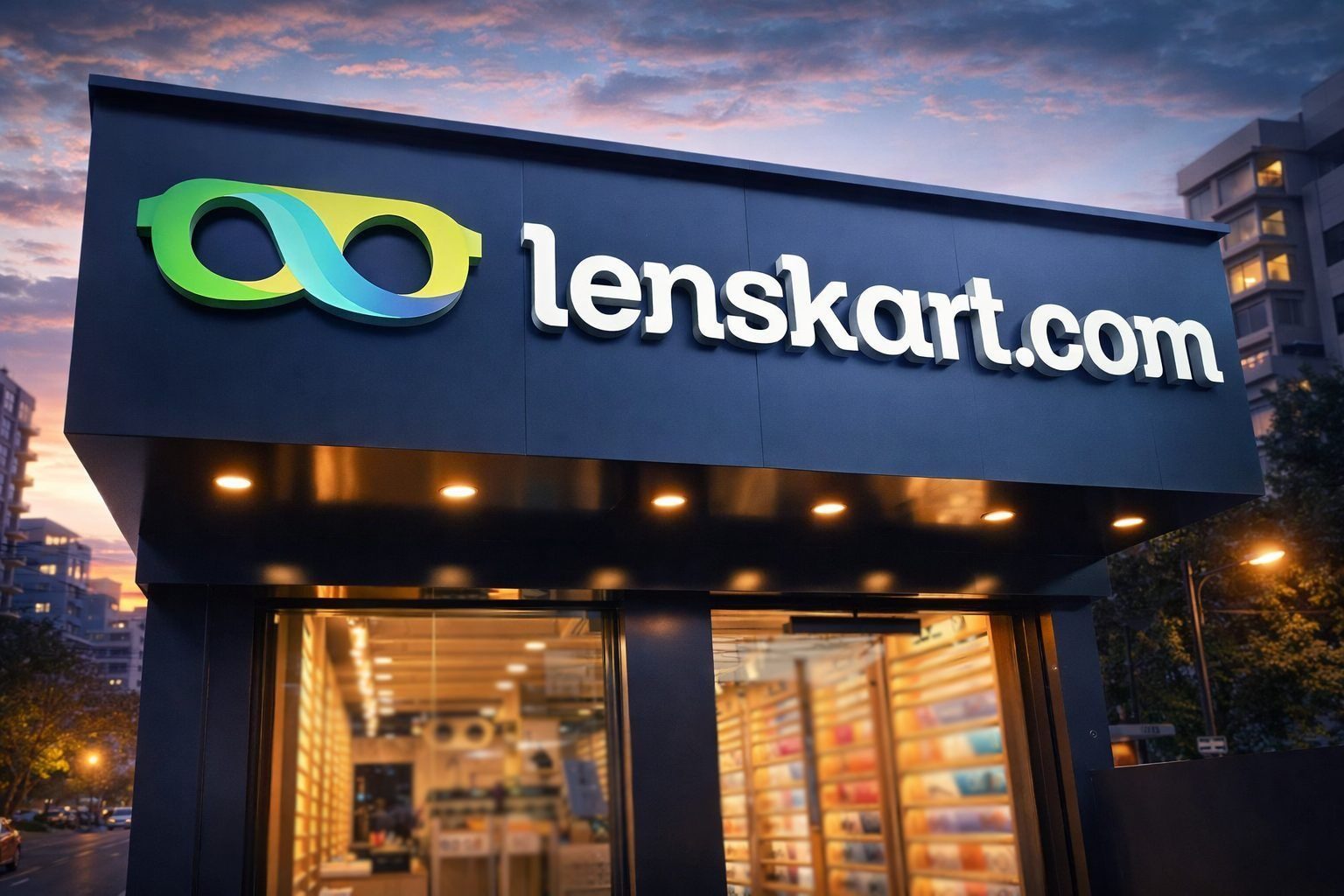

Lenskart Solutions has stepped up its Asia manufacturing push with a fresh bet on optical hardware—investing in South Korea-based iiNeer Corp., a startup that builds technology-enabled eye-testing and lens-cutting equipment.
The update surfaced while Indian markets were shut for Christmas on December 25, 2025—and when trading resumed on December 26, Lenskart’s stock moved quickly. Shares rose as much as 3.98% to ₹470 in early trade before easing back, still holding gains as investors digested what the company is really buying: deeper control over the machines that sit at the heart of eyewear manufacturing and in-store lens processing.
What happened on December 25 and why December 26 mattered
India’s stock exchanges (NSE and BSE) remained closed on December 25, 2025, due to the Christmas trading holiday. Trading across key segments—including equities and derivatives—resumed on December 26.
That calendar detail mattered because the iiNeer announcement landed right around the holiday window, giving the market its first real “price reaction” only after trading reopened.
A Moneycontrol report dated December 25 noted that Lenskart’s Singapore subsidiary had approved the investment, and also pointed out that Lenskart shares had closed at ₹448.95 on December 24, down 3.62%—setting the stage for the post-holiday move.
The deal in one line: Lenskart’s Singapore unit buys into iiNeer
According to exchange-filed disclosures reported by multiple outlets, Lenskart Solutions Pte. Ltd., Singapore—a wholly owned subsidiary—has approved an investment of KRW 3 billion (about ₹18.6 crore, or ₹186 million) to acquire 123,945 preference shares, representing 29.24% of the share capital of iiNeer Corp., Ltd., incorporated in the Republic of Korea.
Key terms at a glance
- Investor: Lenskart Solutions Pte. Ltd., Singapore (wholly owned subsidiary) Business Standard
- Target: iiNeer Corp., Ltd. (South Korea) Business Standard
- Stake: 29.24% Business Standard
- Instrument: 123,945 preference shares Business Standard
- Consideration: KRW 3 billion (approx. ₹18.6 crore) Business Standard
- Timeline: Expected completion by January 31, 2026 (as reported by Moneycontrol) Moneycontrol Hindi
Why Lenskart is buying: less dependence on vendors, more control of “core equipment”
Lenskart’s rationale is straightforward: eyewear is not only about frames and lenses—it’s also about the machines that measure, cut, edge, trace, and finish lenses to fit a customer’s prescription and frame.
The company, via its filings as reported, said the investment is designed to build proprietary capabilities in core equipment, with the expectation of improving operating efficiencies and reducing equipment-related capital expenditure over time.
More specifically, reports say the iiNeer investment helps Lenskart develop in-house optical hardware capabilities for lens edging systems, including:
- Edgers
- Tracers
- Blockers Capital Market
Those terms can sound technical, but in practice they sit at the center of the “make the lens fit the frame” step—where speed, precision, and uptime directly affect delivery times, store productivity, and remake rates.
Who is iiNeer and what it builds
Market reports describe iiNeer as a Korea-based startup focused on technology-enabled eye-testing and lens-cutting equipment, with a reported turnover of KRW 177.77 million in calendar year 2024.
On its own website, iiNeer positions itself as an optical lens processing technology company and highlights what it calls the world’s first web-based remote customer service platform, designed to support opticians and reduce service friction.
iiNeer’s “TOOLTIP” lens processing lineup
iiNeer’s product pages show a “TOOLTIP” range that includes:
- TOOLTIP INE200 Edger
- TOOLTIP INT200 Tracer
- TOOLTIP INB200 Blocker Iineer
That product mix closely mirrors what Lenskart referenced in filings (edgers, tracers, blockers)—which helps explain why this is strategically relevant for an eyewear retailer that’s increasingly focused on vertical integration.
How the market reacted when trading resumed
When Indian markets reopened on December 26, Business Standard reported that Lenskart shares rose 3.98% in early trade to ₹470, and at 09:25 AM were trading around ₹462.35, up 2.29% versus the previous close of ₹452.
The same report also noted:
- 1.35 million shares traded across BSE and NSE, worth about ₹63.55 crore
- A 52-week range of ₹495–₹356.10 (NSE)
- Market capitalisation around ₹80,324.49 crore (as of Dec 26, 2025) Business Standard
In other words: despite the transaction size being relatively modest in rupee terms for a company of this market cap, investors appeared to treat the news as strategically meaningful—more about manufacturing leverage than a purely financial investment.
This isn’t a one-off: Lenskart’s Singapore unit is becoming its Asia expansion vehicle
The iiNeer move also fits into a broader pattern visible in Lenskart’s recent disclosures.
Business Standard reported earlier in the same week that Lenskart’s Singapore subsidiary approved a deal in Thailand—acquiring 50% of Marco Optical (Thailand) Co., Ltd. (Sunrise Thailand) from Matt Optical, setting up a 50:50 joint venture structure.
Put together, the sequencing suggests a clear playbook:
- Use Singapore as a regional hub for deals and partnerships.
- Invest in manufacturing capacity and core tooling across Asia—Thailand for manufacturing/trading footprint, South Korea for equipment innovation.
What to watch next
For investors and industry watchers, the iiNeer deal raises several near-term questions that will shape whether this becomes a meaningful competitive advantage:
1) Can Lenskart translate a minority stake into operational outcomes?
At 29.24%, Lenskart isn’t buying full control. The key will be whether the partnership is structured to deliver tangible benefits—equipment availability, customised feature roadmaps, faster servicing, and lower lifecycle costs—despite the minority position.
2) Will this reduce capex and improve turnaround times at scale?
Lenskart’s stated goal—improving efficiency and reducing equipment capex—sounds simple, but the real proof will show up in rollout speed, uptime, and remake/return metrics once equipment is deployed across labs/stores.
3) Closing timeline
Moneycontrol reported the transaction is expected to be completed by January 31, 2026—a date that will likely be watched for any follow-up filings or operational commentary.
Bottom line
The iiNeer investment is not a headline-grabbing “big-ticket” acquisition by value—but it’s a strategically pointed move aimed at owning more of the eyewear production stack, especially the machines that make fast, consistent lens delivery possible.
And with the announcement emerging over the December 25 market holiday—and the stock reacting as trading resumed on December 26—the timing underlined just how closely investors are tracking Lenskart’s post-listing expansion and vertical-integration roadmap.
Related articles: Stock Market