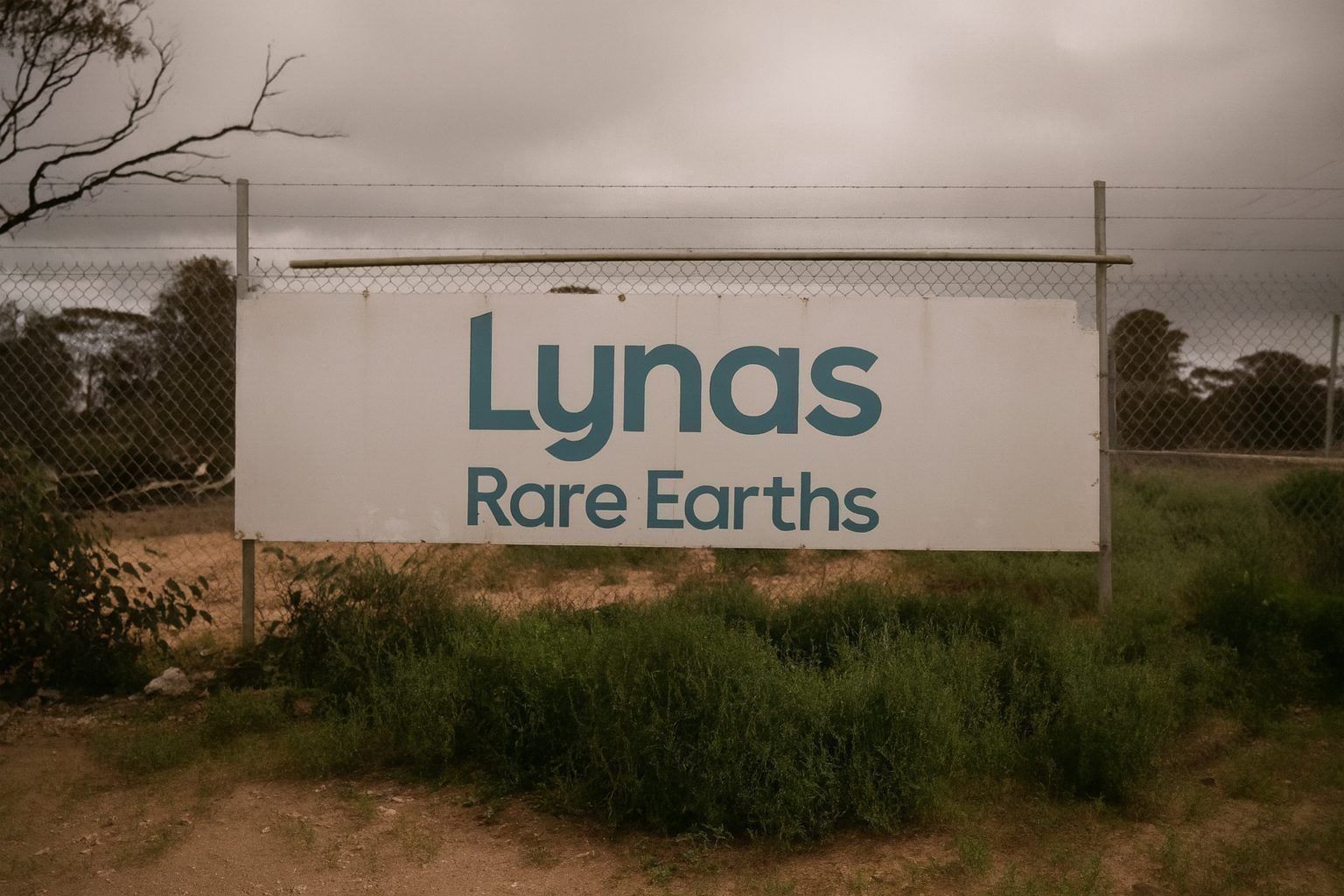
SYDNEY/PERTH — 20 December 2025 — Lynas Rare Earths Limited (ASX:LYC) has spent 2025 doing what rare-earth stocks do best: swinging between geopolitical darling and execution-risk stress test. As of 20 December 2025, Lynas shares are around A$12.19, putting the stock well below its 2025 peak (and reminding investors that “critical minerals” is not a synonym for “low volatility”). Investing.com+1
What’s unusual about Lynas right now is that multiple, very different forces are hitting the tape at the same time:
- Index inclusion: Lynas is set to enter the S&P/ASX 50 effective before the open on 22 December 2025, a mechanical catalyst that can force index-tracking funds to buy. Company Announcements
- Operations risk: Power disruptions at the Kalgoorlie processing facility have triggered warnings about a potential shortfall, with knock-on implications for Malaysian production timing. Announcements+2Reuters+2
- Growth narrative: Lynas is pushing deeper into heavy rare earths and expanding processing capability in Malaysia, including a first samarium production target in the first half of calendar 2026. Announcements+1
- Macro/geopolitics: China has signaled a more “streamlined” licensing approach to rare-earth exports—news that could affect global supply tightness (and the risk premium investors have been paying for non-China supply). Reuters
Below is a full, up-to-date readout of the news flow, forecasts, and analyst positioning shaping Lynas stock heading into 2026.
Lynas share price snapshot on 20 December 2025
Lynas is indicated around A$12.19 with a prior close near A$12.35. Investing.com+1
The stock’s stated 52-week range is roughly A$6.16 to A$21.96—meaning Lynas is trading about 44% below its 52-week high, despite still being substantially above the year’s lows. Investing.com
In the last ASX session before today (19 December), Lynas closed at A$12.19 on reported volume of about 21.28 million shares, down roughly 1.30% on the day. Investing.com
This matters because the recent tape action tells you something important: the market is actively repricing the balance between “strategic value” and “execution friction.” In plain English: investors still like the long-term idea, but they’re not willing to ignore near-term hiccups.
The biggest near-term catalyst: Lynas to join the S&P/ASX 50 on 22 December
On 5 December 2025, S&P Dow Jones Indices announced that Lynas Rare Earths Limited (LYC) would be added to the S&P/ASX 50, effective prior to the open on Monday, 22 December 2025, as part of the quarterly rebalance. Company Announcements
Why index additions can move a stock (even when fundamentals haven’t changed):
- Passive flows are not opinions. Index funds and ETFs that track the ASX 50 typically need to buy the new constituent regardless of valuation.
- Liquidity and visibility improve. More institutional attention can compress bid/ask spreads and increase daily turnover.
- It can be a “one-off bump.” After the rebalance, flows normalize—sometimes leading to the classic “buy the inclusion, sell the event” dynamic.
For Lynas specifically, this catalyst is colliding with a period when investors are already hypersensitive to operational reliability—so the post-inclusion price action may be more volatile than usual.
The main operational headline: Kalgoorlie power disruptions and a potential production shortfall
Lynas’ most immediate operational problem is not geology or metallurgy—it’s electricity.
In an ASX announcement dated 25 November 2025, Lynas reported significant power supply disruptions affecting the Kalgoorlie Rare Earths Processing Facility, noting that outage frequency and duration in November led to significant lost production of mixed rare earth carbonate (MREC). Lynas said it estimated there may be a shortfall equivalent to one month’s production during the quarter, and that production of finished goods in Malaysia would be affected. Announcements
Reuters’ reporting aligns with that warning and adds context: Lynas described the shortfall risk as potentially about a month of production, and said it was urgently evaluating off-grid power generation solutions while working with the WA government and utility provider. Reuters
ABC News also highlighted the broader grid constraints in the region and quoted Lynas management describing the issue as a combination of generation and network limitations, with Kalgoorlie effectively sitting at the end of a long transmission line. ABC
Investor takeaway:
This is the kind of risk the market punishes because it’s messy. Power reliability isn’t a commodity cycle you can hand-wave away with “EV demand in 2030.” It directly impacts throughput, product availability, and customer confidence—especially for a company positioning itself as the reliable non-China supplier.
Lynas growth strategy update: heavy rare earths and a broader product mix
If Kalgoorlie is today’s headache, Lynas’ heavy rare earth (HRE) push is the longer-term “why you own it” argument.
Expanded heavy rare earth separation in Malaysia, with samarium targeted in 1H 2026
In its quarterly reporting, Lynas stated it had approved construction of an expanded HRE separation circuit in Malaysia, with work commencing in the December quarter (including modifications to solvent extraction facilities) and first production of samarium targeted for the first half of calendar 2026. Announcements
Heavy rare earth production ramp: Dy & Tb showing up in reported volumes
In the same update, Lynas reported “ready for sale” production volumes including:
- NdPr: 2,003 tonnes (Q1 FY26 column shown in the table)
- Dy & Tb: 9 tonnes (included for the first time in the table as ramp-up continued) Announcements
That’s strategically meaningful because dysprosium (Dy) and terbium (Tb) are among the highest-value rare earths used to improve magnet performance in high-temperature applications (think EV drivetrains, aerospace, defense). Producing separated HREs outside China is one of the cleanest “geopolitical premium” stories in the sector—when execution is smooth.
Scale and capacity: the “three-node” system (Mt Weld → Kalgoorlie → Malaysia)
Lynas’ investor materials also emphasize the operational footprint and nameplate capacity ambitions across the chain, including:
- Mt Weld expansion capacity referenced to support 12 ktpa NdPr finished product at nameplate
- Kalgoorlie cracking & leaching capacity referenced to support ~9 ktpa NdPr finished product from MREC feedstock
- Lynas Malaysia separation and finishing capacity referenced at 10.5 ktpa NdPr nameplate wcsecure.weblink.com.au
These aren’t guarantees of production (nameplate capacity never is), but they help explain why forecasts for FY26 have become more aggressive: the company is trying to move from “scarce strategic supplier” to “scaled strategic supplier.”
China, licences, and the weird chessboard of rare earths
Rare earths are where industrial economics and geopolitics share a coffee and then set the café on fire.
China: new “general licence” approach to speed exports
On 18 December 2025, Reuters reported that China’s Commerce Ministry said it has begun issuing a new type of general licence intended to streamline rare earth exports, with some exporters receiving approvals. Reuters
For Lynas investors, there are two ways to read this:
- Bearish interpretation (near-term): If exports flow more smoothly, perceived supply risk eases, which can reduce the “non-China premium” embedded in Lynas’ share price.
- Bullish interpretation (structural): China changing process doesn’t remove strategic dependence; it highlights that rare earths remain tightly managed—keeping Western governments and OEMs motivated to diversify suppliers.
Vietnam: tightening rules, but with limited immediate supply impact
Reuters also reported that Vietnam revised its mineral law to restrict exports of refined rare earths and reaffirm a ban on rare earth ore exports, aiming to promote domestic processing. Reuters
That doesn’t instantly create a new supply competitor (refining capacity is the bottleneck), but it supports the broader theme: more countries want to internalize value chains, not just ship ore.
US and allies: industrial policy is getting bigger (and more direct)
The Financial Times reported US backing for a major critical minerals processing investment intended to reduce reliance on China for key materials. Financial Times
This matters for Lynas less as a direct competitor story and more as proof that government-backed supply-chain buildout is accelerating—often with subsidies, loans, and strategic offtake arrangements that can reshape margins and project economics across the sector.
Analyst forecasts and price targets: “Neutral” consensus, but wide dispersion
The market’s current mood is basically: “We can see the upside… we can also see the ways this gets painful.”
Consensus rating and targets (as of 20 Dec 2025)
Investing.com shows a consensus analyst stance described as “Neutral”, with an average 12‑month price target around A$15.63 (about +28% upside from ~A$12.19), but with a very wide spread between low and high estimates. Investing.com
A Nasdaq/Fintel-style compilation similarly points to an average target in the mid-teens (US-format presentation), again with a wide high/low range that signals disagreement on the durability of pricing and the success of ramp-ups. Nasdaq
How to read this dispersion:
When analysts disagree this much, it usually means the “answer” depends on one or two crucial variables—typically realized NdPr pricing, operational uptime, and how quickly new capacity becomes profitable rather than merely operational.
Forecasts for FY26: Visible Alpha / S&P Global points to a sharp rebound
One of the most concrete forward-looking datasets in the current coverage comes from Visible Alpha via S&P Global Market Intelligence. That research highlights expectations for fiscal 2026 including:
- Total rare earth oxide production projected to rise ~53% year-on-year to ~16.1K tons
- Average realized prices projected to rise ~47% to ~A$72.5/kg
- NdPr oxide described as ~91% of revenues, with projected realized NdPr prices rising to about A$118/kg and volumes rising to ~8.8K tons
- Revenue forecast to roughly double to ~A$1.1 billion in 2026 versus ~A$557 million previously SP Global
That’s the bull case in numbers: higher volumes + better pricing = operating leverage. But the path from spreadsheet to reality runs straight through things like grid stability, commissioning schedules, customer qualification cycles, and the minor inconvenience of global politics.
Bull case vs. bear case: what investors are actually betting on
The bull case (what must go right)
Lynas bulls are effectively underwriting three claims:
- Non-China supply keeps a strategic premium. Even if China streamlines exports, customers and governments still pay for diversification.
- Heavy rare earth separation becomes a moat. Dy/Tb ramp continues, samarium arrives in 1H 2026, and Lynas expands product breadth. Announcements+1
- FY26 is the ramp year. Forecast volume and price improvements materialize, pushing revenue meaningfully higher. SP Global
The bear case (what can break the story)
The bearish version is less dramatic and more annoying:
- Operational interruptions persist. Kalgoorlie power reliability remains a recurring drag, constraining upstream feed and Malaysian finished goods timing. Announcements+1
- Rare earth prices retrace. If China export flow normalizes and demand cools, realized pricing disappoints, flattening margins. Reuters+1
- The “strategic premium” fades faster than fundamentals improve. Investors stop paying up for the narrative before the earnings catch up.
What to watch next for Lynas stock
Heading out of 20 December 2025 and into early 2026, the most actionable “watch list” is pretty clear:
- 22 December 2025: S&P/ASX 50 inclusion mechanics — watch volume, spreads, and whether the stock holds gains after passive buying. Company Announcements
- Kalgoorlie power mitigation updates — any concrete progress on off-grid solutions or improved reliability could reduce the biggest near-term execution overhang. Announcements+1
- Heavy rare earth milestones — continued Dy/Tb ramp and timeline confidence on samarium in 1H 2026. Announcements+1
- China export policy signals — not just rules, but implementation: how licences affect actual shipments, prices, and customer behavior. Reuters
- FY26 guidance tone and realized pricing — the market is primed to reward evidence that FY26 is truly the rebound year implied by consensus datasets. SP Global
Bottom line: Lynas Rare Earths stock is being pulled between structural bullish forces (strategic non-China supply, heavy rare earth expansion, projected FY26 rebound) and tactical bearish ones (power disruptions, near-term production risk, and shifting signals from China). The next few weeks are likely to be dominated by index rebalancing and operational updates, while the bigger 2026 debate will hinge on whether Lynas can convert expanded capability into reliably delivered, premium-priced product at scale. Company Announcements+2Announcements+2