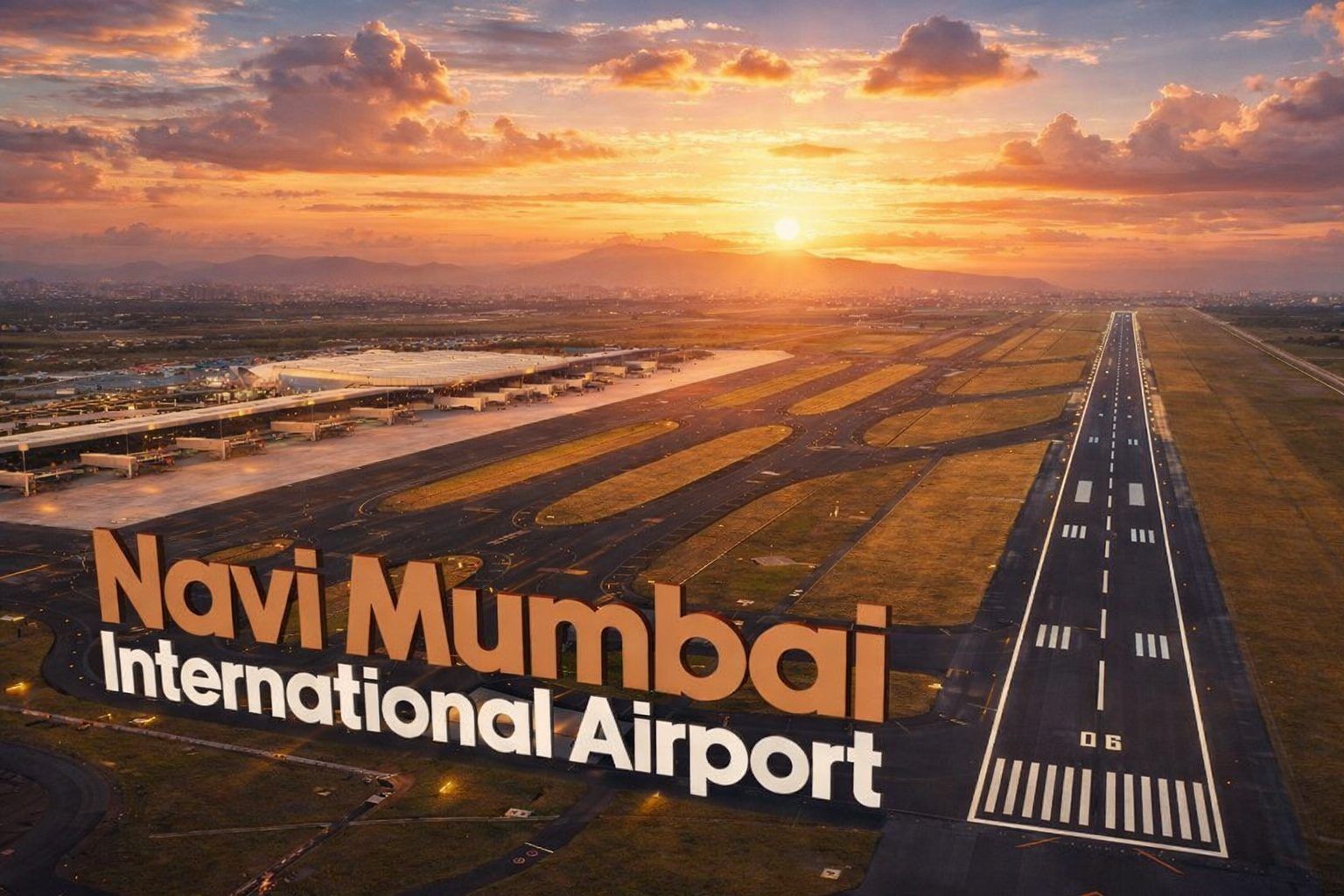
Navi Mumbai International Airport (NMIA) has begun its commercial journey with a strong early turnout, handling nearly 10,000 passengers across its first two days of scheduled operations—a signal that Mumbai’s long-awaited second airport is already attracting demand from the Mumbai Metropolitan Region (MMR). www.ndtv.com+1
According to figures shared by airport authorities and reported by multiple outlets, NMIA processed 4,922 passengers on December 25 (its first day of passenger operations) and 5,028 passengers on December 26, bringing the total to just under the 10,000 mark. www.ndtv.com+1
But the opening week is also revealing the reality of a phased airport launch: some premium facilities are still coming online, transport access is evolving, and travellers are learning the rhythms of a brand-new terminal. Here’s what happened on Day 1 and Day 2, what passengers are experiencing inside the terminal, and what NMIA’s ramp-up plan looks like heading into 2026.
A quick snapshot of NMIA’s first two days
NMIA’s early numbers are being closely watched because they offer the first real test of whether travellers will shift to a second airport—and how quickly operations can scale.
Airport statements cited in reporting indicate that booked passenger load factors rose sharply once scheduled services began on December 25, with arrival and departure load levels climbing compared to December 24. www.ndtv.com
On the operational side, NMIA is starting with limited operating hours and a controlled flight schedule:
- First month: operations planned for 12 hours daily (8:00 a.m. to 8:00 p.m.), with about 23 scheduled daily departures and up to 10 flight movements per hour, as reported from airport statements. www.ndtv.com+1
- From February 2026: planned transition to round-the-clock (24/7) operations, with an expanded schedule reported at 34 daily departures. www.ndtv.com+1
First flights at NMIA: IndiGo lands first, then departs—marking a milestone moment
NMIA’s inaugural scheduled passenger movements followed a tight morning sequence that aviation watchers in Mumbai have been anticipating for years.
Reporting from multiple outlets identifies:
- First arrival:IndiGo flight 6E460 from Bengaluru, landing at 8:00 a.m., welcomed with a ceremonial water cannon salute. The Times of India+2The Tribune+2
- First departure: an IndiGo flight to Hyderabad departing at 8:40 a.m., establishing NMIA’s first commercial arrival–departure cycle. The Times of India+2The Tribune+2
Day-one operations involved multiple airlines, with reports naming IndiGo, Akasa Air, Air India Express, and Star Air among the first carriers operating scheduled services from NMIA. The Times of India+2www.ndtv.com+2
A small but telling detail for frequent flyers: aviation officials quoted in coverage said the airport will be referred to as “Navi” in pilot–air traffic control radio communication—an operational identity that helps distinguish it from Mumbai’s existing airport systems. The Times of India+1
Inside the terminal: lounges aren’t open yet—but hot meals are drawing lines
Early passengers are getting a first look at the terminal’s food and comfort options—and learning what’s still in progress.
Lounges: “not open yet,” with timelines emerging
On Day 1, airport lounges were not yet open, according to reporting from The Times of India. The same report cites sources saying a temporary lounge (about 100 seats) could open within days, while a larger “Adani-1” lounge (reported at 125+ seats) is expected to open later, with segregated areas for business and economy class travellers. The Times of India
Food: Gully Kitchen becomes the early standout
With premium lounges pending, food became an immediate focus—especially for morning departures.
The Times of India reported that Gully Kitchen (operated by Semolina Kitchens Pvt Ltd) was the only hot-meals option available on Day 1, drawing queues as travellers looked for breakfast options. The report also cited example pricing (including items like upma and other breakfast staples) and passenger reactions to menu items such as dosa variations. The Times of India
Airport officials quoted in the same coverage said NMIA plans to add a larger foodhall-style offering in the coming months, suggesting the current set-up is intentionally transitional. The Times of India
Getting to NMIA: buses are starting, but cabs are still doing most of the work
Beyond the terminal, travellers’ first impressions often come down to one question: How easy is it to reach the airport?
A Moneycontrol report on Day 1 described a mix of progress and friction:
- Bus services were launched on five routes by Navi Mumbai Municipal Transport (NMMT). Moneycontrol
- Many travellers reportedly relied on app-based cabs, with auto and taxi stands still incomplete in the early operating window. Moneycontrol
- Some passengers described unclear or missing road signage, and noted that parts of the approach infrastructure were still being worked on. Moneycontrol
This is typical for phased airport openings globally: operational readiness inside the terminal can outpace the pace of surrounding last-mile infrastructure—especially when multiple agencies are involved.
The “people-first” opening narrative: drone tributes, community guests, and first-time flyers
While passenger counts and flight schedules are the hard metrics, NMIA’s opening week is also being defined by a carefully constructed story about who the airport is for.
A private drone show for workers and frontline teams
A PTI feed carried by The Wire described a private drone light show on December 24 held inside airport premises—framed as a tribute for the construction workforce, ground teams, staff, and community members (including persons with disabilities). The Wire
That report said the drone formations included lotus imagery tied to NMIA’s architectural identity and visuals emphasizing sustainability and connectivity. The Wire
Separately, NDTV reported a drone show featuring 1,515 drones on the eve of launch, describing aerial formations (including lotus-themed visuals) presented as part of the airport’s operational rollout. www.ndtv.com
Ceremonial touches—and an emphasis on first-time flyers
Coverage also described a broader ceremonial opening that blended aviation tradition with cultural programming, including the airport’s first flight welcome and on-ground celebrations. The Times of India+1
The Times of India reported initiatives that included a special chartered aerial tour involving groups such as farmers, underprivileged families, and colleagues with disabilities, plus a commemorative India Post “First Flight Carried” special cover flown on an IndiGo service. The Times of India
What airport leadership is saying: “world-class,” resilience, and a multi-airport Mumbai
Airport and group leadership have positioned NMIA as a long-term answer to Mumbai’s air-capacity crunch.
NDTV reported Gautam Adani describing the launch as a proud moment for Mumbaikars and saying the aim was to build a “world-class” airport. www.ndtv.com
Jeet Adani, in a separate interview about the aviation sector, argued that building capacity is also about system resilience—the ability to absorb disruptions and reduce pressure when problems cascade across the network. India Today
That framing aligns with a broader global pattern: major city-regions typically move toward multi-airport systems as demand and operational complexity rise.
Why NMIA matters now: Mumbai congestion, delayed timelines, and India’s fast-growing aviation market
Mumbai has been operating under tight runway constraints
One reason NMIA’s early performance is significant: Mumbai’s existing airport has long been described as capacity constrained.
The Times of India reported that Mumbai’s existing airport handles about 950 flights in 24 hours and operates with a single runway, a constraint frequently cited in debates about why a second airport became unavoidable. The Times of India
Independent aviation experts have long pointed to the cost of delay
NMIA has also been one of India’s most delayed mega-infrastructure projects, and industry analysts have repeatedly highlighted what that meant for airlines and passengers.
A Fortune India long-read on NMIA quoted CAPA India CEO Kapil Kaul as saying the domestic aviation industry “paid a heavy price” for the failure to get the project operational earlier—an argument rooted in years of congestion costs and slot constraints at Mumbai. Fortune India
Demand keeps rising
Global demand trends also help explain why India is racing to expand airports.
In November 2025, IATA reported continued growth in passenger demand and noted that domestic India demand (measured in RPKs) showed year-on-year growth in October 2025, reflecting a market still expanding even as capacity and infrastructure catch up. IATA
And as Reuters reported in late December 2025, India remains a highly competitive and fast-evolving aviation market where capacity, reliability, and competition are becoming national-level policy concerns. Reuters
Security and readiness: ORAT trials and CISF deployment
Airport openings aren’t just about ribbon-cuttings—they require extensive operational testing.
An ANI report carried by The Tribune said NMIA conducted Operational Readiness and Airport Transfer (ORAT) trials with stakeholders, and that the Central Industrial Security Force (CISF) was inducted at NMIA on October 29, 2025, with deployment across key airport functions. The Tribune
This matters for travellers because it’s directly tied to queue management, checkpoint flow, and the consistency of day-to-day operations.
Cargo begins too: NMIA’s logistics ambitions start on Day 1
While passenger operations are the headline, NMIA is also positioning itself as a cargo node.
NDTV reported that NMIA began domestic cargo operations on December 25, and that the first shipment arrived from Bengaluru on IndiGo flight 6E460, marking the start of a broader logistics runway for the airport. www.ndtv.com
What comes next for passengers: 24/7 operations, more flights, more amenities—and smoother access
NMIA’s early passenger counts suggest real latent demand for a second Mumbai airport, but the next phase will be judged on execution:
- Operational scaling: moving from 12-hour operations to 24/7 (planned from February 2026) and increasing daily departures. www.ndtv.com+1
- Amenities coming online: lounges, broader food offerings, and a more complete retail mix as the terminal matures. The Times of India
- Ground connectivity: better signage, completed taxi/auto facilities, and more dependable public transport links—crucial for turning first-time curiosity into repeat behaviour. Moneycontrol
For Mumbai flyers, the practical takeaway is simple: NMIA is open, active, and growing—but it’s still in a controlled launch mode. The first two days show strong passenger appetite; the next few months will determine how quickly the airport converts that momentum into a seamless, full-service second gateway for India’s financial capital. www.ndtv.com+2The Times of India+2