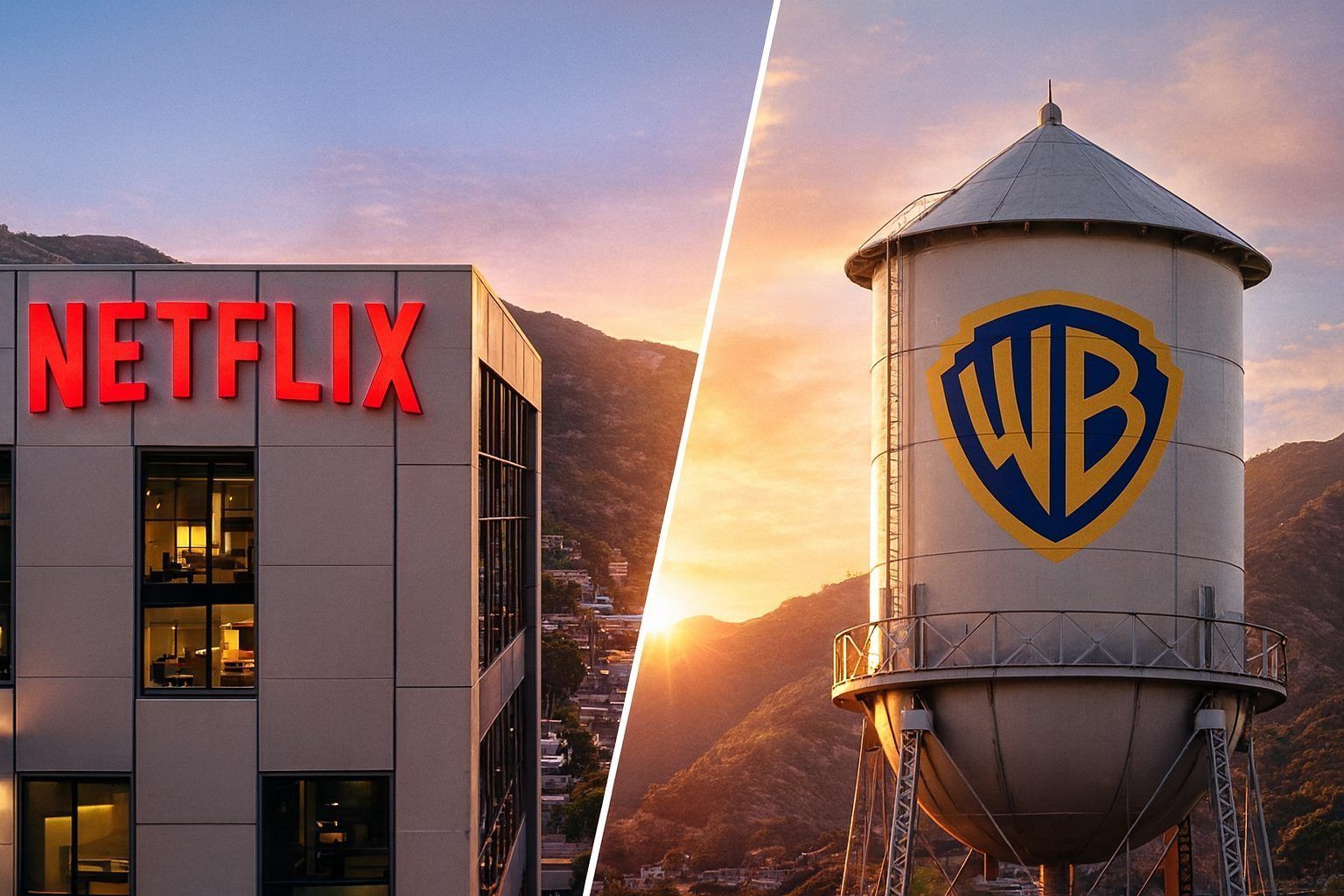
Netflix is simultaneously pulling off the biggest deal in its history, buying one of Hollywood’s crown jewels, while watching its own stock sag to multi‑month lows. On 5 December 2025, investors are trying to reconcile three competing realities: a transformative $72 billion acquisition of Warner Bros. Discovery’s studios and streaming business, mounting antitrust and political risk, and fresh insider selling by co‑founder Reed Hastings — all against a backdrop of analysts still calling Netflix (NFLX) fundamentally undervalued. Reuters+2The Economic Times+2
Below is a deep dive into where Netflix stands today — and what the Warner Bros. megadeal and “Harry Potter trade” could mean for the stock in 2026 and beyond.
Where Netflix Stock Stands After the Latest Pullback
As of the close on 4 December 2025, Netflix shares finished at $103.22, down 0.71% on the day after trading between $101.77 and $103.79. Trading volume hit 51.3 million shares, far above the recent average, as investors reacted to continued headlines around the Warner Bros. bid and regulatory risk. The current market capitalization sits around $437 billion, and the stock trades on a price‑to‑earnings ratio of roughly 43x. The Economic Times
The sell‑off has erased a chunk of Netflix’s 2025 rally:
- Shares have fallen about 5% in recent sessions, hitting a seven‑month low. The Economic Times+1
- Over the last month, the stock is roughly flat to slightly negative, while still up about 20% over the last 12 months. Finviz+1
- Over three years, total shareholder return remains above 200%, underscoring how far the stock had run before this correction. Simply Wall St
Fundamentals remain solid. Netflix generated $11.51 billion in Q3 2025 revenue, beating expectations and continuing double‑digit growth, driven by its paid‑sharing crackdown, the ad‑supported tier, and international subscriber gains. The Economic Times+1
Yet the market is now clearly focused on risk rather than recent beats: regulatory pushback, deal integration, and whether Netflix is stretching its balance sheet and strategic focus with an $80‑plus‑billion bet on Warner Bros. Discovery.
Inside the $72 Billion Warner Bros. Discovery Megadeal
On 5 December 2025, Netflix officially agreed to buy Warner Bros. Discovery’s TV and film studios plus its streaming division, including HBO Max, in a deal valued at $72 billion in equity and roughly $82.7 billion including debt. Reuters+1
Key terms and structure:
- Price: Warner Bros. Discovery shareholders will receive $27.75 per share, composed of $23.25 in cash and about $4.50 in Netflix stock. Reuters+1
- Premium: The offer represents a 121% premium to Warner’s share price before buyout rumors surfaced in September. Reuters
- Closing timeline: The transaction is expected to close after Warner spins off its Discovery Global cable networks into a separately traded company, a step currently scheduled for Q3 2026. Reuters+1
- Break‑up fees: Netflix has agreed to pay a $5.8 billion break‑up fee if regulators block the deal; Warner would owe Netflix $2.8 billion if it walks away. Reuters+1
- Synergies: Netflix expects $2–3 billion in annual cost savings by year three after closing, largely from overlapping content spend, tech, and corporate overhead. Reuters
The acquisition instantly hands Netflix control of some of the world’s most coveted franchises:
- Harry Potter
- Game of Thrones
- DC Comics’ superhero universe
- A deep film library spanning Warner Bros.’ century‑long studio history Reuters+1
Strategically, the deal turns Netflix from a streaming‑first platform dependent on third‑party studios into a vertically integrated media giant with one of Hollywood’s richest content vaults. Reuters notes that Netflix has effectively skipped decades of slow library building by buying a ready‑made studio empire, strengthening its position against Disney and Paramount. Reuters+1
Co‑CEO Ted Sarandos has framed the acquisition as a way to “define the next century of storytelling,” promising more original productions, continued theatrical releases for Warner’s movies, and a cheaper bundled streaming offering that combines Netflix and HBO Max. Reuters+1
The “Harry Potter Trade”: Why Netflix Investors Are Nervous
The user‑facing headline might be “Netflix buys Harry Potter,” but equity markets are less enchanted.
On 4 December, Investopedia reported that Netflix shares were trading at a seven‑month low as Wall Street digested reports that the company was the leading bidder for Warner Bros. Discovery and its deep intellectual property bench. investopedia.com
Their analysis highlighted several pressure points:
- Deal fatigue and sticker shock: Netflix and competitor Paramount Skydance both saw their shares decline after submitting first‑round bids on 20 November. The buyer is expected to pay a substantial premium, which often triggers profit‑taking and questions about deal logic. investopedia.com
- Antitrust scrutiny: U.S. officials have reportedly raised concerns that combining Netflix with HBO Max could give a single player outsized power in streaming and content distribution, potentially harming competitors and consumers. investopedia.com+1
- Political risk: Reports have suggested the Trump administration is prepared to oppose a Netflix–Warner deal on antitrust grounds, adding uncertainty about Department of Justice review and potential litigation. investopedia.com
A Reuters piece published the day before the deal announcement noted that a consortium of Hollywood figures has already urged Congress to intervene if Netflix’s bid succeeds, warning of a looming “economic and institutional crisis” for the entertainment industry. Reuters+1
On 5 December, after the deal was formally announced:
- Warner Bros. Discovery (WBD) shares rose only about 2–3%, still trading below the offer price — a classic sign that investors are discounting the odds of a smooth, timely closing. Reuters+1
- Netflix stock fell roughly 3–4% in pre‑market trading, extending recent losses and underlining skepticism about the price, integration risk and regulatory gauntlet ahead. Reuters+1
In short, markets love the intellectual property — Harry Potter, Game of Thrones, DC and HBO’s prestige slate — but they’re not sure they love the price or the regulatory path.
Is Netflix Stock Actually Undervalued After a 17% Pullback?
Despite the near‑term jitters, a large camp of analysts and quant models still argues that Netflix shares are undervalued at current levels.
Valuation models vs. current price
A December 4 analysis from Simply Wall St, syndicated across financial portals, notes that: Simply Wall St
- Netflix has slipped about 5% over the past month and around 16% in the past three months.
- Even after the pullback, three‑year total shareholder return tops 200%, reflective of a long stretch of outperformance.
- Their most‑followed valuation “narrative” estimates a fair value of roughly $134.65 per share, versus a recent price near $104 — implying the stock is about 23% undervalued.
However, the same analysis stresses that the stock isn’t cheap on earnings, trading at about 42x trailing earnings compared with a “fair” P/E multiple of 33.6 and a U.S. entertainment sector average near 21x. In other words, Netflix may be undervalued relative to its own growth story, but it still commands a premium versus peers. Simply Wall St
Street targets and growth forecasts
The Economic Times, summarising Wall Street consensus on 5 December, reports that: The Economic Times
- Analysts generally rate Netflix a “Moderate Buy.”
- 12‑month price targets cluster around $133.90–$135.20, implying 23–30% upside from $103.22.
- Some models project targets north of $160, reflecting bullish scenarios where revenue grows roughly 18% to about $46 billion in 2025 and margins continue to expand.
Separately, Evercore ISI reiterated an Outperform rating and a $138 price target on 5 December, following positive survey data from France and Germany. Their target suggests about 34% upside from current levels. Investing.com India
Evercore’s thesis leans heavily on:
- Strengthening penetration and customer satisfaction in key European markets
- Declining price sensitivity, indicating that Netflix retains pricing power even in a crowded streaming landscape
- Rapid growth in the ad‑supported tier, which they see as both a customer acquisition tool and a churn reducer
Investing.com notes that Netflix currently carries a perfect Piotroski Score of 9 and revenue growth of 15.4% over the last 12 months, pointing to strong balance‑sheet health and profitability. Investing.com India+1
What long‑term investors are saying
Institutional investors remain heavily involved. An investor letter from Brown Advisory’s Large‑Cap Growth Strategy, cited this week, observed that Netflix stock pulled back despite “solid results” and raised full‑year guidance, with strong subscriber growth across regions and disciplined content spending. The firm continues to see Netflix as a “best‑in‑class operator with meaningful long‑term upside,” even while acknowledging that recent headlines around media consolidation and trade tensions have spooked the market. Finviz
At the end of Q3 2025, some 154 hedge funds reportedly held Netflix shares, up from 133 in the prior quarter, suggesting that professional investors were still adding exposure into strength before the recent slide. Finviz
Reed Hastings Sells $40.7 Million in Stock: Red Flag or Just Diversification?
Complicating the narrative are fresh insider sales by Netflix co‑founder and director Reed Hastings.
According to an SEC filing summarised by Investing.com, Hastings: Investing.com Nigeria+1
- Sold 377,570 shares of Netflix common stock on 1 December 2025
- The trades were executed between $106.85 and $108.89 per share, for total proceeds of roughly $40.7 million
- Simultaneously exercised 375,470 stock options at $10.57, paying about $4.0 million to acquire those shares
Crucially, the filing shows that after the transactions Hastings:
- Directly owns 3,940 shares, and
- Indirectly controls about 21.4 million shares via the Hastings‑Quillin Family Trust
At recent prices, that trust stake alone is worth well over $2 billion, according to GuruFocus’ holdings summary. Investing.com Nigeria+1
So is the sale a red flag?
Reasons it might not be:
- The trades were conducted under a Rule 10b5‑1 plan, suggesting they were pre‑scheduled and not a sudden reaction to undisclosed news. TradingView+1
- Hastings continues to have the vast majority of his wealth tied up in Netflix stock, keeping his incentives aligned with shareholders. GuruFocus+1
Reasons investors are still watching closely:
- The sale comes on the heels of earlier disposals around 31 October, when Hastings sold about 40,374 shares for roughly $45 million, coinciding with Netflix’s 10‑for‑1 stock split and a previous leg of the rally. MarketBeat+1
- Insider selling during a period of rising strategic risk — massive M&A, heightened antitrust scrutiny and a stretched valuation multiple — can be interpreted as prudent diversification or subtle caution.
For now, the pattern looks more like planned portfolio management than a vote of no confidence. But given the size and timing, these sales will remain a talking point in any Netflix investment thesis.
How the Warner Bros. Deal Could Reshape Netflix’s Investment Case
1. From streamer to studio titan
Netflix has historically grown organically, shying away from large acquisitions and legacy networks. As recently as October, Sarandos told investors the company had “no interest in owning legacy media networks” — a stance Friday’s deal clearly overturns. AP News
Owning Warner’s studio and HBO Max gives Netflix:
- One of Hollywood’s largest back catalogs, reducing dependence on third‑party licensing
- A stronger footing in theatrical film, where it promises to keep releasing Warner titles in cinemas
- A second, premium streaming brand and app that can be bundled, rebranded, or integrated into the Netflix experience over time Reuters+1
Done right, that combination could strengthen Netflix’s moat and improve long‑term economics by spreading content costs across a bigger subscriber base.
2. Regulatory and political overhang
The deal is almost guaranteed to face intense scrutiny from U.S. and European regulators:
- The combined entity will control the world’s largest streamer plus HBO Max, together representing a massive share of premium scripted TV and blockbuster films. Reuters+1
- Film industry groups have already called it an “unprecedented threat” to movie theaters. Reuters
- Reports of White House and congressional concern increase the odds of extended DOJ review and possible court challenges. investopedia.com+1
For Netflix shareholders, that means a real risk that:
- The deal is delayed, changing the synergy timetable
- Approved only with heavy conditions that limit cost‑cutting or bundling
- Or, in a worst‑case scenario, blocked entirely, leaving Netflix with legal bills and no asset to show for its efforts
The sizable break‑up fee (up to $5.8 billion if regulators derail the deal) underscores just how high the stakes are. Reuters+1
3. Balance sheet and capital allocation
While Netflix has built a reputation as a disciplined capital allocator, this is an $80‑plus‑billion bet. Investors will be focused on:
- How much new debt Netflix takes on versus stock issuance
- Whether elevated leverage constrains future share buybacks or content spending
- How quickly the promised $2–3 billion of annual cost savings show up in margins and free cash flow Reuters+1
If integration goes smoothly and regulators sign off, the deal could justify today’s premium valuation by locking in control of the Harry Potter and HBO universes for decades. If not, the multiple could compress further.
Key Things for Netflix Investors to Watch Next
For anyone tracking Netflix stock, the next 12–18 months will likely hinge on a handful of catalysts:
- Regulatory milestones
- DOJ and FTC commentary on the deal
- Initial antitrust reviews in the EU and U.K.
- Any early signals of structural remedies regulators might demand (e.g., divestitures, content licensing obligations) Reuters+1
- Q4 2025 and 2026 guidance
- Subscriber adds, especially in ad‑tier and password‑sharing markets
- Revenue and ARPU trends relative to the ~18% growth embedded in bullish models The Economic Times+1
- Integration roadmap for Warner Bros.
- How Netflix positions HBO Max: separate app, bundle, or full integration
- Content strategy for Harry Potter, DC and Game of Thrones — spin‑offs, films, games, and live experiences
- Insider and institutional flows
- Whether other senior executives follow Hastings in trimming stakes
- Hedge‑fund and mutual‑fund positioning in subsequent 13F filings Investing.com Nigeria+1
- Valuation vs. peers
- Whether the stock multiple stabilizes around 40x earnings, compresses toward the sector average, or re‑rates higher if the Warner deal is seen as a masterstroke
Bottom Line: High‑Risk, High‑Reward Chapter for Netflix Stock
On 5 December 2025, Netflix sits at a crossroads:
- The Warner Bros. acquisition could cement its status as the undisputed king of streaming and give it unrivaled control over franchises like Harry Potter, Game of Thrones, and DC Comics. Reuters+1
- At the same time, the stock has pulled back roughly 16–17% over three months, trades at a still‑rich mid‑40s earnings multiple, and faces heavy antitrust and political scrutiny. Simply Wall St+2The Economic Times+2
- Insider sales by Reed Hastings will keep sentiment cautious, even though he remains deeply invested in the company’s long‑term success. Investing.com Nigeria+1
Analysts largely agree on one thing: Netflix remains a growth story, not a value stock. Current prices embed a meaningful discount to many fair‑value models — but also a very real possibility that the Warner Bros. bet proves more complicated and expensive than hoped. Simply Wall St+2Investing.com India+2
For investors, that makes Netflix in late 2025 a high‑conviction, high‑volatility name. Bulls see a once‑in‑a‑generation chance to buy the future combined Netflix‑Warner at a discount to intrinsic value; bears worry that regulators and integration risk will drag on the story for years.
As always, this article is for information and analysis only and does not constitute investment advice. Anyone considering Netflix stock should weigh their risk tolerance, time horizon, and overall portfolio before making a move.