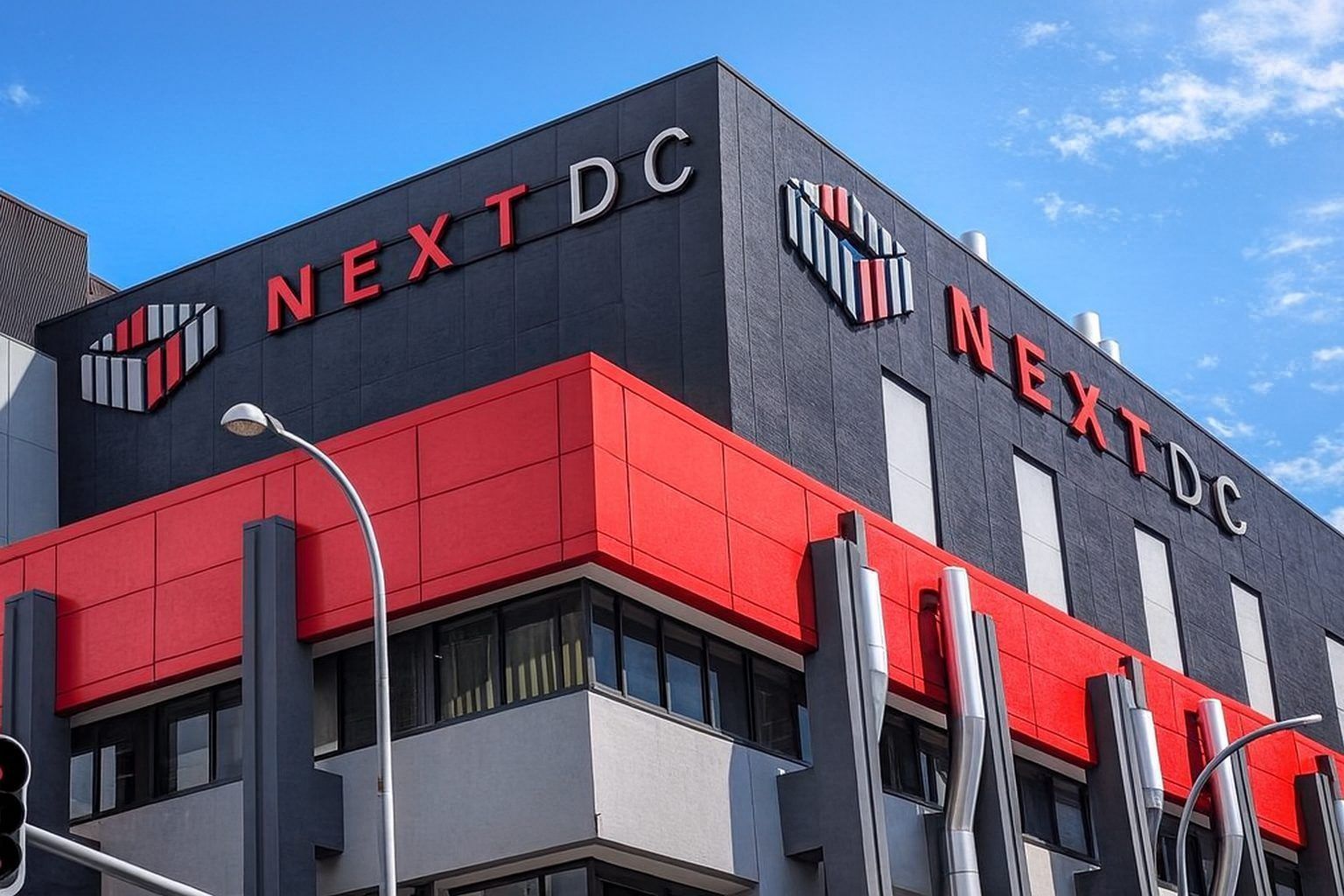
Australia’s biggest listed pure‑play data centre operator, NEXTDC Limited (ASX:NXT), is right in the blast radius of the global AI infrastructure boom – and its latest ASX update has jolted the stock back into focus.
As of 1 December 2025, the company has reported a sharp jump in contracted utilisation, lifted its FY26 capex guidance, locked in multi‑year AI deals, and attracted a wall of bullish analyst price targets – all while short‑term technical indicators are flashing “sell”.
This piece pulls together the most recent news, forecasts and analysis around NEXTDC stock as at 1 December 2025.
NEXTDC share price today: where NXT sits in December 2025
On 1 December 2025, NEXTDC shares are trading at about A$13.79, after closing the previous session at A$13.57. Intraday trading has seen the price move between A$13.79 and A$14.38, with a 52‑week range of A$9.40 to A$18.22. Investing.com
A few key snapshots:
- Market capitalisation: roughly A$8.8–8.9 billion, depending on the intraday price. Investing.com+1
- Earnings per share (trailing 12 months): around ‑A$0.10, reflecting heavy depreciation and interest from its build‑out phase. Investing.com
- YTD price performance: about ‑9.9% in 2025, despite the AI hype around the sector. TipRanks
The immediate catalyst today is the company’s Contracted Utilisation and Capex Guidance Update, released on 30 November and digested by the market on 1 December. The update pushed the stock up almost 5% intraday to around A$14.21 in early trade, according to local coverage, before settling back toward the high‑A$13s. The Motley Fool Australia+1
So: the stock is well below its 2024/early‑2025 highs, but today’s price action shows investors are still very willing to reward genuine contract wins.
Fresh ASX announcement: utilisation jumps 29%, capex guidance lifted
The most important new information for investors landed in NEXTDC’s 30 November 2025 ASX announcement:
- Contracted utilisation (the IT load customers have signed up for) has risen by 71MW, or 29%, to 316MW since 30 June 2025. NEXTDC
- The pro‑forma forward order book (contracted but not yet billing) has increased 53% to 205MW over the same period. NEXTDC
- That forward order book is expected to progressively convert to billings and revenue between FY26 and FY29. NEXTDC
To support those new contracts, NEXTDC has increased FY26 capex guidance by A$400 million:
- New FY26 capex range: A$2.2–2.4 billion
- Old FY26 capex range: A$1.8–2.0 billion NEXTDC
Net revenue and underlying EBITDA guidance for FY26 are unchanged, meaning management is signalling that the new capital spend should be backed by contracted demand rather than speculative build‑it‑and‑hope.
Short version: more concrete AI and cloud deals, and a willingness to pull forward capital to deliver capacity. The trade‑off is obvious – growth visibility improves, but so do execution and funding risks.
From FY25 results to FY26 guidance: a pipeline built for AI
NEXTDC’s latest full‑year numbers (FY25, year to 30 June 2025) give some context for the current growth spurt.
According to the FY25 commentary and subsequent coverage: techpartner.news+1
- Net revenue (excluding power pass‑through) rose 14% to A$350.2 million, an increase of A$42.3m year‑on‑year.
- Underlying EBITDA increased 6% to A$216.7 million.
- On a broader basis, total revenue has been reported at around A$427 million, with EBITDA near A$200 million, but the company remained loss‑making at the statutory level due to depreciation and interest associated with its expansion programme. Datacenter Dynamics+1
Operationally, FY25 was all about scale:
- Contracted utilisation jumped 42% to 244.8MW, a record sales year at the time. techpartner.news
- The forward order book reached 133.9MW, with around 85% expected to bill by FY27, and the rest by FY29. techpartner.news
- NEXTDC commissioned 42.7MW of new built capacity in FY25, with another 121MW under construction at 30 June 2025. techpartner.news
- New edge and regional sites came online, including D1 Darwin and A1 Adelaide, while new developments such as SC2 Sunshine Coast and D2 Darwin were launched to support Google’s Australia Connect subsea cable projects. techpartner.news
For FY26, NEXTDC has guided to:
- Net revenue of A$390–400 million
- Underlying EBITDA of A$230–240 million techpartner.news
That guidance – now backed by a rapidly growing order book and the new utilisation update – underpins the bullish analyst forecasts we’ll get to shortly.
Strategic moves: AI factories, mega‑deals and new governance
1. AI mega‑campus at Fishermans Bend (M4 Melbourne)
In June 2025, NEXTDC announced a A$2 billion commitment to develop M4 Melbourne, an “AI Factory and Technology Campus” at Fishermans Bend in Port Melbourne. NEXTDC
Key features of the project include:
- Up to 150MW of power across ~50,000m² of mission‑critical facilities
- Hyper‑dense, liquid‑cooled infrastructure designed for NVIDIA Blackwell and Rubin‑class GPUs, supporting rack densities beyond 1,000kW
- A Mission Critical Operations Centre built to Tier IV standards for sovereign‑grade workloads
- A Technology Centre of Excellence aimed at AI skills, R&D and innovation onshore in Australia NEXTDC
M4 is essentially a purpose‑built AI campus: high‑density, power‑hungry, and targeted at hyperscale AI training and inference workloads – exactly the kind of customers signing the big multi‑year contracts NEXTDC keeps talking about.
2. 50MW Sharon AI deal in Melbourne
In November 2025, Sharon AI, an Australian “neocloud” provider, signed a 50MW capacity expansion agreement with NEXTDC at its M3 Melbourne data centre. Datacenter Dynamics
- Sharon AI already runs its “Supercluster” at M3 and now plans to expand it to more than 20,000 NVIDIA B‑series or GB300 GPUs, up from about 1,000 GPUs today. Datacenter Dynamics
- The deal is squarely positioned as sovereign AI infrastructure for enterprise, government and research customers in the region. Datacenter Dynamics
This kind of long‑duration, high‑density AI lease is exactly what makes analysts comfortable modelling multi‑year revenue growth even while reported earnings stay thin.
3. Western Sydney 850MW JV platform
To avoid drowning its own balance sheet in concrete and transformers, NEXTDC has moved toward capital‑light joint ventures.
- Advisors have been appointed to create a JV platform to own, develop and operate S4 and S7 in Western Sydney, with NEXTDC retaining a minority stake while still managing and operating the assets. techpartner.news+1
- Those two sites alone are expected to provide more than 850MW of IT capacity. techpartner.news+1
- Reporting suggests the platform could support around A$15 billion of investment over a decade or more, funded by super funds, pension funds and infrastructure capital. Datacenter Dynamics+1
In other words: NEXTDC wants to be paid like an operator and developer, but avoid owning every megawatt of capacity outright.
4. Beefed‑up debt facilities
In June 2025, NEXTDC secured A$2.2 billion of new senior debt facilities maturing in 2030. Once those facilities reach financial close, the company will have total available senior debt of A$5.1 billion, according to its ASX announcement. NEXTDC
Those facilities are explicitly earmarked to fund data centre capex tied to recent customer wins – which now includes the utilisation spike reported on 30 November.
Some external commentary suggests additional banking lines bring the total “funding armoury” closer to A$6.4 billion, underscoring how central leverage is to the investment story. Stockhead
5. Data Centres Australia: new peak body, founding role
In late November, NEXTDC played a founding role in launching Data Centres Australia (DCA), a new national peak body for data centre and AI infrastructure operators. NEXTDC+1
- DCA’s members include AirTrunk, AWS, CDC Data Centres, Microsoft and NEXTDC, plus players like Equinix and Goodman. Cyber Daily
- The body aims to coordinate policy on planning, energy, sustainability, workforce development and sovereign capability, with AI infrastructure at its core. NEXTDC+1
For shareholders, DCA is a reminder that a big part of NEXTDC’s future returns depends on regulation and energy policy, not just engineering.
6. Board strengthened with Jamaludin Ibrahim
In October, NEXTDC announced the appointment of Mr Jamaludin Ibrahim as a non‑executive director, effective 1 November 2025. Antara News
- He brings over 40 years of IT and telecoms experience, including stints as CEO of Axiata Group and Maxis Communications, and currently chairs QSR Brands and AirAsia Aviation Group, while sitting on the board of SEEK Ltd. Antara News
That background is squarely in “large‑scale, capital‑intensive networks” – exactly the kind of expertise you want when you’re planning 850MW campuses and A$2b AI factories.
Analyst forecasts: upside on fundamentals, caution on charts
Fundamental analyst targets
Recent consensus data shows a strongly bullish view from fundamental analysts:
- Investing.com:
- Average 12‑month price target ~A$20.35, with a high of A$28.66 and low of A$17.
- 14 analysts currently rate NEXTDC a “Strong Buy” with no “Sell” ratings. Investing.com
- TradingView (analyst summary):
- Price target A$20.47, with a range from A$16.60 to A$28.66.
- Based on 15 analysts over the last three months, the consensus rating is also “Strong Buy”. TradingView
- Fintel:
- Average one‑year price target A$21.09, implying ~54% upside from a late‑November price around A$13.73.
- Target range: A$18.53 (low) to A$30.09 (high). Fintel
Several brokers have gone on record with particularly punchy targets. For example, a mid‑November piece cited UBS with a price target around A$21.45 – nearly 60% above where the shares were trading after a 25% pullback from their peak. The Motley Fool Australia+1
And earlier in 2025, coverage of Microsoft’s multi‑billion‑dollar Australian data centre plans highlighted NEXTDC as one of the likely local beneficiaries, with major brokers such as Citi and UBS reiterating “Buy” ratings around the A$20 mark. The Australian
In other words: most analysts are comfortable valuing NXT as a long‑duration growth asset rather than on today’s thin earnings.
Technical and quantitative views
The technical and quantitative screens are far less enthusiastic:
- Investing.com’s technical summary currently classifies NEXTDC as a “Strong Sell” on daily indicators, despite the bullish fundamental price targets. Investing.com
- TipRanks shows:
- YTD price performance: about ‑9.95%
- Technical sentiment signal:“Sell”
- Market cap: ~A$8.7 billion
TipRanks
Short‑term chartists are even more sceptical:
- StockInvest notes the stock sits in the lower part of a wide, falling short‑term trend and assigns it a “Sell candidate” rating.
- Their model projects a ~‑18.9% move over the next three months, with a 90% probability that the price ends up between A$10.64 and A$12.56.
- They highlight support around A$13.55, resistance near A$16.14, and above‑average volatility. StockInvest
So you get a neat tension:
- Fundamentals/analysts: “Strong Buy, big upside on multi‑year AI demand”
- Short‑term technicals: “Weak trend, elevated risk, likely to stay choppy or drift lower”
That tension is exactly what makes NXT an active trader’s playground and a long‑term investor’s headache.
Sector backdrop: AI “industrial revolution” and Australian data centre build‑out
It’s not just NEXTDC talking its own book. The broader Australian data centre narrative is intense:
- Stake’s recent sector overview notes that Australian data centre capacity is forecast to more than double from ~1,350MW in 2024 to around 3,100MW by 2030, with over A$26 billion in expected investment. Stake
- An analysis of listed data centre players described operators like NEXTDC as surfing the demand spike of the “AI industrial revolution”, even as their share prices have corrected 15–20% from earlier highs. Stockhead+1
The message: demand for AI‑ready, high‑density, low‑latency infrastructure is real and growing, but investors have started to question how much future growth should be priced in today.
Bull vs bear: how investors are reading NEXTDC
The bull case in a nutshell
Supporters of NEXTDC generally argue:
- Huge, visible demand pipeline
- Contracted utilisation up to 316MW and a 205MW forward order book that should convert to revenue between FY26 and FY29. NEXTDC+1
- Big AI‑driven deals like Sharon AI’s 50MW lease and the emerging AI factory at M4 provide proof that AI workloads are landing in Australia, not just in the US or Europe. NEXTDC+1
- Scarce, strategic infrastructure
- Premium sites in Sydney, Melbourne and other key metros, plus a growing footprint in Darwin, Adelaide and international locations like Kuala Lumpur, Tokyo and Auckland. techpartner.news+1
- Regulatory and sovereign‑capability tailwinds, especially now that Data Centres Australia gives the sector a unified voice. NEXTDC+1
- Funding increasingly de‑risked
- A$5.1 billion in senior debt facilities, with maturities pushed out to 2030. NEXTDC
- The Western Sydney JV model reduces the need for NEXTDC to fund every megawatt on its own balance sheet. techpartner.news+1
- Analyst support and valuation gap
- Consensus price targets in the A$20–21 range imply roughly 45–55% upside from current levels. Investing.com+2Fintel+2
From this perspective, the current share price reflects AI and rate‑fear fatigue, not a deterioration in the underlying business.
The bear (and short‑seller) case
Sceptics, including several prominent short sellers highlighted in Australian press earlier in the year, tend to focus on: The Australian+1
- Valuation vs near‑term earnings
- Even after the pullback, NEXTDC still trades on eye‑watering multiples of current EBITDA and negative statutory earnings.
- Much of the bull case assumes flawless execution converting the order book into high‑margin revenue through to FY29 and beyond.
- Balance sheet and capex risk
- Capex guidance for FY26 alone is A$2.2–2.4 billion, on top of a multi‑year build‑out and existing leverage. NEXTDC+1
- While JVs and debt facilities help, any stumble in utilisation, energy costs, or construction timelines could pressure returns.
- Competition and customer power
- Australia’s data centre scene now includes global and local heavyweights like CDC Data Centres, Equinix, AirTrunk and Goodman, plus hyperscalers building their own capacity. AFR+1
- Large cloud and AI customers often have significant bargaining power on pricing and contract terms.
- Macro and regulatory uncertainty
- AI data centres are highly exposed to power prices, grid constraints and environmental regulation, areas where policy can shift faster than concrete cures.
- If the AI build‑out slows globally or is seen as a bubble, data centre valuations could de‑rate sharply – some industry commentary is already openly debating this risk. DataX Connect+1
Put crudely: bulls think NEXTDC is building the digital railways of the next decade; bears think it might be overpaying for tracks at the top of an AI cycle.
Key risks to watch into 2026
For anyone following NXT closely, the main 2026 watch‑list looks something like this:
- Execution on mega‑projects
- Timelines and budgets for S3, S4, S5, M4 and KL1 will matter as much as the headline megawatt numbers. techpartner.news+1
- Conversion of order book
- Investors will want to see the 205MW forward order book steadily convert into billed utilisation at decent margins, not just headline announcements. NEXTDC+1
- Funding mix and dilution
- Further JVs, asset sell‑downs or potential equity raisings could change the risk/reward profile for existing shareholders. techpartner.news+1
- Regulatory and energy environment
- How quickly DCA can influence planning approvals, energy policy and sustainability standards will have a real impact on the economics of large‑scale AI facilities. NEXTDC+1
- Macro rates and tech sentiment
- Higher‑for‑longer interest rates raise the hurdle rate for all long‑duration infrastructure plays.
- A change in global sentiment toward AI capex – positive or negative – will flow directly into how markets price NXT.
Bottom line: what 1 December 2025 really tells us about NEXTDC stock
As of 1 December 2025, the NEXTDC investment story is unusually clear and unusually binary:
- On the one hand, the company has:
- Rapidly rising contracted utilisation (316MW) and a ballooning order book (205MW). NEXTDC
- Big, named AI tenants like Sharon AI scaling sovereign GPU clusters on its platform. Datacenter Dynamics
- A structural tailwind from AI and cloud, reinforced by national‑level coordination via Data Centres Australia. NEXTDC+1
- An analyst community almost uniformly calling the stock a “Strong Buy” with double‑digit percentage upside over 12 months. Investing.com+2TradingView+2
- On the other hand, shareholders are being asked to underwrite:
At today’s price, the market seems to be placing NEXTDC somewhere between “AI infrastructure royalty” and “highly levered special situation”. Whether that looks attractive depends less on the next three months of price action – which technical models currently treat with suspicion – and more on your conviction that AI and cloud workloads in Australia will keep compounding through the back half of the decade.
Either way, NXT has firmly established itself as one of the purest listed plays on Australia’s attempt to become an AI infrastructure hub. For investors, that makes it a stock to understand in detail, even if the eventual decision is to watch from a safe distance.