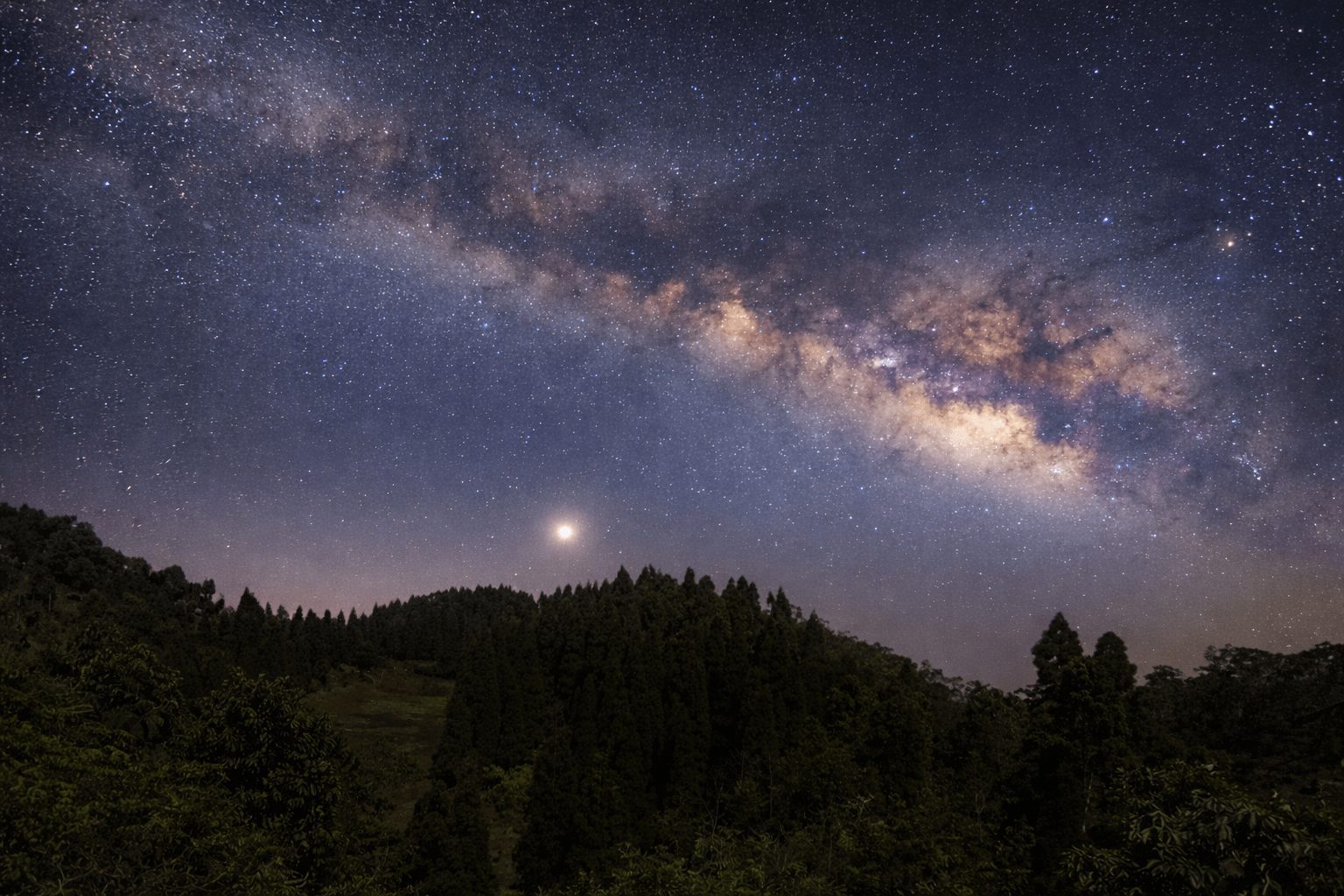

Dec. 23, 2025 — Tonight’s sky is doing that classic winter trick: it gets dark early, stays dark long, and then quietly hands you a few genuinely photogenic targets as a reward for being a warm-blooded mammal who chose to go outside anyway.
The main storylines in Night Sky Today (December 23, 2025) are straightforward and very worth your time: a thin waxing crescent Moon with “earthshine” shortly after sunset, a NOAA-backed aurora chance that could push the northern lights into parts of the U.S., and the Ursid meteor shower still ticking through its final nights of the year. American Meteor Society+3Space+3Space+3
Northern lights alert: A minor geomagnetic storm could light up 10 U.S. states tonight
If you live far enough north (or you’re traveling for the holidays and happen to be in the right place), tonight comes with an aurora watch.
Space-weather forecasters are tracking fast solar wind from an Earth-facing coronal hole, a setup that can rattle Earth’s magnetic field just enough to trigger G1 (minor) geomagnetic storm conditions. That matters because even a “minor” storm can produce visible aurora if your skies are dark and clear—and if the magnetic field’s mood swings cooperate. Space+1
Where auroras may be visible tonight
Based on NOAA’s aurora viewline forecast (as summarized in Space.com’s Dec. 23 report), these 10 states appear fully or partially above the aurora viewline tonight:
- Alaska
- Washington
- North Dakota
- Minnesota
- Montana
- Maine
- Michigan
- Wisconsin
- South Dakota
- Idaho Space
That list is forecast-based, not a promise. Aurora visibility can expand southward if conditions intensify—or fizzle into nothing if key solar-wind ingredients don’t line up.
Best timing (and why it’s so annoying)
NOAA’s official 3‑day forecast issued early Dec. 23 (UTC) flags the strongest expected geomagnetic windows today at Kp 4.67 (G1). In plain language: minor storm potential is on the table, particularly around 21:00–00:00 UTC and 03:00–06:00 UTC (convert those to your local time).
Space.com highlights one especially watch-worthy block as 4 p.m.–7 p.m. EST (21:00–00:00 UTC).
Quick, practical aurora tactics (no mysticism required)
To give yourself the best shot:
- Go darker than you think you need to. Streetlights and “cute holiday lighting” are aurora kryptonite.
- Face north with a clear view of the horizon.
- Use your phone camera as a cheat code: phones often pick up faint green glow before your eyes do.
- Dress like you’re negotiating with winter, not visiting it. The aurora’s favorite hobby is showing up five minutes after you give up.
Moonwatch: The delicate crescent Moon (and the sneaky glow of Earthshine)
The easiest “wow” object tonight is also the simplest: the Moon.
Just after sunset, look toward the southwestern sky for a waxing crescent Moon around 14% illuminated. It sits in Capricornus and pairs beautifully with Fomalhaut nearby—an easy guide star for casual skywatchers and a great framing target for wide‑angle photos.
Sky & Telescope notes that at nightfall the crescent Moon hangs between Fomalhaut (to the Moon’s left) and Altair (to the Moon’s right)—a handy “triangle of bright things” to get your bearings fast. Sky & Telescope+1
The bonus feature: Earthshine
If you’ve never noticed earthshine, tonight is a friendly night to try. Earthshine is the soft glow on the Moon’s night side, caused by sunlight reflecting off Earth (clouds, oceans, land) and faintly illuminating the lunar surface.
The trick is timing: look soon after sunset, while the sky is darkening but the Moon is still low and the bright part isn’t blowing out your night vision.
Meteor watch: The Ursids are still active through Dec. 26
The Ursids are the “last call” meteor shower of the year: smaller than the Geminids, often overlooked, sometimes surprisingly good—and perfectly placed on the calendar for people who are already outside at night dealing with holiday chaos.
According to the American Meteor Society, the Ursids are active from Dec. 17 to Dec. 26, 2025, with peak activity having occurred on Dec. 21–22. That means Dec. 23 is still inside the active window, so you can still catch Ursid meteors tonight—just expect fewer than peak night.
What to expect tonight
- Typical rates near peak are often about 5–10 meteors per hour under dark skies (with occasional stronger bursts reported in some years).
- The radiant is near Ursa Minor (the Little Dipper), making this largely a Northern Hemisphere show.
- Moonlight impact is low this year: AMS notes a thin crescent Moon around peak that doesn’t significantly interfere with viewing.
How to watch the Ursids without overcomplicating it
- Find the darkest patch of sky you can (light pollution matters more than gear).
- Give your eyes 20–30 minutes to adapt.
- Watch for at least 30–60 minutes—meteors come in clumps.
Planets tonight: Jupiter rules late, Saturn shines early (and three planets play hide-and-seek with the Sun)
If your goal is “planets I can actually see with my own human eyeballs,” tonight is basically a two‑planet headline for many locations:
- Saturn is best after sunset in the early evening.
- Jupiter is visible for much of the night (often improving later into the evening and toward morning, depending on location).
Meanwhile, Mercury, Venus, and Mars are all very close to the Sun right now for many observers, making them difficult to spot safely (and in some cases essentially unobservable without specialized timing and a wide-open horizon). A location-based sky guide like Timeanddate’s nightly map shows Mercury and Venus as “close to the Sun” and Mars as extremely difficult in typical mid‑latitude viewing scenarios. Time and Date
And if you have binoculars (or a small telescope) and a decent sky:
- Uranus is often an “average visibility / binocular target” kind of object.
- Neptune is typically much tougher and easily washed out by haze or light pollution.
Winter-sky bonuses: Andromeda overhead, the “dog stars” rising, and a stubborn Summer Triangle cameo
Even if you ignore the Moon, meteors, aurora, and planets, the winter starfield itself is the real luxury item.
Andromeda is well-placed this week
Sky & Telescope flags this week as prime time for the Andromeda Galaxy (M31) in mid‑northern latitudes—crossing near the zenith after dark for many observers. Binoculars are enough to see it as a small, elongated gray haze from a reasonably dark site.
Procyon and Sirius are climbing into the evening
A nightly sky note from the Fairbanks Museum & Planetarium highlights Procyon rising in the evening, followed by Sirius—the brightest star in the night sky—soon after (timing varies by location, but the general sequence holds as winter constellations take the stage).
The Summer Triangle is still hanging around (briefly)
Yes, it’s winter. No, the sky didn’t get the memo. The Fairbanks Museum also notes that the Summer Triangle can still be visible in the western sky in the earlier evening—an “out-of-season” pattern that lingers before it finally exits the nightly show. Fairbanks Museum & Planetarium
Why mornings are still getting darker: the “latest sunrise” effect after the solstice
A fun seasonal paradox: even though the winter solstice has passed and daylight is slowly returning, many places in the Northern Hemisphere don’t get their latest sunrises until late December and early January.
EarthSky’s Dec. 23 explainer highlights this timing quirk, which matters for stargazers because it can keep pre-dawn observing windows darker for a little longer—useful if you’re chasing meteors, planets, or just quiet time under the sky.
The bottom line for Night Sky Today (Dec. 23, 2025)
If you only do one thing tonight: step outside just after sunset and catch the thin crescent Moon (and try for earthshine).
If you do two things: add an aurora check if you’re in (or near) the northern tier of the U.S.—and keep one eye on NOAA’s geomagnetic forecast windows.
If you do three things: stay out longer and let the Ursids surprise you, because meteor showers are basically the universe’s way of rewarding patience with brief, silent fireworks.