
New York, April 27, 2026, 15:04 EDT
Nvidia climbed once more on Monday afternoon, lifting its market cap to roughly $5.27 trillion after Friday’s record finish nudged the stock back above $5 trillion. Shares hovered around $215, up 3.3%, as traders continued snapping up the heavyweight in AI chips.
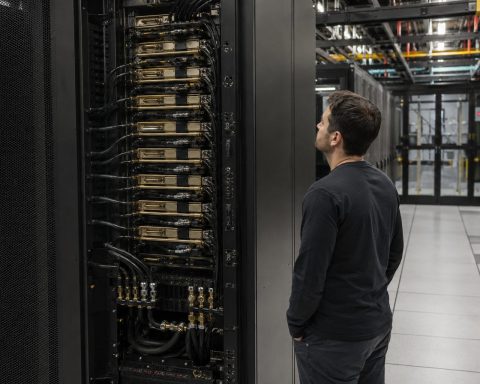
This shift comes right ahead of a packed earnings stretch for tech’s heavyweight spenders on AI infrastructure. Amazon, Alphabet, Meta, Apple, and Microsoft all have results on deck. Investors will be parsing every detail on capex—think data centers, servers, chips—to gauge just how strong Nvidia demand really is.
Friday snapped the stock’s long rut. Nvidia jumped 4.3% to $208.26—hitting a fresh record for the first time since October, Bloomberg said. Shares had been stuck in a range most of the past year and, just four weeks ago, were still down 20% from their Oct. 29 closing high.
Nvidia wasn’t the only name moving. Intel’s beefier numbers put a charge into chip stocks across the board: Nvidia ended Friday at $208.27, up 4.32%, while Advanced Micro Devices surged 13.90% and Intel shot up 23.64%, per market coverage. Alphabet continues to push on its in-house AI chips, a threat hanging over Nvidia since custom silicon could cut its hardware out of the loop.
Intel posted a 7% bump in first-quarter revenue, hitting $13.6 billion, with non-GAAP earnings landing at 29 cents a share. Looking ahead, the chipmaker projected second-quarter revenue between $13.8 billion and $14.8 billion—guidance investors read as evidence that the broader semiconductor recovery could be gaining traction.
Bulls haven’t lost their ammunition: Nvidia posted fiscal 2026 revenue of $215.9 billion, a 65% jump. Fourth-quarter numbers came in at $68.1 billion. Data-center revenue, covering AI-focused chips and gear, surged 75% from a year ago to $62.3 billion for the quarter.
“Investors will be listening for more visibility into long-term growth with these big names,” said Tim Ghriskey, senior portfolio strategist at Ingalls & Snyder in New York, speaking to Reuters about the megacaps reporting this week. The immediate hurdle isn’t just enthusiasm around AI—it’s about whether spending levels stay high enough to support Nvidia’s valuation. Reuters
The risks aren’t just hypothetical anymore. Beth Kindig, the lead tech analyst at I/O Fund, says her $20 trillion call on Nvidia still stands. Even so, her allocation for 2026 is dialed back; she expects a bigger payoff might not show up until 2028 or even 2030. Kindig highlights inference—the real-world use of AI models—as a spot where Nvidia’s CUDA software edge could shrink, and custom silicon is starting to look like a bigger competitor. There’s also some noise about Rubin, Nvidia’s next-generation AI chip, with questions swirling around its reliance on HBM4—this new high-bandwidth memory standard that’s key for advanced AI processors. “The debate,” Kindig wrote, is whether Nvidia’s returns still stack up to other AI plays. IO Fund
Power is starting to look like just another input in the trade. Last week, Oklo announced plans to team up with Nvidia and Los Alamos National Laboratory, targeting nuclear-fuel validation and nuclear-driven AI factories—a mix of advanced reactors, AI tech, and lab know-how. “Reactor deployment, high-performance compute, and world-class fuel and materials science expertise” now intersect, Oklo CEO Jacob DeWitte said in a statement. Oklo
Right now, investors are betting Nvidia stays the go-to name for AI chips. But the next signal won’t come from Nvidia, it’ll show up in spending plans from its top customers. Should the big cloud players keep boosting their data-center budgets, that $5 trillion figure could start to look more like a stepping stone than a limit. But if those budgets start shrinking, Nvidia’s latest high is going to have a lot more to prove.
Related articles: NASDAQ:NVDA





![Australia Stock Market Today 26/08/2026 [UPDATE: 11:43 AEST] [Headline CPI Cools as Sticky Core Tests ASX Gains]](https://ts2.tech/wp-content/uploads/2026/08/AU-market-dashboard-2026-08-26-1143-480x384.jpg "Australia Stock Market Today 26/08/2026 [UPDATE: 11:43 AEST] [Headline CPI Cools as Sticky Core Tests ASX Gains]")