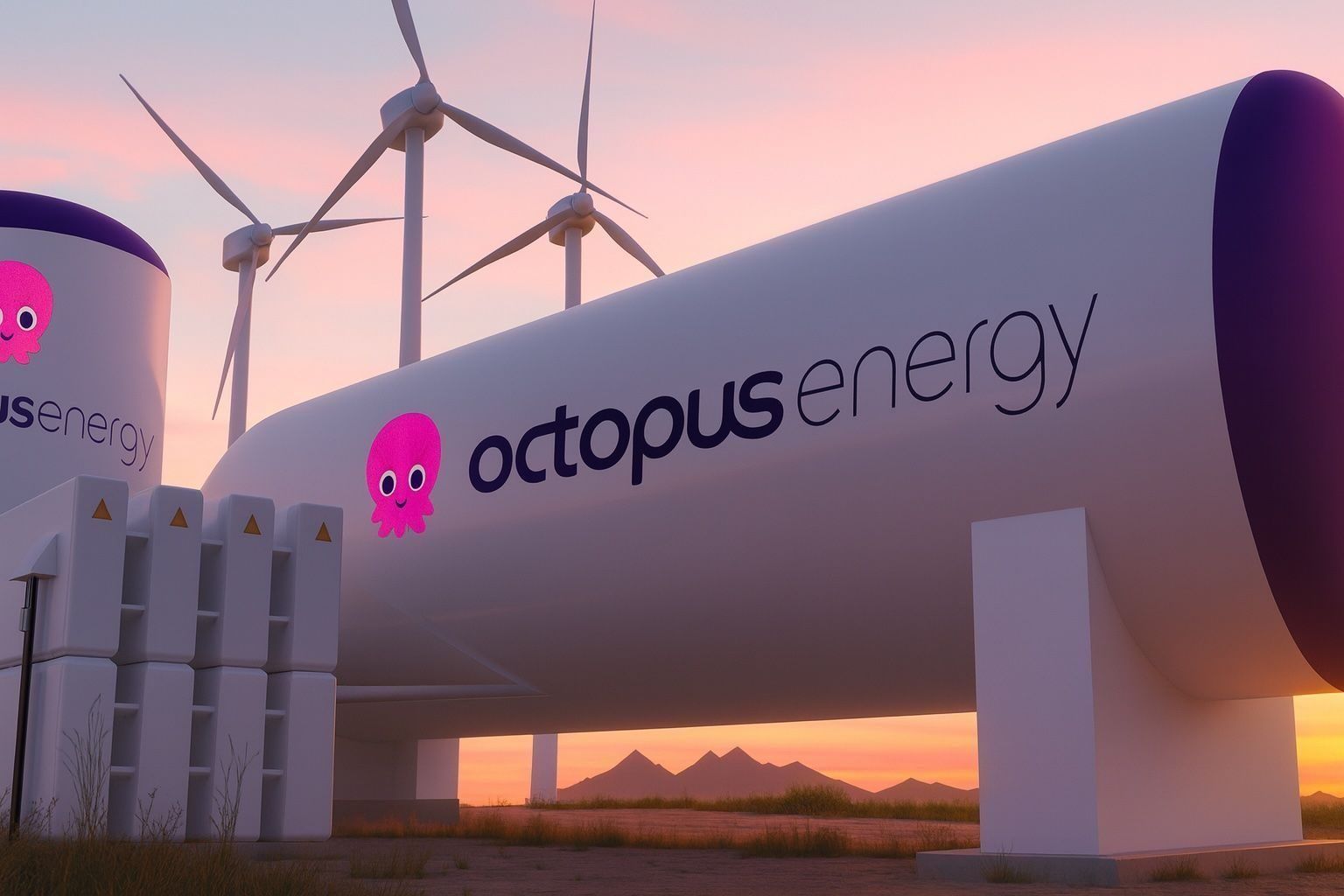
As of 9 December 2025, “Octopus Energy stock” is one of the most searched clean‑energy investing terms in the UK – but it’s also one of the most misunderstood.
Octopus Energy Group itself is still privately owned. The listed security most people are actually trading is Octopus Renewables Infrastructure Trust plc (LON: ORIT), an investment trust managed by Octopus Energy Generation, part of Octopus Energy Group. Octopus Renewables Infrastructure+1
At the same time, Octopus’s software arm Kraken is being spun off, with a fresh funding round targeting a valuation of around $15 billion and talk of an IPO within the next year. Octopus Energy+2Bloomberg+2
Below, we break down what’s really going on with Octopus Energy, ORIT’s share price and dividend, Kraken’s planned listing, and how analysts currently see the stock.
1. Is There Actually an “Octopus Energy Stock”?
Short answer: not directly.
- Octopus Energy Group – the retail, generation and tech business – is a private company, majority‑owned by its founders and institutional investors such as Generation Investment Management, Origin Energy, Tokyo Gas and CPP Investments. ION Analytics+1
- In 2022, Octopus Group demerged Octopus Energy into a separate structure and now holds a 32% stake in the energy business via OE Holdco Limited. Octopus Group
The public market proxy is:
Octopus Renewables Infrastructure Trust plc (ORIT, often branded as “Octopus Energy” on quote sites) – a London‑listed, closed‑ended fund investing in renewable projects across the UK, Europe and Australia. Its investment manager is Octopus Energy Generation, part of Octopus Energy Group. Wikipedia+1
So when you see “Octopus Energy (ORIT)” quoted on platforms, you are usually looking at ORIT, not shares in Octopus Energy’s retail or Kraken tech business.
2. ORIT Share Price on 9 December 2025
On 9 December 2025, Octopus Renewables Infrastructure Trust (LON: ORIT):
- Traded around: 59.2p per share, with an intraday range roughly 58.9–59.37p. Investing.com UK+1
- 52‑week range: about 54p (low) to 76.6p (high). Share Prices+1
- Market capitalisation: roughly £310–£330 million, depending on the data provider and exact time of quote. Fidelity International+1
- Latest reported NAV per share: 98.46p as at 30 September 2025 (cum‑income basis). FT Markets+1
That means ORIT currently trades at around a 40% discount to its latest net asset value – an unusually wide gap for a diversified renewables trust.
Analyst commentary from Kepler Trust Intelligence and QuotedData notes that ORIT’s dividend yield, when compared with UK 10‑year government bonds, is near record spread levels, reflecting both interest‑rate headwinds and investor nervousness about UK renewables policy. The AIC+1
3. Dividends, Yield and the “ORIT 2030” Strategy
ORIT is positioned as an income‑focused renewable energy trust. Recent numbers:
- Q3 2025 dividend: 1.54p per share, paid on 28 November 2025. FT Markets+1
- 2025 dividend target: 6.17p per share for the full year. Octopus Renewables Infrastructure
- Indicative yield: based on the 6.17p target and a ~59p share price, the forward yield is around 10%, broadly in line with the 9.9–10.3% figures quoted on ORIT’s site and major data providers. Octopus Renewables Infrastructure+2Hargrea…
In its H1 2025 results, ORIT reported:
- NAV per share down from 102.6p at 31 December 2024 to 99.5p at 30 June 2025.
- NAV total return of ‑0.2% for H1 2025 (vs +2.0% in H1 2024), largely due to lower long‑term power price forecasts and higher discount rates. Investegate+1
- Around 85% of revenue fixed over the next two years, providing some insulation from wholesale price swings. TipRanks+1
Alongside those results, the board launched “ORIT 2030”, a five‑year roadmap aiming to:
- Grow NAV to around £1 billion by 2030,
- Deliver 9–11% medium‑ to long‑term total returns, combining income and capital growth,
- Increase exposure to higher‑return construction assets to about 20% of the portfolio, while keeping long‑term gearing below 40%. The AIC+2The AIC+2
For income investors, the key takeaway is that ORIT is explicitly targeting a high single‑digit to low double‑digit total return, with dividends forming the bulk of that profile.
4. Q3 2025 NAV Update: Share Buybacks and Power‑Price Headwinds
The Q3 2025 Net Asset Value statement provides more colour on what’s happening under the bonnet:
- NAV at 30 Sept 2025: £523.4m, or 98.46p per share, down from 99.46p at 30 June. FT Markets
- Drivers of the 1p drop in NAV per share:
- Power prices & green certificates: –1.42p, driven by more conservative long‑term assumptions for renewable subsidies.
- Macroeconomic factors: +0.65p, helped by FX and inflation.
- Share buybacks: +0.64p (accretive uplift).
- Dividend payment: –1.52p. FT Markets
Over Q3, ORIT:
- Repurchased 11.8m shares for about £8.2m at an average 69.4p, part of a £30m buyback programme launched in 2024. FT Markets
- Reported 86% of forecast revenue over the next 24 months fixed or contracted, up from 85% at June – a key statistic for income‑oriented investors. FT Markets+1
- Had gearing of 47.8% of Gross Asset Value, with a stated plan to reduce that below 40% by year‑end 2025 via amortising project debt and asset recycling. FT Markets+1
In other words, ORIT is actively using buybacks and long‑term contracts to support per‑share returns, even as headline NAV inches lower.
5. Policy Risk: UK Subsidy Indexation Consultation
One of the biggest near‑term overhangs is the UK government’s consultation on changing how certain renewable subsidies are indexed to inflation.
A November 2025 note from QuotedData summarised ORIT’s own estimates:
- Less than 30% of ORIT’s revenue over each of the next five years comes from UK Renewables Obligation (RO) assets, and it has no exposure to FIT (feed‑in tariffs).
- A simple move from RPI to CPI indexation from 2026 would reduce NAV by about 1.1p per share.
- A more radical option involving a temporary freeze in RO buyout prices followed by CPI indexation could hit NAV by up to 3.9p per share. QuotedData
QuotedData also highlighted that:
- ORIT’s shares were trading on a roughly 42% discount to NAV and an 11% yield,
- Total shareholder returns (including dividends) have fallen about 34% over three years, as the whole infrastructure‑fund sector derated in response to higher interest rates. QuotedData
This is the backdrop to today’s wide discount: investors are demanding a hefty risk premium for policy uncertainty and higher bond yields.
6. The Wider UK Energy Backdrop: Bills, Tariffs and Regulation
Two broader stories are shaping sentiment around UK energy names, including anything carrying the Octopus brand:
- Grid upgrade costs and energy bills
- Ofgem has approved around £28 billion in upgrades to Britain’s gas and electricity networks over the next five years, part of a much larger programme that could add roughly £116 a year to household energy bills by 2030. The Guardian+1
- While the regulator argues this investment should ultimately reduce system costs, it feeds political pressure around profit levels for energy companies.
- Octopus tariff changes for EV drivers
- In early December, multiple outlets reported that Octopus is tightening rules on its popular Intelligent Go EV tariff, limiting cheap off‑peak charging to six hours a day from January 2026. For owners of larger‑battery EVs needing more time, the shift could add hundreds of pounds a year to charging costs. The Sun
Neither development directly alters ORIT’s existing contracted revenues, but they influence public and political attitudes to energy suppliers and the sector’s long‑term regulatory risk.
7. Octopus Energy Group: Private Valuation and Equity Raise
Away from ORIT, Octopus Energy Group has been expanding aggressively:
- As of September 2025, Octopus said it serves over 7.7 million UK households and around 2.8 million customers overseas, operating in 27 countries with a £7 billion renewables portfolio and growing businesses in EV leasing, heat pumps and rooftop solar. Octopus Energy+1
- An October 2025 Octopus Group report states that Octopus Energy has raised more than £2 billion of external capital since 2015 and is now backed by a roster of global pension funds and energy majors. Octopus Group+1
In May 2025, infrastructure news service Infralogic reported that Octopus Energy:
- Was seeking up to £500m in fresh equity,
- Had hired KPMG to run the process,
- Was building on a 2024 funding round that lifted the company’s valuation to around $9 billion,
- Reported £12.4bn in revenue and £136m in EBITDA for 2024. ION Analytics
Separate reporting from Reuters and the Financial Times suggests current internal estimates imply an overall group enterprise value around $15bn, especially once Kraken is fully carved out. Reuters+1
For now, though, none of this is in a listed vehicle: ordinary investors can’t yet buy Octopus Energy Group shares on a stock exchange.
8. Kraken Spin‑Off: Preparing for a $15 Billion IPO
The biggest single catalyst tied to the Octopus name right now is the planned spin‑off and funding round for Kraken, the company’s AI‑driven utility software platform.
Recent milestones:
- September 2025: Octopus Energy Group formally announced that Kraken would be spun off into a standalone company, with Tim Wan (ex‑Asana CFO) joining as CFO. Kraken’s platform now manages 70+ million energy accounts worldwide and has reached $500m in contracted annual licensing revenue. Octopus Energy+1
- September–October 2025: Reports from the Wall Street Journal, Morningstar and others said the spin‑off could create a $15bn software platform, with a potential IPO “within the next year”. The Wall Street Journal+2Morningstar+2
- 4 December 2025: Bloomberg reported that Kraken has opened a funding round to raise about $500m, targeting a valuation “of about $15bn”, according to people familiar with the talks. Bloomberg+1
- 9 December 2025 update: Tech Buzz and other tech outlets reiterated that Kraken’s IPO could arrive within 12 months, calling it one of the most significant vertical‑AI listings in the utility space. The Tech Buzz+1
A recent Financial Times piece noted that UBS values Kraken at around $9bn of Octopus’s estimated $15bn enterprise value, underlining how central the software unit has become to the group’s equity story. Financial Times
From an investor’s perspective, Kraken’s spin‑off matters because:
- It crystallises value for existing Octopus shareholders (mainly institutions and insiders today).
- A future IPO – likely in London, New York, or dual‑listed – would finally create a direct way to buy into Octopus’s technology business.
However, structure, timing and listing venue are all still subject to change.
9. Analyst Views and Forecasts on ORIT
Different data providers paint a nuanced picture of ORIT’s risk‑reward profile:
- TipRanks:
- Reports that the latest human analyst rating on ORIT is “Hold” with a 85p price target, implying upside from current levels.
- Its AI‑driven “Spark” model, however, scores ORIT as an “Outperform” based on balance‑sheet strength, buybacks and dividend policy, while flagging declining revenue as a concern. TipRanks
- Kepler Trust Intelligence / AIC:
- Emphasise ORIT 2030’s ambition for 9–11% total returns and a £1bn NAV,
- Note that the trust’s yield is unusually high versus gilts, but warn that higher discount rates and lower power price forecasts will continue to pressure valuations. The AIC+1
- Investing.com technicals:
- Currently label ORIT as a “Strong Sell” on a technical‑analysis basis, reflecting downward price momentum despite fundamental yield attractions. Investing.com UK
Forecasts like these are not guarantees. They show that while the income case is strong, the market is still wary of policy, power‑price and interest‑rate risk.
10. How Can Investors Get Exposure to Octopus Energy Today?
Right now, public‑market investors have three main routes to Octopus‑related exposure:
- ORIT shares (LON: ORIT)
- Direct stake in a diversified renewables infrastructure portfolio managed by Octopus Energy Generation.
- Offers around a 10% dividend yield and trades on a deep discount to NAV, but is highly sensitive to discount‑rate moves and UK policy decisions. Octopus Renewables Infrastructure+2QuotedD…
- Funds or trusts that hold ORIT or Octopus‑managed infrastructure
- Multi‑asset income funds, ESG funds or infrastructure investment trusts may hold ORIT or projects managed by Octopus. You’d need to check individual fund factsheets for exact weightings.
- Potential future Kraken IPO or Octopus Energy listing
- If Kraken follows through with a public float, that will likely be the first pure‑play way to buy into the Octopus technology story.
- Separate speculation persists that Octopus Energy’s core retail and generation business could consider a listing in the longer term, especially if Kraken establishes a high standalone valuation, but nothing concrete has been announced. Reuters+2Financial Times+2
For now, anyone buying “Octopus Energy stock” through a broker is almost certainly buying ORIT, not the private Octopus Energy Group.
Important: None of this is personal investment advice. Yields, discounts and prices move quickly, and any decision to buy or sell should be based on your own research, risk tolerance and (ideally) professional advice.
11. Quick FAQs About Octopus Energy Stock (December 2025)
Is Octopus Energy itself listed on a stock exchange?
No. Octopus Energy Group is privately held. The listed vehicle most closely associated with it is Octopus Renewables Infrastructure Trust (LON: ORIT), whose manager is Octopus Energy Generation. Octopus Renewables Infrastructure+1
What is the Octopus Energy (ORIT) share price today?
On 9 December 2025, ORIT was trading around 59p per share, within a 52‑week range of roughly 54–76.6p. Investing.com UK+1
How high is ORIT’s dividend yield?
Based on its 2025 dividend target of 6.17p per share and the current share price, ORIT yields around 10%, with the trust itself quoting a roughly 9.9% yield as of 30 September 2025. Octopus Renewables Infrastructure+1
Why is ORIT trading at such a big discount to NAV?
The discount of about 40% reflects a mix of higher interest rates, concerns over UK renewables policy (especially subsidy indexation), and sector‑wide derating of infrastructure funds, despite relatively stable contracted revenues. FT Markets+2QuotedData+2
When can I buy Kraken or Octopus Energy shares directly?
Kraken is being spun off and is currently raising capital at a targeted $15bn valuation, with an IPO widely reported as possible within the next year. Octopus Energy itself has not confirmed any listing plans. Bloomberg+2The Tech Buzz+2
If you’re tracking Octopus Energy stock for 2025 and beyond, the story now has two distinct legs:
- ORIT, an income‑heavy renewables trust on a wide discount, and
- Kraken, a fast‑growing AI platform heading towards a potential blockbuster IPO.
How those two pieces ultimately come together – and how UK energy policy evolves – will likely determine whether today’s high yields and big discounts turn into long‑term opportunity or a value trap.