
SAN FRANCISCO, May 4, 2026, 13:05 PDT
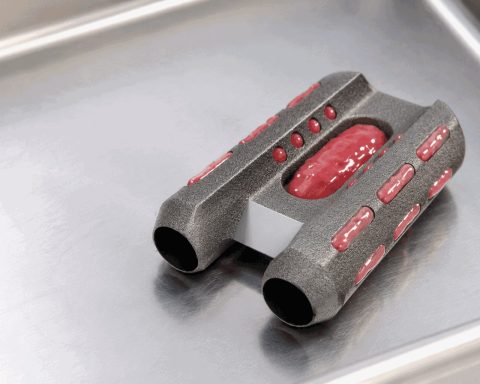
- Ouster claims its Rev8 lidar sensor is capable of capturing both 3D depth data and color imagery in a single device.
- Shares jumped roughly 8% in late Nasdaq action, with first-quarter results expected Tuesday.
- The company said Google, Volvo Autonomous Solutions, and several other customers plan to use its Rev8 sensors.
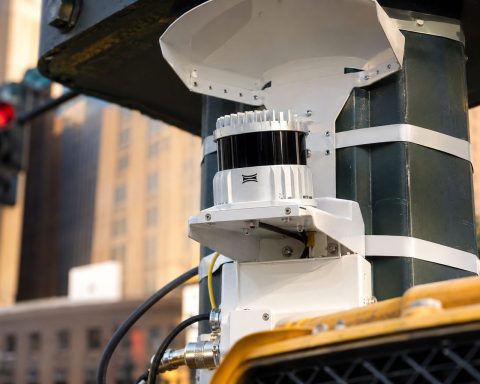
Shares of Ouster Inc. jumped Monday as the San Francisco-based firm introduced Rev8, its latest lineup of digital lidar sensors. The company claims these sensors bring native color capabilities to laser 3D sensing technology. Lidar—light detection and ranging—relies on laser pulses to capture spatial data for vehicles, robots, and machines.
Timing is in focus here. Ouster drops its first-quarter numbers after Tuesday’s close, with investors tracking if orders for its sensors—key in robots, traffic control and self-driving tech—are actually scaling up beyond trials. The earnings call kicks off at 5 p.m. ET on May 5.
Ouster says its Rev8 sensor merges color and depth data natively—no need for customers to cobble info together from a camera plus a lidar unit. The company is touting this as the world’s first patented native color lidar system, but that label faces a real-world test as customers begin rollouts beyond lab conditions.
“The goal is to obviate cameras,” Chief Executive Angus Pacala told TechCrunch. His pitch: one sensor ought to do the work of both, targeting robotics and autonomous-driving teams juggling extra costs and labor calibrating multiple streams. TechCrunch
Ouster claims its new OS1 Max sensor delivers twice the range and resolution compared to the Rev7 line. According to the company, the device can spot objects up to 200 meters away at 10% reflectivity, and stretches to a maximum 500-meter detection range, with a 45-degree field of view.
In the company’s statement, Pacala called Rev8 “foundational technology” that’s meant to help customers shift “from prototype to commercial production at scale.” According to the company, Rev8 sensors can be ordered immediately, with shipments set to go out this quarter. Ouster, Inc.
Ouster listed Google, Volvo Autonomous Solutions, Liebherr, Epiroc, Field AI, Flyability, Skydio, PlusAI and others among the “dozens of customers” across industrial, robotics, automotive and smart-infrastructure sectors that plan to use its Rev8 product. Still, “intend to adopt” leaves room for interpretation—these aren’t confirmed sales. Ouster, Inc.
The stock was last seen at $28.55, a gain of $2.10, or 7.9%, versus its previous close. Earlier in the session, it hit an intraday high of $30.94. Roughly 5.36 million shares changed hands, putting the company’s market cap around $1.65 billion.
The launch comes on the heels of a stronger close to 2025. Ouster posted fourth-quarter revenue at $62 million, a jump of 107% year over year, with roughly $21 million coming mainly from one-off royalties, and shipped upwards of 8,100 lidar sensors. Looking ahead, the company expects first-quarter 2026 revenue between $45 million and $48 million, a figure that factors in about seven weeks of Stereolabs operations.
The field isn’t getting any easier. As TechCrunch points out, lidar makers have seen multiple rounds of consolidation—Ouster’s takeover of Velodyne, and, more recently, the Luminar asset buyout after bankruptcy. Hesai, for its part, rolled out a color lidar platform, and Innoviz has its own spin on color lidar too. That keeps the heat on Ouster to prove its same-chip strategy does something tangible for customers.
Execution remains the sticking point. Ouster flagged a host of uncertainties clouding its projections—ranging from competitors and market adoption of lidar to the risk of contracts getting nixed or pushed back, headaches in quality control, supplier reliance, tariffs, and the tangle of trade rules. For Rev8, what matters next isn’t the headline, but whether certified production, pricing, and ongoing orders actually materialize.
On Tuesday, investors get the tougher call: is Ouster’s latest revenue bump, plus that Rev8 buzz, actually translating into a business with staying power—or is the stock just outpacing what the next numbers can support?