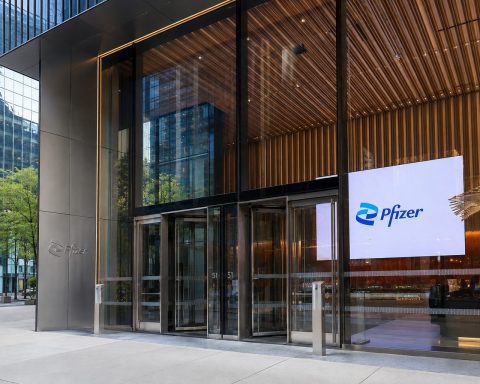

Pfizer Inc. NYSE:PFE heads into Christmas Day with investors digesting a dense run of December headlines: a 2026 outlook that came in below Wall Street expectations, ongoing restructuring and cost-cutting, fresh U.S. drug-pricing initiatives that could reshape the industry’s economics, and multiple pipeline updates spanning oncology, immunology and cardiometabolic disease.
U.S. markets are closed on Thursday, Dec. 25, 2025, but Pfizer shares last traded on Wednesday, Dec. 24 at $25.03, after moving between $24.90 and $25.14 intraday, according to the latest available pricing data.
Below is a detailed look at the current news, forward guidance, and sell-side forecasts shaping the near-term narrative around Pfizer stock as of 25.12.2025.
Where Pfizer stock stands right now
Pfizer’s stock remains in the mid-$20s, a level that underscores the market’s “show me” stance after the post-pandemic reset in COVID-era revenue streams and the company’s efforts to rebuild durable growth through pipeline execution, acquisitions, and cost discipline.
One reason PFE continues to attract attention from income-focused investors is its dividend: Pfizer’s board declared a $0.43 per share quarterly dividend for Q1 2026, payable March 6, 2026, to shareholders of record on January 23, 2026—the company’s 349th consecutive quarterly dividend.
At a $25-ish share price and a $1.72 annualized dividend (0.43 × 4), that implies a dividend yield near the high-6% range—though yields move daily with the stock price.
The big driver: Pfizer’s 2026 guidance update (and why it mattered for PFE stock)
The most market-moving Pfizer update in December was its full-year 2026 guidance, released Dec. 16, 2025.
Pfizer’s official 2026 outlook
Pfizer guided to:
- 2026 revenue:$59.5B to $62.5B
- 2026 adjusted diluted EPS:$2.80 to $3.00
- 2026 COVID-19 product revenue: about $5.0B (vs. about $6.5B expected in 2025)
- 2026 adjusted SI&A:$12.5B to $13.5B
- 2026 adjusted R&D:$10.5B to $11.5B
- 2026 adjusted tax rate: about 15% (vs. about 11% expected in 2025) Pfizer
Pfizer also revised its 2025 revenue guidance to approximately $62.0B while reaffirming 2025 adjusted EPS guidance of $3.00–$3.15.
Why the market reacted
Reuters reported that Pfizer’s 2026 adjusted EPS range trailed the Wall Street average estimate (compiled by LSEG), and that Pfizer expects two separate ~$1.5B headwinds: one from lower COVID product revenue and another from loss of exclusivity (LOE) impacts.
In other words: even with cost cuts and pipeline investment, 2026 still looks like a “transition year” rather than a clean return to growth.
Cost cuts and restructuring: Pfizer leans harder into efficiency
Pfizer’s guidance explicitly ties lower 2026 spending ranges to its ongoing Cost Realignment Program, with adjusted SI&A expected to step down versus 2025 while R&D spending rises to support pipeline priorities.
In parallel, Pfizer continues to reshape its footprint:
- Reuters reported that Pfizer plans to cut 200+ jobs in Switzerland, reducing the Swiss workforce to about 70 by the end of 2025, as part of the company’s multi-year cost reduction push.
- Reuters also framed Pfizer’s broader target as roughly $7.7B in cost cuts by the end of 2027.
Additionally, Reuters noted Pfizer said it will create a new hospital and biosimilars unit, with at least one analyst interpreting the move as a potential signal that Pfizer may ultimately dispose of pieces of that business.
U.S. drug pricing headlines: TrumpRx, “most-favored-nation” pricing, and Medicare pilots
Pfizer investors are also tracking policy risk—and, in 2025, policy deal-making—more closely than usual.
Pfizer’s agreement with the U.S. government
Pfizer announced a “historic agreement” with the Trump Administration on Sept. 30, 2025, saying it would voluntarily implement measures aimed at giving Americans prices comparable to other developed countries, price new launches at parity with key developed markets, and participate in a direct purchasing platform, TrumpRx.gov. Pfizer said discounts on select products could range as high as 85%, averaging about 50%. Pfizer
A White House fact sheet described Pfizer as the first agreement under the administration’s push for “most-favored-nation” pricing. The White House
More drugmakers join—and tariffs enter the bargain
In December, the policy story broadened beyond Pfizer.
Reuters reported that additional drugmakers struck deals that included cutting Medicaid prices, offering select cash-pay discounts potentially via TrumpRx, and launching new drugs at prices aligned with other wealthy nations—paired with a potential three-year exemption from tariffs.
AP reported that nine large drugmakers agreed to lower Medicaid prices to match prices in other developed countries, with “most-favored-nation” pricing for newly launched drugs extending across markets; AP also noted Pfizer and several other major firms had reached similar agreements earlier in the year. AP News
A separate White House fact sheet said the administration had announced 14 deals with manufacturers since Sept. 30, 2025.
Medicare pilots and IRA out-of-pocket changes add another layer
Meanwhile, Reuters reported CMS announced two pilot programs—GLOBE (Part B) and GUARD (Part D)—using international reference pricing concepts to reduce out-of-pocket costs, with timelines beginning in 2026 and 2027.
Reuters also reported that, under Inflation Reduction Act-related changes, Medicare enrollees are expected to see materially lower out-of-pocket costs for some drugs in 2026 and that the law introduces a $2,100 annual cap on Medicare out-of-pocket drug spending in 2026.
Stock implication: Even if near-term financial impacts prove limited (as some analysts have suggested for parts of the MFN/TrumpRx framework), the direction of travel for U.S. pricing is a key variable for large-cap pharma valuations—especially for companies already navigating patent expirations and portfolio mix shifts.
Pipeline and clinical headlines: oncology momentum, hemophilia scrutiny, and new R&D partnerships
Beyond macro and financial guidance, Pfizer stock often reacts to (or gets repriced around) pipeline credibility. December delivered several notable data points.
1) Hemophilia: Hympavzi safety event in a long-term study
On Dec. 23, 2025, Reuters reported that a patient in a long-term study of Pfizer’s hemophilia drug Hympavzi (marstacimab) died after a stroke and subsequent brain hemorrhage (death occurred Dec. 14, per the European Haemophilia Consortium). Pfizer said it does not anticipate an impact to the drug’s safety for treated patients based on current knowledge, and it is gathering information with investigators and an independent monitoring committee.
A Hemophilia Federation of America post also referenced the death and pointed to the broader community notice.
This follows earlier clinical momentum: Pfizer’s Dec. 6, 2025 release highlighted Phase 3 results where Hympavzi reduced bleeds versus on-demand therapy in certain patients, while emphasizing ongoing long-term evaluation.
Stock implication: Safety signals—especially involving stroke/hemorrhage—tend to raise investor sensitivity around label expansion, real-world adoption, and regulatory posture, even if companies argue the overall risk-benefit profile remains intact.
2) Oncology: PADCEV + Keytruda perioperative bladder cancer data
On Dec. 17, 2025, Pfizer announced that a pivotal EV-304 study evaluating PADCEV plus pembrolizumab (Keytruda) as treatment before and after surgery in muscle-invasive bladder cancer met its primary endpoint (event-free survival) and showed improvement in overall survival as a key secondary endpoint, with safety consistent with the known regimen profile. Pfizer said results would be discussed with regulators for potential filings.
Stock implication: With Pfizer’s strategic emphasis on oncology—boosted structurally by the Seagen acquisition—data that suggests a potential new standard of care in earlier-stage disease can support the longer-term growth narrative.
3) Obesity / cardiometabolic: YaoPharma GLP-1 deal and the Metsera acquisition
Pfizer has been working to rebuild credibility in obesity after abandoning internal oral GLP-1 candidates. In December:
- Pfizer announced an exclusive collaboration with YaoPharma for YP05002, an oral small-molecule GLP-1 receptor agonist in Phase 1 for chronic weight management. The deal includes $150M upfront and up to $1.935B in milestones, plus royalties if approved; Pfizer also plans combination studies with its Phase 2 GIP receptor antagonist PF-07976016.
- Reuters contextualized Pfizer’s move by noting it previously discontinued two oral GLP-1 candidates—lotiglipron (2023) and danuglipron (2025)—due to liver safety concerns, leaving Pfizer without a viable in-house obesity drug, and highlighting that Pfizer closed its up to $10B Metsera acquisition in November after a bidding war.
- Reuters’ November report on Metsera said the deal marked Pfizer’s re-entry into obesity, cited Metsera’s lead candidate MET-097i advancing toward late-stage trials, and described the transaction structure and timeline commentary.
- Reuters also published a Dec. 23 factbox on the race for oral weight-loss pills, describing Pfizer’s discontinued danuglipron program and the broader competitive landscape.
Stock implication: Obesity is a “category-maker” market, but it’s crowded and brutally execution-driven. Pfizer is effectively buying and partnering its way back into the space—potentially a smart move, but not a quick fix.
4) Immunology and AI-enabled discovery: Adaptive Biotechnologies partnership
On Dec. 15, 2025, Reuters reported that Adaptive Biotechnologies signed deals with Pfizer worth up to $890M tied to a rheumatoid arthritis asset (including upfront and milestones), and that Pfizer also licensed access to Adaptive’s immune receptor database to train AI models across disease areas.
Stock implication: These kinds of partnerships generally don’t move a mega-cap stock overnight, but they do feed the “pipeline quality and productivity” debate.
5) Oncology (again): Tukysa trial update in metastatic breast cancer
Reuters’ Health Rounds reported on Dec. 12, 2025 that Pfizer’s Tukysa (tucatinib) added to maintenance therapy significantly delayed disease progression in HER2-positive metastatic breast cancer patients in a late-stage trial, with data presented at the San Antonio Breast Cancer Symposium and published in the Journal of Clinical Oncology.
What Wall Street forecasts look like for Pfizer stock
Analyst opinions on Pfizer remain mixed—often reflecting a balance between a low valuation / high yield on one side and the “growth gap” created by COVID normalization and patent expirations on the other.
Consensus price targets and ratings
- MarketBeat’s summary shows an average 12-month price target around $28.06, with targets ranging from roughly $24 to $35 (based on the analyst set it tracks).
- MarketScreener’s consensus snapshot shows an average target around $28.62, with a last close around $25.03, and labels the mean consensus as Outperform (with a reported high target above $36 and low target near $23).
Recent examples of analyst updates
- Investing.com reported BMO reiterated an Outperform rating and maintained a $30 target following Pfizer’s 2026 guidance, describing the outlook as conservative and emphasizing focus points like the Metsera acquisition and ongoing cost savings.
- MarketScreener’s feed also lists multiple mid-December target adjustments (including neutral/underperform stances from some firms and buys from others), reflecting the push-pull around Pfizer’s 2026 setup.
How to read this: A low-to-mid teens implied upside embedded in consensus targets is not a guarantee—especially in a year where Pfizer itself guided to lower EPS and flat-to-down revenues. But it does indicate that many analysts think the stock is closer to “undervalued and range-bound” than “structurally broken,” assuming execution holds.
Key dates and catalysts to watch next for PFE
Even on a holiday, investors tend to map the next few “price discovery” moments:
- Earnings: Feb. 3, 2026
Pfizer has scheduled a conference call with analysts on Tuesday, Feb. 3, 2026 at 10:00 a.m. EST, tied to its fourth-quarter and full-year 2025 performance report. - Dividend calendar: Jan. 23, 2026 record date (and ex-date)
The declared $0.43 dividend is payable March 6, 2026 to holders of record Jan. 23, 2026. - Policy follow-through: TrumpRx rollout and Medicare pilots
Investors will be watching for implementation details, industry participation, and any concrete financial impacts as pricing programs and pilots move from announcement to execution. - Pipeline milestones and regulatory interactions
Watch for regulatory updates tied to the bladder cancer perioperative regimen data, and for any further disclosures related to the Hympavzi study investigation.
Bottom line: the Pfizer stock story on Dec. 25, 2025
As of 25.12.2025, Pfizer stock sits at the intersection of three forces:
- Near-term financial gravity: Management guided to 2026 EPS of $2.80–$3.00 and revenue of $59.5B–$62.5B, below some consensus expectations, with known headwinds from COVID-product decline and LOE impacts.
- Execution-led rebuilding: Cost reductions (with an industry-reported target of $7.7B through 2027) plus portfolio reshaping are meant to stabilize margins and fund pipeline bets.
- Longer-term optionality: Oncology data, cardiometabolic deals (YaoPharma), the Metsera acquisition, and research partnerships add shots-on-goal—but the market is asking for proof that these translate into durable growth.
For now, Pfizer’s equity case looks less like a “one headline fixes it” situation and more like a multi-quarter credibility rebuild—with the next major checkpoint arriving on Feb. 3, 2026.
Related articles: NYSE:PFE