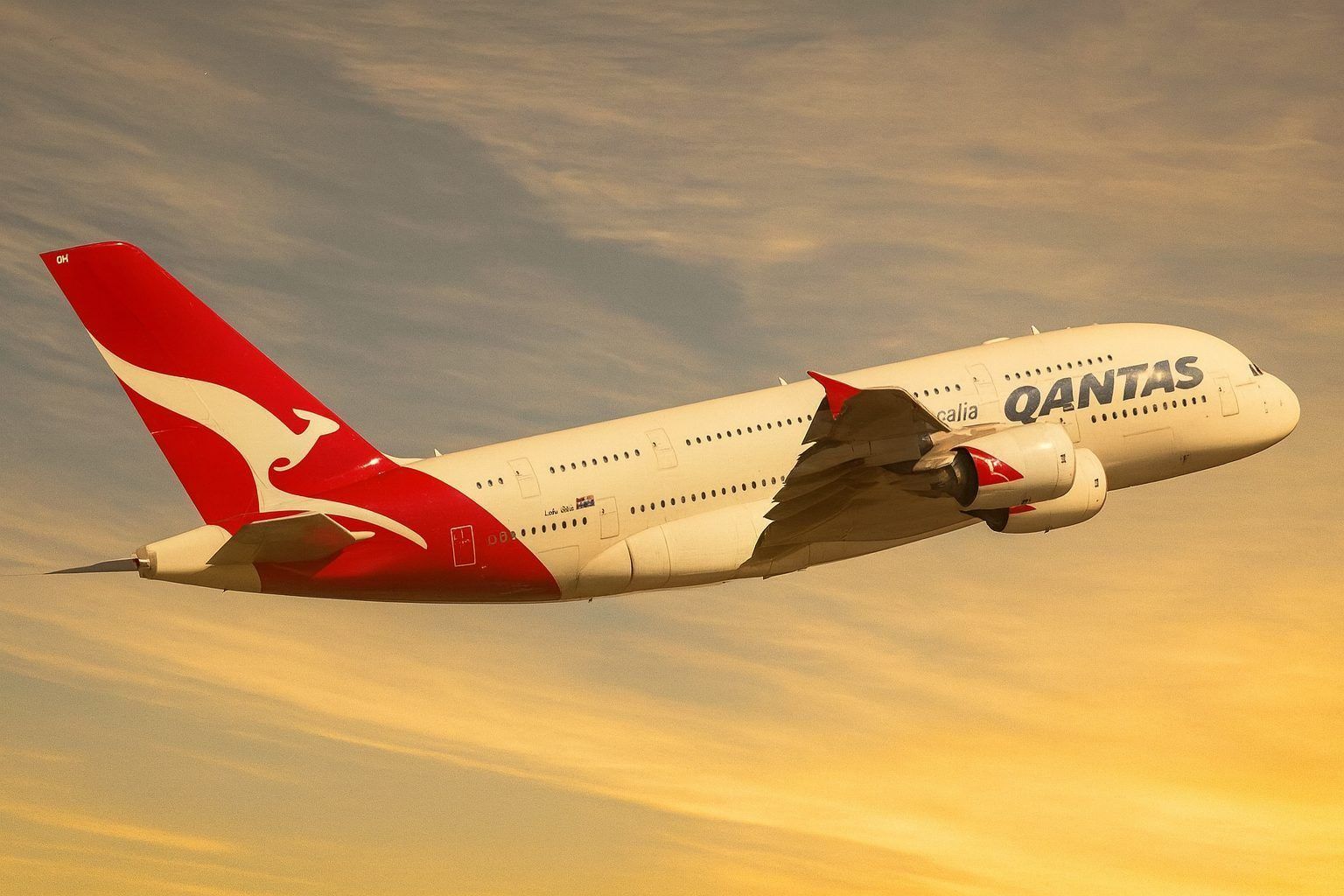
A high-profile Qantas Airbus A380 has been dramatically grounded in Los Angeles after a piece of its left wing slat was found damaged at the end of its first commercial flight back in service, forcing the cancellation of its return leg to Sydney and raising fresh questions about the airline’s maintenance standards and on-board experience.theaustralian.com.au+ 1
A Celebrated Comeback Cut Short
The aircraft at the center of the incident is A380 VH-OQC , named Paul McGinness after one of Qantas’ founders. It had only just rejoined the fleet after nearly six years out of regular service – three years in desert storage during the pandemic, followed by about two and a half years undergoing what Qantas itself promoted as the largest maintenance check in its 105-year history .theaustralian.com.au+ 2australianaviation.…
The heavy maintenance and refurbishment program, spread across global facilities including Abu Dhabi, involved:
- Around 100,000 engineering hours
- Landing-gear replacement and comprehensive structural checks
- A full cabin refresh, including updated First, Business and Premium Economy cabins
- Test flights before re-entering commercial servicetheaustralian.com.au+ 1
VH-OQC was the tenth and final A380 to be reactivated, completing Qantas’ post-COVID superjumbo comeback and slated for long-haul routes such as Sydney–Los Angeles and Sydney–Dallas from early 2026.theaustralian.com.au+ 1
That triumphant narrative collided with reality on its very first revenue service back: QF11 from Sydney to Los Angeles , operated in early December and arriving into LAX with visible damage to a section of its left wing slat.theaustralian.com.au+ 2AviationSource News…
What Passengers Saw on QF11
Among those on board was Australian actor and World Poker Tour anchor Lynn Gilmartin , who posted footage to social media showing what appeared to be a missing or peeled-back section of the wing surface just outboard of the engine during landing into Los Angeles.heraldsun.com.au+ 2brisbanetimes.com.au+ 2
Gilmartin and other passengers described a cascade of service and technical problems on the long-haul flight, including:
- In-flight entertainment (IFE) blackout due to a power issue
- Limited lighting in the cabin for much of the journey
- Seats that would not recline properly
- Cabin cleanliness and lavatory issues on a full flight heading into the busy holiday periodheraldsun.com.au+ 2theaustralian.com.au+ 2
While passengers only noticed the wing damage late in the flight, the visuals of a ragged opening in the slat section quickly went viral, fueling public anxiety about Qantas’ safety and maintenance practices.
Despite the unsettling view, the aircraft landed normally and taxied to the gate without further incident. There were no injuries reported among the passengers or crew.theaustralian.com.au+ 2A2Z Aviation+ 2
Qantas’ Explanation: A Damaged Wing Slat, Not a Structural Wing Failure
Qantas has confirmed that the issue involved a broken section of the wing slat , a movable aerodynamic surface used mainly during take-off and landing to increase lift at low speeds. It stressed that:
- The damage did not affect the primary structural integrity of the wing
- The flight remained within normal operating parameters
- Pilots were aware of technical alerts but assessed that the aircraft was safe to continue to Los Angelestheaustralian.com.au+ 2theaustralian.com.a…
Engineers in Los Angeles inspected the aircraft on arrival and determined that the damaged slat section would need to be replaced before the A380 could fly again. Qantas has reportedly sourced a replacement part from overseas, with work to be carried out in LA.theaustralian.com.au+ 2A2Z Aviation+ 2
The airline has also acknowledged the failure of the in-flight entertainment system on QF11, saying passengers were offered compensation and that it regrets the disruption on what was meant to be a flagship service showcasing the refurbished superjumbo.heraldsun.com.au+ 1
Grounded in LA and a Scramble for Passengers
The wing-slat damage has forced VH-OQC to be grounded in Los Angeles , with its scheduled return service to Sydney canceled.
According to Australian media reports, the disruption has affected hundreds of passengers, among them high-profile travelers such as former Australian ambassador to the US Joe Hockey , who was due to fly home on the aircraft’s return leg.theaustralian.com.au+ 1
Qantas has been rebooking customers onto alternative services and other aircraft, but the timing is particularly awkward:
- The airline is in the middle of a busy December travel window , with limited spare long-haul capacity
- VH-OQC had been positioned as an “operational spare” to help the airline cope with peak demand over Christmas and New Yearnews.com.au+ 2VisaHQ+ 2
The grounding not only removes that buffer but also amplifies scrutiny of Qantas’ A380 comeback strategy, which it has marketed as a major milestone in restoring international capacity post-pandemic.theaustralian.com.au+ 2forbes.com+ 2
Regulators Watching: Will the ATSB Investigate?
The Australian Transport Safety Bureau (ATSB) has confirmed it is reviewing details of the wing-slat event and will decide whether to launch a formal investigation.theaustralian.com.au+ 1
While wing-slat damage is generally considered a serious defect but not on the same level as a structural wing failure or engine fire, any incident involving large wide-body aircraft on long-haul international sectors attracts heightened regulatory scrutiny.
The ATSB has previously called out issues with Qantas’ engineering controls. A 2024 report found that another Qantas A380 flew 34 sectors and nearly 300 hours with a large nylon tool accidentally left inside one of its engines after maintenance, prompting recommendations on tool-control procedures and sign-off practices.atb.gov.au+ 2AeroTime+ 2
That earlier case caused no damage to the engine, but in combination with the latest wing-slat incident, it is likely to fuel debate about whether Qantas’ rapid ramp-up of long-haul capacity has put extra strain on its maintenance system.
What Is a Wing Slat – and How Serious Is This?
For anxious travelers, the distinction between a “chunk of wing” and a “damaged slat” can sound like semantics. In technical terms, however, there is an important difference.
- Wing slats are hinged panels along the front (leading edge) of the wing used primarily during take-off and landing.
- They extend to increase the wing’s curvature and surface area, allowing the aircraft to fly safely at lower speeds.
- If a part of a slat is damaged or breaks away, it can reduce aerodynamic efficiency or trigger cockpit warnings, but the core structure of the wing and the main lift surfaces can remain intact.
The Airbus A380 has an excellent safety record overall, with no hull-loss accidents to date and only a handful of high-profile incidents – notably the 2010 uncontained engine failure on Qantas Flight 32 , which the crew managed without injuries.en.wikipedia.org
In the Los Angeles event, available reporting indicates that:
- The aircraft remained controllable throughout
- The crew completed the flight to LAX without declaring an emergency
- Post-flight engineering checks identified a localized slat issue that can be addressed through component replacementtheaustralian.com.au+ 2A2Z Aviation+ 2
For regulators and engineers, that still demands a detailed root-cause analysis – including whether the damage was due to a manufacturing defect, a maintenance error, foreign object impact, or an undetected issue that developed during testing.
Passenger Experience vs. Brand Promise
From a brand and customer-experience perspective , the story is more complicated for Qantas.
The airline has spent heavily on positioning the A380 comeback as a premium, reliable flagship product, highlighting:
- Renovated First suites and refreshed Business cabins
- An updated upper-deck lounge and upgraded soft product
- The A380 as a symbol of Qantas’ renewed long-haul ambitionforbes.com+ 3news.com.au+ 3theaustralian.c…
Yet high-profile passengers on QF11 described a flight that was closer to “limping back into service” than a polished relaunch : no IFE, cabin issues, and then the shock of seeing damaged wing hardware right outside their windows.heraldsun.com.au+ 2theaustralian.com.au+ 2
In the age of social media and Google Discover, those images and testimonies can quickly overshadow carefully crafted marketing campaigns. For Qantas, facing existing criticism over reliability and customer service, this incident risks reinforcing a narrative of over-promising and under-delivering .
What Happens Next for VH-OQC and Qantas A380 Operations?
In the short term, several key steps are underway:
- Component Replacement & Engineering Checks
- The damaged wing-slat section will be replaced in Los Angeles.
- Engineers will likely perform detailed inspections of adjacent structures and slat mechanisms on that wing – and potentially across the A380 fleet as a precaution.theaustralian.com.au+ 2A2Z Aviation+ 2
- ATSB Review
- The safety bureau will decide whether to open a full investigation, which would include analysis of flight-deck data, maintenance records, and inspection logs from the massive A380 refurbishment program.theaustralian.com.au+ 1
- Operational Planning
- Qantas must juggle schedules to cover the loss of a freshly reactivated A380 at the height of the summer peak, potentially leaning on 787 and partner airline capacity to backfill services.forbes.com+ 1
- Rebuilding Passenger Confidence
- Beyond providing compensation and rebookings, Qantas will need to convince customers that its A380 comeback is not just ambitious, but safe, robust and reliable . That may mean more transparent communication about what went wrong and what has changed as a result.
Should Travellers Be Worried?
For travelers booked on upcoming Qantas A380 services, several points are worth keeping in mind:
- Long-haul wide-body aircraft are designed with multiple layers of redundancy and are subjected to strict regulatory oversight.
- Incidents like slat damage are rare but not unexpected , and the standard response – grounding the aircraft, replacing the damaged component, and conducting inspections – is exactly what regulators expect.
- Qantas has a long-standing reputation for strong safety outcomes, even if its recent operational reliability and customer satisfaction scores have drawn scrutiny.en.wikipedia.org+ 2AeroTime+ 2