December 15, 2025 — Rocket Lab is starting the week with fresh momentum after successfully completing a milestone mission for Japan’s national space agency — and as its next-generation Neutron rocket moves closer to its long-awaited debut.
Shares of Rocket Lab (Nasdaq: RKLB) were up about 2.5% in premarket trading on Monday after the company confirmed it deployed a Japanese technology-demonstration spacecraft on its first dedicated mission for the Japan Aerospace Exploration Agency (JAXA).
The stock move follows a volatile but headline-packed stretch for Rocket Lab: a string of late-year Electron launches, an expanding pipeline of government and international customers, and a key engineering milestone for Neutron — the partially reusable medium-lift rocket that investors and space-industry watchers see as Rocket Lab’s biggest near-term catalyst.
Rocket Lab’s JAXA mission: what happened on the “RAISE And Shine” launch
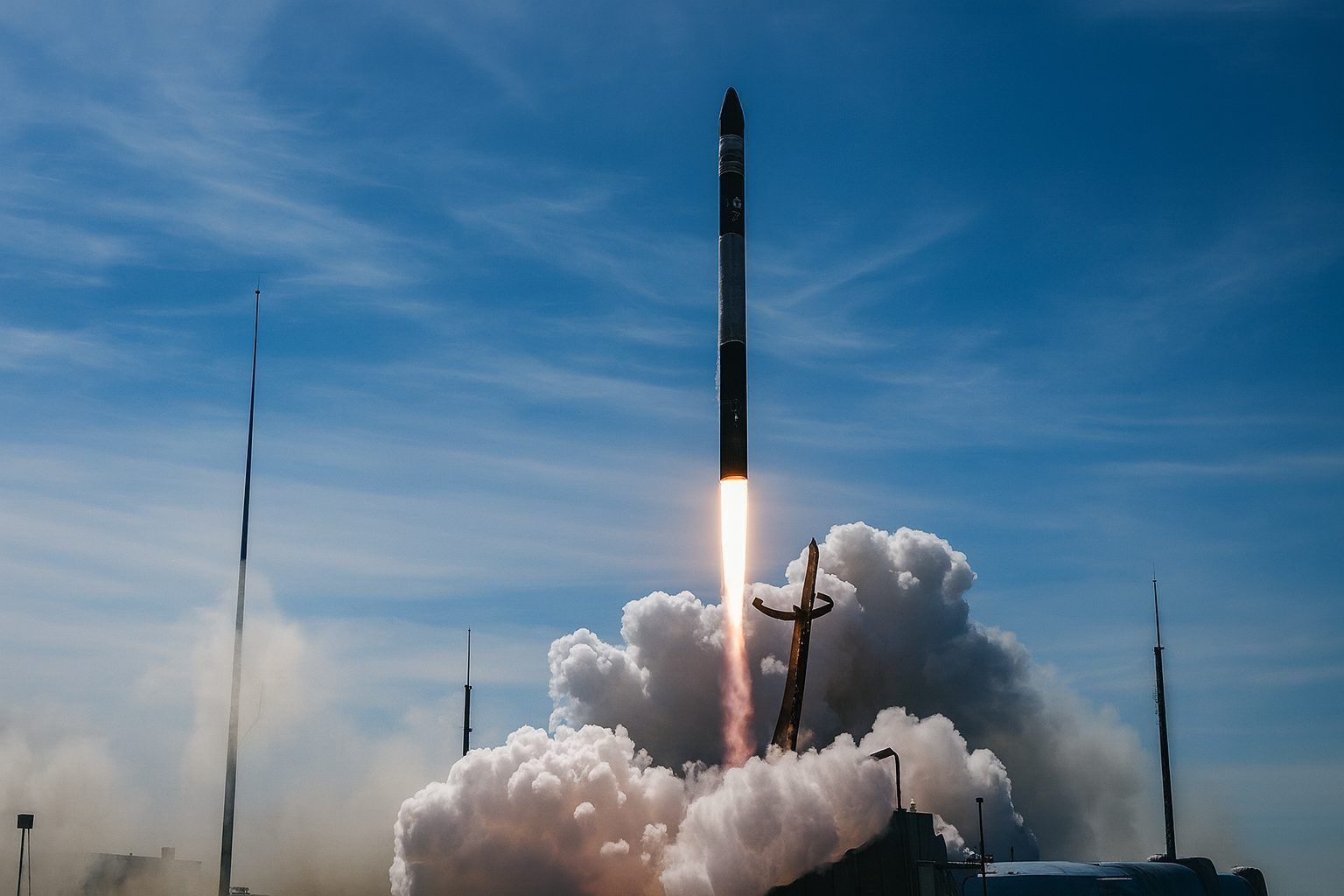
Rocket Lab’s “RAISE And Shine” mission lifted off from Launch Complex 1 in New Zealand at 03:09 UTC on December 14, 2025 (16:09 NZDT), and successfully deployed RAISE-4 — short for RApid Innovative payload demonstration SatellitE-4. GlobeNewswire+1
RAISE-4 is designed to demonstrate eight technologies created by a mix of Japanese private companies, universities, and research institutions, as part of JAXA’s Innovative Satellite Technology Demonstration Program.
Space.com reported that the Electron launch placed the spacecraft into a circular orbit about 336 miles (540 kilometers) above Earth, with deployment occurring roughly 54.5 minutes after liftoff.
The programmatic context matters: Rocket Lab says this is the first of two dedicated missions for JAXA under this initiative, with a second mission expected in Q1 2026.
Why the JAXA launch matters for Rocket Lab’s global credibility
Electron has long been positioned as Rocket Lab’s workhorse for dedicated small-satellite launches. But winning a dedicated mission for a major national space agency is a reputational step forward — particularly in a launch market increasingly shaped by government procurement, national-security demand, and schedule reliability.
Rocket Lab founder and CEO Sir Peter Beck said the company delivered “precision and reliability” for one of the world’s most respected space agencies, emphasizing dedicated access to space as a key enabler for Japan’s aerospace economy. GlobeNewswire
Space.com also noted this was Rocket Lab’s first flight contracted directly with JAXA, and highlighted Rocket Lab’s broader history of launching missions for Japan-based customers over time.
Rocket Lab adds that an additional dedicated Electron mission for the European Space Agency (ESA) is planned for the new year, underscoring rising demand from institutional customers beyond the U.S. market.
Record launch pace: Rocket Lab closes 2025 with 19 launches
The JAXA mission also extends what Rocket Lab is calling a record-setting year for launch cadence.
Rocket Lab says “RAISE And Shine” was its 19th launch of 2025, extending an annual record established last month following two Electron missions launched within 48 hours. GlobeNewswire
Space.com breaks that annual figure down further, reporting 16 orbital launches plus three suborbital HASTE missions, a modified Electron variant used to support hypersonic technology tests.
In practical terms, cadence is not just a vanity metric for a launch company. A faster, more repeatable launch rhythm can improve factory utilization, spread fixed costs across more missions, and — crucially — convince commercial and government customers that “schedule certainty” is more than a marketing phrase.
Rocket Lab says its next launch of 2025 is scheduled from Launch Complex 2 (Virginia) later this month, with details to be announced soon.
RKLB stock reaction on December 15: a premarket pop after a weekend milestone
Investors reacted quickly to the JAXA milestone. Reuters reported RKLB shares were up 2.5% to $63.03 in premarket trading on December 15, following the JAXA mission confirmation.
Reuters also noted that, as of the prior close, Rocket Lab shares had more than doubled year-to-date — a reflection of how strongly the market has repriced “space infrastructure” and launch capacity in 2025. TradingView
Zooming out to the prior week, an Insider Monkey report said Rocket Lab shares rose 25.3% week-on-week, citing a busy sequence of launches and heightened attention on Neutron and its “Hungry Hippo” fairing milestone. Insider Monkey
Neutron rocket update: what “Hungry Hippo” is — and why it’s different
While Electron keeps flying, the most consequential hardware story around Rocket Lab right now is Neutron — the company’s partially reusable, medium-lift rocket in development since late 2021.
At the center of Neutron’s reusability strategy is an unusual piece of engineering called “Hungry Hippo.” Unlike traditional payload fairings that separate and fall away during ascent, Neutron’s fairing is designed to remain attached to the first stage. It opens to release the rocket’s second stage and payload, then closes again so the vehicle can return to Earth as a single reusable unit. GlobeNewswire+1
Rocket Lab describes this as a “world-first” approach for a reusable commercial rocket — aimed at simplifying recovery and enabling higher launch cadence by removing the need to chase fairing halves at sea. GlobeNewswire
Space.com described the mechanism as opening and closing like a clamshell, positioning Neutron as Rocket Lab’s answer to larger-class missions dominated today by SpaceX’s Falcon 9.
The key milestone: Hungry Hippo fairing qualification testing is complete
Rocket Lab announced earlier this month that Hungry Hippo successfully completed qualification testing and was headed to Virginia for integration ahead of Neutron’s first launch.
The testing details offer a window into how Rocket Lab is trying to de-risk a first flight:
- Rocket Lab says the fairing’s carbon-composite structure endured 275,000 pounds of force to simulate loads experienced during Max Q (maximum aerodynamic pressure).
- Rocket Lab says it validated opening/closing operations under flight-like conditions, including an open-close cycle completed in about 1.5 seconds.
- The company also tested combined loads at the canard hubs (control surfaces integrated into the fairing structure) at levels exceeding 125% of expected flight loads.
Space.com reported that once integrated with the first stage, Rocket Lab plans prelaunch campaigns that include a static hotfire of Neutron’s nine Archimedes engines, and reiterated Neutron’s planned performance envelope: about 141 feet (43 meters) tall, 23 feet (7 meters) in diameter, and capable of delivering up to 13,000 kilograms (about 28,700 pounds) to low Earth orbit.
Rocket Lab has said Neutron’s first launch is scheduled for 2026, and Space.com described the first flight expectation as “early next year” relative to the December reporting window. GlobeNewswire+1
The investment narrative behind Neutron: bigger contracts, bigger payloads, bigger TAM
Neutron’s strategic value is straightforward: it moves Rocket Lab into a different competitive arena.
A widely circulated Nasdaq-hosted analysis (syndicated from The Motley Fool) highlights the capacity jump from Electron (up to 300 kilograms to LEO) to Neutron (up to 13,000 kilograms to LEO) — a scale increase that could allow Rocket Lab to compete for larger, more lucrative commercial and government missions.
That same analysis notes Rocket Lab has previously signaled Neutron timing changes — with commentary from Stifel and Morgan Stanley framing schedule adjustments as more realistic than feared, prioritizing mission success.
Importantly, Neutron is not just “another rocket.” It’s also the missing piece that could connect Rocket Lab’s spacecraft manufacturing business to larger constellation and national-security deployment opportunities — where customers increasingly want a contractor that can build, integrate, and launch at speed.
Rocket Lab’s other growth engine: space systems revenue and backlog
Rocket Lab is often described as a launch company, but it is increasingly being valued like a broader space infrastructure provider — in large part because of its space systems segment.
The Nasdaq-hosted analysis reports that through Sept. 30, Rocket Lab generated nearly $300 million in revenue from space systems, with $93.8 million in gross profit, compared with $123 million in launch services revenue and $45.1 million in gross profit.
It also points to Rocket Lab’s role as a prime contractor on the Space Development Agency’s Proliferated Warfighter Space Architecture, building satellites intended for resilient, real-time military communications.
Then there’s backlog — a metric investors watch closely in capital-intensive aerospace businesses. The same analysis says Rocket Lab’s backlog was $1.1 billion as of Sept. 30, with roughly 47% tied to launch services and the remainder linked to space systems.
What’s next for Rocket Lab in late 2025 and early 2026
With the JAXA milestone in the books, Rocket Lab has several near-term signposts that could shape both sentiment and fundamentals:
- Another Electron launch from Launch Complex 2 (Virginia) later this month, which Rocket Lab says will be announced soon.
- A second dedicated mission for JAXA in Q1 2026, extending Rocket Lab’s relationship with a top-tier national space agency.
- A planned dedicated Electron launch for ESA in the new year, signaling continued international agency demand.
- Continued Neutron prelaunch integration and testing in Virginia after Hungry Hippo’s qualification — with Archimedes engine hotfires and other ground campaigns as the next gates toward first flight.
The bigger picture: why Rocket Lab is suddenly central to the “space economy” conversation
Rocket Lab’s news cycle is arriving as the broader commercial space market becomes less speculative and more operational — driven by national-security architecture, Earth observation, communications, and launch bottlenecks.
The Nasdaq-hosted analysis cites estimates that the global space economy could grow to $1.8 trillion by 2035, underscoring why investors are increasingly focused on companies that can provide repeatable access to orbit — and increasingly, the spacecraft and mission services that go with it.
For Rocket Lab, the 2025 story is no longer just “Electron launches small satellites.” It is increasingly about whether the company can pair a record cadence in small launch with a credible path to medium lift via Neutron — while scaling a space systems business that already appears to be its primary revenue engine.