NEW YORK — Friday, December 26, 2025 (2:32 p.m. ET).
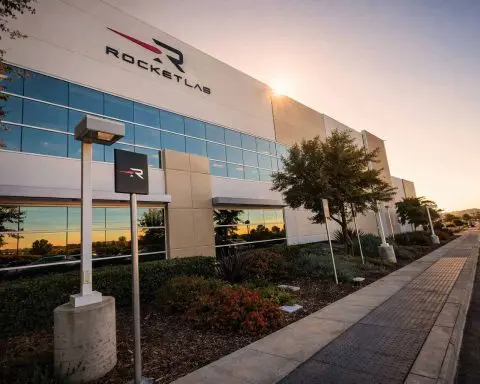
Rocket Lab Corporation (NASDAQ: RKLB) is having a volatile “re-entry” day on Wall Street. In early afternoon New York trading, shares were down about 7% to roughly $71.67 (delayed quote updated at 2:17 p.m. ET), pulling back after a powerful December run that recently pushed the stock to fresh highs. FinancialContent
The timing matters: U.S. markets reopened after the Christmas holiday into a thin-volume, year-end tape, with major indexes hovering near record levels but slightly lower midday. AP News+1 And unlike the half-day session on Christmas Eve, NYSE and Nasdaq are operating a full regular session today (Dec. 26)—so price swings are happening in real time, not just in premarket noise. Reuters
So why is Rocket Lab stock down today when the news flow around the company has been so bullish? And what do forecasts and analysts say after RKLB’s surge?
Why Rocket Lab stock is down today
The simplest explanation is the one traders love to hate: a fast-moving, high-beta stock is digesting gains.
Rocket Lab has been one of 2025’s standout “space economy” winners, and the stock’s rally has been fueled by tangible catalysts—especially a landmark U.S. national security award. After moves like that, it’s common to see:
Profit-taking into strength.
RKLB’s recent run included sessions where the stock pushed into the upper-$70s and set new highs; in that context, a 6–8% pullback can be less “panic” and more “gravity.” FinancialContent+1
Holiday-thinned liquidity.
Post-Christmas trading is often lighter, and when volume is thin, price can gap around more dramatically on relatively modest order flow. The broader market has been seeing exactly that kind of quiet, low-catalyst session. AP News+1
A classic “sell-the-news / rebalance-the-book” setup.
When a stock rockets higher after a headline, some investors rotate out as the story becomes widely known—especially into year-end positioning.
One market data recap also flagged unusually light trading volume alongside today’s drop and framed the move as a consolidation after a big breakout month. MarketBeat
The big catalyst still driving the story: Rocket Lab’s Space Force/SDA win
Rocket Lab’s December rally wasn’t based on vibes—it was built on a contract win that changes how many investors categorize the company.
On Dec. 19, Rocket Lab announced it had been awarded a $816 million prime contract to design and manufacture 18 satellites for the Tracking Layer Tranche 3 (TRKT3) program for the U.S. Space Development Agency (SDA). The company described the award as $806 million base plus up to $10.45 million in options, and said additional subsystem opportunities as a merchant supplier could lift “total capture value” toward ~$1 billion. GlobeNewswire
SDA’s own release put Rocket Lab’s award at a total potential value of $805 million as part of four agreements totaling about $3.5 billion for 72 Tracking Layer satellites (18 each for Rocket Lab, Lockheed Martin, Northrop Grumman, and L3Harris), with launches planned in fiscal year 2029. SDA
This is a big deal for two reasons:
- It’s revenue scale. An $800M+ award is meaningfully large for Rocket Lab’s current financial profile, especially as it continues working toward sustained profitability.
- It’s positioning. Prime-contractor status for a major national security architecture pushes Rocket Lab further into the “serious defense space supplier” category—historically dominated by legacy primes.
Rocket Lab founder and CEO Peter Beck framed it as proof that the company’s vertically integrated model is gaining traction in defense space, pointing to “demand for resilient, scalable, and affordable space systems.” GlobeNewswire
Operational momentum: launches, launch cadence, and credibility
Rocket Lab has also been stacking operational proof points—exactly the kind that institutional investors tend to care about when a company claims it can execute at scale.
Record year for Electron.
On Dec. 21, Rocket Lab said it successfully launched its 21st Electron mission of 2025, ending the year with 21 launches and 100% mission success, and noted the next Electron launch is expected in early Q1 2026. GlobeNewswire
Ahead-of-schedule national security execution.
On Dec. 18, Rocket Lab announced a successful launch for the U.S. Space Force’s Space Systems Command (STP-S30), saying it completed the mission five months ahead of schedule—a detail that reinforces the “reliable execution” narrative that often supports premium valuations in aerospace. GlobeNewswire
Several market commentators tied the stock’s late-December surge to that one-two punch: contract win + successful launch cadence. MarketWatch+1
Rocket Lab fundamentals: what the latest financials say
Rocket Lab’s stock is trading on future expectations—but the company’s most recent reported results provide important guardrails for those expectations.
In its Q3 2025 financial results (reported Nov. 10, 2025), Rocket Lab reported:
- Record quarterly revenue of $155.1 million (up 48% year-over-year)
- Record gross margin (the company highlighted 37% GAAP gross margin)
- More than $1 billion in liquidity after financing activity
- A Neutron update: the rocket is expected to arrive at Launch Complex 3 in Q1 2026, with the first launch thereafter pending qualification and acceptance testing GlobeNewswire
On the company’s earnings materials, Rocket Lab also discussed ~$1.1 billion in total backlog exiting Q3 2025. Yahoo Finance
This matters because today’s RKLB valuation debate usually comes down to one question:
Is Rocket Lab becoming a scaled space systems + defense prime fast enough to justify a “SpaceX alternative” multiple—before Neutron even flies?
Wall Street forecasts: upgraded targets, but a split consensus
After the SDA award and the stock’s surge, analysts updated their models—and their price targets started moving (up).
A few of the most-cited moves in recent coverage:
- Needham reiterated a Buy and raised its price target to $90 after the SDA award, according to coverage summarizing the note and attributing the move to Rocket Lab’s strengthening defense role. TipRanks+1
- Stifel raised its price target to $85 and maintained a positive rating, according to analyst-rating roundups. MarketBeat
- Cantor Fitzgerald has been cited maintaining an overweight stance with a $72 price target in recent reporting around the rally. MarketWatch
At the same time, “consensus” targets depend heavily on whose dataset you look at—and that’s where investors should be careful. One roundup pegged the consensus as Moderate Buy with an average target around the low $60s, even as the stock traded above that level after the rally. MarketBeat Another widely referenced dataset put the average target closer to the high $60s, with a high target at $90. TipRanks+1
That spread is a signal, not a math problem: RKLB is a story stock in transition, and analysts are pricing in very different outcomes for (1) defense satellite scaling, (2) Neutron execution, and (3) eventual margin structure.
The Neutron factor: the next “big unlock” (and a key risk)
If Electron is Rocket Lab’s proof of competence, Neutron is the company’s bet on step-change economics and a larger addressable market.
Rocket Lab has told investors it expects Neutron to arrive at LC-3 in Q1 2026, with the first launch thereafter pending testing and acceptance work. GlobeNewswire
Why investors care so much:
- A successful Neutron program could expand Rocket Lab from small-lift missions into broader constellation deployment and national security missions at higher scale.
- A delayed or troubled Neutron program would challenge one of the stock’s most aggressive valuation narratives.
In other words, Rocket Lab stock can rally hard on contracts, but it can rerate structurally on Neutron milestones.
What investors should know before the next session
The U.S. market is open right now (2:32 p.m. ET), and today is a full trading day—so the “next session” question is really about what happens between now and Monday’s open (and how to interpret today’s tape). Reuters
Here’s what tends to matter most into the next session for a name like RKLB:
Watch the close, not just the headlines.
When volume is lighter (common after holidays), late-day flows can swing the close and shape the next session’s tone. AP News+1
Separate “price action” from “thesis damage.”
Today’s drop is happening after the company landed its largest contract and capped a record launch year. The thesis debate is less “did something break?” and more “how much of the good news was already priced in?” GlobeNewswire+1
Know the next major fundamental checkpoint: earnings.
Several market calendars currently estimate Rocket Lab’s next earnings report in late February 2026 (the company may confirm later). That upcoming report is likely to re-focus attention on revenue trajectory, margins, cash usage, and any updates on Neutron and contract execution. Zacks+1
Keep an eye on the broader tape.
Today’s market is characterized by quiet, thin post-Christmas trading with indexes near record highs, which can amplify single-stock moves—up or down—without necessarily implying a broader risk-off shift. Investing.com+1
Bottom line
Rocket Lab stock is pulling back today, but it’s doing so after a cluster of developments that materially strengthen the bull case: a major SDA Tracking Layer award (prime contractor, $800M+ scale), a record year of Electron launches, and a financial backdrop showing strong growth and sizable backlog. Yahoo Finance+4GlobeNewswire+4SDA+4
The key question investors are really pricing now is whether Rocket Lab can convert defense wins into scalable production economics—and whether Neutron’s 2026 milestones arrive on time and on spec.
Nothing about that is simple. Space rarely is. But the signals driving RKLB—contracts, cadence, and execution—are the kind that markets tend to reward over time… even if the stock occasionally reminds everyone that gravity still exists.